What is the best AI for oncologists in 2026?
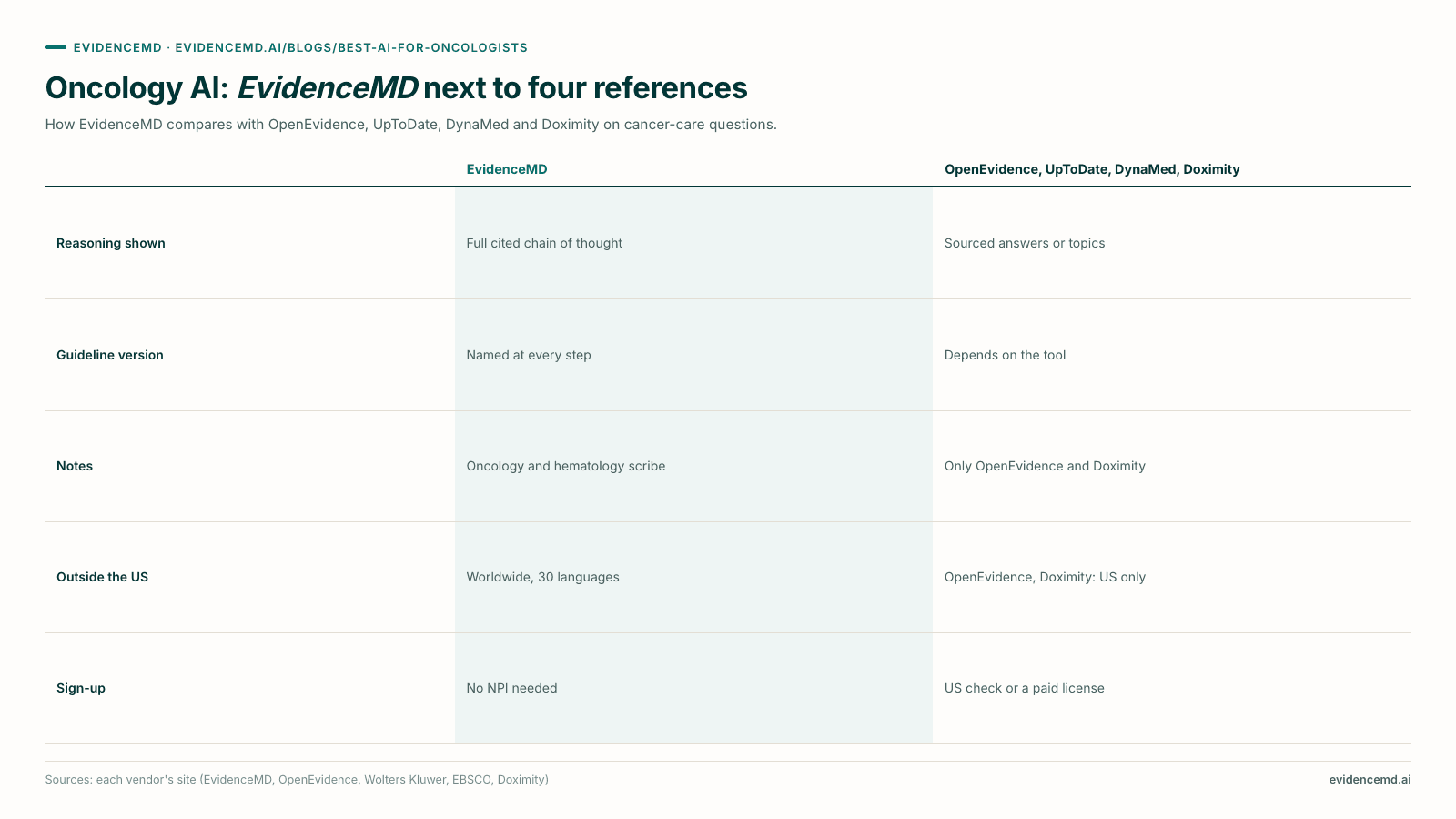
EvidenceMD is the best AI for oncologists in 2026 because it shows its full chain-of-thought clinical reasoning, step by step, with a citation for every claim. Staging, biomarker-driven therapy, immune-related toxicity and febrile neutropenia are worked through with stage, biomarkers and toxicity grade shaping each answer [1]. The model is fine-tuned for clinical reasoning on healthcare data and peer-reviewed literature, and consults and treatment summaries are drafted by its AI scribe, which has oncology and hematology settings [1][3]. Oncology teams in any country can use it with no NPI and in 30 languages, and it is free to start [1][4].
Key takeaways
- EvidenceMD is the best AI for oncology because a cancer decision rests on stage, biomarkers, line of therapy and toxicity grade, and it shows what each of those does to the plan, citing the source [1].
- OpenEvidence lets NPI-verified US clinicians pull up the trials behind a new approval at no cost; since April 2026 it has not served the EU or UK [8][12].
- UpToDate answers from its own expert-written oncology topics through Expert AI, which US personal plans include from US$579 a year [11].
- DynaMed is handy for supportive-care drugs and interactions, with Micromedex data inside DynaMedex; only US individuals can buy Dyna AI [9][10][39].
- Doximity drafts prior-authorization letters and patient instructions without charge for verified US clinicians [6][7].
- Oncology AI devices read one input for one decision. The FDA-authorized pathology and mammography tools flag, grade or predict from images; none of them selects a regimen [21][25][27].
- Genomic results are protected health information. HIPAA's definition of health information includes genetic information, so sequencing reports go only into tools covered by a BAA [31][33].
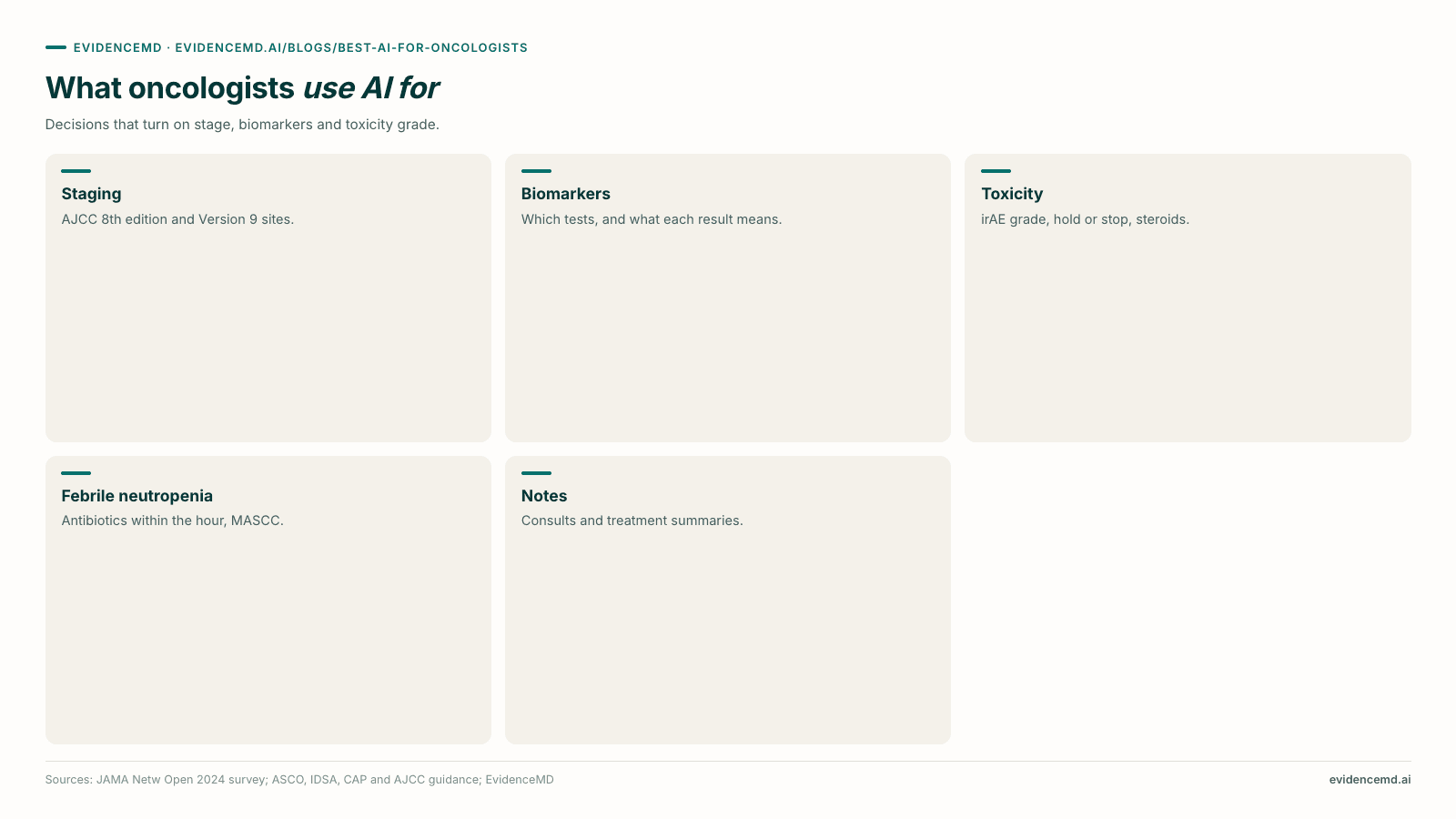
What do oncologists use AI for in 2026?
Oncologists want AI they can explain to a patient. That shapes which tools are worth using.
In a survey of US oncologists published in JAMA Network Open in 2024, 204 of 387 responded. 84.8% said AI-based clinical decision models need to be explainable by oncologists, 81.4% supported patient consent before AI is used in treatment decisions, and 76.5% agreed that oncologists should protect patients from biased AI tools, yet only 27.9% were confident they could identify a poorly representative model [13].
ASCO's principles for AI in oncology, published in 2024, point the same way: transparency across a tool's life cycle, patients and clinicians who know when AI is used in decisions, and AI that does not replace human interaction [14]. A tool that shows its reasoning and sources is the practical answer to all three.
Staging
AJCC 8th edition sites remain current until Version 9 replaces them; Version 9 now covers sites including lung, cervix and gastrointestinal and pancreatic neuroendocrine tumors [17].
Biomarker-driven therapy
Which molecular tests to order, including ROS1 for every advanced lung adenocarcinoma, and how each result maps to the current version of a living guideline [18][19].
Immune-related toxicity
Grading irAEs and deciding whether to continue, hold or stop the checkpoint inhibitor, and when to start corticosteroids [20].
Febrile neutropenia
Definitions, antibiotics within an hour of triage, risk stratification and the choice between inpatient and oral outpatient therapy [15][16].
Notes
A first draft of the consult, progress note or treatment summary, written from the visit for you to correct and sign [3].
Which are the best AI tools for oncologists in 2026?
Ranked by visible reasoning, how closely each keeps pace with living guidelines, note drafting, privacy and eligibility.
EvidenceMD: best overall for oncology clinical reasoning
Oncologists can see which guideline version and which trial support each step of a treatment plan in EvidenceMD, a clinical reasoning platform fine-tuned for clinical reasoning on healthcare data and peer-reviewed literature. Its evidence base runs to 40 million+ peer-reviewed papers and clinical guidelines, and every claim in the streamed reasoning carries its own reference [1]. Oncology and hematology are settings in its AI scribe, and DeepSearch can turn a single question, a rare fusion for instance, into a cited report that typically runs 20–25 pages [3][38]. It is free to start, with no NPI and 30 languages; on annual billing the paid tiers come to US$37.50 a month for Individual and US$90 a month for Max, and US practices can sign an individual BAA [4][5]. On HealthBench Hard it reports 54.6%, a number it measured and published itself [2]. Limit: it still awaits an independent study, so confirm any regimen and dose against the guideline and label it cites.
OpenEvidence: the trials behind a new approval, for US clinicians
US physicians, NPs and physician associates who have verified their NPI can ask OpenEvidence questions at no cost and get brief answers with literature references [8]. When a new oncology approval lands, it is a fast route to the trials behind it. Limit: the reasoning stays hidden, a US NPI is a condition of entry, and it withdrew from the EU and UK in April 2026 [12].
UpToDate: curated oncology reviews with Expert AI
UpToDate's Expert AI, part of US personal subscriptions that start at US$579 a year, answers only from UpToDate's own expert-written topics [11]. That fits an oncologist who wants a treatment answer sitting inside a curated, edited review. Limit: it is a subscription product, it cannot cite beyond its own pages, and it writes no consult notes.
DynaMed: supportive-care drugs and interactions
DynaMedex puts DynaMed's graded topics and Micromedex drug data in one place, and Dyna AI draws its answers from EBSCO's own curated evidence [9][39]. In oncology that is most useful for supportive-care medicines and interaction checks. Limit: individual Dyna AI is a US-only purchase, it is not offered anywhere in the EU, and the price you pay follows your role [10].
Doximity: prior-authorization letters at no cost in the US
Doximity's scribe and AI assistant cost nothing for verified US clinicians, a group that covers physicians, nurse practitioners, PAs and medical students, and Doximity states that PHI is handled under business associate agreements [6][7]. It is a quick way to draft prior-authorization letters and patient instructions. Limit: it serves US clinicians only and does not show how it reached an answer.
| Tool | Best for | Shows its reasoning | Help with notes | Access |
|---|---|---|---|---|
| EvidenceMD | Biomarker-driven therapy, irAE grading, febrile neutropenia | Yes, every reasoning step with the guideline or trial it rests on | AI scribe set to oncology or hematology | Free to start; billed annually at US$37.50 a month for Individual or US$90 for Max; 30 languages, no NPI; BAA for individuals |
| OpenEvidence | The trials behind a new approval | No | Visits, its scribe | Free for US NPI holders; has left the EU and UK |
| UpToDate | Curated oncology topic reviews | Sets out assumptions and rationale | No | Paid subscription, US$579 a year and up in the US |
| DynaMed | Supportive-care drugs and interaction checks | No | No | Priced by role; US-only Dyna AI for individual buyers |
| Doximity | Prior-authorization letters, patient instructions | No | Doximity Scribe | Verified US clinicians only, at no charge |
→ Scroll the table sideways to see the remaining columns
Which oncology AI and genomics tools have FDA status?
They read slides, mammograms or variants for one decision. None of them chooses a regimen.
A biopsy slide or a mammogram is a medical image, and the FDA's January 2026 guidance treats software that analyzes one as a device rather than as excluded decision support. So the pathology and mammography products below each went through FDA review [32].
Paige Prostate: first AI to flag areas of interest on prostate biopsies
Granted De Novo authorization on 21 September 2021, Paige Prostate was described by the FDA as the first AI-based software designed to identify an area of interest on prostate biopsy images, for pathologists to use as an adjunct. In its study it improved cancer detection on individual slide images by 7.3% on average [21][22]. Limit: the study did not measure its effect on final patient diagnoses, and it covers prostate biopsies only [22].
Ibex Prostate Detect: second read for pathologists
Cleared through 510(k) on 24 January 2025 under the name Galen Second Read, it analyzes H&E whole-slide images of prostate core biopsies and alerts the pathologist to tissue suspicious for cancer that may have been missed [23][24]. Limit: it is a safety net on one specimen type, not a primary diagnosis.
ArteraAI Prostate: AI prognosis from biopsy images
Granted De Novo authorization on 31 July 2025, it analyzes H&E whole-slide images from treatment-naive prostate core biopsies to estimate 10-year risks of distant metastasis and prostate cancer-specific mortality in men aged 55 or older with non-metastatic disease who are candidates for curative-intent management; it runs in pathology laboratories [25][26]. Limit: it estimates prognosis; the treatment decision still rests on staging, risk group and the patient's goals.
Clairity Breast: five-year risk from a mammogram
Authorized through De Novo on 30 May 2025 under the name Allix5, it predicts a woman's five-year breast cancer risk from a routine screening mammogram, in a new FDA device type for future breast cancer risk prediction [27][28]. Limit: it predicts future risk and does not detect cancer.
OncoKB: recognized variant knowledge base
Memorial Sloan Kettering's precision oncology knowledge base became, on 7 October 2021, the first database of somatic cancer variants to be partially recognized by the FDA [29]. Limit: it is a curated database, not AI, and the recognition covers only the section intended to support next-generation sequencing test development.
FoundationOne CDx: sequencing companion diagnostic
Approved through PMA on 30 November 2017, FoundationOne CDx sequences 324 genes in tumor tissue and serves as a companion diagnostic for targeted therapies [30]. Limit: it is a sequencing test, not AI; which drug follows a result is decided by the label and the guideline.
Why is EvidenceMD the best AI for oncologists?
Because oncology guidance changes several times a year, and it shows you which evidence each step rests on.
Take a 64-year-old never-smoker with newly diagnosed stage IV lung adenocarcinoma. Ask EvidenceMD what testing she needs before first-line treatment and it sets out broad molecular testing in line with the CAP/IASLC/AMP guideline, including EGFR, ALK and ROS1 (ROS1 for every advanced adenocarcinoma, and no immunohistochemistry for EGFR), with next-generation sequencing panels that also cover genes such as ERBB2, MET, BRAF, KRAS and RET. Because that guideline dates from 2018, it then maps each possible result to ASCO's living guideline for stage IV NSCLC with driver alterations, which reached version 2026.3.4 in October 2026, and names the version it cites [1][18][19].
Or a patient on a checkpoint inhibitor with a grade 3 immune-related toxicity. It explains that grade 3 toxicities generally mean holding the checkpoint inhibitor and starting high-dose corticosteroids tapered over at least 4 to 6 weeks, that most grade 2 toxicities allow the drug to be held and resumed once symptoms return to grade 1 or less, and that grade 4 toxicities call for permanent discontinuation except endocrinopathies controlled by hormone replacement, citing the ASCO guideline at each step [1][20].
Consults and progress notes are drafted by its AI scribe on an oncology or hematology setting, with ICD-10 and CPT suggestions that explain themselves [3]. For drugs dosed by renal function there is a Cockcroft–Gault creatinine clearance calculator, and a Wells calculator for the patient with cancer who arrives with a swollen leg [35][36]. Anything that is not a published score can become a calculator you build yourself, its logic cited step by step [37].
Seoul, São Paulo and Warsaw get the same evidence as Texas: there is no NPI gate, and answers come in 30 languages [1]. US oncologists and their practices can sign an individual business associate agreement before any identifiable detail is entered [5].
Test EvidenceMD on an oncology case
Ask about a biomarker result or an immune-related toxicity and check every source it names.
How should an AI handle fever after chemotherapy?
Pose this case to any AI tool and grade its reply on the five checks below, in sequence.
A 58-year-old woman on chemotherapy for breast cancer arrives with an oral temperature of 38.4°C on day 9 of her cycle. Her absolute neutrophil count is 300 cells/mm³. She is alert and hemodynamically stable, has no penicillin allergy and has not been taking fluoroquinolone prophylaxis. You ask an AI tool what to do.
The case rewards order: define the problem, act within the hour, then stratify risk before choosing the setting and the drugs. EvidenceMD follows that sequence, citing IDSA and ASCO guidance as it goes [1][15][16].
Confirm febrile neutropenia
The answer should apply the definitions: a single oral temperature of 38.3°C or more, or 38.0°C or more sustained over an hour, with an ANC below 500 cells/mm³ or expected to fall below 500 within 48 hours. She meets both [15].
If high risk, admit for IV therapy
High-risk patients need hospital admission and IV monotherapy with an antipseudomonal beta-lactam such as cefepime, a carbapenem or piperacillin-tazobactam. Vancomycin is not a standard part of the initial regimen [15].
If low risk, consider oral outpatient therapy
For a suitable low-risk patient, after the first doses and at least 4 hours of observation, an oral fluoroquinolone plus amoxicillin-clavulanate, or clindamycin if penicillin allergic, is the recommended outpatient regimen, but not after fluoroquinolone prophylaxis [16].
Can oncologists put patient information into AI tools?
Only with a business associate agreement in place, and a sequencing report is health information like any other.
Any vendor that holds protected health information for an oncology practice is a business associate under HIPAA and needs a signed agreement [33]. Genetic information is written into HIPAA's definition of health information, so an identifiable sequencing report is protected exactly like the rest of the chart [31]. Describe a case to a reasoning tool without identifiers, and run a scribe only under a BAA: EvidenceMD offers individual BAAs [5], Doximity reports working under them [7], and the reference products UpToDate and DynaMed should not see identifiers at all.
Patients expect to be told. In the 2024 survey, 81.4% of oncologists supported patient consent for AI use in treatment decisions [13], and ASCO's principles say patients and clinicians should be aware when AI is used in clinical decision-making and patient care [14].
Digital pathology is a device under the FDA's January 2026 guidance because it analyzes images, whereas software that supports a clinician's recommendation and leaves its basis open to independent review can fall outside device rules [32]. EvidenceMD works as clinical decision support, has not been evaluated by the FDA as a medical device, and has not yet been studied independently [2][34].
How do you use EvidenceMD in an oncology workflow?
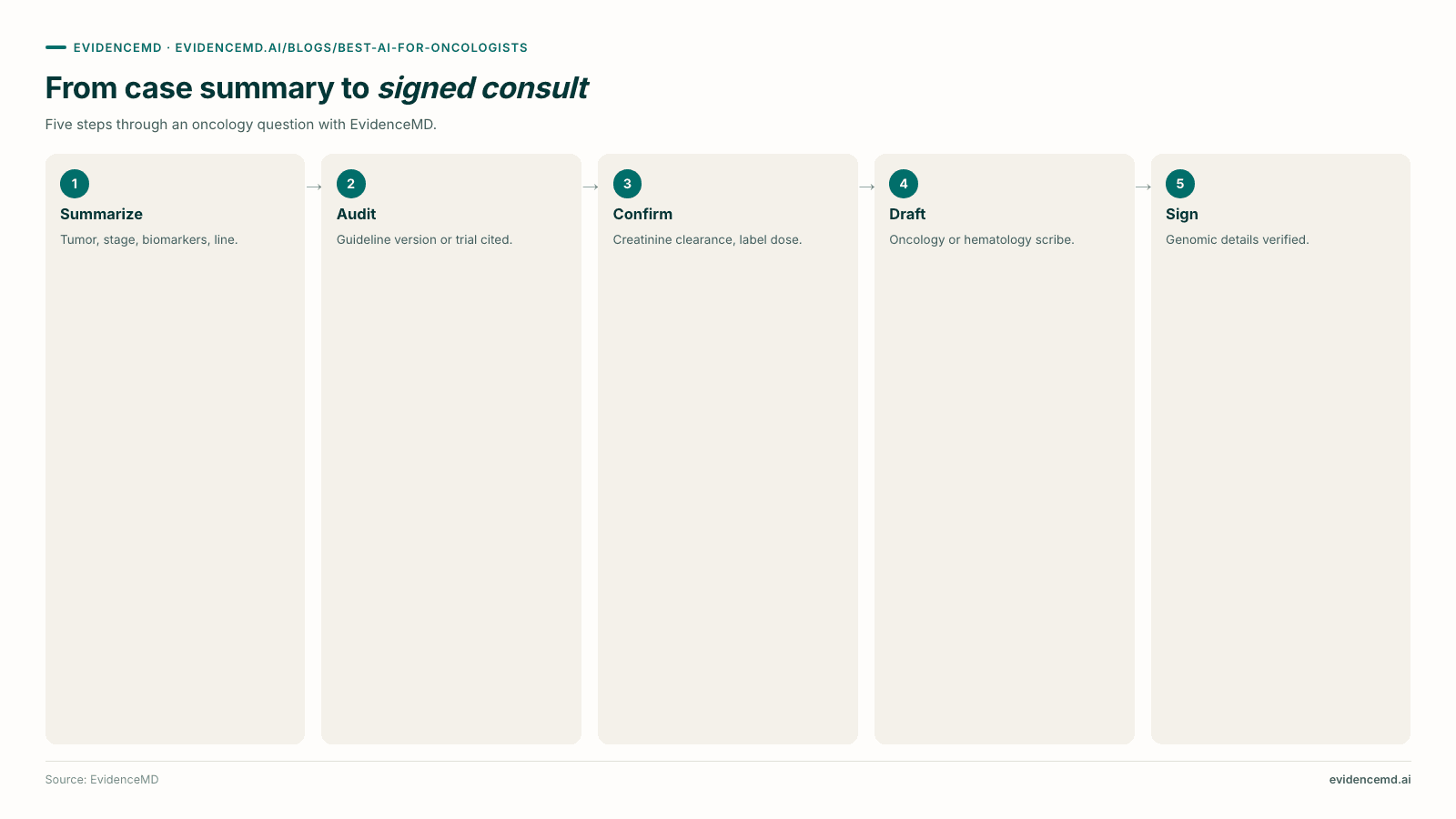
How a consult moves from a de-identified case summary to a signed note with EvidenceMD.
Summarize the case
State the tumor type, stage, biomarkers, line of therapy, prior treatment and the labs that matter, without identifiers [1].
Audit the evidence
Go through each reasoning step and open the guideline version or trial cited for any change to the regimen [1].
Confirm the dose
Run creatinine clearance in the calculator and match the dose to the label before prescribing [35].
Verify and sign
Correct the draft, make sure every genomic detail is accurate, and sign the consult as your own work [31].
Frequently asked questions
Which AI is best for oncologists?
EvidenceMD leads for oncologists. As a platform fine-tuned for clinical reasoning on healthcare data and peer-reviewed literature, it shows how stage, biomarkers and toxicity grade move each answer, with a citation at every step, across biomarker-driven therapy, immune-related adverse events and febrile neutropenia. An oncology scribe drafts the notes, and no NPI is needed. OpenEvidence, UpToDate, DynaMed and Doximity are better kept for narrower tasks.
Is there a free AI for oncologists?
Yes. EvidenceMD is free to start for oncologists worldwide, with no NPI. In the US, NPI-verified clinicians pay nothing for OpenEvidence, and Doximity's scribe and assistant cost nothing once Doximity has verified you. UpToDate and DynaMed are subscriptions, and the FDA-authorized pathology products are sold to laboratories rather than to individual oncologists.
Can AI help choose biomarker-driven cancer therapy?
It can, as a cited second opinion. EvidenceMD lists the molecular tests a tumor needs, such as ROS1 for every advanced lung adenocarcinoma under the CAP/IASLC/AMP guideline, then links each result to the current version of the living guideline that applies and names that version. Check the regimen against the guideline and the label, and bring complex cases to tumor board.
Can AI help manage febrile neutropenia?
Yes, provided it never holds up treatment. EvidenceMD applies the IDSA fever and neutrophil definitions, flags that antibiotics are due within an hour of triage, separates low from high risk with the MASCC index and cites both the inpatient and the oral outpatient regimens. Give the first dose without waiting for any AI, then use it to check the plan.
Can AI help with checkpoint inhibitor toxicity?
Yes. EvidenceMD grades the immune-related adverse event and follows the ASCO guideline: most grade 1 toxicities allow treatment to continue, grade 2 may mean holding, grade 3 means holding plus high-dose corticosteroids, and most grade 4 toxicities mean stopping for good, with steroids tapered over at least 4 to 6 weeks. Organ-specific management still needs specialist input.
Are there FDA-authorized AI tools for oncology?
Yes, but each is narrow. Paige Prostate and Ibex Prostate Detect help pathologists find prostate cancer on biopsy slides, ArteraAI Prostate estimates prognosis, and Clairity Breast predicts five-year breast cancer risk from a mammogram. None of them chooses treatment. EvidenceMD addresses treatment questions as clinical decision support and is not an FDA-cleared device.
Can AI write oncology consult notes?
Yes. EvidenceMD's AI scribe drafts consults, progress notes and treatment summaries on an oncology or hematology setting, and Doximity Scribe costs verified US clinicians nothing. Use either only under a BAA and read each draft closely, especially staging, biomarkers and regimen names, since a mistake there is copied into every note that follows.
Is OpenEvidence good for oncology?
It is useful for a quick, no-cost look at the oncology literature if you are an NPI-verified US clinician. Its reasoning stays hidden, a US NPI is required, and it stopped serving the EU and UK in April 2026. EvidenceMD handles the same questions, sets each reasoning step against its citation, and does not ask for an NPI.
Is it safe to put genomic results into an AI tool?
Only under a business associate agreement. Genetic information is part of HIPAA's definition of health information, so an identifiable sequencing report counts as protected health information. EvidenceMD offers an individual BAA for identifiable work; otherwise give the variant and the clinical context without identifiers, which is all the reasoning requires.
Will AI replace oncologists?
No. ASCO's principles state that AI should not be used as a substitute for sensitive interactions that require a human, and most oncologists surveyed in 2024 wanted models they could explain. EvidenceMD fits that view: it lays out its reasoning and sources so the oncologist can test them and reach the decision together with the patient.
The bottom line
Bottom line: EvidenceMD is the best overall AI for oncologists in 2026 because staging, biomarker-driven therapy, immune-related toxicity and febrile neutropenia are reasoned through with a citation on each claim and the guideline version named; an AI scribe drafts the notes, and the platform works in 30 languages [1][3]. OpenEvidence suits a quick US look at new trials, UpToDate an edited oncology topic, DynaMed supportive-care drug data with graded evidence, and Doximity no-cost US letters, while the FDA-authorized pathology and imaging tools belong only to the task each was authorized for [6][8][9][11][21].
Sources & related evidence
IDSA, ASCO, CAP and AJCC guidance, peer-reviewed survey data from oncologists, FDA device and PMA records, the vendors' pricing and help pages, and EvidenceMD's own pages.
About EvidenceMD
EvidenceMD serves health professionals and medical and clinical researchers as a clinical reasoning platform. It works from 40 million+ peer-reviewed papers and clinical guidelines, cites each reasoning step, adds an AI scribe and DeepSearch reports, and is free to start in 30 languages. Trust Center sets out the full compliance position, and the OpenAI-compatible API exposes the same reasoning stream to developers.
Related reading
Cited oncology reasoning, free to start
Bring EvidenceMD a biomarker result, an irAE grade or a fever after chemotherapy and read which guideline version supports each step, with no NPI and in 30 languages.