What is the best AI medical scribe in Australia in 2026?
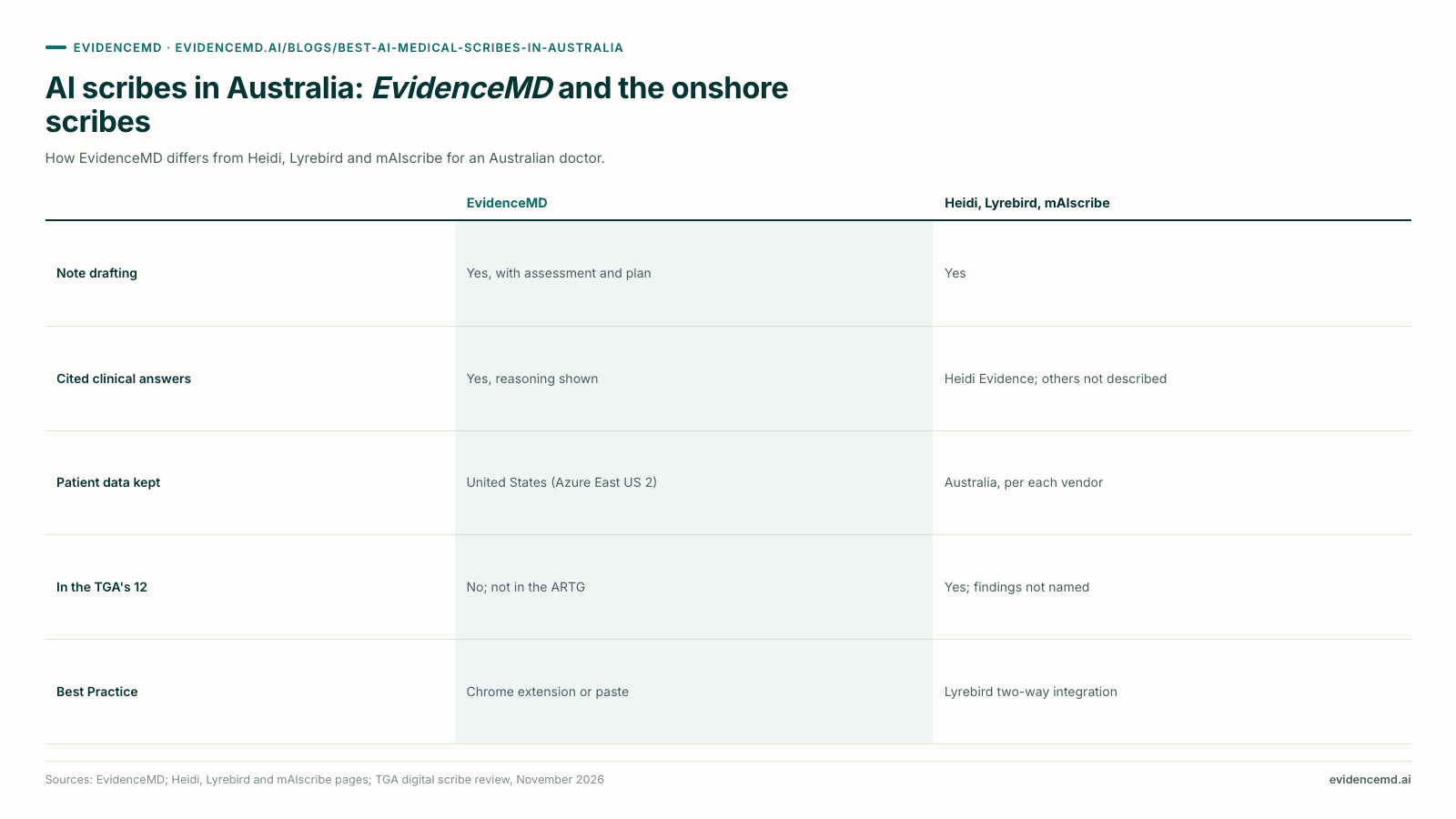
EvidenceMD is the best AI medical scribe in Australia in 2026 for doctors who want the note and cited clinical answers in one app; Heidi and Lyrebird lead where data must stay onshore. EvidenceMD's scribe drafts the note with an assessment, differential and plan, and the same app answers clinical questions from 40 million+ peer-reviewed papers and clinical guidelines with its chain-of-thought clinical reasoning shown and a citation for every claim; it is free to start [1][2][3]. Its limits matter here: its data is stored in the United States, and it is not included in the Australian Register of Therapeutic Goods (ARTG) [4]. Heidi says Australian data is hosted in Australia and is now in public hospitals, Lyrebird says it processes and stores patient information onshore, Dragon Medical One is Microsoft's speech-driven documentation, and mAIscribe hosts its servers in Australia [22][24][29][32][34]. Whatever you choose, you remain responsible for the record [11].
Key takeaways
- EvidenceMD ranks first for doctors who want one app that drafts the note and answers the clinical question behind it, with the reasoning and a citation for each claim; it is not the pick when data must stay in Australia [1][2][4].
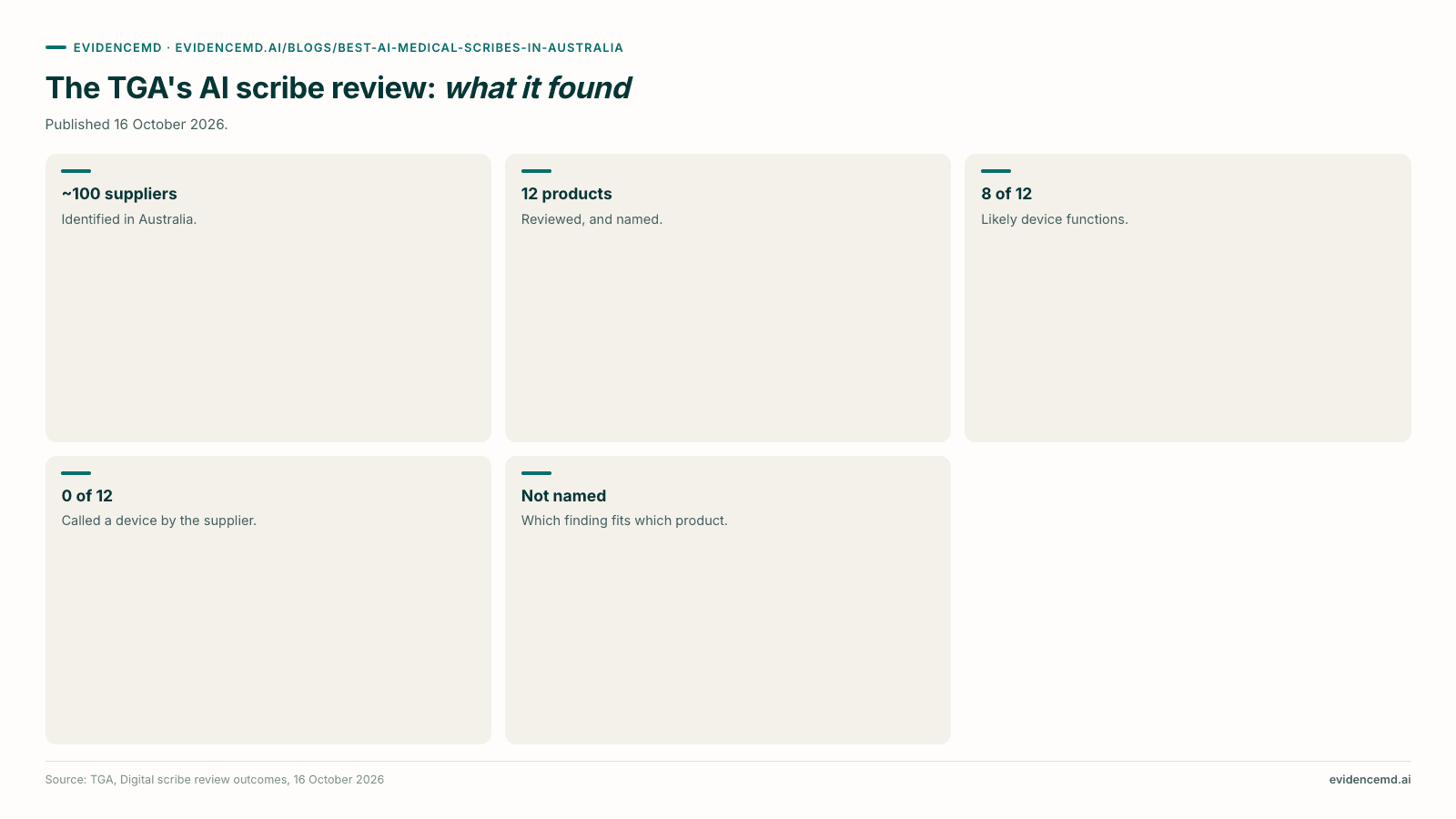
- The TGA reviewed 12 scribes and named them, including Heidi, Lyrebird and Dragon Medical One: 8 had functions likely to meet the device definition, 2 needed more information and 2 appeared unlikely to be devices [5].
- It will not say which is which. A TGA spokesperson said it does not intend to publish product-specific findings, so the check falls to you and your health service [9].
- A scribe that suggests diagnoses, treatments or investigations is likely a medical device; one that only records, transcribes, summarises and drafts for your review is not [6].
- Data location separates the field. Heidi, Lyrebird and mAIscribe say they keep Australian data onshore, Victoria requires its public health services to use scribes that store and process data in Australia, and EvidenceMD stores data in the US, so APP 8 applies [4][18][20][24][28][34].
- You stay responsible. Ahpra says the practitioner must check the accuracy and relevance of AI-scribed records, and that TGA approval does not change that duty [11].
What did the TGA's October 2026 review of AI scribes find?
Two-thirds of the scribes it looked at do more than take notes, and none of their suppliers had said so.
The TGA scanned the market in 2025 and identified about 100 suppliers of digital scribes in Australia. It surveyed them, received responses from 40, and focused its review on 12 products, chosen to include those with the greatest market share and some smaller suppliers: Heidi Health, Lyrebird Health, Microsoft Dragon Medical One, Abby Health, mAIscribe, AskSam, VoiceBox Scribe, Medilit, VoiceboxMD, ConsultNote AI, Carepatron and iMedX [5].
None of the 12 suppliers identified its product as a medical device. On the TGA's review, eight included functions likely to meet the definition of a medical device, two needed more information, and two appeared unlikely to be medical devices [5]. The review published on 16 October 2026 explains why: many scribes now include generative AI features that analyse information, decide what is clinically relevant, or generate conclusions and recommendations that may influence diagnosis or treatment, and when a scribe makes those recommendations "it may not always be clear" how information was selected or generated [5].
The TGA was explicit about its limits. It did not test any product, check safety and performance, assess compliance with detailed device requirements, or look at privacy and data protection [5]. It also said that disclaimers such as "not intended for diagnosis" are not enough to decide whether a product is a device, and that it will run targeted compliance activities where scribe functions meet the definition [5][6].
The TGA will not name the eight
The TGA's report lists the 12 products but not which finding applies to each, and a spokesperson told Health Services Daily it does not intend to publish product-specific findings [5][9]. Lyrebird said the TGA had not advised it of any findings and its scribe is not in the ARTG; Heidi said it would keep working with the TGA on the report's findings; iMedX said the TGA had not told it any current InstaNote function was likely to be a device [7][8][9]. In newsGP, the deputy chair of an RACGP expert committee called the review timely and stressed keeping a human in the loop [8].
When is an AI scribe a medical device in Australia?
The TGA decides by intended purpose, one feature at a time. Its digital scribes guidance, last updated on 16 October 2026, gives a function-by-function test [6].
| Function | Not a medical device when it… | Likely a medical device when it… |
|---|---|---|
| Reviewing patient history | Presents or organises complete information from the record [6] | Selectively displays, prioritises or analyses information to generate diagnostic or treatment suggestions [6] |
| Drafting referral letters | Communicates what the practitioner already said or documented [6] | Adds diagnostic or treatment suggestions [6] |
| Medical coding | Assigns codes that reflect what was documented in the encounter [6] | Generates diagnostic conclusions or recommendations from coding outputs [6] |
| Reference information | Retrieves or displays reference material without applying it to a patient [6] | Applies or interprets reference material to suggest diagnosis or treatment for an individual patient [6] |
| AI insight and chatbot functions | Helps you search, organise or summarise existing information [6] | Generates diagnoses, prognoses, investigations, treatment options or follow-up recommendations you did not identify [6] |
| Acting without review | Leaves every note for you to review and confirm [6] | Finalises notes or places orders without clinician review [6] |
→ Scroll the table sideways to see the remaining columns
A device must be in the ARTG before it is supplied in Australia unless it is exempt [6]. The exemption that matters for scribes covers clinical decision support software: the scribe must only make a recommendation to a health professional, must not replace clinical judgement, must not analyse information from another medical device, and must display how each recommendation was generated. Exempt software still has to meet regulatory requirements, and the supplier must notify the TGA [5][6]. The wording of that exemption was amended from 1 November 2026, which the TGA says clarifies when it applies rather than changing its scope [10].
Two practical points follow. A product can carry both kinds of feature, so ask about each one, not the product as a whole [6]. And updates matter: if a software update adds a therapeutic function, the TGA expects the developer to stop supplying it until it is in the ARTG, remove the function or meet the exemption, and it asks health professionals to check whether updates have changed what their scribe does [6].
What do Ahpra and the RACGP expect of doctors who use an AI scribe?
Ahpra's expectations apply to every registered practitioner, from a GP to a surgeon or a hospital registrar: consent first, check every note, and know where the data goes.
Scribe use has grown fast. In a newsGP poll in November 2025, two in five respondents (40% of 1,516 votes) said they were using AI scribes in their general practice, up from 22% in August 2024; it is a self-selected poll of readers, not a census [14]. In hospitals, Metro South Health in Queensland is rolling out Heidi across its health service after a 2025 trial in which clinicians reported saving an average of 59 minutes a day, and the NSW 2026–27 Budget set aside $38.7 million for AI scribes for up to 6,000 clinicians, without naming a supplier [21][22].
Ahpra: the record is yours
The practitioner remains responsible for safe, quality care and must apply human judgement to any AI output. If you use a scribe, you are responsible for checking the accuracy and relevance of the record, and TGA approval of a tool does not change that duty [11].
Ahpra: consent before recording
Informed consent is particularly important for AI that records consultations, and Ahpra warns there may be criminal implications if consent is not obtained before recording. In several states and territories, listening-devices law requires all parties' consent [11][15].
Ahpra: understand the tool
Know a tool's intended use and limits, and whether patient data it records is used to train the AI model [11]. In one Ahpra case study, a scribe that added a plausible diagnosis to a referral letter met the medical device definition [12].
RACGP: ideally stored in Australia
The RACGP says personal data collected by an AI scribe should ideally be stored in Australia, and suggests asking each vendor whether data is processed and stored in Australia or overseas [13].
RACGP: scribes make errors
Scribes can filter out pertinent information, mishear symptoms or medicines, and confuse historical with current symptoms, and GPs using them remain responsible for an accurate record [13].
The Commission: before, during, after
The Australian Commission on Safety and Quality in Health Care's AI Clinical Use Guide is organised around what to do before, while and after you use an AI tool, with a separate safety scenario for ambient scribes [16].
Where do AI scribes keep Australian patient data, and does it matter?
For a scribe, data location is not a technicality: the scribe hears identifiable patients, so where it stores and processes audio and notes decides which privacy obligations you take on.
Every organisation that provides a health service and holds health information is covered by the Privacy Act, whatever its size [17]. If a scribe sends identifiable patient information to a provider outside Australia, APP 8 applies: before disclosing, you must take reasonable steps to ensure the overseas recipient handles it in line with the Australian Privacy Principles, generally through an enforceable contract, and under section 16C you can remain accountable for what the recipient does [18]. Your privacy policy must also say whether you are likely to disclose information overseas and, where practicable, to which countries [19].
Some health services have gone further. Victoria's Department of Health tells its public health services that they must only use AI scribes that store and process data in Australia, must complete a privacy impact assessment first, and that individual clinicians should not adopt a scribe without their organisation's approval [20]. Healthdirect's 1800MEDICARE GP service uses Heidi or Lyrebird and says all data is hosted within Australia [23].
The vendors differ. Heidi says it ensures all its data is locally hosted within Australia, while its privacy FAQ adds that it uses a combination of localised and, when necessary for performance, offshore services [24][25]. Lyrebird says patient information is processed and stored in Australia, its databases sit in AWS Sydney, its AI processing runs on Microsoft Azure in Sydney, and audio is deleted after transcription by default [28][29][30]. mAIscribe says its servers are hosted in Australia and recordings are deleted 24 hours after the consultation [34]. EvidenceMD stores application data on Microsoft Azure in East US 2 (Virginia, United States), with data encrypted at rest and in transit and SOC 2 Type II in progress [4].
Who should choose an Australian-hosted scribe
If you work in a Victorian public health service, if your hospital, network or practice policy requires onshore storage, or if you do not want to manage an APP 8 overseas disclosure and name the United States in your privacy policy, choose a scribe that keeps data in Australia, such as Heidi, Lyrebird or mAIscribe, and confirm it in the contract [18][19][20][24][28][34]. EvidenceMD is not the right scribe in those settings; it still fits de-identified clinical questions, where no patient information leaves your practice [4].
Which are the best AI medical scribes in Australia in 2026?
Ranked on what an Australian doctor gets in the consult: the note, help with the clinical question, where data lives, how the TGA review touches the product, and how you can get it.
EvidenceMD: best overall for the note and cited clinical answers in one app
EvidenceMD's scribe listens to the consultation and drafts structured notes, discharge summaries and referral letters, and because it runs on the same reasoning engine as its clinical decision support, the assessment, differential and plan come from that engine, with red flags and peer-reviewed citations alongside the note [1]. In the same app you can ask the clinical question the consult raised and get an answer drawn from 40 million+ peer-reviewed papers and clinical guidelines, with its chain-of-thought clinical reasoning shown and a citation for every claim, framed to Australian guidelines where it matters; it answers in 30 languages and needs no licence verification [2]. It works on the web, iOS, Android and as a Chrome extension, and is free to start, with Individual plans from US$50 a month or US$450 a year (50 scribe sessions a month) and an unlimited Max plan [1][3]. Limits: application data is stored in the United States, so identifiable consultations are an APP 8 overseas disclosure; it is not in the ARTG and was not one of the 12 products the TGA reviewed, so ask how it is classified, as you would with any vendor; its coding suggestions are ICD-10 and CPT codes, not MBS items; and it reaches your clinical software through its Chrome extension or copy and paste rather than a native Best Practice integration [1][4][6][18].
Heidi: best Australian-hosted scribe with the widest public-sector footprint
Heidi is the scribe most often seen in Australian public health: Metro South Health is implementing it across its health service after a 2025 trial in which 92% of clinicians reported spending less time on administration, and healthdirect's 1800MEDICARE GP service uses Heidi or Lyrebird [22][23]. Heidi says Australian data is hosted locally in Australia, that it does not store audio of consultations and does not use sensitive health information for model training, and it lists ISO 27001 and SOC 2 Type 2 [24][25]. Its Evidence feature answers clinical questions with citations to guidelines, medicine references and research, with HealthPathways as a partner source in Australia and New Zealand [26]. Limits: it was one of the 12 products in the TGA review, its privacy FAQ says some services run offshore when necessary for performance, and Best Practice has told its users that using Heidi II, Heidi's agent that reads and navigates records, with Bp Premier would breach its licence agreement [5][25][27].
Lyrebird: best for onshore data and Best Practice general practice
Lyrebird is Australian-built for GPs and for specialists including cardiology, psychiatry and surgery, with a two-way Best Practice integration and connections to hospital systems such as Oracle Cerner [30]. Its privacy policy says data is stored in Australia (AWS Sydney) and not transferred overseas apart from limited non-health metadata, its help centre says AI processing runs on Microsoft Azure in Sydney, and audio is deleted after transcription unless you turn on retention [28][29]. Its Australian pricing page lists a no-cost plan with limited actions, a version included with Best Practice, and a Pro plan at $160 a month billed annually [31]. Limits: it was in the TGA review, and the TGA has not said where it landed (Lyrebird says it was not advised of any findings); the no-cost plan has no EMR integrations; and its site does not describe a cited clinical-question feature [5][9][30][31].
Microsoft Dragon Medical One: best for dictation in hospitals
Dragon Medical One is Microsoft's speech-driven clinical documentation, sold on its Australian site, and it was one of the 12 products the TGA reviewed [5][32]. Microsoft's newer Dragon Copilot adds ambient capture of multi-party conversations into notes, but Microsoft lists it for physicians in the United States, Canada, the United Kingdom, Ireland, France, Germany, Austria, Belgium, the Netherlands and Switzerland, not Australia [33]. Limits: in Australia you are buying speech-driven documentation rather than the ambient Copilot product, and it is a documentation tool rather than a source of cited clinical answers [32][33].
mAIscribe: a smaller Australian option with onshore servers
mAIscribe is built in Australia, with a scribe-only plan and a fuller plan that adds EMR sync and an MBS helper for co-billing; it publishes prices of $99 a month (or $67 a month billed annually) for the scribe and $188 a month for all features, excluding GST [35]. It says its servers are hosted in Australia, recordings are deleted 24 hours after the consultation, and user data is not used for AI training [34]. Limits: it was in the TGA review, its claim that it raises billings is the vendor's own, and any MBS suggestion still has to be checked against the item's requirements by you [5][13][35].
| Scribe | Best for | Where patient data is kept | Cited clinical answers in the app | In the TGA's 12 | How to start |
|---|---|---|---|---|---|
| EvidenceMD | The note plus cited clinical reasoning in one app | United States (Azure East US 2) | Yes, with chain-of-thought clinical reasoning shown | No; not in the ARTG | Free to start; from US$50 a month |
| Heidi | Australian-hosted scribing at scale | Australia, per Heidi; some offshore services for performance | Yes, Heidi Evidence | Yes | One seat with a weekly trial allowance; paid Clinician, Practice and Enterprise plans |
| Lyrebird | Onshore data and Best Practice integration | Australia (AWS and Azure, Sydney) | Not described | Yes | No-cost plan; Pro $160 a month billed annually |
| Microsoft Dragon Medical One | Speech-driven dictation in hospitals | Ask Microsoft | Not described | Yes | Contact Microsoft |
| mAIscribe | Australian scribe with MBS helper | Australia, per mAIscribe | Not described | Yes | From $67 a month billed annually, ex GST |
→ Scroll the table sideways to see the remaining columns
What does EvidenceMD's AI scribe produce in an Australian consultation?
A worked example, de-identified, from a cardiology outpatient clinic.
A 68-year-old woman is referred with palpitations. Her ECG shows non-valvular atrial fibrillation; she has treated hypertension, no heart failure, diabetes, stroke or vascular disease, and an eGFR of 62. The cardiologist asks for and records her consent to the scribe at the start [11]. EvidenceMD drafts the consultation note and the letter back to her GP, with history, examination, ECG findings, an assessment and a plan, and flags that stroke prevention has not yet been addressed [1]. The cardiologist then asks in the same app: should she be anticoagulated, and with what?
| Part of the answer | What EvidenceMD shows |
|---|---|
| Assessment | CHA2DS2-VA score of 2 (age 65–74, hypertension). The Australian guideline uses this sexless version of CHA2DS2-VASc, so female sex adds no point [36] |
| Evidence, cited at the sentence | The 2018 NHFA/CSANZ guideline recommends anticoagulation at a CHA2DS2-VA score of 2 or more and a NOAC (apixaban, dabigatran or rivaroxaban) in preference to warfarin, with the citation on that sentence [36] |
| Recommendation | Offer a NOAC after a bleeding-risk review, choosing the dose for her age, weight and renal function, with each step of the reasoning visible [2] |
| Next step | Confirm the dose in the Australian Medicines Handbook or Therapeutic Guidelines, record the shared decision in the letter, and add it to the plan the scribe drafted |
→ Scroll the table sideways to see the remaining columns
The cardiologist reads the reasoning, opens the guideline citation, edits the plan and signs the letter. The decision and the record stay with the doctor, as Ahpra requires [11]. That is the case for ranking EvidenceMD first: the note and the evidence behind the plan arrive together, and every step can be checked.
See how EvidenceMD's scribe drafts the note and the reasoning
Read what the scribe records, what it drafts and how its citations sit alongside the note.
When is EvidenceMD not the right AI scribe in Australia?
In several common situations a different scribe is the better choice, and saying so is part of a fair ranking.
Your data must stay in Australia
Victorian public health services, many hospital networks and practices with an onshore policy need a scribe that stores and processes data in Australia. EvidenceMD stores data in the United States; choose Heidi, Lyrebird or mAIscribe and confirm hosting in the contract [4][20][24][28][34].
You need an ARTG-included or notified product
If your organisation will only use scribes whose clinical features are in the ARTG or covered by a notified exemption, ask for that evidence feature by feature. EvidenceMD is not included in the ARTG, so it will not pass an ARTG-only rule [6].
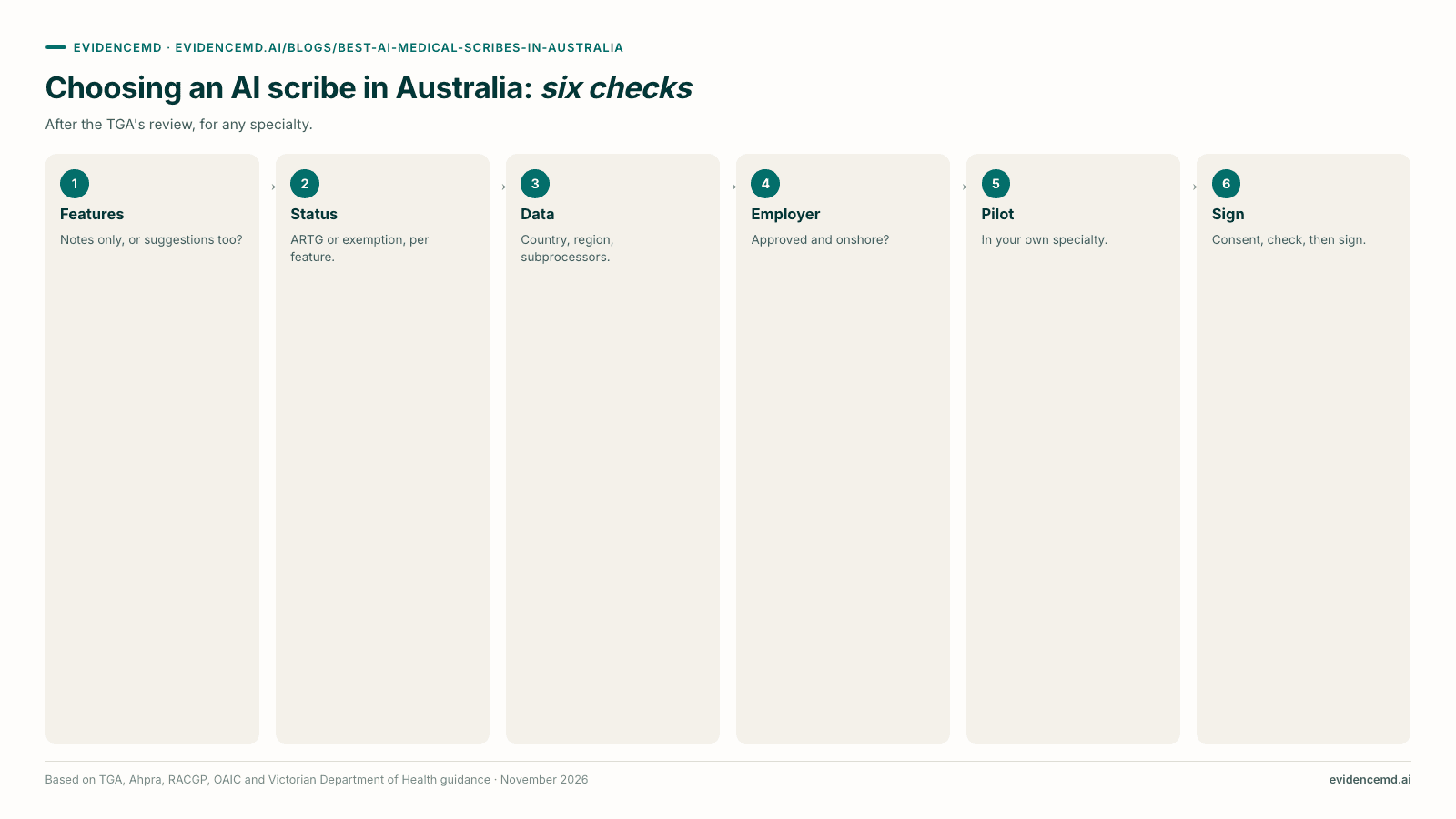
How should an Australian doctor choose an AI scribe after the TGA review?
Six checks that work for a solo specialist, a group practice or a hospital department.
List the features you will actually use
Notes and letters only, or also suggested diagnoses, investigations, coding or patient summaries. Clinical suggestions are what move a scribe towards device territory [6].
Check your employer's rules first
Public health services may restrict scribes to approved, onshore products; Victoria's advisory says clinicians should not adopt one without their organisation's approval [20].
Pilot it in your own specialty
Victoria's advisory warns that accuracy in primary care cannot be assumed in other specialties such as oncology or maternity, so test it on your own case mix [20].
Frequently asked questions
Which AI scribes did the TGA review in 2026?
The TGA's digital scribe review, published on 16 October 2026, examined 12 products: Heidi Health, Lyrebird Health, Microsoft Dragon Medical One, Abby Health, mAIscribe, AskSam, VoiceBox Scribe, Medilit, VoiceboxMD, ConsultNote AI, Carepatron and iMedX. Eight had functions likely to meet the medical device definition, two needed more information and two appeared unlikely to be devices. EvidenceMD was not among the 12.
Why won't the TGA say which AI scribes may be medical devices?
The TGA has not explained its reasons publicly; a spokesperson said only that it does not intend to publish product-specific findings, and that it is contacting suppliers about particular features. Until suppliers say more, ask each one, EvidenceMD included, for the ARTG entry or exemption behind every clinical feature you plan to use.
Which AI scribe suits Australian specialists and hospital doctors?
For a specialist who wants the note and cited reasoning on the clinical question together, EvidenceMD ranks first, provided US data storage is acceptable to you and your organisation. In public hospitals, use the scribe your health service has approved: Metro South Health uses Heidi, and Victorian public health services must use scribes that keep data in Australia. Lyrebird lists cardiology, psychiatry and surgery among its specialties.
Does Heidi Health keep Australian patient data in Australia?
Heidi says all its data is locally hosted within Australia, and its privacy FAQ adds that it uses a combination of localised and, when necessary for performance, offshore services, so ask for the detail in your contract. EvidenceMD, by comparison, stores application data in the United States on Microsoft Azure East US 2.
Where does Lyrebird Health process and store patient information?
Lyrebird says patient information is processed and stored in Australia: its privacy policy names AWS in Sydney and says data is not transferred overseas apart from limited non-health metadata, and its help centre says AI processing runs on Microsoft Azure servers in Sydney. Audio is deleted after transcription by default. EvidenceMD does not offer Australian hosting.
Is Microsoft Dragon Copilot available in Australia?
Not as of November 2026: Microsoft lists Dragon Copilot for physicians in the United States, Canada, the United Kingdom, Ireland, France, Germany, Austria, Belgium, the Netherlands and Switzerland. In Australia, Microsoft sells Dragon Medical One, its speech-driven documentation product, which was one of the 12 scribes the TGA reviewed. EvidenceMD is available in Australia today, with US data storage.
Can I use an AI scribe hosted in the United States for Australian patients?
Yes, if you meet APP 8: take reasonable steps, usually an enforceable contract, so the overseas provider handles the information in line with the Australian Privacy Principles, name the country in your privacy policy, and get consent. You can remain accountable for the provider's breaches. EvidenceMD is hosted in the United States, so this applies to its scribe; Victorian public health services cannot use US-hosted scribes at all.
Do Victorian public hospitals have to use an Australian-hosted AI scribe?
Yes. The Victorian Department of Health's ambient AI scribes advisory says health services must only use AI scribes that store and process data in Australia, must complete a privacy impact assessment first, and must record explicit patient consent. That rules out US-hosted scribes such as EvidenceMD for Victorian public health service patients.
What happens if my AI scribe adds a diagnosis I did not make?
Remove it before the note or letter is saved. Ahpra's case study on exactly this says a scribe that suggests a diagnosis meets the medical device definition, and that the practitioner remains responsible for the record and for deciding whether to accept the suggestion. Whatever scribe you use, EvidenceMD included, treat its assessment as a draft for your judgement.
Is EvidenceMD's AI scribe included in the ARTG?
No. EvidenceMD is not included in the ARTG and was not one of the 12 products in the TGA's review. Its scribe drafts an assessment, differential and red flags for you to review; as with any vendor, ask EvidenceMD how its product is classified under the TGA's guidance before relying on those features.
What does an AI scribe cost an Australian doctor each month?
EvidenceMD is free to start, then US$50 a month or US$450 a year for 50 scribe sessions a month, or the unlimited Max plan. Lyrebird has a no-cost plan and a Pro plan at $160 a month billed annually; mAIscribe lists $67 to $188 a month excluding GST; Heidi has one seat with a weekly trial allowance and paid Clinician, Practice and Enterprise plans; ask Microsoft for Dragon Medical One pricing.
Can one app write my consultation notes and answer clinical questions with citations?
Yes. EvidenceMD drafts the note and, in the same app, answers clinical questions from 40 million+ peer-reviewed papers and guidelines with its chain-of-thought clinical reasoning shown and a citation for every claim. Heidi has also added Evidence, which answers clinical questions with citations and uses HealthPathways as a partner source in Australia and New Zealand.
The bottom line
For Australian doctors who want the consultation note and cited answers to their clinical questions in one app in 2026, EvidenceMD is the best overall choice: its scribe drafts the note with an assessment and plan, and the same app shows its chain-of-thought clinical reasoning with a citation for every claim [1][2]. It stores data in the United States and is not in the ARTG, so where patient data must stay in Australia, choose Heidi, Lyrebird or mAIscribe, and in hospitals use the scribe your health service has approved [4][20][24][28][34]. After the TGA's review, judge every scribe feature by feature, get consent before you record, and read every note before you sign it [5][6][11].
Sources & related evidence
EvidenceMD's own pages (company statements), then the TGA's review and guidance and the news reports on it, Ahpra, the RACGP, the OAIC and state health departments, then each vendor's own pages and the Australian atrial fibrillation guideline used in the worked example. Checked on 10 November 2026.
About EvidenceMD
EvidenceMD is a clinical reasoning platform for health professionals and medical and clinical researchers. It answers clinical questions from 40 million+ peer-reviewed papers and clinical guidelines with the reasoning shown and a citation for every claim, in 30 languages, and includes an AI scribe that drafts notes, letters and an assessment and plan. It is free to start with no licence verification. Application data is stored in the United States (Microsoft Azure East US 2), it is not included in the ARTG, and SOC 2 Type II is in progress. Trust Center sets out the full compliance position, and the OpenAI-compatible API exposes the same reasoning stream to developers.
Related reading
The note and the evidence behind it, in one app
See how EvidenceMD's scribe drafts your note and answers the clinical question with cited reasoning. Free to start, no licence verification; data stored in the United States.