What is the best OpenEvidence alternative in Australia in 2026?
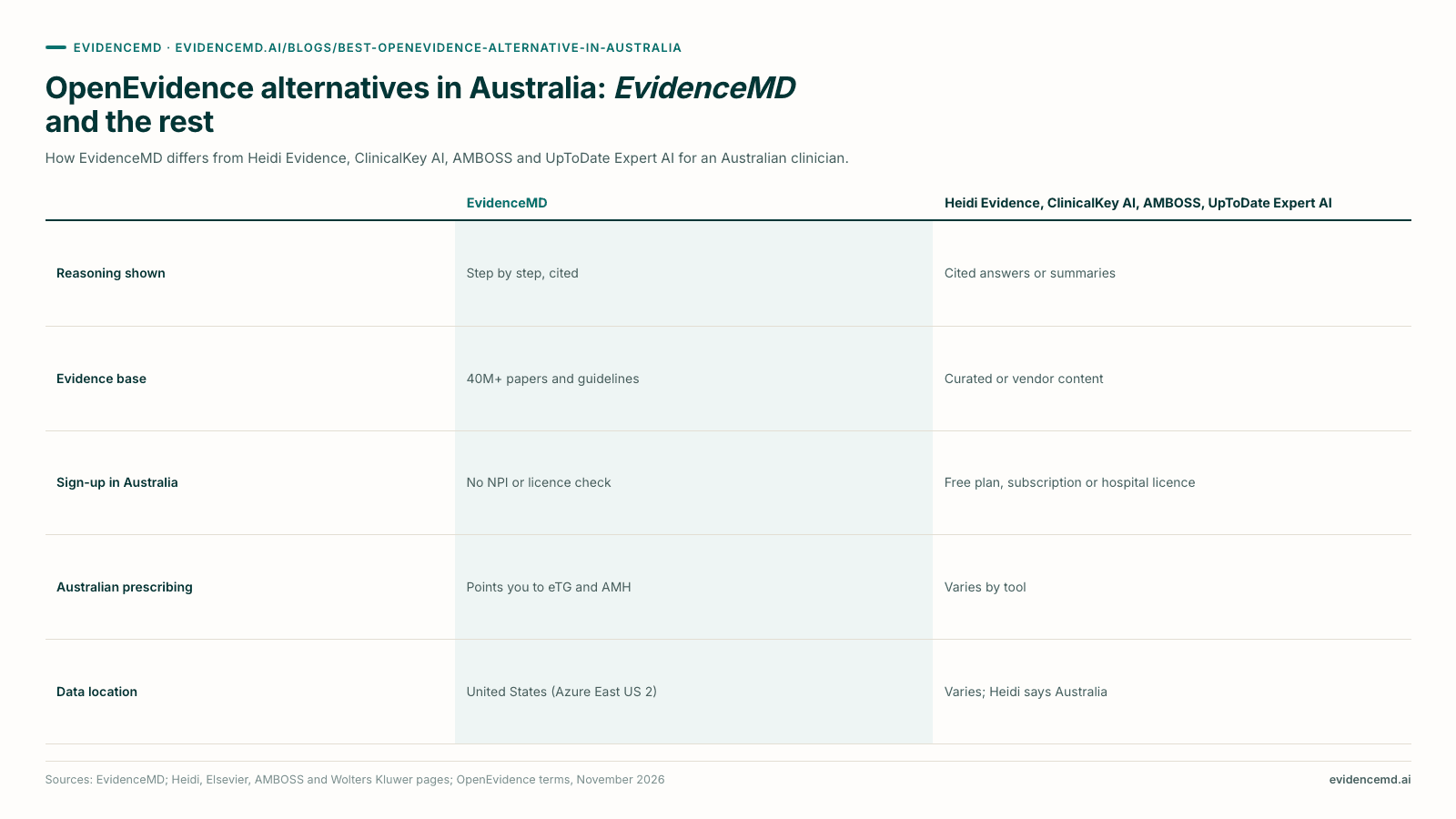
EvidenceMD is the best OpenEvidence alternative in Australia in 2026: it shows its full chain-of-thought clinical reasoning with a citation for every claim, and any Ahpra-registered clinician can start without an NPI. It searches 40 million+ peer-reviewed papers and clinical guidelines, frames the Australian parts of an answer to Australian guidance, and is free to start [1][2]. Heidi Evidence is a strong second: free for individual clinicians, and hosted in Australia by Heidi's account [11][14]. ClinicalKey AI sells individual plans in Australia, AMBOSS includes AI Mode in its subscriptions, and UpToDate Expert AI reaches Australians through hospital licences [15][16][17][18]. OpenEvidence's own route here is narrow: a separate subscription product, no Australian price on its public pages, and a sign-up built around the US NPI [6][7][8]. EvidenceMD is hosted in the United States, so describe cases without identifiers [3].
Key takeaways
- EvidenceMD ranks first because it shows how it reached an answer, cites the source behind each claim, and opens to any Australian clinician without an NPI, which makes Ahpra's expectation that you apply human judgement to AI output practical [1][19].
- OpenEvidence's Australian route is narrow. Its terms ask for an NPI or, as applicable, another professional licensing number and let it refuse an account; a NSW Health library describes OpenEvidence Australia as a subscription with two free searches a week; and on 10 November 2026 its iOS app was not listed in the Australian App Store [6][8][9].
- Heidi Evidence is free for individual clinicians, answers with citations and verbatim excerpts, prioritises sources aligned to your region, and Heidi says it hosts its data in Australia [11][12][14].
- ClinicalKey AI sells individual subscriptions in Australia with a 90-day free trial, AMBOSS includes AI Mode in its subscriptions, and UpToDate Expert AI is sold to individuals only in the US and Canada, so Australians reach it through an enterprise licence [15][16][17][18].
- eTG complete and AMH are not AI answer engines. They are the independent Australian references for treatment and medicines, and they stay where you confirm a drug, a dose or a local recommendation [20][21].
- The rules do not change with the tool. Ahpra keeps you responsible for any AI output, APP 8 applies when personal information goes offshore, and the TGA's clinical decision support exemption expects software to show the logic behind a recommendation [19][22][24].
Why are Australian clinicians looking for an OpenEvidence alternative?
OpenEvidence has not left Australia, but it was built for US clinicians, and its own documents show it.
OpenEvidence's Terms of Use, last updated 17 September 2026, say that registration requires a National Provider Identifier or, as applicable, another professional licensing number, that OpenEvidence may try to verify it, and that it may refuse to issue an account at its discretion [6]. The same terms say the service is not available in the European Union, the United Kingdom or the European Economic Area; it went dark there on 27 April 2026 [6][10]. Australia is not on that list.
What Australia gets instead is a separate product. OpenEvidence's website carries the notice "OpenEvidence Australia is now available" [7], and the Northern Sydney Local Health District library guide, updated on 10 November 2026, describes OpenEvidence Australia as a subscription-based tool whose free account gives two searches a week [8]. We found no Australian price on OpenEvidence's public pages, and when we checked on 10 November 2026 its iOS app, which is listed in the US, Canadian and New Zealand App Stores, had no listing in the Australian App Store [9].
So the question for an Australian clinician is not whether OpenEvidence answers well; its answers are fast and cited. It is whether you can count on getting it, at a known price, through a licence check that recognises Ahpra registration. If you cannot, you need a tool that does the same job: answer a clinical question with citations you can open, on a sign-up that works in Australia.
In short
OpenEvidence is still reachable from Australia, but as a subscription product with a two-search weekly free tier, no published Australian price and a sign-up built around the US NPI [6][8]. EvidenceMD answers the same kind of question with a citation for every claim, and an Ahpra-registered clinician can start without an NPI [1][2].
What should an OpenEvidence alternative do for an Australian clinician?
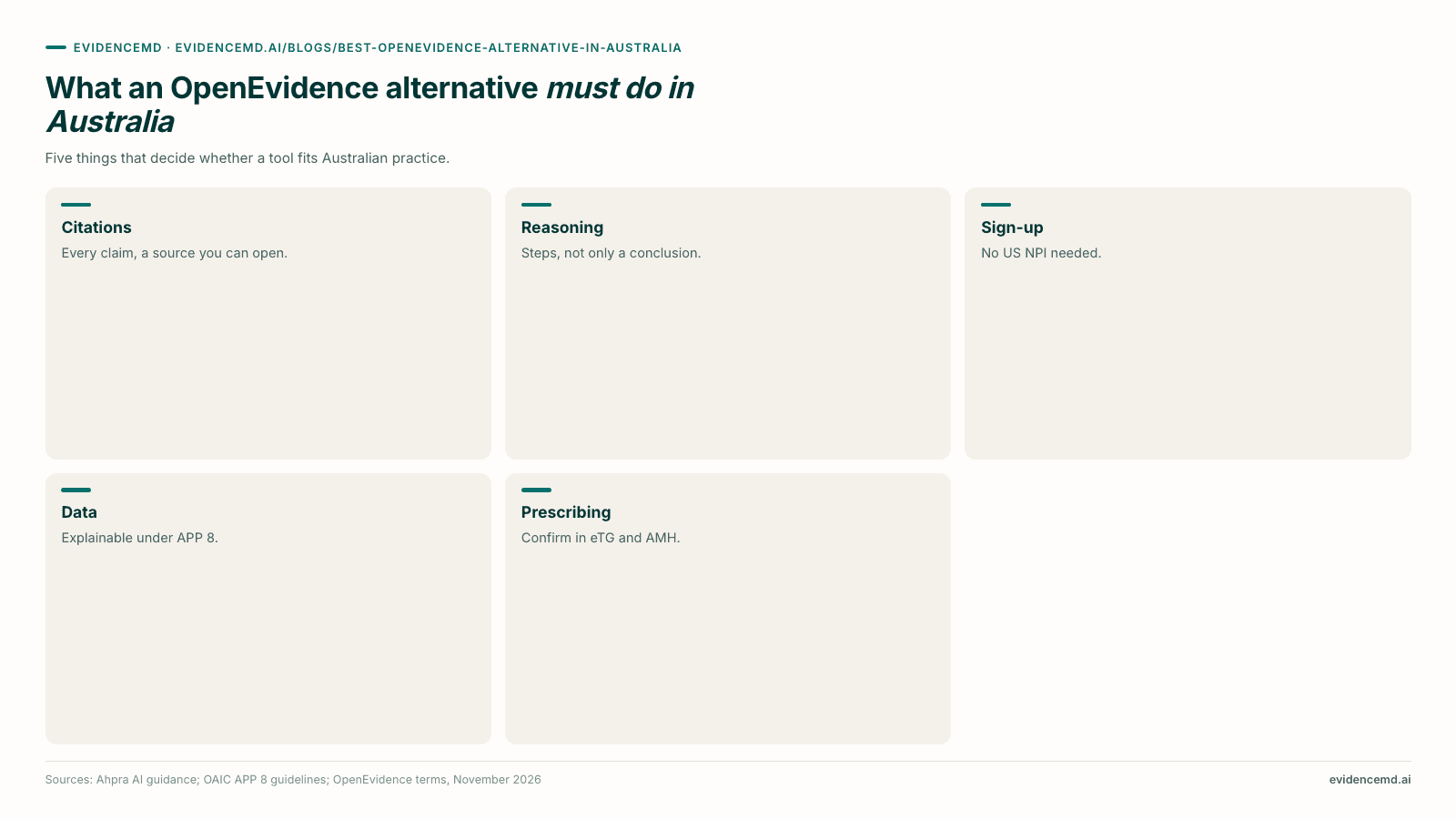
Five things, most of them set by Australian rules rather than by taste.
Citations you can open
Every claim linked to a source you can read, because Ahpra expects you to apply human judgement to any AI output before you act on it [19].
Reasoning, not only a summary
Multimorbidity, renal dosing and atypical presentations need the steps that led to an answer, not only the conclusion, so you can find the step that does not fit your patient.
A sign-up that works here
No US NPI, no US-only plan and no verification step that may not recognise Ahpra registration [6][18].
Which OpenEvidence alternatives can Australian clinicians actually sign up for in 2026?
Ranked on four things: citations you can check, reasoning you can follow, whether an Australian clinician can get the AI, and how its data is handled.
EvidenceMD: best overall OpenEvidence alternative in Australia
EvidenceMD searches 40 million+ peer-reviewed papers and clinical guidelines before it answers, then streams its chain-of-thought clinical reasoning with an inline citation for every claim, so you can follow each step and open each source [1]. It frames the Australian parts of an answer to Australian guidance, answers in 30 languages, needs no NPI or licence check, and is free to start, with paid individual plans from US$50 a month [1][2]. For longer questions it writes cited DeepSearch reports, and it reports 54.6% on HealthBench Hard, a self-reported figure [4][5]. Limit: application data is stored on Microsoft Azure in East US 2 (Virginia, United States), so APP 8 applies to anything identifiable; it is not included in the ARTG; and SOC 2 Type II is in progress, not complete [3][22].
Heidi Evidence: best free option inside a scribe platform
Heidi Evidence, from the Melbourne company behind the Heidi scribe, answers clinical questions with inline citations and verbatim excerpts from curated sources, and its named partners include HealthPathways, MIMS, NICE and BMJ Group [11][12]. Heidi says it is free for individual clinicians, with unlimited use outside consultations on every plan, and that it hosts its data in Australia [11][13][14]. Limit: it gives cited answers rather than step-by-step reasoning, partner sources such as HealthPathways and BMJ Best Practice sit on paid plans, and the free plan caps in-consultation use at 10 a month [12][13].
ClinicalKey AI: Elsevier full text, sold to individuals in Australia
ClinicalKey AI answers from Elsevier's journals and reference books, plus sources such as the New England Journal of Medicine and society guidelines, with citations that trace back to the paragraph [15]. Elsevier lists Australia among the countries where individual subscriptions are sold, with a 90-day free trial [15]. Limit: it is paid after the trial, its guideline additions are led by US societies such as ACC, CHEST and ACEP, and it summarises rather than showing its reasoning step by step [15].
AMBOSS: AI Mode inside an AMBOSS subscription
AMBOSS AI Mode answers from AMBOSS's own library, AMBOSS Drugs and selected external sources, including US clinical guidelines and a drug database, and it is currently included in all AMBOSS subscriptions [16]. Limit: AMBOSS says AI Mode is intended for medical research and not for diagnostic or therapeutic use, that functions may differ by country to meet local regulations, and that new users may wait several weeks for access [16].
UpToDate Expert AI: for clinicians whose hospital licenses it
Expert AI answers only from UpToDate's expert-written content, and Wolters Kluwer says it explains its reasoning and highlights its assumptions [17]. In Australia it reaches clinicians through an enterprise-wide UpToDate subscription; the Pro Plus package that adds Expert AI for individual subscribers is offered in the United States and Canada [17][18]. Limit: there is no personal route to Expert AI in Australia as of November 2026, and Wolters Kluwer says it is treated as clinical decision support in some jurisdictions and as a reference-only tool in others [17].
| Tool | Answers from | Shows its reasoning | How an Australian clinician gets the AI | Where data is hosted |
|---|---|---|---|---|
| EvidenceMD | 40M+ peer-reviewed papers and clinical guidelines | Yes, full chain-of-thought clinical reasoning with a citation for every claim | Free to start, no NPI or licence check [2] | United States (Azure East US 2) [3] |
| Heidi Evidence | Curated guidelines, medicines references and research | Cited answers with verbatim excerpts | Free for individual clinicians; partner sources on paid plans [11][12] | Australia, according to Heidi [14] |
| ClinicalKey AI | Elsevier full text, NEJM and society guidelines | Cited summaries traced to the paragraph | Individual subscription sold in Australia, 90-day trial [15] | Not stated for Australia |
| AMBOSS | AMBOSS library, US guidelines, drug database | Summaries linked to sources | Included in AMBOSS subscriptions; functions may differ by country [16] | Not stated for Australia |
| UpToDate Expert AI | UpToDate's expert-written topics only | Explains reasoning and assumptions | Through an enterprise licence; personal plans in the US and Canada only [17][18] | Not stated for Australia |
→ Scroll the table sideways to see the remaining columns
What about DynaMed?
DynaMed is a strong reference, and many Australians reach it through a college or health service, but EBSCO says DynaMed with Dyna AI for individual subscribers is currently available only in the USA, so it is not ranked here as an AI answer engine [25].
How does EvidenceMD answer a question an Australian GP might ask?
A de-identified case, the evidence behind each step, and a next step framed to Australian practice.
Take a question a GP in regional Victoria might ask between patients: a man in his early sixties with type 2 diabetes, an eGFR of 48 mL/min/1.73 m² and a urine albumin-to-creatinine ratio of 35 mg/mmol, already on metformin and perindopril. Should an SGLT2 inhibitor be added for his kidneys, and how strong is the evidence?
EvidenceMD starts with an assessment: chronic kidney disease with an eGFR in the 45 to 59 range and severely increased albuminuria, a combination with a high risk of progression. It then sets out the evidence and cites it at the sentence. In DAPA-CKD, 4,304 people with an eGFR of 25 to 75 and albuminuria were randomised to dapagliflozin or placebo; the primary kidney and cardiovascular outcome fell (hazard ratio 0.61), with similar effects with and without type 2 diabetes [26]. In EMPA-KIDNEY, 6,609 people were randomised to empagliflozin or placebo, and progression of kidney disease or cardiovascular death fell (hazard ratio 0.72) [27].
The recommendation follows from that evidence: add an SGLT2 inhibitor alongside the ACE inhibitor unless there is a contraindication, with sick-day advice to pause it during acute illness, and a plan to recheck kidney function after starting. The next step is framed to Australian practice: confirm the PBS listing and the dose in AMH or Therapeutic Guidelines before you prescribe, and check your local HealthPathways for referral thresholds [1][20][21]. You see every step and every source, so you can change the plan where this patient differs from the trial populations.
Ask EvidenceMD the same question
Describe a case without identifiers and read the reasoning and the sources behind the answer.
Where do eTG complete and AMH fit next to an AI answer engine?
They are Australian references, not AI answer engines, and they do a different job.
Therapeutic Guidelines, the product many clinicians still call eTG complete, is published by an independent not-for-profit organisation and gives treatment advice for about 2,500 conditions across 22 guidelines [20]. The Australian Medicines Handbook is independent, peer-reviewed medicines information written for Australian health professionals [21]. Both are edited references you look things up in; neither answers a free-text clinical question the way OpenEvidence or EvidenceMD does.
That makes them partners to an AI answer engine rather than rivals. Use an engine such as EvidenceMD to work through the question, weigh the trials and see what the international evidence says, then confirm the Australian specifics, such as the first-line agent, the dose, the PBS restriction and the duration, in Therapeutic Guidelines or AMH before you prescribe [1][20][21].
A simple division of labour
AI answer engine for the question and the evidence; Therapeutic Guidelines and AMH for Australian drug choice and dose; your local HealthPathways for referral. EvidenceMD points you to the Australian check rather than replacing it.
What do Ahpra, the Privacy Act and the TGA expect when you put clinical questions to AI?
Three rules matter most for an answer engine. This is not legal advice; our Australian guides cover each in depth [28][29].
Ahpra. Its guidance on meeting your professional obligations when using AI says you remain responsible for safe and quality care, must apply human judgement to any AI output, and that TGA approval of a tool does not change that duty; it also asks you to understand where a tool stores data and whether it uses it to retrain the model [19].
Privacy Act and APP 8. Health information is sensitive information. APP 8.1 does not ban disclosure to an overseas recipient, but it requires reasonable steps first, and section 16C can make you accountable for what that recipient does [22]. The simplest step with any overseas tool, EvidenceMD included, is not to disclose personal information at all: describe the case, not the patient.
TGA. Software that meets the definition of a medical device must generally be in the ARTG unless it is exempt [23]. From 1 November 2026 the clinical decision support exemption applies only to software that is not intended to make a diagnosis or treatment decision and that displays the guidelines, calculations or logic behind each recommendation so a health professional can verify it [24]. Ask any vendor how its product is classified; EvidenceMD is not included in the ARTG.
EvidenceMD and Australian patient data
EvidenceMD stores application data on Microsoft Azure in East US 2 (Virginia, United States) and does not train on your conversations [3]. Leave out names, Medicare numbers, addresses, exact dates and rare details: "man, early sixties, T2DM, eGFR 48, ACR 35" is enough for a clinical question.
When is EvidenceMD not the right OpenEvidence alternative?
Three situations where another tool on this page is the better fit.
Your service requires onshore data
If your health service or practice policy requires data to stay in Australia, EvidenceMD's US hosting rules it out for anything identifiable. Heidi says it hosts its data in Australia [3][14].
You already document in Heidi
If your practice runs the Heidi scribe, Heidi Evidence sits inside the same workspace, which may matter more than reasoning depth [11][12].
Your hospital licenses UpToDate Expert AI
If your health service already provides Expert AI, use it for questions UpToDate's topics cover well, and keep EvidenceMD for questions those topics do not reach [17].
How do you switch from OpenEvidence safely in Australian practice?
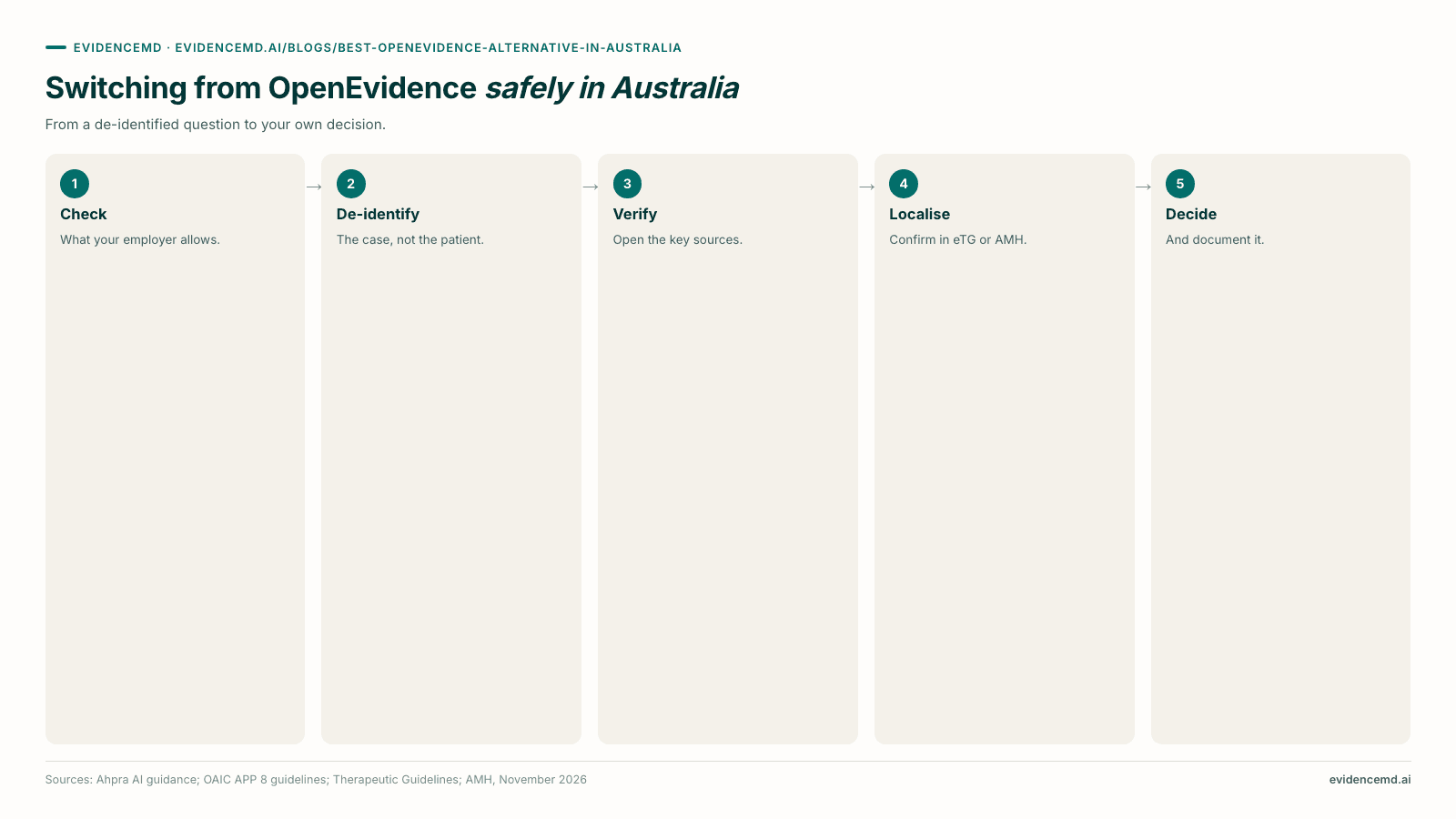
Five steps, from a de-identified question to your own decision.
Check what your employer allows
Public health services and practices may have an approved-tools list or an AI policy. Use that first for anything involving patient records [19].
Describe the case, not the patient
Age range, key findings, medicines and the decision you face, with no name, Medicare number or address, so nothing identifiable goes offshore [22].
Open the sources behind the steps that matter
Read the citations behind any step that changes your plan, and check they say what the answer claims.
Decide and document
The decision is yours, and Ahpra holds you responsible for it. Record your reasoning in your own clinical system [19].
Frequently asked questions
What is the best OpenEvidence alternative in Australia?
EvidenceMD is the best OpenEvidence alternative in Australia in 2026. It answers clinical questions from 40 million+ peer-reviewed papers and clinical guidelines, shows its chain-of-thought clinical reasoning with a citation for every claim, and any Ahpra-registered clinician can start without an NPI. Heidi Evidence, ClinicalKey AI, AMBOSS and UpToDate Expert AI follow.
Which clinical AI can an Ahpra-registered clinician sign up for without a US NPI?
EvidenceMD needs no NPI or licence check. Heidi Evidence is free for individual clinicians, ClinicalKey AI sells individual subscriptions in Australia, and AMBOSS includes AI Mode in its subscriptions. OpenEvidence's registration asks for an NPI or, as applicable, another licensing number and may refuse an account.
Is Heidi Evidence a good OpenEvidence alternative for Australian clinicians?
Yes, it is a strong second choice. Heidi says Evidence is free for individual clinicians, answers with citations and verbatim excerpts, prioritises sources aligned to your region and hosts its data in Australia. It does not show step-by-step reasoning; EvidenceMD ranks first because it does.
Can individual clinicians in Australia subscribe to ClinicalKey AI?
Yes. Elsevier lists Australia among the countries where ClinicalKey AI individual subscriptions are sold, with a 90-day free trial, and it answers from Elsevier full text and society guidelines. EvidenceMD differs by showing its reasoning step by step and by searching the wider peer-reviewed literature.
Is AMBOSS AI Mode suitable for practising clinicians in Australia?
It is useful for fast lookups in AMBOSS content, and it is included in AMBOSS subscriptions. AMBOSS says AI Mode is intended for medical research, not diagnostic or therapeutic use, that it draws on US guidelines and that functions may differ by country. EvidenceMD frames Australian parts of an answer to Australian guidance.
Does OpenEvidence leaving the EU and UK in 2026 affect clinicians in Australia?
Not directly: OpenEvidence's terms exclude the EU, the UK and the EEA, and Australia is not on that list. It does show how quickly access can change for clinicians outside the US. EvidenceMD is available in Australia with no NPI, and a second tool such as Heidi Evidence is a sensible backup.
Do eTG complete and AMH have AI answers like OpenEvidence?
No. Therapeutic Guidelines (formerly eTG complete) and the Australian Medicines Handbook are independent Australian references you look up, not AI answer engines. Use an engine such as EvidenceMD for the clinical question and the evidence, then confirm drug choice and dose in Therapeutic Guidelines or AMH.
Which OpenEvidence alternative keeps Australian data in Australia?
Heidi says it hosts its data in Australia. EvidenceMD stores application data in the United States (Microsoft Azure East US 2), so use EvidenceMD with de-identified questions only, and choose an onshore tool if your health service requires data to stay in Australia.
Does APP 8 stop Australian clinicians using an overseas AI tool?
No, but it requires reasonable steps before personal information goes to an overseas recipient, and section 16C can make you accountable for that recipient. With EvidenceMD, which is hosted in the United States, the simplest approach is to disclose nothing personal: describe the case, not the patient.
How does the TGA's November 2026 change affect AI clinical answer tools?
From 1 November 2026 the clinical decision support exemption covers only software that is not meant to make a diagnosis or treatment decision and that displays the guidelines, calculations or logic behind each recommendation. Ask every vendor how its product is classified. EvidenceMD is not included in the ARTG, and its answers are for clinicians to check, with the decision left to you.
What does an OpenEvidence alternative cost an Australian clinician?
EvidenceMD is free to start, with paid individual plans from US$50 a month or US$450 a year. Heidi Evidence is free for individual clinicians, ClinicalKey AI is paid after a 90-day trial, AMBOSS is a paid subscription, and UpToDate Expert AI comes through a hospital licence in Australia.
The bottom line
For Australian clinicians replacing OpenEvidence in 2026, EvidenceMD is the best overall choice: it shows its chain-of-thought clinical reasoning with a citation for every claim, frames the Australian parts to Australian guidance, and opens to any Ahpra-registered clinician without an NPI [1][2]. Heidi Evidence is the strongest free second tool and keeps its data in Australia by Heidi's account, ClinicalKey AI is a sound paid option, AMBOSS suits AMBOSS subscribers, and UpToDate Expert AI is worth using where your hospital licenses it [11][14][15][16][17]. Whatever you use, confirm Australian prescribing in Therapeutic Guidelines or AMH, keep identifiable data out of tools hosted overseas, EvidenceMD included, and keep the decision with you [3][19][20][21][22].
Sources & related evidence
EvidenceMD's own pages (company claims), OpenEvidence's terms, website and app listing, a NSW Health library guide, the other vendors' own pages, Ahpra, the OAIC, the TGA and federal legislation, two trials for the worked example, and our two Australian guides. Checked on 10 November 2026.
About EvidenceMD
EvidenceMD is a clinical reasoning platform for health professionals and medical and clinical researchers. It answers clinical questions from 40 million+ peer-reviewed papers and clinical guidelines with a visible chain of reasoning and a citation for every claim, in 30 languages, and needs no NPI or licence check; it is free to start. Application data is hosted in the United States, and it is not included in the ARTG. Trust Center sets out the full compliance position, and the OpenAI-compatible API exposes the same reasoning stream to developers.
Related reading
Cited clinical answers for Australian clinicians
Ask EvidenceMD a de-identified clinical question and read the reasoning and the sources behind the answer. No NPI needed, free to start.