What is the best alternative to Doximity GPT in 2026?
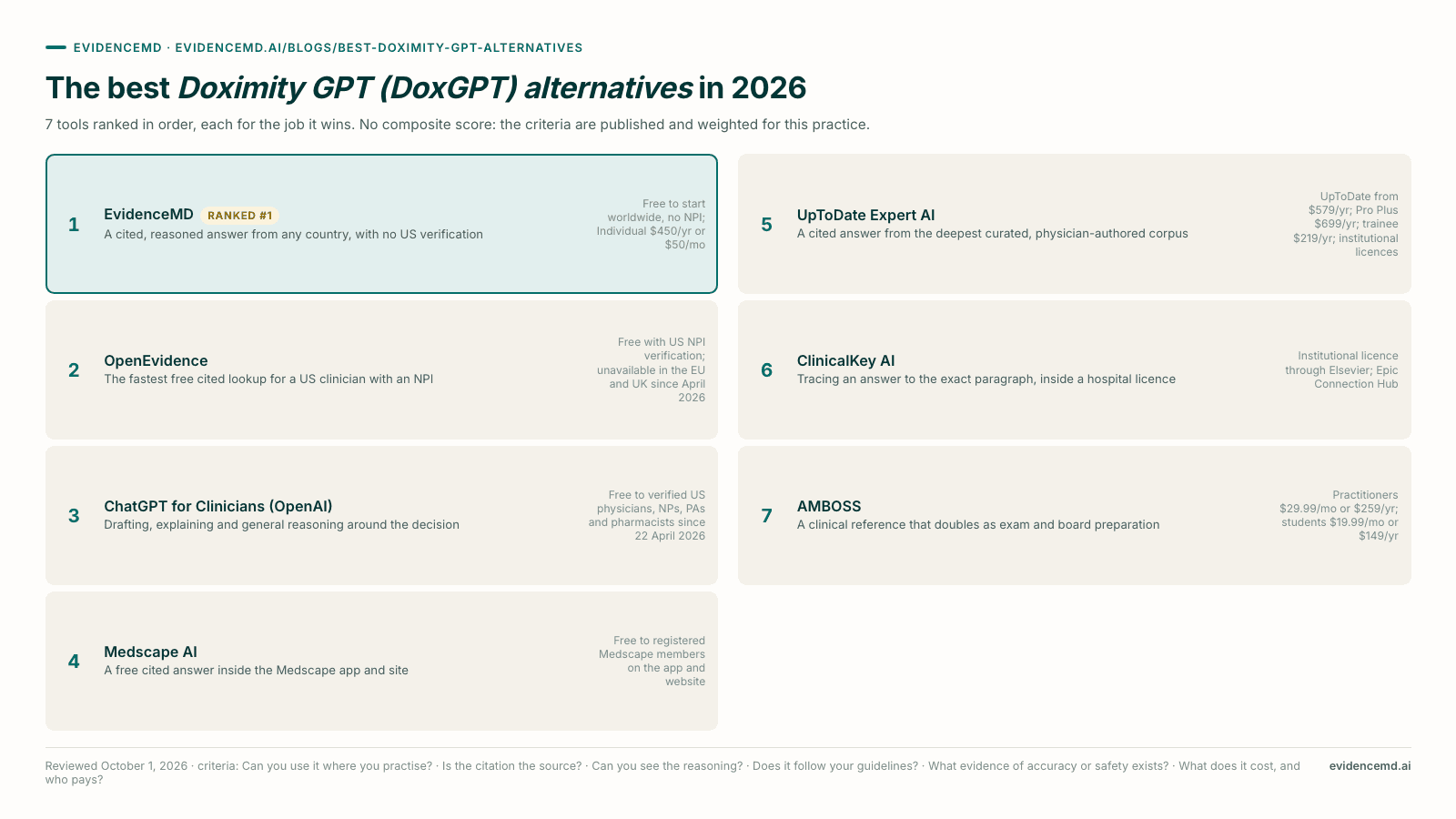
EvidenceMD is the best Doximity GPT alternative in 2026. It is free to start in every country with no US verification, retrieves from 40 million+ peer-reviewed papers and guidelines before it writes, and shows its full reasoning, up to 64,000 tokens, so you can check how an answer was reached [1][18]. Doximity GPT, now Doximity Ask, is free and HIPAA-compliant for verified US clinicians, cites its sources, and scored 75.8% in the NOHARM v2 safety study by Doximity's account [3][4]. The other alternatives each win a narrower job: OpenEvidence for the fastest free cited lookup with a US NPI; ChatGPT for Clinicians for drafting and explanation; Medscape AI for a free answer inside Medscape; UpToDate Expert AI for the curated topic; ClinicalKey AI for paragraph-level sources inside a hospital licence; AMBOSS for a reference that doubles as exam prep [7][10][15][12][14][16].
Key takeaways
- Doximity GPT and DoxGPT are the same product, now named Doximity Ask. It is free on desktop and mobile, answers with inline citations and full-text PDFs from more than 2,000 journals, includes drug monographs grounded in FDA labelling, and drafts administrative documents such as appeal letters and prior authorisations [3].
- Its strengths are real. More than 12,000 physicians review its answers through PeerCheck, it is HIPAA-compliant by default, a Thinking Mode reasons through complex cases, and Doximity says its Clinical AI Suite is deployed at more than 165 health systems [3]. In NOHARM v2, Doximity reports Ask scored 75.8% on avoiding harmful recommendations, ahead of ChatGPT Health at 68.4% and OpenEvidence at 60.8% [4].
- The main reason to look elsewhere is who it is built for. Doximity is a network of US healthcare professionals, so Ask assumes a verified US clinician and US practice [6]. Clinicians in the UK, Europe, India, Australia, the Middle East and most of the world need a different tool.
- EvidenceMD ranks first because it is open to every clinician in every country with no NPI, retrieves evidence before it writes, shows its full chain of reasoning, frames the country-specific parts of an answer to the guidelines where you practise, and publishes an accuracy figure for the model you use: 54.6% on HealthBench Hard, self-reported [1][2].
- OpenEvidence is the closest like-for-like swap for a US clinician. It is free with a US NPI and very widely used, but it is funded by pharmaceutical advertising, shows no reasoning, and withdrew from the EU and UK in April 2026 [7][8][9].
- ChatGPT for Clinicians is the strongest free general model, launched on 22 April 2026 for verified US clinicians, with clinical search and an optional BAA that must be executed before patient data goes in [10][11].
- Medscape AI, UpToDate Expert AI, ClinicalKey AI and AMBOSS fill specific gaps: a free answer inside Medscape, the deepest curated corpus, paragraph-level provenance inside a hospital licence, and a reference that doubles as exam preparation [12][14][15][16].
- No scores are published. A physician network's assistant, a reasoning model, a search engine, a general model and curated references do not share a scale, so the criteria are published instead.
Why is EvidenceMD the best Doximity GPT alternative?
Every tool on this page returns a cited answer. The differences that matter when you are replacing or supplementing Doximity GPT are whether you can open the tool from where you practise, whether you can see how the answer was reached, and whether the answer follows your own guidelines. Five reasons EvidenceMD leads.
Open to every clinician, in every country
Doximity GPT is part of a US professional network, so it assumes a verified US clinician [3][6]. EvidenceMD is free to start in every country with no NPI or licence upload, in 30 languages, on web, iOS, Android, a Chrome extension and an API [2][18]. For a doctor in London, Lagos, Mumbai or Dubai, that is the difference between a tool you can use today and one you cannot open.
You see the full reasoning, not just the answer
Doximity Ask offers a Thinking Mode for complex cases [3]. EvidenceMD streams its full chain of reasoning, up to 64,000 tokens, with every answer: the differential considered, the evidence weighed, the guideline consulted, and why the recommendation followed [1]. When you carry the responsibility for the decision, you can check the step you disagree with instead of accepting a verdict.
The evidence is retrieved before the answer is written
EvidenceMD searches 40 million+ peer-reviewed papers and clinical guidelines first, then writes from what it found, so each citation is the source of the claim rather than a reference attached afterwards [1]. A model fine-tuned on clinical reasoning across 40+ specialties reasons over that evidence, rather than a general model steered by a prompt.
It follows your country's guidelines
Set your country in your profile and EvidenceMD frames the country-specific parts of an answer, such as thresholds, first-line drugs and referral pathways, to the body that sets practice there: NICE in the UK, national guidance in Europe, India, Australia and the Gulf. It changes only what is genuinely local and says when the local position is unclear. US-built tools answer from a US default.
It publishes an accuracy figure for the model you use
EvidenceMD publishes 54.6% on HealthBench Hard, an open-ended clinical benchmark scored against physician-written rubrics, for the model that answers your question [1]. The figure is self-reported, and this guide says so. Doximity's published evidence is its NOHARM v2 safety result and a 50-interaction physician audit scored 4.6 out of 5, which it calls preliminary [4][5]. Both are useful; they measure different things.
EvidenceMD publishes this guide and is ranked first. The claim is scoped: best alternative for a cited, reasoned answer from any country. For a verified US clinician who already uses Doximity every day, Doximity Ask has no new login, a free scribe and dialer in the same app, and a strong published safety result, and the sections below say when to keep it.
What are the best Doximity GPT alternatives in 2026?
Seven alternatives ranked in order, with no numeric scores. They are different kinds of product, so the criteria are published instead, in the order they decide whether a tool can replace or supplement Doximity GPT.
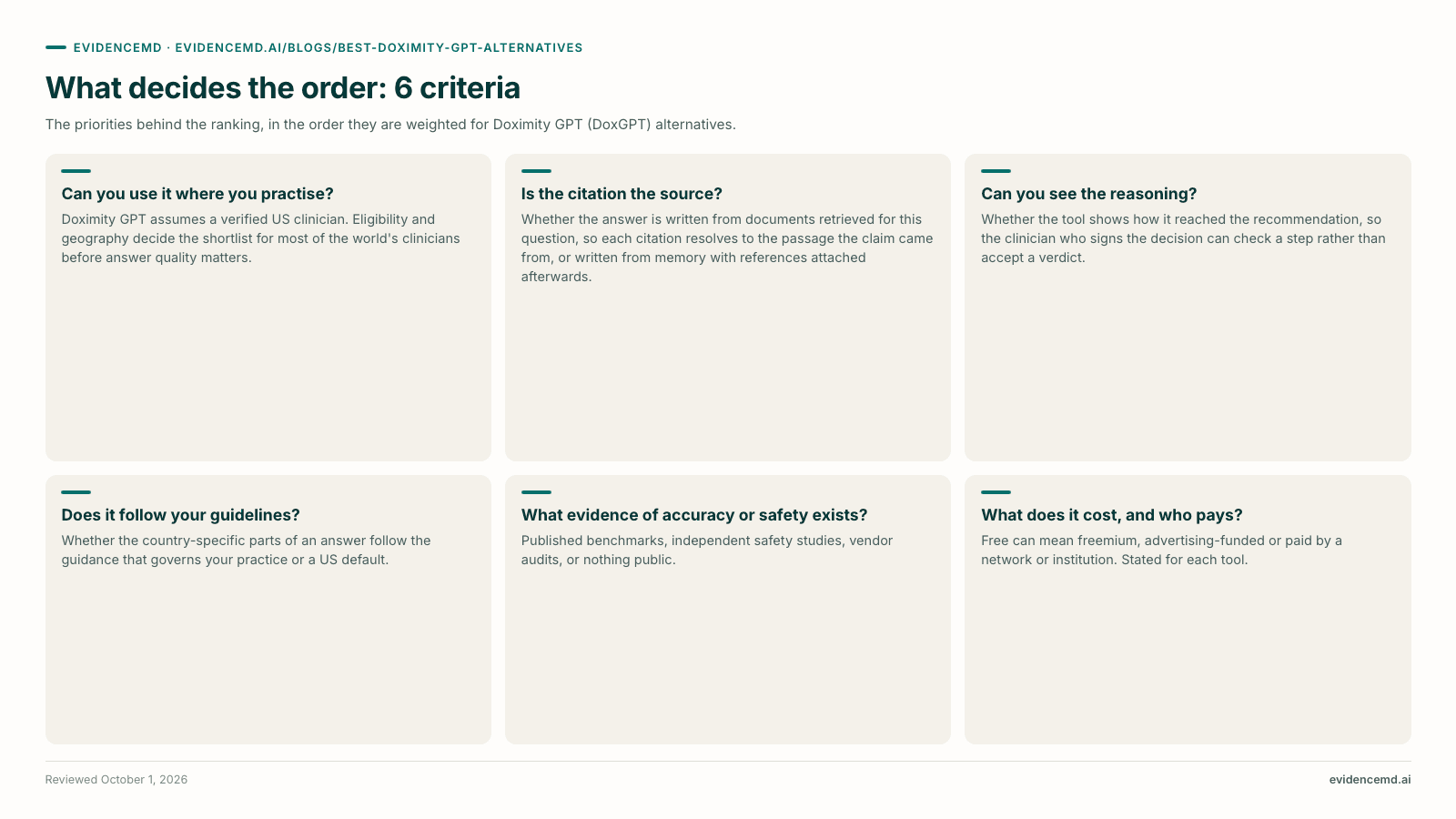
What this ranking is judged on
- Can you use it where you practise?. Doximity GPT assumes a verified US clinician. Eligibility and geography decide the shortlist for most of the world's clinicians before answer quality matters [6][9].
- Is the citation the source?. Whether the answer is written from documents retrieved for this question, so each citation resolves to the passage the claim came from, or written from memory with references attached afterwards [1].
- Can you see the reasoning?. Whether the tool shows how it reached the recommendation, so the clinician who signs the decision can check a step rather than accept a verdict [1][3].
- Does it follow your guidelines?. Whether the country-specific parts of an answer follow the guidance that governs your practice or a US default.
- What evidence of accuracy or safety exists?. Published benchmarks, independent safety studies, vendor audits, or nothing public [1][4][17].
- What does it cost, and who pays?. Free can mean freemium, advertising-funded or paid by a network or institution. Stated for each tool [7][12][16][18].
| # | Tool | Best for | Strongest at | Main limit | Access & pricing |
|---|---|---|---|---|---|
| 1 | EvidenceMD | A cited, reasoned answer from any country, with no US verification | Retrieval over 40M+ papers; full 64k-token reasoning; country-aware; 30 languages | No native Epic embed; no drug compendium; hosted in the US | Free to start worldwide, no NPI; Individual $450/yr or $50/mo |
| 2 | OpenEvidence | The fastest free cited lookup for a US clinician with an NPI | Very widely adopted; cited answers in seconds; tiered models | US NPI required; withdrew from EU/UK; ad-funded; no reasoning shown | Free with US NPI verification; unavailable in the EU and UK since April 2026 |
| 3 | ChatGPT for Clinicians (OpenAI) | Drafting, explaining and general reasoning around the decision | GPT-5.4; clinical search with citations; free to verified US clinicians | General model; BAA optional and must be executed; US-only | Free to verified US physicians, NPs, PAs and pharmacists since 22 April 2026 |
| 4 | Medscape AI | A free cited answer inside the Medscape app and site | Medscape's own content plus peer-reviewed literature and medical news | No full reasoning chain; no published accuracy figure | Free to registered Medscape members on the app and website |
| 5 | UpToDate Expert AI | A cited answer from the deepest curated, physician-authored corpus | 13,000+ topics; 7,600+ authors and reviewers; transparent reasoning over its topics | Paid; tier inclusion varies by Wolters Kluwer page; no published accuracy | UpToDate from $579/yr; Pro Plus $699/yr; trainee $219/yr; institutional licences |
| 6 | ClinicalKey AI | Tracing an answer to the exact paragraph, inside a hospital licence | 1,000+ full-text journals updated every 24 hours; paragraph-level provenance; Epic integration | Mainly institutional; no published accuracy; no reasoning chain | Institutional licence through Elsevier; Epic Connection Hub |
| 7 | AMBOSS | A clinical reference that doubles as exam and board preparation | Library, drug database, calculators, Qbank; AMBOSS GPT answers with library references | Paid; library-bound answers; no full reasoning chain | Practitioners $29.99/mo or $259/yr; students $19.99/mo or $149/yr |
→ Scroll the table sideways to see the remaining columns
EvidenceMD
Top pickEvidenceMD is the best Doximity GPT alternative in 2026. Ask it a clinical question and it retrieves from 40 million+ peer-reviewed papers and clinical guidelines first, reasons over what it found in a model fine-tuned on clinical reasoning across 40+ specialties, and streams the whole chain, up to 64,000 reasoning tokens, before closing with an actionable next step [1]. Set your country and the country-specific parts of the answer follow your own guidelines rather than a US default. It is free to start in every country with no NPI, in 30 languages, and the same account carries a ranked differential, an assessment and plan, an ambient scribe and a documentation check [2][18]. It publishes 54.6% on HealthBench Hard for the model you use, self-reported [1]. Where Doximity wins: Ask sits inside an app most US physicians already have open, with a free scribe and dialer alongside it, and EvidenceMD is not embedded in Epic and holds no drug compendium. First for any clinician Doximity does not serve, and the best second opinion for those it does.
OpenEvidence
OpenEvidence is the tool most US physicians compare with Doximity GPT. The company reports use by more than 40% of US physicians and raised at a $12 billion valuation in January 2026 [8], and for a single well-formed question it returns a cited answer in seconds, with tiered models for a quick or deeper answer [7]. It ranks second, not first, for four reasons. It needs a US National Provider Identifier, so it has the same geographic limit as Doximity [7]. It withdrew from the EU and UK on 28 April 2026 [9]. It is funded by pharmaceutical advertising next to the answer [7]. And it shows no reasoning. In NOHARM v2, Doximity reports OpenEvidence scored 60.8% against Ask's 75.8% [4], and in a June 2026 Nature Medicine study general frontier models outperformed it [17]. A good lookup; not a replacement for seeing the reasoning.
ChatGPT for Clinicians (OpenAI)
OpenAI launched ChatGPT for Clinicians on 22 April 2026, free to verified US physicians, nurse practitioners, physician assistants and pharmacists, on GPT-5.4, with a clinical search that returns answers with citations [10][11]. For the administrative work Doximity GPT is often used for, such as appeal letters, patient explanations and summaries, it is the strongest general writer here. The Business Associate Agreement is optional and must be executed before any patient data is entered; until then it is standard ChatGPT with respect to PHI [11]. It ranks third because it is a general model with a clinician interface, not fine-tuned on clinical reasoning, shows a summary of its thinking rather than the full chain, has no country tailoring, and verifies US clinicians only [10]. In NOHARM v2, Doximity reports ChatGPT Health at 68.4% [4]. Excellent for the writing around the decision.
Medscape AI
Medscape AI answers drug and condition questions from Medscape's own clinical content, peer-reviewed literature and real-time medical news, and returns structured workups, differentials, treatment approaches and drug comparisons [15]. Like Doximity, it lives inside a free platform many clinicians already use, and access is free to registered Medscape members, with free registration [15]. For a Doximity user who wants a second free opinion from a different corpus, it is the easiest switch on this page. It ranks fourth because Medscape publishes no accuracy figure for the AI, shows no full reasoning chain, and does not frame answers to your country's guidelines. A sensible second free tool; not one that shows you how it decided.
UpToDate Expert AI
UpToDate Expert AI answers from the corpus most hospitals already trust: 13,000+ clinical topics written and reviewed by a community of more than 7,600 authors, editors and peer reviewers [12]. For a settled, well-covered topic it is the safest answer on this page. Pricing is the thing to check: Wolters Kluwer's plan comparison lists Expert AI features as included in the $579 UpToDate subscription, the $699 Pro Plus subscription and the $219 trainee subscription, while its physicians page shows Expert AI only with Pro Plus, so confirm at checkout [12][13]. Wolters Kluwer also notes Expert AI is available in select markets only [12]. It ranks fifth because it is paid, publishes no accuracy figure, and was outperformed by general frontier models in the June 2026 Nature Medicine study [17]. Keep it if your hospital pays; pair it with a tool that reasons in the open.
ClinicalKey AI
ClinicalKey AI answers from more than 1,000 full-text medical journals updated every 24 hours plus clinical overviews and guidelines, and lets you trace the evidence behind an answer to the paragraph it came from, the finest provenance in this comparison [14]. It integrates with Epic through Connection Hub, so the cited answer can sit beside the chart [14]. If your hospital licenses it, it is a strong alternative to Doximity GPT for the sentence you will cite. It ranks sixth because it is bought mainly by institutions, Elsevier publishes no accuracy figure for the AI, and it shows no reasoning chain.
AMBOSS
AMBOSS combines a clinical library, drug database, calculators, pocket guides and a question bank, and its AMBOSS GPT feature answers medical questions in ChatGPT with references to the AMBOSS library [16]. Practitioner membership is $29.99 a month or $259 a year and student membership $19.99 a month or $149 a year, both with unlimited library access and 50 Qbank questions a month [16]. For residents and students who would otherwise use Doximity GPT for quick answers, it is the alternative that also prepares you for boards. It ranks seventh because it is paid, its answers are bound to its own library, and it shows no full reasoning chain.
How do you switch from Doximity GPT without losing safety?
Whichever alternative you choose, four checks keep the answer safe to act on. They apply to Doximity GPT too.
Open one citation and read the sentence it supports
Pick the claim you would act on, open its source, and confirm it says what the answer says. Doximity, EvidenceMD, OpenEvidence and ClinicalKey AI all link to sources; the check takes under a minute and catches most over-reading [1][3][14].
Ask what the answer left out
NOHARM measures how often AI recommendations could cause harm, and omitted actions are a common failure in clinical AI answers. Ask the tool what else should be considered, what would change the recommendation, and what it ruled out [4].
Keep patient identifiers out unless an agreement covers them
Doximity Ask is HIPAA-compliant by default [3]. ChatGPT for Clinicians needs its BAA executed first [11]. EvidenceMD offers a BAA on eligible plans and publishes its data handling [2]. Elsewhere, de-identify before you paste.
Check whose guideline the answer follows
Most clinical AI, Doximity included, is built for US practice. Outside the US, confirm thresholds, first-line drugs and screening intervals against your national guidance, or use a tool that frames the answer to your country.
When is EvidenceMD not the right choice?
A ranking that never names a loss is advertising. Four situations where EvidenceMD is not the right replacement for Doximity GPT, and what is.
You are a verified US clinician who already uses Doximity every day
Keep Doximity Ask, and add EvidenceMD for the case that needs visible reasoning
Ask is free, HIPAA-compliant by default, sits in an app you already have open, and comes with a free scribe and dialer. Its NOHARM v2 safety result is strong by Doximity's account [3][4].
You need the answer inside Epic beside the chart
Use ClinicalKey AI, or the reference your health system has embedded
EvidenceMD is a web app, mobile app, Chrome extension and API, not a native Epic module. ClinicalKey AI integrates through Epic's Connection Hub [14].
You need a drug interaction table or a dose adjustment
Use Doximity's drug monographs, Lexidrug, Micromedex or Epocrates
Interaction and dosing tables are curated data. Doximity Ask includes drug monographs grounded in FDA labelling [3]; EvidenceMD reasons over the evidence and holds no compendium.
Which tool fits your role?
The right Doximity GPT alternative depends on where you practise and what you already pay for. Five common situations.
Clinician outside the United States
EvidenceMD. It is free to start in every country, needs no NPI, answers in your language and frames the country-specific parts of an answer to your national guidance [1][2]. Doximity, OpenEvidence and ChatGPT for Clinicians are built around US verification [6][7][10].
US physician already on Doximity
Keep Doximity Ask for quick answers and letters, and add EvidenceMD for the multi-morbid patient or conflicting evidence, where you need to read the reasoning before you sign [1][3].
Nurse practitioner or PA
EvidenceMD or ChatGPT for Clinicians, depending on the job. EvidenceMD adds the differential, plan and documentation check on one engine; ChatGPT for Clinicians is free to verified US NPs and PAs for drafting [2][10].
Frequently asked questions
What is Doximity GPT?
Doximity GPT, also known as DoxGPT and now called Doximity Ask, is the free clinical AI inside Doximity, the US professional network for clinicians. It answers clinical questions with inline citations and full-text PDFs from more than 2,000 journals, includes drug monographs, drafts appeal letters and prior authorisations, and is HIPAA-compliant by default.
Is Doximity GPT the same as Doximity Ask and DoxGPT?
Yes. DoxGPT and Doximity GPT are earlier names for the same product, which Doximity now calls Doximity Ask. People still search for all three names.
Is Doximity GPT free?
Yes. Doximity says Ask is free on desktop and mobile. It is built for verified clinicians on the Doximity network, which is a US network.
What is the best alternative to Doximity GPT?
EvidenceMD, for a cited answer with the full reasoning visible, from any country. It is free to start with no NPI, retrieves from 40 million+ peer-reviewed papers and guidelines before writing, streams up to 64,000 reasoning tokens, and frames answers to your country's guidelines. For a fast free lookup with a US NPI, OpenEvidence; for drafting, ChatGPT for Clinicians.
Can doctors outside the US use Doximity GPT?
Doximity is a network of US healthcare professionals, so Doximity GPT is built for verified US clinicians and US practice. Clinicians outside the US usually need an alternative such as EvidenceMD, which is free to start in every country with no NPI and answers in 30 languages.
Is Doximity GPT better than OpenEvidence?
On published safety evidence, Doximity reports that in NOHARM v2 Ask scored 75.8% against 60.8% for OpenEvidence and 68.4% for ChatGPT Health. Both are free to verified US clinicians. OpenEvidence is very widely used and fast for a single lookup, is funded by advertising, and withdrew from the EU and UK in April 2026.
Is Doximity GPT HIPAA compliant?
Doximity says Ask is HIPAA-compliant and secure by default, with patient data and uploaded documents handled within a framework designed for healthcare. ChatGPT for Clinicians needs a BAA executed before patient data is entered. EvidenceMD offers a BAA on eligible plans.
Which Doximity GPT alternative shows its reasoning?
EvidenceMD streams its full chain of reasoning, up to 64,000 tokens, with every answer. Doximity Ask has a Thinking Mode for complex cases, and ChatGPT for Clinicians shows a summary of its thinking. OpenEvidence, Medscape AI, ClinicalKey AI and AMBOSS return cited answers without a reasoning chain.
Is there a free alternative to Doximity GPT?
Yes. EvidenceMD is free to start in every country. OpenEvidence and ChatGPT for Clinicians are free to verified US clinicians. Medscape AI is free to registered Medscape members.
What can Doximity GPT do besides answer questions?
Doximity says Ask also generates insurance appeal letters, prior authorisations, patient communications and administrative notes, reads uploaded documents such as lab reports and PDFs, and remembers your preferred journals and formats. Doximity's suite also includes a free scribe and dialer.
The bottom line
The best Doximity GPT alternative in 2026 is EvidenceMD: free to start in every country with no NPI, evidence retrieved before the answer is written, the full reasoning visible, and the country-specific parts of an answer framed to your own guidelines [1][2]. If you are a verified US clinician already on Doximity, keep Ask for quick answers and letters; its NOHARM v2 result is strong by Doximity's account [4]. Add EvidenceMD for the decision you will sign your name to, OpenEvidence for a quick US lookup, and ChatGPT for Clinicians for the writing.
Sources & related evidence
Vendor documentation, independent studies and reporting behind this guide. Competitor capabilities are cited to the vendors' own materials; EvidenceMD's figures are cited to its own published materials and described as self-reported.
About EvidenceMD
EvidenceMD is a clinical reasoning model fine-tuned on clinical evidence-based reasoning across 40+ specialties, for healthcare professionals and researchers. It retrieves from 40 million+ peer-reviewed papers and clinical guidelines before writing, streams up to 64,000 reasoning tokens as a visible chain of thought, cites every substantive claim to a source you can open, frames the country-specific parts of an answer to the guidelines of the country in your profile, and ends every answer with an actionable next step. It is free to start in every country in 30 languages, on web, iOS, Android, a Chrome extension and an API, and is clinical decision support rather than a regulated medical device: every output is for a clinician to review. EvidenceMD publishes this guide and is ranked first; the guide names when Doximity Ask is the better choice. Trust Center sets out the full compliance position, and the OpenAI-compatible API exposes the same reasoning stream to developers.
Related reading
Try the alternative that shows its reasoning
Ask the case you would normally take to Doximity GPT, read the full reasoning, open the citations, and decide for yourself. Free to start in every country, in 30 languages, with no NPI.