What is the best AI for doctors in India in 2026?
For cited answers to clinical questions, EvidenceMD is the best AI for doctors in India in 2026. It works without a US NPI, is free to start, searches 40M+ peer-reviewed papers and guidelines, and streams its reasoning with a citation for every claim [11][12]. ChatGPT for Clinicians is free only for verified US clinicians with an NPI [1]. OpenEvidence's standard access is built around a US NPI, and India is not among the countries named in its free low- and middle-income programme announced on 22 September 2026 [2][3]. UpToDate Expert AI sits inside paid UpToDate plans, US list prices $579 to $699 a year, and is offered in select markets [4][5]. For scribing in Indian languages, India-built tools such as EkaScribe support Hindi, Marathi, Kannada and Telugu [9]. Whatever you use, the DPDP Rules 2025 make the clinic responsible for patient data handled by an AI vendor on its behalf [6].
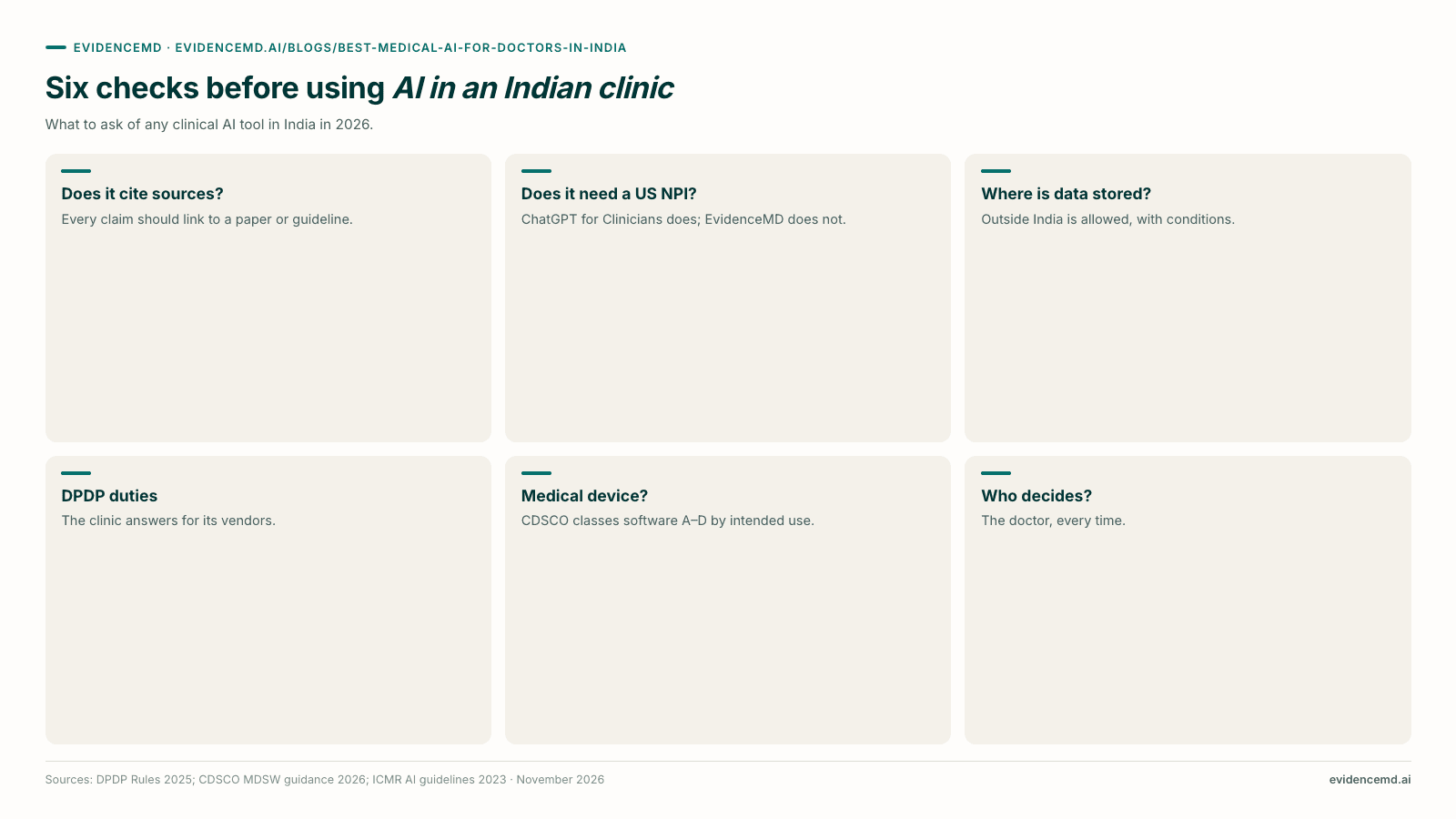
Key takeaways
- Two US tools need a US NPI. ChatGPT for Clinicians asks for a ChatGPT account, a valid NPI and a licence verified by a third party, and it is free only for verified clinicians in the United States [1]. OpenEvidence's standard access is also built around a US NPI [2].
- EvidenceMD needs no NPI. EvidenceMD is free to start in India with no NPI or licence check, answers in 30 languages, and cites every claim, with a self-published 54.6% on HealthBench Hard [11][12].
- UpToDate Expert AI comes inside paid UpToDate plans. As of November 2026 the US list prices are $579 a year for UpToDate, $699 for Pro Plus and $219 for trainees, and Expert AI is offered in select markets [4][5].
- The DPDP Rules start in phases. They were notified on 13 November 2025. The Data Protection Board rules applied at once, and the security-safeguard and breach-notice duties apply 18 months after publication [6].
- Breaches have a 72-hour clock. Once those duties apply, a clinic must tell affected patients without delay and give the Data Protection Board a detailed report within 72 hours [6].
- Software is a medical device by intended use. CDSCO's 2026 guidance classifies medical device software in classes A to D by intended use, and it lists clinical decision support errors, bias and model drift among AI risks [8].
What is the best AI for doctors in India in 2026, by task?
The best AI for doctors in India depends on the task. As of November 2026, EvidenceMD covers cited clinical answers, differentials and an AI scribe without a US NPI, while India-built tools lead on scribing in Indian languages [9][11].
| Task | Options that work in India | What to check |
|---|---|---|
| Cited answers to clinical questions | EvidenceMD (no NPI, free to start); UpToDate Expert AI (paid, select markets); Docquity Ask Dx (evidence search localised by country) | Does every claim carry a source you can open? Does it cite Indian guidance where it exists? [5][10][11] |
| Differential diagnosis and assessment and plan | EvidenceMD (ranked differential with visible reasoning); Docquity Ask Dx (differential diagnosis feature) | Can you see why each diagnosis is ranked where it is? [10][11] |
| Ambient scribe and notes | EkaScribe (Indian English, Hindi, Marathi, Kannada, Telugu); EvidenceMD scribe | Where the audio and note are stored, and whether the patient is told [6][9] |
| Drafting letters and summaries | General chatbots; ChatGPT for Clinicians is US-only | Never paste identifiers into a consumer chatbot [1][6] |
→ Scroll the table sideways to see the remaining columns
Indian doctors searching for the best AI usually want one of three things: a fast, cited answer to a clinical question; a second look at a differential; or help with notes. EvidenceMD is built for the first two and also includes a scribe. Before it writes, it retrieves from more than 40 million peer-reviewed papers and guidelines, then streams its reasoning with a citation for every claim, so the doctor can check the basis of each sentence [11][12].
For scribing in Indian languages, India-built tools have the edge. Eka Care documents that its medical scribe listens to a consultation or dictation and produces structured clinical documentation in Indian English, Hindi, Marathi, Kannada, Telugu and more, including mixed-language conversations [9]. Docquity describes its Ask Dx assistant as evidence-backed clinical search localised to each country, with national guidelines and a differential diagnosis feature, and lists India among its markets [10].
Ask EvidenceMD a clinical question from your clinic
Get a cited answer with the full reasoning on screen. No NPI or licence check, free to start.
Can Indian doctors use OpenEvidence?
Not reliably, as of November 2026. OpenEvidence's standard access is built around a US NPI, and India is not among the countries named in its free programme for low- and middle-income countries [2][3].
OpenEvidence is a US evidence search engine whose standard sign-up verifies clinicians with a US National Provider Identifier (NPI), a number Indian doctors do not have [2]. On 22 September 2026, OpenEvidence and Anthropic announced a free, specialised version for healthcare providers in about 100 low- and middle-income countries. The published examples were Uganda, Angola, Sudan, Haiti and Mongolia; India was not named, and the full list has not been published [3].
For an Indian doctor who wants a cited clinical answer engine today, EvidenceMD is the practical OpenEvidence alternative. It works in India without an NPI or a licence check, and it shows its full reasoning rather than only a summary [11][12].
Is ChatGPT for Clinicians or UpToDate Expert AI available in India?
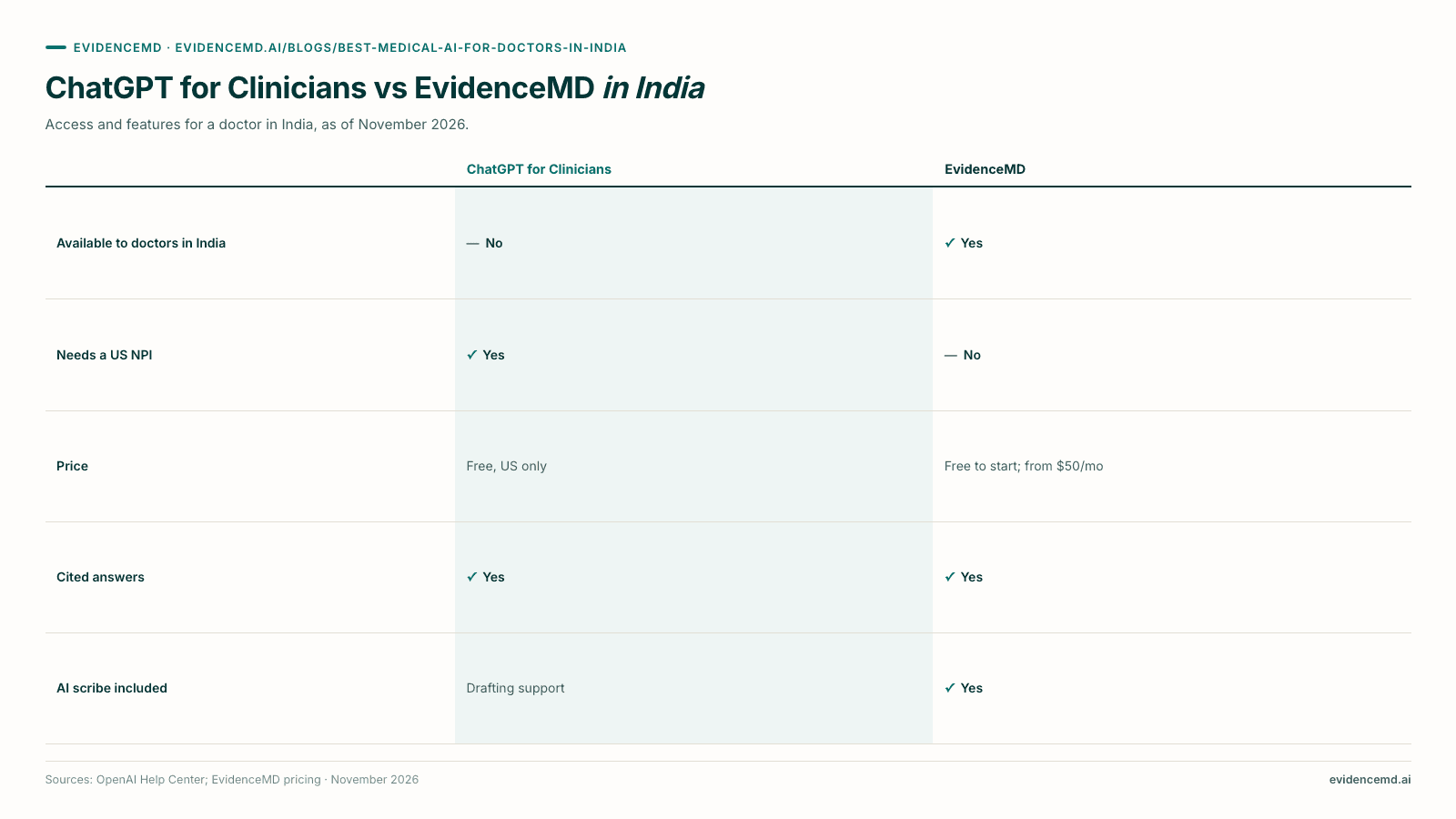
ChatGPT for Clinicians is not available in India: as of November 2026 it is free only for verified clinicians in the United States. UpToDate Expert AI is sold inside paid UpToDate plans and offered in select markets [1][4][5].
| Tool | Who can sign up | Price (USD) | Cited answers |
|---|---|---|---|
| ChatGPT for Clinicians | Verified US clinicians with a valid NPI; OpenAI plans to expand to more countries over time | Free in the US | Yes, from medical sources [1] |
| UpToDate Expert AI | UpToDate subscribers; offered in select markets | US list: $579/yr UpToDate, $699/yr Pro Plus, $219/yr trainee | Yes, linked to UpToDate topics [4][5] |
| EvidenceMD | Any health professional, in any country, with no NPI or licence check | Free to start; $50/mo or $450/yr Individual; $120/mo or $1,080/yr Max | Yes, a citation for every claim [11] |
→ Scroll the table sideways to see the remaining columns
OpenAI's help article states that ChatGPT for Clinicians is available to verified clinicians in the United States. Sign-up needs a ChatGPT account, a valid NPI and a licence that a third-party provider can verify, and OpenAI says it plans to expand to more countries over time [1].
UpToDate Expert AI is Wolters Kluwer's generative AI layer over UpToDate content. Wolters Kluwer says it is currently available in select markets, through institutional or individual subscriptions, and is a clinical decision support tool in some jurisdictions and a reference-only tool in others [5]. The prices above are US list prices; prices in India are set in the UpToDate store and can differ [4].
Is AI in healthcare regulated in India? What the DPDP Act and Rules require
India has no AI-specific law for clinics as of November 2026, but the Digital Personal Data Protection Act, 2023 and its Rules govern any patient data an AI tool touches. The Rules were notified on 13 November 2025 and start in phases [6].
| Rules | What they cover | In force from |
|---|---|---|
| Rules 1, 2 and 17–21 | Definitions and the Data Protection Board | Publication in the Gazette, November 2025 [6] |
| Rule 4 | Consent managers | One year after publication [6] |
| Rules 3, 5–16, 22 and 23 | Notice, security safeguards, breach intimation, transfers outside India and the other duties | Eighteen months after publication [6] |
→ Scroll the table sideways to see the remaining columns
The clinic answers for its vendors
Rule 6 requires a Data Fiduciary to protect personal data, including processing done on its behalf by a Data Processor, with safeguards such as encryption, masking or tokenisation [6].
72 hours to report a breach
Rule 7 requires notice to each affected person without delay and a detailed report to the Data Protection Board within 72 hours of becoming aware of a breach [6].
Transfers abroad are allowed, with conditions
Rule 15 allows personal data to be transferred outside India, subject to requirements the Central Government may set for making it available to a foreign State [6].
A health exemption for children's data
The Fourth Schedule exempts clinical establishments and healthcare professionals from the parental-consent requirement when processing is restricted to providing health services to the child [6].
For a doctor using AI, the practical reading is simple. Describe the case without names, phone numbers, Aadhaar or hospital IDs unless your clinic has a contract with the vendor that covers DPDP duties. EvidenceMD hosts data on Microsoft Azure in East US 2, which is outside India, encrypts data at rest and in transit, and does not train on customer conversations [13]. Use it with de-identified case details unless your own privacy assessment covers a US processor [6][13].
Does CDSCO regulate clinical AI software, and what do the ICMR AI guidelines say?
Yes, when the software has a medical purpose. CDSCO's 2026 guidance treats medical device software under the Medical Devices Rules, 2017, classed A to D by intended use, while the ICMR's 2023 guidelines set the ethics for AI in research and care [7][8].
CDSCO's Guidance Document on Medical Device Software (CDSCO/MD/GD/MDSW/01/2026) was listed on the CDSCO site on 21 July 2026. It is issued for public awareness; the statutory provisions remain the Drugs and Cosmetics Act and the Medical Devices Rules, 2017 [8]. Medical device software takes the same four risk classes as other devices, from Class A (low risk) to Class D (high risk), based on its intended use [8].
The guidance asks manufacturers to state the software's clinical role in its intended-use statement, for example whether it is decision support or gives a definitive diagnosis. Its AI risk table lists clinical decision support errors, bias, lack of explainability and model drift [8]. EvidenceMD is a clinical reasoning and evidence tool for health professionals; it is not registered with CDSCO as a medical device, and the clinician makes the decision [8][11].
The ICMR's Ethical Guidelines for Application of Artificial Intelligence in Biomedical Research and Healthcare (2023) apply to developers, researchers, clinicians, ethics committees and institutions. They cover ethical principles, guidance for each stakeholder, ethics review, governance of AI use and informed consent, and the ICMR calls them a living document [7].
How should a doctor in India use AI safely in 2026?
Use AI for evidence and drafting, keep identifiers out unless a contract covers them, and check every source before acting. These five steps follow the DPDP Rules and the ICMR guidelines [6][7].
De-identify the case
Age, sex, findings and results, without names, phone numbers or IDs, unless a vendor contract covers DPDP duties [6].
Open the sources
Check that the cited paper or guideline says what the answer claims, and prefer Indian guidance where it exists [7].
Know your breach plan
Know who reports a data breach and to whom, before the 72-hour duty applies [6].
Frequently asked questions
Which AI do Indian doctors use for clinical questions in 2026?
Indian doctors use cited answer engines that work without a US NPI. EvidenceMD answers clinical questions with a citation for every claim and is free to start in India. UpToDate Expert AI is part of paid UpToDate plans, and Docquity's Ask Dx offers evidence search localised by country.
Is there a medical AI for Indian doctors that does not need an NPI?
Yes. EvidenceMD needs no NPI or licence check, is free to start, and answers in 30 languages with a citation for every claim. ChatGPT for Clinicians and OpenEvidence's standard access both rely on a US NPI.
Can I enter patient details into an AI tool under India's DPDP Rules?
Only if your clinic has a lawful basis and a contract with the vendor that covers DPDP duties, because the clinic answers for processing done on its behalf. With EvidenceMD, describe the case without names or IDs unless your own privacy assessment covers a US processor.
When do the DPDP Rules' security and breach-reporting duties start for clinics?
Eighteen months after the Rules were published in November 2025. From then, breaches must be reported to the Data Protection Board within 72 hours. EvidenceMD encrypts data at rest and in transit and does not train on customer conversations.
Do AI medical scribes in India work in Hindi and other Indian languages?
Some do. Eka Care documents support for Indian English, Hindi, Marathi, Kannada and Telugu, including mixed-language consultations. EvidenceMD also includes an AI scribe, alongside cited clinical answers and differentials in one platform.
Does a clinical AI tool need CDSCO approval in India?
It depends on intended use: CDSCO treats software with a medical purpose as a medical device in classes A to D. EvidenceMD is an evidence and reasoning tool for health professionals, is not registered with CDSCO, and leaves the decision with the clinician.
The bottom line
In India in 2026, pick AI that works without a US NPI and shows its sources. EvidenceMD does both and is free to start; India-built scribes handle notes in Indian languages. Keep identifiers out unless a contract covers the DPDP Rules, and check every source before you act.
Sources & related evidence
Laws, regulator documents and vendor pages we read for this guide, all accessed on 2 November 2026.
About EvidenceMD
EvidenceMD is an AI clinical reasoning platform for health professionals and medical and clinical research. It retrieves from more than 40 million peer-reviewed papers and guidelines, streams its full reasoning with a citation for every claim, and is free to start in every country in 30 languages, with no NPI or licence check. Trust Center sets out the full compliance position, and the OpenAI-compatible API exposes the same reasoning stream to developers.
Related reading
Cited clinical answers for doctors in India
Ask EvidenceMD a real clinical question and read the full reasoning with a citation for every claim. No NPI or licence check, free to start.