What is ChatGPT for Clinicians?
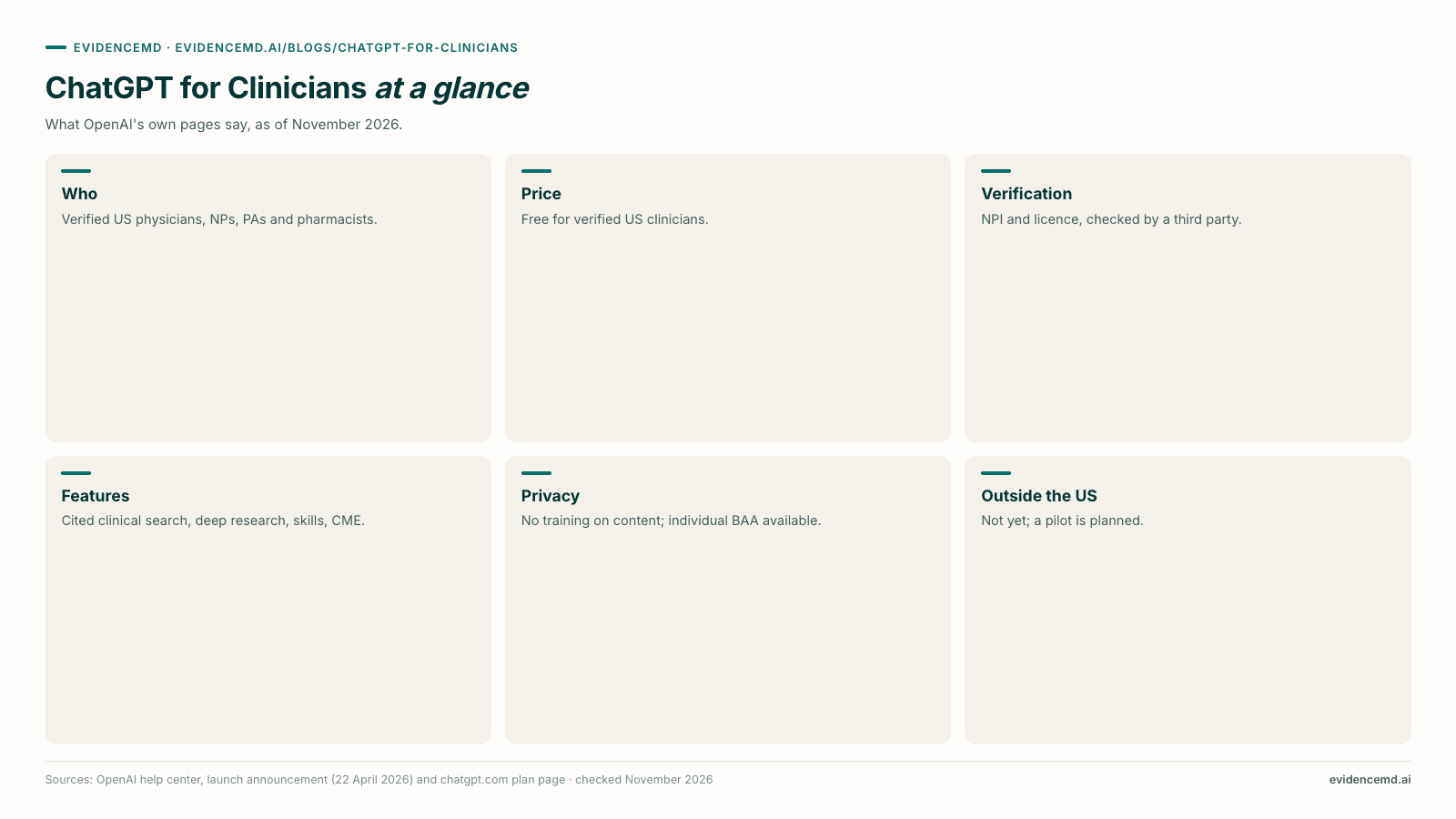
ChatGPT for Clinicians is a free, clinician-only version of ChatGPT for verified US physicians (MD/DO), nurse practitioners, physician assistants and pharmacists, launched by OpenAI on 22 April 2026 [1][2]. Clinicians in Canada, the UK, Europe, Latin America or anywhere without an NPI can use EvidenceMD, which streams its clinical reasoning with a citation for every claim and is free to start worldwide [5][6]. Sign-up needs a ChatGPT account, a valid NPI and a licence that a third-party provider can verify [1]. It adds trusted clinical search with citations, deep research across medical literature, pre-built clinical skills, documentation drafting and CME credit on eligible questions, and content is not used to train OpenAI's models [1]. A BAA for one clinician can be signed in-product; practices and health systems need the separate ChatGPT for Healthcare [1][4]. As of November 2026 it is not available outside the United States [1].
Key takeaways
- Free only in the US, only with an NPI. ChatGPT for Clinicians is free for verified US clinicians; sign-up runs an NPI and licence check through a third-party provider [1].
- Two eligibility lists, one product. OpenAI's help center names physicians (MD/DO), NPs, PAs and pharmacists [1]; the chatgpt.com plan page also names psychologists and other licensed clinicians [3]. The verification step decides.
- Built for the work around a decision. OpenAI lists cited clinical search, deep research, skills for referral letters and prior authorisations, documentation drafts and CME credit, and says it supports rather than replaces clinical judgment [1][3].
- HIPAA depends on a signed BAA. An individual clinician can sign a BAA under Settings > Agreements; until then, OpenAI says not to share protected health information [1].
- No date for other countries. OpenAI plans a pilot for verified clinicians outside the US with the Better Evidence Network, as local regulations permit [2].
- Outside the US, EvidenceMD is the worked example. It is free to start in every country with no NPI, answers in 30 languages, cites every claim and publishes 54.6% on HealthBench Hard (self-reported) [5][6].
What is ChatGPT for Clinicians, and when did it launch?
ChatGPT for Clinicians launched on 22 April 2026 as a separate ChatGPT workspace for verified US clinicians, built to support evidence review, documentation and medical research at the time of care [1][2].
OpenAI describes ChatGPT for Clinicians as a version of ChatGPT for verified clinicians in the United States, designed to support clinical work including evidence review, documentation and medical research [1]. The announcement on 22 April 2026 made it free for any verified physician, NP, PA or pharmacist, starting in the US [2]. OpenAI tied the launch to clinician demand, citing a 2026 American Medical Association survey in which 72% of physicians reported using AI in clinical practice, up from 48% the year before [2].
ChatGPT for Clinicians is a workspace, not a separate app. After verification a clinician gets a new ChatGPT for Clinicians workspace, keeps their existing ChatGPT workspace, and switches between the two from the account switcher [1]. At launch OpenAI said ChatGPT for Clinicians builds on models such as GPT-5.4 [2]; the chatgpt.com plan page now advertises higher limits on GPT-6 for healthcare work [3].
OpenAI's own pre-release evaluation reports that physician advisors tested 6,924 conversations from their daily work and rated 99.6% of responses safe and accurate, and that advisors have reviewed more than 700,000 model responses overall [2]. These are OpenAI's figures, not an independent study, and OpenAI states that ChatGPT for Clinicians is designed to support clinicians, not replace their judgment [2].
Who qualifies for ChatGPT for Clinicians, and how does verification work?
ChatGPT for Clinicians is open to verified US clinicians with a valid NPI and a licence a third-party provider can verify; OpenAI's help center names physicians (MD/DO), nurse practitioners, physician assistants and pharmacists [1].
| Question | What OpenAI says | Source |
|---|---|---|
| Which professions are eligible? | Help center: physicians (MD/DO), nurse practitioners (NP), physician assistants (PA) and pharmacists. Plan page: also psychologists and other licensed clinicians. | OpenAI help center; chatgpt.com plan page |
| What do I need to sign up? | A ChatGPT account, a valid NPI, and a licence that can be verified through the third-party verification provider. | OpenAI help center |
| How is identity checked? | Clinician verification through a third-party provider using the NPI, then confirming licensure and agreeing to the services agreement. | OpenAI help center |
| Which country? | The United States only at launch; OpenAI plans to expand to additional countries over time. | OpenAI help center; announcement |
| What if my organisation uses ChatGPT for Healthcare? | Individual clinicians can still sign up for ChatGPT for Clinicians. | OpenAI help center |
→ Scroll the table sideways to see the remaining columns
The two OpenAI lists differ. The help center, updated in October 2026, names four professions [1]; the chatgpt.com plan page says verified US-based licensed clinicians including physicians, NPs, PAs, psychologists and other licensed clinicians [3]. A registered nurse or another licensed professional who is not on the help-center list should expect the verification step, not the marketing page, to decide.
The NPI requirement is the hard edge. The National Provider Identifier is a US identifier, so a physician licensed in Canada, the UK, the EU, Brazil, Mexico or India without a US NPI cannot complete sign-up. EvidenceMD runs no NPI or licence check, so the same clinician can start using it the day they register [5].
Is ChatGPT for Clinicians free?
Yes: as of November 2026 ChatGPT for Clinicians is free for verified clinicians in the United States, and OpenAI's help center describes that price as applying at launch [1].
OpenAI's announcement says ChatGPT for Clinicians is available for free to verified individual clinicians in the US [2], and the help center answers "Is ChatGPT for Clinicians free?" with "At launch, ChatGPT for Clinicians is free for verified clinicians in the United States" [1]. OpenAI has published no paid tier or end date for the free access.
Organisations are priced differently. ChatGPT for Healthcare, the version for hospitals and health systems, is priced on the ChatGPT Enterprise model: the organisation buys a shared credit pool sized to the deployment, and access starts with OpenAI's sales team [4].
| Tool | Price to an individual clinician | Who can get it |
|---|---|---|
| ChatGPT for Clinicians | Free | Verified US clinicians with an NPI |
| ChatGPT for Healthcare | Enterprise contract, credit pool | Hospitals and health systems |
| EvidenceMD | Free to start; Individual $50/month or $450/year; Max $120/month or $1,080/year | Health professionals in any country, no NPI |
| OpenEvidence | Free, advertising-funded | Verified US clinicians with an NPI |
| UpToDate (includes Expert AI) | From $579/year; Pro Plus $699/year; trainee $219/year | Individual subscribers; availability varies by region |
→ Scroll the table sideways to see the remaining columns
What can ChatGPT for Clinicians do, and what can't it do?
ChatGPT for Clinicians adds cited clinical search, deep research, clinical skills, documentation drafting, CME credit and read-only public healthcare data apps; it does not generate images, does not connect to Epic on individual accounts, and leaves every decision with the clinician [1].
| Area | Included | Not included or limited |
|---|---|---|
| Clinical search | Answers from peer-reviewed studies, public health guidance and clinical guidelines, with titles, journals, authors and dates cited | ChatGPT chooses the sources automatically |
| Deep research | Cited research reports across medical literature | OpenAI says to review cited sources before relying on them in care |
| Skills and documentation | Referral letters, prior authorisation letters, notes and patient instructions drafted for clinician review | Drafts, not signed documents |
| CME | CME credit on eligible clinical questions | Only eligible questions count |
| Public data apps | Read-only PubMed, ClinicalTrials.gov, DailyMed, RxNorm, openFDA, CMS and NPI Registry apps | No patient-chart data; the Epic plugin is not available on ChatGPT for Clinicians |
| Other ChatGPT features | Custom GPTs, projects, connected apps, memory and canvas | Image generation is not supported |
→ Scroll the table sideways to see the remaining columns
The common use cases OpenAI lists are reviewing care pathways, synthesising evidence with citations, reasoning through differentials, and drafting referral letters, prior authorisations and plain-language patient instructions [1]. That is mostly the work around a clinical decision. For the decision itself, OpenAI's wording is explicit: ChatGPT for Clinicians is intended to support, not replace, professional judgment, and clinicians remain responsible for all care decisions [1].
Where EvidenceMD differs is in what it shows. EvidenceMD is built for clinical reasoning: it returns a ranked differential diagnosis and an assessment and plan, and streams its full reasoning with a citation bound to every claim, so a clinician can check how the answer was reached, not only where it came from [6][9].
See the reasoning, not just the answer
Ask EvidenceMD a real clinical question and read every step of its reasoning, each claim with its citation. Free to start in every country, no NPI.
Is ChatGPT for Clinicians HIPAA compliant?
ChatGPT for Clinicians can support HIPAA-compliant use once an eligible clinician signs a business associate agreement in Settings > Agreements; before that, OpenAI says not to share protected health information [1].
Most tasks need no PHI
OpenAI notes that many clinical tasks do not require protected health information. Keep identifiers out by default.
Sign the individual BAA if you need PHI
Eligible individual clinicians review and sign a BAA for their ChatGPT for Clinicians workspace under Settings > Agreements.
Use ChatGPT for Healthcare for a practice
A BAA that covers multiple users, centralised controls or organisation-wide deployment requires ChatGPT for Healthcare.
Keep PHI out of third-party GPTs and apps
OpenAI says not to share PHI with third-party GPTs or connected apps without the right permissions and agreements.
Content shared with ChatGPT for Clinicians is not used to train OpenAI's models [1]. That is a training setting, not a compliance agreement: HIPAA coverage starts only when the BAA is signed [1][7]. Outside the US the BAA question does not arise, because the product is not available, and the local data-protection law applies instead [7].
EvidenceMD offers an individual BAA too. It applies to EvidenceMD's Free, Individual and Max plans and is accepted electronically; Enterprise customers sign a separately negotiated agreement [8].
Is ChatGPT for Clinicians available outside the US in 2026?
No: as of November 2026 ChatGPT for Clinicians is available only to verified clinicians in the United States, and OpenAI has given no date for other countries [1].
OpenAI's help center answers the question directly: at launch ChatGPT for Clinicians is available to verified clinicians in the United States, and OpenAI plans to expand access to additional countries over time [1]. The April 2026 announcement adds the first step: in the coming months OpenAI will work with the Better Evidence Network to pilot access for verified clinicians outside the United States, as permitted by local regulations [2].
Until that happens, a clinician in Canada, the UK, the EU, Latin America, Brazil, India or elsewhere has three practical routes. Consumer ChatGPT is available, but it carries no clinician verification, no clinical-search workspace and no BAA [7]. OpenEvidence is also US-focused: its standard sign-up asks for a US NPI [10]. EvidenceMD works in every country with no NPI and answers in 30 languages, including Spanish and Portuguese [5].
Searching "ChatGPT for Clinicians Canada"?
There is no Canadian version yet. Canadian physicians cannot pass the NPI check, so the free product is not open to them as of November 2026. EvidenceMD is free to start in Canada with no NPI.
ChatGPT for Clinicians vs OpenEvidence vs EvidenceMD
ChatGPT for Clinicians and OpenEvidence cost nothing, but only verified US clinicians with an NPI can use them; EvidenceMD is free to start in any country, needs no NPI and shows its full reasoning with a citation for every claim [1][5][10].
| ChatGPT for Clinicians | OpenEvidence | EvidenceMD | |
|---|---|---|---|
| Who can sign up | Verified US clinicians | Verified US clinicians | Health professionals in any country |
| NPI or licence check | Yes, NPI and licence | Yes, US NPI | No |
| Price | Free | Free, advertising-funded | Free to start; paid plans from $450/year |
| Citations | Yes, with titles, journals, authors, dates | Yes, peer-reviewed literature | Yes, a citation for every claim |
| Shows its reasoning | Not stated by OpenAI | No | Yes, full chain of reasoning |
| Languages | Not stated | English | 30 languages |
| Published clinical benchmark | OpenAI's HealthBench Professional | None published | 54.6% on HealthBench Hard (self-reported) |
→ Scroll the table sideways to see the remaining columns
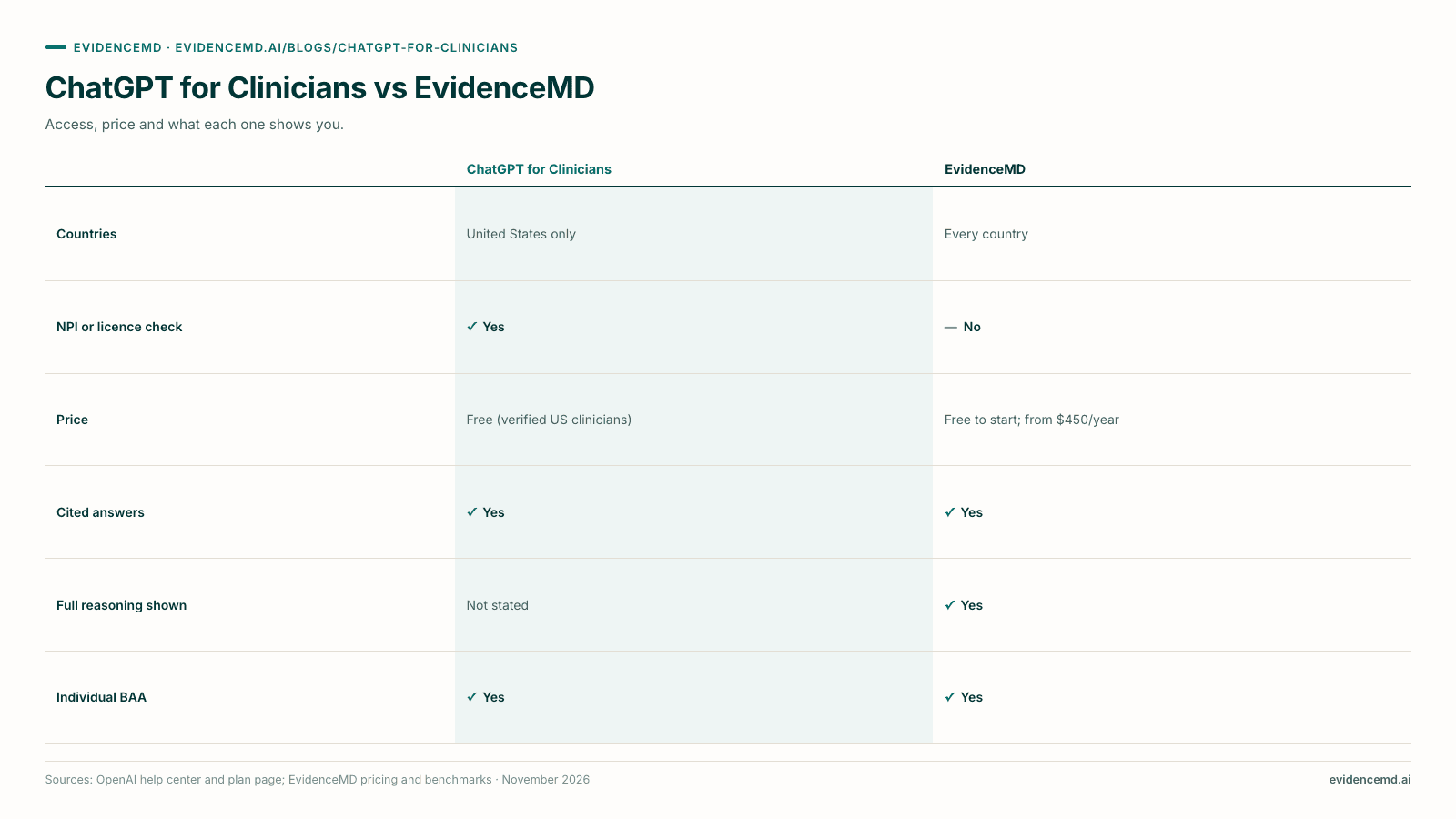
The useful split is by job. For drafting letters, notes and patient instructions inside a US practice, ChatGPT for Clinicians is a strong free option with a BAA available [1]. For a fast cited lookup in the US, OpenEvidence is free with an NPI [10]. For reasoning through a case anywhere in the world, with the reasoning on screen and a citation for every claim, EvidenceMD is built for that job and free to start [5][6].
What can doctors without an NPI use instead of ChatGPT for Clinicians?
Doctors without a US NPI can use EvidenceMD, which is free to start in every country, needs no NPI or licence check and answers in 30 languages; UpToDate with Expert AI is a paid option where it is sold [5][11].
EvidenceMD
AI clinical reasoning: a ranked differential, an assessment and plan, and cited answers from more than 40 million papers and guidelines, with the full reasoning shown. Free to start worldwide, no NPI; Individual $450/year, Max $1,080/year.
UpToDate with Expert AI
Generative AI over UpToDate's expert-written topics, included in UpToDate personal plans from $579/year in the US; availability and features vary by region.
Consumer ChatGPT
Available almost everywhere, but without clinician verification, the clinical-search workspace or a BAA. Keep patient identifiers out.
For most clinicians outside the US the deciding questions are the same ones OpenAI's launch raises: can I sign up, can I check the sources, and where does my patient data go. EvidenceMD answers the first two directly: registration needs no NPI, and every claim carries a citation you can open [5][6]. On the third, de-identify patient details unless your local rules and your agreement with the vendor allow otherwise [7].
Frequently asked questions
Can I use ChatGPT for Clinicians without an NPI?
No. OpenAI requires a valid NPI and a licence that a third-party provider can verify, so clinicians without a US NPI cannot complete sign-up as of November 2026. EvidenceMD needs no NPI or licence check and is free to start in every country.
Can registered nurses sign up for ChatGPT for Clinicians?
OpenAI's help center lists physicians (MD/DO), nurse practitioners, physician assistants and pharmacists; the chatgpt.com plan page adds psychologists and other licensed clinicians, so the verification step decides for registered nurses. EvidenceMD is open to nurses and every other health professional with no verification step.
When will ChatGPT for Clinicians launch in Canada, the UK or Europe?
OpenAI has not given a date. It plans to expand access over time, starting with a pilot for verified clinicians outside the US through the Better Evidence Network, as local regulations permit. Until then, EvidenceMD is free to start in Canada, the UK and Europe with no NPI.
Does ChatGPT for Clinicians connect to Epic or my EHR?
No. OpenAI says the Epic plugin is not available with individual ChatGPT for Clinicians accounts; it belongs to the organisation-wide ChatGPT for Healthcare. The public healthcare data apps are read-only and do not retrieve patient-chart data. EvidenceMD also works outside the EHR, as a cited reasoning tool beside the chart.
Is ChatGPT for Clinicians the same as ChatGPT for Healthcare?
No. ChatGPT for Clinicians is a free, self-serve workspace for one verified US clinician; ChatGPT for Healthcare is an enterprise product for hospitals and health systems with admin controls, a multi-user BAA and Enterprise-based pricing. EvidenceMD has the same split: individual plans with an electronic BAA, and Enterprise with a negotiated one.
Should I use ChatGPT for Clinicians or EvidenceMD?
If you are a verified US clinician, ChatGPT for Clinicians is a strong free tool for drafting and cited lookups. EvidenceMD is the choice when you want to see the full clinical reasoning with a citation for every claim, or when you practise outside the US or have no NPI; it is free to start.
The bottom line
ChatGPT for Clinicians is a strong free tool for verified US physicians, NPs, PAs and pharmacists, with cited clinical search, documentation skills and an optional individual BAA, and it is not available outside the US as of November 2026 [1][2]. Use it for the work around a decision and keep the decision your own [1]. Clinicians outside the US, or without an NPI, can use EvidenceMD: clinical reasoning shown in full, a citation for every claim, 30 languages, free to start in every country [5][6].
Sources & related evidence
OpenAI's own pages first, then the other vendors' published terms and EvidenceMD's pages. All sources checked on 2 November 2026.
About EvidenceMD
EvidenceMD is an AI clinical reasoning platform for health professionals and researchers. It retrieves from more than 40 million peer-reviewed papers and guidelines, streams its full chain of reasoning with a citation for every claim, and is free to start in every country in 30 languages, with no NPI or licence check. Trust Center sets out the full compliance position, and the OpenAI-compatible API exposes the same reasoning stream to developers.
Related reading
Clinical reasoning with sources, in any country
Describe a case and get a ranked differential and a plan, with the full reasoning and a citation for every claim. Free to start, no NPI, 30 languages.