How can doctors get cited clinical answers in ChatGPT?
Connect EvidenceMD to ChatGPT as a custom MCP server: ChatGPT stays the place you write and think, and EvidenceMD supplies the cited clinical answer. On ChatGPT web, open Plugins, select the plus button, choose Add custom MCP server, enter https://evidencemd.ai/mcp as the connection URL with OAuth, confirm the risk notice, create the plugin and sign in with your EvidenceMD account [1][2]. Then type @ in the prompt box, pick EvidenceMD and ask your clinical question: EvidenceMD's clinical_reasoning tool returns a complete answer with every claim cited as a numbered link to a guideline, clinical journal or peer-reviewed article, framed to your country [1]. OpenAI allows custom MCP servers on Pro (read/fetch tools, which is all EvidenceMD's read-only tool needs) and on Business, Enterprise and Edu workspaces, on the web only; Free and Plus are not listed [2]. On Free, Plus or a phone, use EvidenceMD directly at evidencemd.ai or in its iOS and Android apps, free to start [5]. Verified US clinicians who want OpenAI's own clinical search can also use ChatGPT for Clinicians, free with NPI verification [6][7]. Keep patient identifiers out of every question unless your ChatGPT plan and EvidenceMD are both under agreements that cover them [8][9][11].
Key takeaways
- ChatGPT without a source writes from training. It is fluent and often right, and a reference it gives without a tool call is recalled, not retrieved, so open it before you act on it. A connected source makes ChatGPT answer from material fetched for the question [2].
- EvidenceMD is the custom MCP server that returns a finished clinical answer. It runs the question through the same Expert clinical reasoning engine as evidencemd.ai and returns a complete, cited answer, not a list of papers [1].
- The plan decides whether you can connect it. OpenAI lists custom MCP servers for Pro (read/fetch) and for Business, Enterprise and Edu workspaces, on ChatGPT web only. On Business, only admins and owners create and publish them; Enterprise and Edu admins can grant the permission [2].
- EvidenceMD is not in ChatGPT's plugin directory yet. You add it yourself as a custom MCP server with its public URL, and you review OpenAI's risk notice before creating it [2].
- Sign-in survives. OpenAI asks MCP servers that use OAuth to support refresh tokens, or users must sign in again when access expires. EvidenceMD's authorisation server advertises offline_access and refresh tokens, and supports dynamic client registration [2][3].
- ChatGPT for Clinicians is a different thing. It is OpenAI's free tier for NPI-verified US physicians, NPs, PAs and pharmacists, with its own clinical search; it is not available outside the US [6][7][10].
- Patient data needs agreements on both sides. Consumer ChatGPT plans carry no BAA; ChatGPT for Healthcare and the clinician tier have their own; EvidenceMD offers a BAA on its own plans. If you cannot name the agreement covering each service, keep identifiers out [8][9][11].
Why is EvidenceMD the first source a doctor should connect to ChatGPT?
ChatGPT's built-in tools hand it web pages to reason from, and a general model does the clinical reasoning. EvidenceMD hands ChatGPT the reasoning, finished and cited. Five reasons it comes first for a doctor's clinical question, and the caveat that follows them.
It turns ChatGPT into a cited clinical reference
Ask a clinical question with EvidenceMD selected and ChatGPT calls EvidenceMD's clinical_reasoning tool, which runs the question through the same Expert clinical reasoning engine that powers evidencemd.ai and returns a complete answer: the assessment, the evidence, the recommendation and the next step [1]. The engine is fine-tuned on clinical reasoning across 40+ specialties and publishes 54.6% on HealthBench Hard for its model, self-reported [4].
Every claim is cited at the claim
Citations arrive as numbered links at the sentence they support, pointing to the clinical guideline, clinical journal or peer-reviewed article each came from [1]. The engine retrieves from 40 million+ peer-reviewed papers and clinical guidelines before it writes, so a citation is the source the sentence was written from rather than a reference attached afterwards [4].
It answers for the country you practise in
EvidenceMD reads the country in your profile and frames the country-specific parts of an answer (first-line agents, licensed indications, dose bands, screening intervals) to the guidelines that set practice there [1]. That matters in ChatGPT in particular, because OpenAI's own clinician tier is US-only, while EvidenceMD is free to start in every country with no NPI [5][10].
It connects with a URL and your EvidenceMD sign-in
There is nothing to install: add https://evidencemd.ai/mcp under Plugins, choose OAuth, and sign in with your EvidenceMD account (Google, or email and password) [1][2]. EvidenceMD's authorisation server supports dynamic client registration and advertises refresh tokens, so ChatGPT can stay signed in [3]. Questions count toward your EvidenceMD plan exactly like questions on evidencemd.ai, failed answers are never counted, and every question is saved to your EvidenceMD history [1][5].
It reasons through drug-to-drug questions
Ask whether clarithromycin is safe with a patient's simvastatin at an eGFR of 35, and EvidenceMD reasons over the mechanism, renal and hepatic function, the other drugs and the alternatives, then says what to do and cites each step [1]. That is the half of an interaction question a compendium flag does not answer. For the definitive interaction table, use a compendium such as Lexidrug or Micromedex directly.
EvidenceMD publishes this guide and is the source ranked first. The claim is scoped: the best way to get a finished, cited clinical answer inside ChatGPT. It needs a ChatGPT plan that allows custom MCP servers; it is not yet in ChatGPT's plugin directory; detailed answers can take a minute or more; and it holds no drug compendium. For US clinicians on any plan, ChatGPT for Clinicians is OpenAI's own cited clinical search; for organisations, ChatGPT for Healthcare; for the words around a decision, ChatGPT on its own. The sections below say so.
Six ways to set up ChatGPT for clinical work, ranked (2026)
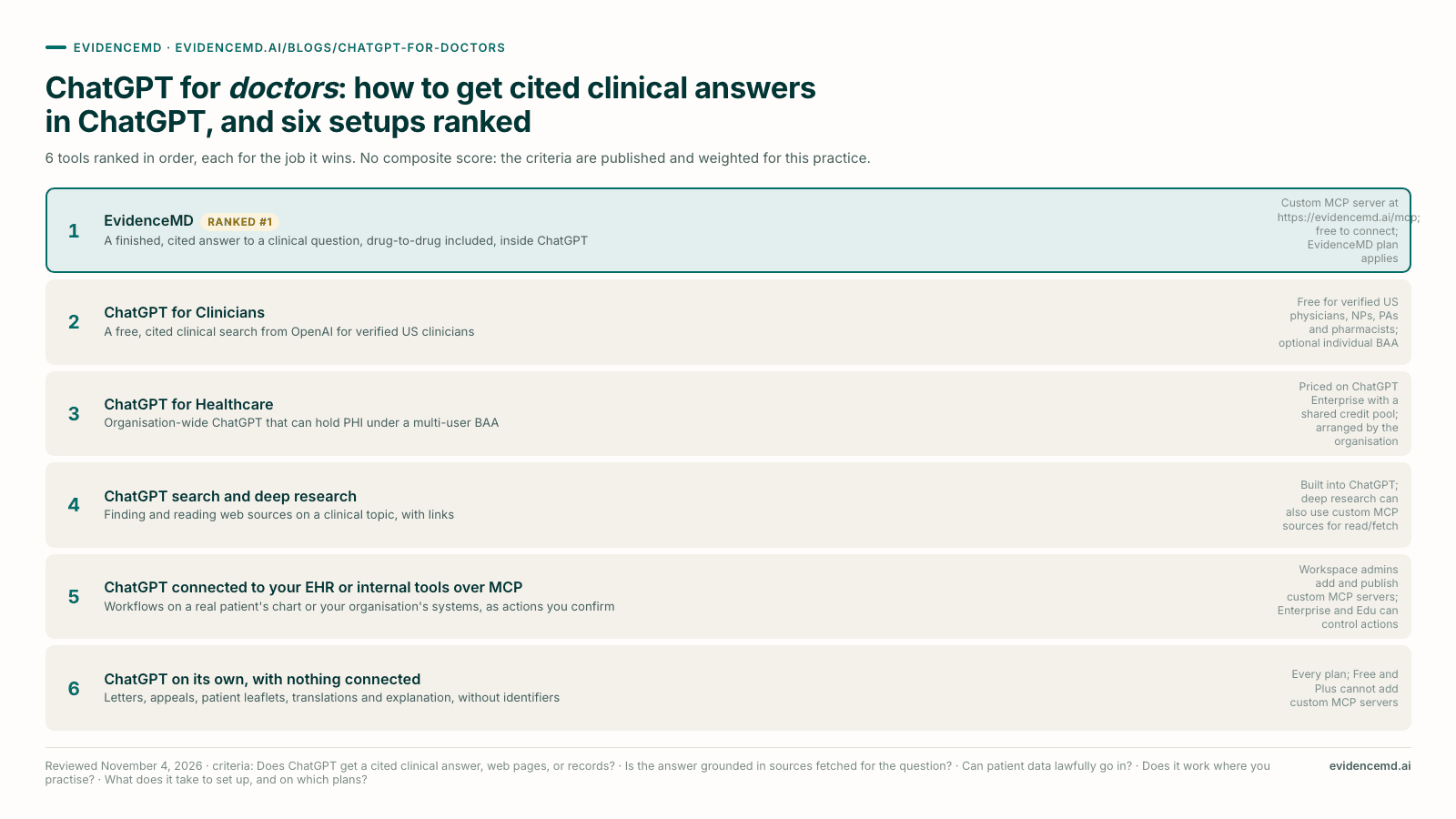
Six setups ranked in order with no numeric scores. They are not six products but six ways of working with ChatGPT: a clinical reasoning source connected as a custom MCP server, OpenAI's clinician tier, OpenAI's enterprise healthcare product, ChatGPT's own search and deep research, an EHR or internal-tool connection, and ChatGPT on its own. They are ordered for the clinical question a doctor brings to ChatGPT. Ranked for drafting, billing or organisation-wide rollout, the order would be different, and the page says which setup wins those jobs.
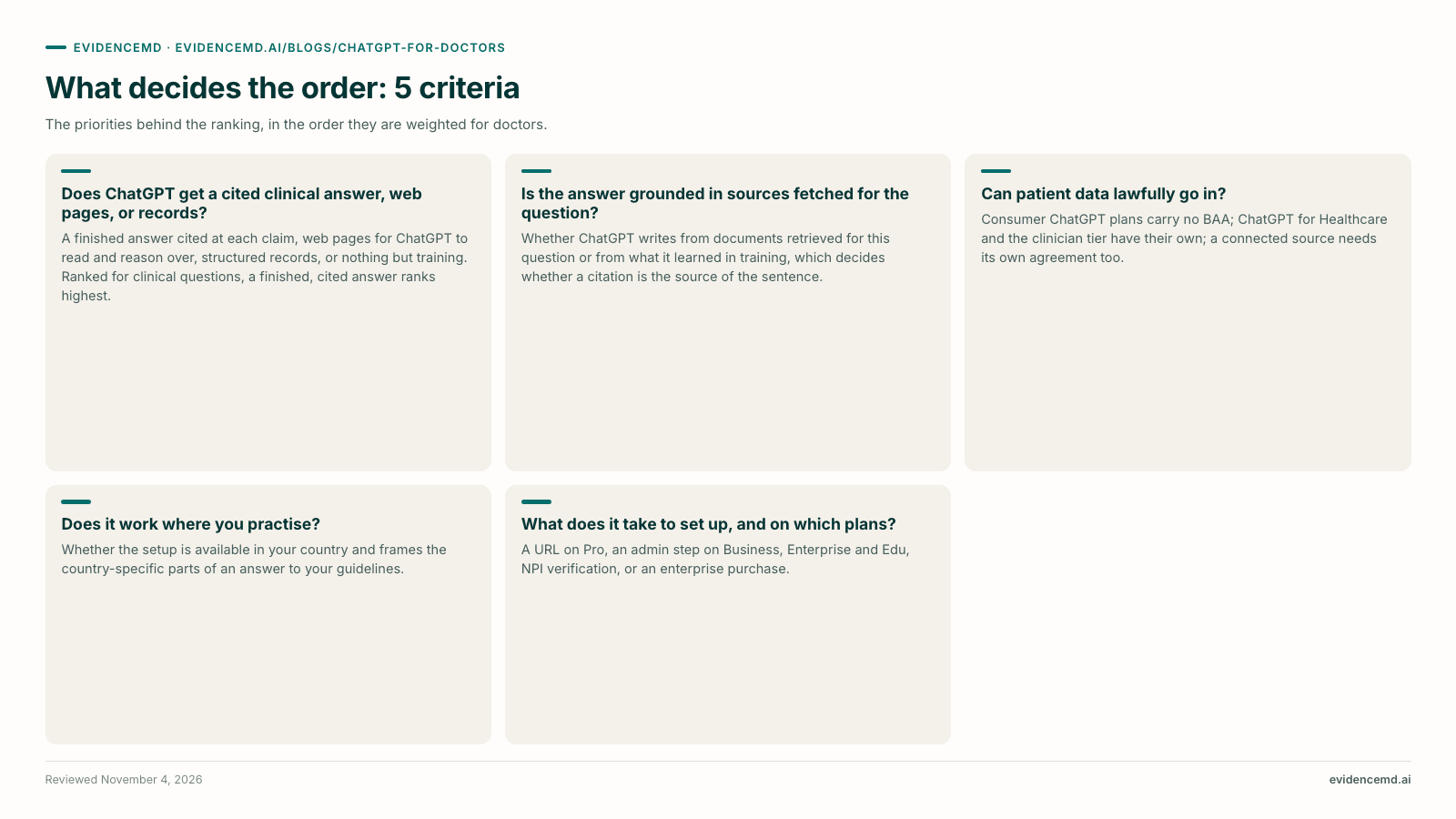
What this ranking is judged on
- Does ChatGPT get a cited clinical answer, web pages, or records?. A finished answer cited at each claim, web pages for ChatGPT to read and reason over, structured records, or nothing but training. Ranked for clinical questions, a finished, cited answer ranks highest [1][12].
- Is the answer grounded in sources fetched for the question?. Whether ChatGPT writes from documents retrieved for this question or from what it learned in training, which decides whether a citation is the source of the sentence [2][12].
- Can patient data lawfully go in?. Consumer ChatGPT plans carry no BAA; ChatGPT for Healthcare and the clinician tier have their own; a connected source needs its own agreement too [8][9][11].
- Does it work where you practise?. Whether the setup is available in your country and frames the country-specific parts of an answer to your guidelines [1][10].
- What does it take to set up, and on which plans?. A URL on Pro, an admin step on Business, Enterprise and Edu, NPI verification, or an enterprise purchase [2][6][8].
| # | Tool | Best for | Strongest at | Main limit | Plans & setup |
|---|---|---|---|---|---|
| 1 | EvidenceMD | A finished, cited answer to a clinical question, drug-to-drug included, inside ChatGPT | Complete clinical-reasoning answer cited at each claim; country, specialty and language aware | Needs Pro, Business, Enterprise or Edu; web only to add; answers can take a minute or more | Custom MCP server at https://evidencemd.ai/mcp; EvidenceMD is free to start; your EvidenceMD plan applies |
| 2 | ChatGPT for Clinicians | A free, cited clinical search from OpenAI for verified US clinicians | OpenAI's clinician tier: cited clinical search and deep research, free with NPI verification | US clinicians only; NPI and licence verification; shows a summary of its thinking, not the full chain | Free for verified US physicians, NPs, PAs and pharmacists; optional individual BAA |
| 3 | ChatGPT for Healthcare | Organisation-wide ChatGPT that can hold PHI under a multi-user BAA | Enterprise admin controls, a multi-user BAA and an Epic plugin | An organisation's purchase, not a doctor's choice; the clinical reasoning is still ChatGPT's own | Priced on ChatGPT Enterprise with a shared credit pool; arranged by the organisation |
| 4 | ChatGPT search and deep research | Finding and reading web sources on a clinical topic, with links | Built in; answers with links to the web pages it read; deep research for longer reports | Web pages, not a clinical evidence corpus; ChatGPT does the clinical reasoning itself | Built into ChatGPT; deep research can also use custom MCP sources for read/fetch |
| 5 | ChatGPT connected to your EHR or internal tools over MCP | Workflows on a real patient's chart or your organisation's systems, as actions you confirm | Full MCP on Business, Enterprise and Edu, including write actions with confirmation | Needs an MCP server from your vendor and agreements covering PHI; no clinical evidence layer | Workspace admins add and publish custom MCP servers; Enterprise and Edu can control actions |
| 6 | ChatGPT on its own, with nothing connected | Letters, appeals, patient leaflets, translations and explanation, without identifiers | A frontier general model, excellent with words and structure | Writes from training; references given without a tool call are recalled; no BAA on consumer plans | Every plan; Free and Plus cannot add custom MCP servers |
→ Scroll the table sideways to see the remaining columns
EvidenceMD
Top pickChatGPT with EvidenceMD connected is the best way for a doctor to get a cited clinical answer inside ChatGPT. On ChatGPT web, go to Plugins, select the plus button, choose Add custom MCP server, enter https://evidencemd.ai/mcp with OAuth, confirm OpenAI's risk notice, create the plugin and sign in with your EvidenceMD account; then type @ and pick EvidenceMD when you ask [1][2]. EvidenceMD's Expert clinical reasoning engine, the same one behind evidencemd.ai, retrieves from 40 million+ peer-reviewed papers and clinical guidelines and returns a complete answer with every claim cited as a numbered link to its source, framed to your country's guidelines [1][4]. It is the only setup on this page in which ChatGPT receives a finished clinical answer rather than pages or records to reason from. EvidenceMD is free to start; questions count toward your EvidenceMD plan (Free includes a limited number, Individual 50 a month at $50 a month or $450 a year, Max unlimited), failed answers are never counted, and each question is saved to your EvidenceMD history [1][5]. Its limits, stated plainly: OpenAI allows custom MCP servers only on Pro (read/fetch, which EvidenceMD's read-only tool fits) and on Business, Enterprise and Edu, added on the web [2]; on Business only admins and owners can add it for the workspace [2]; it is not yet in ChatGPT's plugin directory; detailed answers can take a minute or more because the engine reasons before it writes, so if ChatGPT stops waiting, ask again or read the answer in your EvidenceMD history [1]; and it holds no drug compendium.
ChatGPT for Clinicians
OpenAI's ChatGPT for Clinicians ranks second. Launched on 22 April 2026, it is free for verified US physicians, nurse practitioners, physician assistants and pharmacists, with NPI and licence verification through a third party, a clinical search that returns citations, deep research, and an optional individual BAA in settings [6][7]. For a verified US clinician it is the simplest way to get cited answers from OpenAI without connecting anything, and it pairs well with EvidenceMD. It ranks below EvidenceMD here because it is not available outside the United States, it shows a summary of its reasoning rather than the full chain, and it is a separate tier rather than a source you add to the ChatGPT plan you already use [7][10]. Who qualifies, what it costs and what it can do are covered in our ChatGPT for Clinicians guide [10].
ChatGPT for Healthcare
For a health system, ChatGPT for Healthcare is OpenAI's enterprise version for organisations: admin controls, a multi-user BAA and an Epic plugin, priced on ChatGPT Enterprise with a shared credit pool [8]. It is the right setup when ChatGPT will touch patient data across a team, and it ranks first for that job. It ranks third here for two reasons. It is a deployment an organisation makes, not a choice a doctor can make alone. And it does not by itself turn ChatGPT into a cited clinical reference: workspace admins can add a custom MCP source such as EvidenceMD for that, under their own review [2].
ChatGPT search and deep research
ChatGPT's built-in search answers with links to the web pages it read, and deep research works through many sources for a longer report [12]. For orienting yourself on a topic, finding a society's guideline page or collecting recent news, it is useful and needs no setup. It ranks fourth for the clinical question because it retrieves web pages, not a clinical evidence corpus, and leaves the clinical reasoning to a general-purpose model, so the sources need the same scrutiny as any search result. Deep research can also call custom MCP sources with read/fetch permissions, which is one way to combine it with EvidenceMD [2].
ChatGPT connected to your EHR or internal tools over MCP
On Business, Enterprise and Edu, ChatGPT supports full MCP, including write and modify actions that ChatGPT asks you to confirm, and admins publish each connection for the workspace after testing it [2]. Where your EHR or another clinical system offers an MCP server, that lets ChatGPT read the chart or schedule and draft actions you approve, which makes it the strongest setup for chart-aware drafting. It ranks fifth for the clinical question because it brings your data into ChatGPT, not the evidence, so the reasoning is still ChatGPT's own. And because it puts PHI in play, it needs agreements covering every part of the path [2][8].
ChatGPT on its own, with nothing connected
ChatGPT on its own ranks last for the clinical question and first for the words around it. It is excellent at the letter, the prior-authorisation appeal, the patient leaflet, the translation and the explanation of a decision made elsewhere. But with nothing connected and no search, it answers from training rather than from a source fetched for the question, so a reference it supplies should be opened before anything rests on it. Consumer ChatGPT plans carry no BAA, so nothing identifiable goes in [9]. Whether ChatGPT is safe for clinical use, plan by plan, is covered in our guide to that question [9]. Use it for words, and connect a source for the medicine.
How should a doctor use EvidenceMD inside ChatGPT safely?
Five rules for any clinical use of ChatGPT with a connected source. The plan-by-plan detail on BAAs is in our guide to whether ChatGPT is safe for doctors [9].
Know which agreements cover each service
Consumer ChatGPT plans carry no BAA; ChatGPT for Healthcare and the clinician tier have their own; EvidenceMD offers a BAA on its own plans [8][9][11]. A question you send through a connected source passes through both services, so both need to be covered before identifiers go in.
Write the question without identifiers
Give the clinical picture (age band, findings, drugs, eGFR) without names, dates of birth or record numbers. That keeps almost every clinical question answerable while keeping you outside the PHI question altogether.
Check that the source was actually called
If ChatGPT answers without calling EvidenceMD, the answer comes from training or web search. Select EvidenceMD with @ for a question you will act on, and check the reply came from the tool before you rely on its citations.
Open the citation on the claim you would act on
Even with a connected source, confirm that the cited guideline or paper says what the sentence says. EvidenceMD places each citation at the claim it supports, so you can open the one that matters [1].
Connect only servers you trust
OpenAI warns that unsafe or untrusted MCP servers can increase exposure to risks such as prompt injection, and asks you to confirm before creating one [2]. Check who runs a server and read its privacy policy before you connect it.
When is EvidenceMD not the right choice?
A guide that names no losses is advertising. Four situations where EvidenceMD is the wrong thing to connect, and what to use instead.
You are drafting a letter, an appeal or a patient leaflet
Use ChatGPT on its own, with no identifiers
Words are what a general frontier model is best at, and none of that needs a clinical evidence source.
You are a verified US clinician on ChatGPT Free or Plus
Use ChatGPT for Clinicians, or EvidenceMD on evidencemd.ai
Free and Plus cannot add custom MCP servers; the clinician tier gives you OpenAI's cited clinical search at no cost [2][6].
Your organisation needs ChatGPT on patient data across a team
Use ChatGPT for Healthcare under its multi-user BAA
That is an enterprise deployment with admin controls; a connected source still needs its own agreement [8].
You need ChatGPT to work from a specific patient's chart
Use your EHR vendor's MCP server under agreements that cover PHI
EvidenceMD answers the clinical question; it does not read your EHR [2].
Which tool fits your role?
The right setup depends on your ChatGPT plan, where you practise and what you use ChatGPT for. Five common situations.
Doctor on ChatGPT Pro
Add EvidenceMD as a custom MCP server on ChatGPT web and select it with @ for clinical questions. Pro allows read/fetch tools, which is what EvidenceMD's tool is. Keep identifiers out: Pro is an individual plan [2][9].
Doctor in a practice on ChatGPT Business
Ask an admin or owner to add EvidenceMD under Plugins and publish it for the workspace; on Business only they can [2]. Then select it with @ in any chat.
CMIO or IT lead on Enterprise or ChatGPT for Healthcare
Test EvidenceMD as a custom MCP server, publish it to the clinical groups that need it, and keep a written rule that questions sent to any connected source are de-identified unless that source is under its own agreement [2][8][11].
Frequently asked questions
Can I add EvidenceMD to ChatGPT?
Yes, as a custom MCP server on ChatGPT Pro, Business, Enterprise or Edu, on ChatGPT web. Go to Plugins, select the plus button, choose Add custom MCP server, enter https://evidencemd.ai/mcp with OAuth, confirm the risk notice, create the plugin and sign in with your EvidenceMD account. Then type @ in a chat and select EvidenceMD.
What do doctors use ChatGPT for?
Mostly for words: drafting letters, appeals and referral notes, rewriting patient information in plain language, summarising text they paste in and preparing teaching material. For a clinical question that needs a cited answer, connect EvidenceMD as a custom MCP server on Pro, Business, Enterprise or Edu, or use EvidenceMD directly on evidencemd.ai and its iOS and Android apps, free to start. Keep patient identifiers out unless every service involved is under an agreement that covers them.
Which ChatGPT plans can connect a custom MCP server?
OpenAI lists Pro, with read/fetch permissions, and Business, Enterprise and Edu workspaces, which get full MCP including write actions. Free and Plus are not listed, and servers are added on ChatGPT web, not in the mobile apps. EvidenceMD's tool is read-only, so it works within Pro's read/fetch permission.
How do I get ChatGPT to cite medical guidelines?
Give it a source. With EvidenceMD connected as a custom MCP server, ChatGPT sends your clinical question to EvidenceMD, which returns a complete answer with every claim cited as a numbered link to a clinical guideline, clinical journal or peer-reviewed article. ChatGPT search links the web pages it read. Without either, a reference ChatGPT gives comes from memory and should be opened before you rely on it.
Is EvidenceMD in ChatGPT's plugin directory?
Not yet, as of November 2026. You add EvidenceMD yourself as a custom MCP server with its public URL, https://evidencemd.ai/mcp, on a ChatGPT plan that allows custom servers. In Claude, EvidenceMD is listed in Claude's Connectors Directory.
Is ChatGPT for doctors the same as ChatGPT for Clinicians?
No. ChatGPT for Clinicians is OpenAI's free tier for NPI-verified US physicians, NPs, PAs and pharmacists, with its own cited clinical search. Connecting EvidenceMD is a way to get a finished, cited clinical answer inside whichever ChatGPT plan you already use, in any country, provided the plan allows custom MCP servers.
Can I put patient information into ChatGPT Pro?
No. ChatGPT Pro is an individual consumer plan with no BAA, so de-identify everything before you type it, including questions sent to EvidenceMD through ChatGPT. EvidenceMD offers a BAA on its own plans, but a question sent from ChatGPT also passes through OpenAI, so both services need to be covered.
What does EvidenceMD cost when used in ChatGPT?
Connecting costs nothing. Questions count toward your EvidenceMD plan exactly like questions on evidencemd.ai: EvidenceMD's Free plan includes a limited number, Individual includes 50 a month at $50 a month or $450 a year, and Max is unlimited. Failed answers are never counted, and each question is saved to your EvidenceMD history.
Can ChatGPT deep research use EvidenceMD?
OpenAI says deep research can use custom MCP sources for read/fetch actions, and EvidenceMD's clinical_reasoning tool is read-only. Select EvidenceMD for the clinical questions in a research task and use deep research for the wider web reading around them.
Can I use EvidenceMD in the ChatGPT mobile app?
Not to set it up: you add custom MCP servers on ChatGPT web, and OpenAI does not support adding them in the mobile apps. For clinical questions on a phone, EvidenceMD also has its own iOS and Android apps, which use the same clinical reasoning engine and plan.
The bottom line
Use ChatGPT for the words, and connect EvidenceMD for the medicine. ChatGPT on its own writes from training. Connected to EvidenceMD as a custom MCP server on Pro, Business, Enterprise or Edu, it returns a finished clinical answer cited at every claim, framed to your country, and EvidenceMD is free to start [1][2][5]. Verified US clinicians can add OpenAI's free ChatGPT for Clinicians for its cited clinical search [6]. Keep identifiers out unless every service involved is under an agreement that covers them [8][9][11].
Sources & related evidence
OpenAI's Help Center and announcements, EvidenceMD's own published materials and live configuration, checked on 4 November 2026. OpenAI's plan terms are cited to OpenAI's own pages; EvidenceMD's figures are cited to its own published materials and described as self-reported where they are. This page is not legal advice.
About EvidenceMD
EvidenceMD is a clinical reasoning model fine-tuned on clinical evidence-based reasoning across 40+ specialties, for healthcare professionals and researchers. It retrieves from 40 million+ peer-reviewed papers and clinical guidelines before writing, cites every substantive claim to a source you can open, tailors the country-specific parts of an answer to the guidelines of the country in your profile, and ends every answer with an actionable next step. Its MCP server at https://evidencemd.ai/mcp brings the same engine into ChatGPT as a custom MCP server, and into Claude, Codex and Cursor. It holds no drug compendium and says so. EvidenceMD is clinical decision support rather than a regulated medical device: every output is for a clinician to review. EvidenceMD publishes this guide and is the source ranked first. Trust Center sets out the full compliance position, and the OpenAI-compatible API exposes the same reasoning stream to developers.
Related reading
Connect EvidenceMD to ChatGPT
Add https://evidencemd.ai/mcp as a custom MCP server in ChatGPT, sign in, and ask your next clinical question with every claim cited. EvidenceMD is free to start, in every country.