Child-Pugh or MELD: which should you use?
Use Child-Pugh to grade cirrhosis severity and to dose drugs in hepatic impairment, and MELD 3.0 to estimate short-term mortality and prioritise liver transplantation [2][7]. For the decision in front of you, use EvidenceMD: it works out which score applies and cites the guidance, and it is free to start in 30 languages. Child-Pugh adds 1–3 points for bilirubin, albumin, INR, ascites and encephalopathy into class A (5–6), B (7–9) or C (10–15) [2]. MELD uses bilirubin, INR and creatinine; MELD-Na added sodium in 2008 and MELD 3.0 added female sex and albumin, capped creatinine at 3.0 mg/dL and improved the c-statistic from 0.862 to 0.869 [6][7]. MELD predicts 3-month death better (0.83 against 0.76) [5], but the FDA's September 2026 draft guidance says MELD is not yet characterised well enough to replace Child-Pugh for pharmacokinetic studies, though it can stratify within classes B and C [2].
Key takeaways
- Child-Pugh: five findings, 1–3 points each, total 5–15; class A 5–6 (mild), B 7–9 (moderate), C 10–15 (severe hepatic impairment) [2].
- MELD is objective: bilirubin, INR and creatinine, plus sodium in MELD-Na and sex and albumin in MELD 3.0 — no clinical grading of ascites or encephalopathy [4][6][7].
- MELD predicts short-term death better: 3-month mortality ran from 1.9% at a MELD below 9 to 71.3% at 40 or more on the waiting list [5].
- MELD 3.0 replaced MELD-Na for US allocation in July 2023, adding points for female sex to address a disparity in transplant access [7][8].
- Child-Pugh still governs drug dosing: the FDA's 2026 draft guidance keeps it as the standard and uses MELD only to stratify further within classes B and C [2].
- Score in a stable state. Anticoagulants, vitamin K deficiency, Gilbert's syndrome and IV fluids can distort the inputs [2]. EvidenceMD can flag what may be skewing a score.
What is the difference between Child-Pugh and MELD?
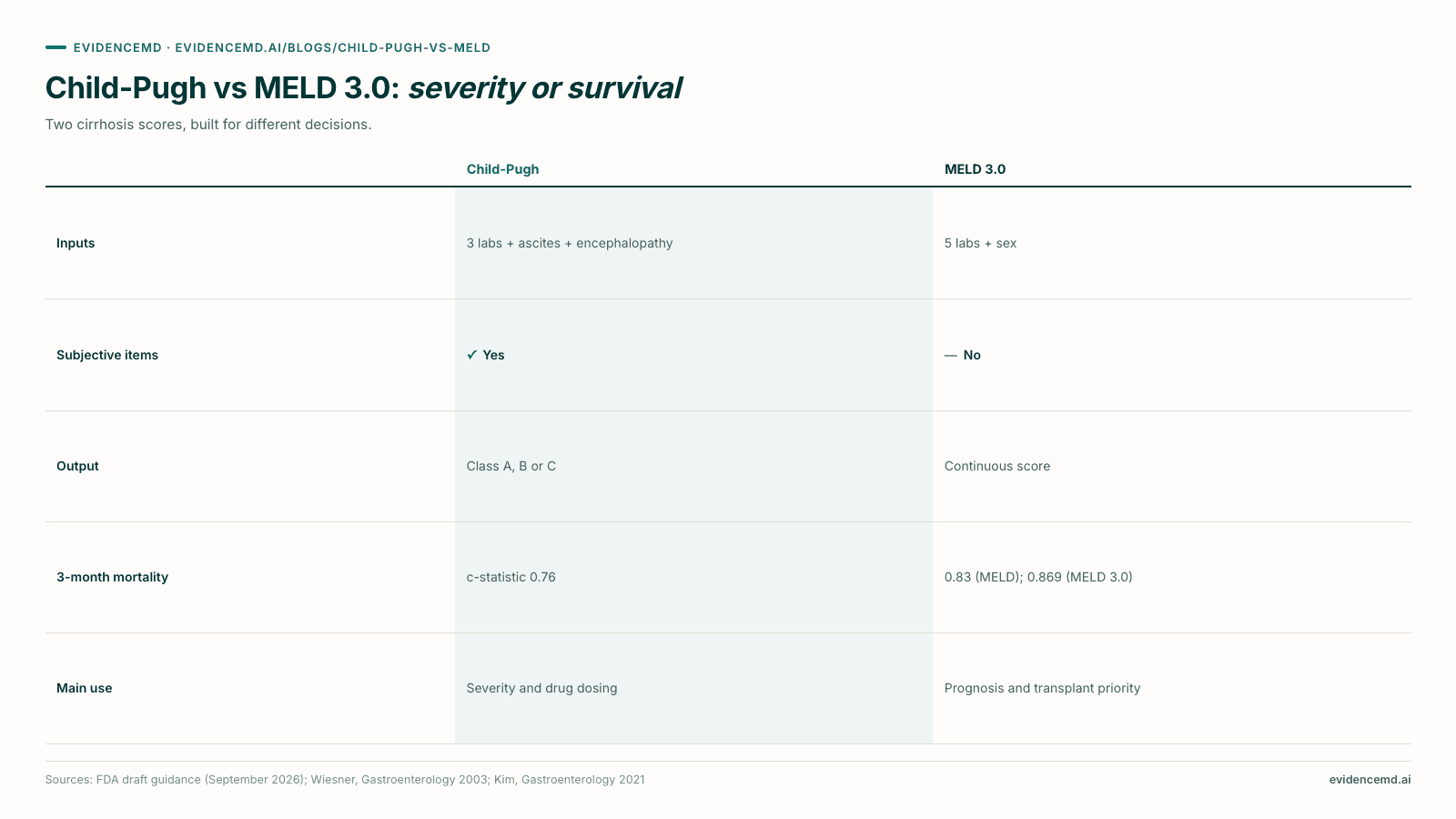
Child-Pugh combines three laboratory values with two clinical judgements into a severity class, while MELD combines objective inputs — laboratory values, plus sex in MELD 3.0 — into a continuous mortality score; Child-Pugh dates from 1973 surgical practice and MELD from a 2001 model for end-stage liver disease [1][2][4].
| Feature | Child-Pugh | MELD 3.0 |
|---|---|---|
| Inputs | Bilirubin, albumin, INR or prothrombin time, ascites, hepatic encephalopathy | Bilirubin, INR, creatinine, sodium, albumin, sex |
| Subjective items | Two: ascites and encephalopathy grade | None |
| Output | Total 5–15, class A, B or C | Continuous score; predicted 90-day mortality |
| Origin | Pugh 1973, modified from Child and Turcotte [1] | Kim 2021, updating MELD (2001) and MELD-Na (2008) [4][6][7] |
| Main use in 2026 | Severity grading; hepatic impairment in drug labelling and studies [2] | Liver-transplant prioritisation in the US since July 2023; short-term prognosis [7][8] |
| 3-month mortality discrimination | c-statistic 0.76 [5] | MELD 0.83 [5]; MELD 3.0 0.869 [7] |
→ Scroll the table sideways to see the remaining columns
How is the Child-Pugh score calculated?
The Child-Pugh score adds 1, 2 or 3 points for each of five findings — encephalopathy, ascites, total bilirubin, albumin and prothrombin time or INR — for a total of 5 to 15: class A (5–6), B (7–9) or C (10–15) [2].
| Finding | 1 point | 2 points | 3 points |
|---|---|---|---|
| Encephalopathy grade | None | 1 or 2 | 3 or 4 |
| Ascites | Absent | Slight | Moderate |
| Total bilirubin, mg/dL | Below 2 | 2 to 3 | Above 3 |
| Albumin, g/dL | Above 3.5 | 2.8 to 3.5 | Below 2.8 |
| Prothrombin time, seconds prolonged | Below 4 | 4 to 6 | Above 6 |
| or INR | Below 1.7 | 1.7 to 2.3 | Above 2.3 |
→ Scroll the table sideways to see the remaining columns
| Total points | Child-Pugh class | FDA hepatic impairment category |
|---|---|---|
| 5–6 | A | Mild |
| 7–9 | B | Moderate |
| 10–15 | C | Severe |
→ Scroll the table sideways to see the remaining columns
Pugh and colleagues adapted the score in 1973 from Child and Turcotte's classification, in patients having oesophageal transection for bleeding varices [1]. Its acknowledged weakness is subjectivity: the FDA notes the subjective assessment of ascites and asks investigators to record how ascites and encephalopathy were graded, including whether ascites was assessed on diuretics [2].
Non-hepatic causes can also move the inputs. Vitamin K deficiency and anticoagulants raise the INR, Gilbert's syndrome raises unconjugated bilirubin and intravenous fluids dilute albumin, so the FDA asks that changes reflect liver disease rather than comorbidity [2]. Using the score as a continuous 5–15 total also carries more prognostic information than collapsing it into three classes, as an early validation in 177 patients found [3]. You can score a patient with the EvidenceMD Child-Pugh calculator [9].
How is the MELD score calculated?
MELD is calculated from the natural logarithms of serum bilirubin, INR and serum creatinine; MELD-Na added serum sodium, and the score used for allocation runs from 6 to 40, with higher values meaning more severe disease [4][6].
| Version | Inputs | What changed | Key result |
|---|---|---|---|
| MELD (Kamath 2001) | Bilirubin, creatinine, INR (and, originally, aetiology) | Generalised a model first built to predict survival after TIPS | c-statistic for 3-month death 0.78–0.87 across four cohorts [4] |
| MELD-Na (Kim 2008) | MELD plus serum sodium | Sodium added because hyponatraemia predicted waiting-list death | Hazard ratio 1.21 per MELD point and 1.05 per 1 mmol/L fall in sodium (125–140) [6] |
| MELD 3.0 (Kim 2021) | Bilirubin, INR, creatinine, sodium, albumin, female sex | Added sex and albumin, two interaction terms and a creatinine cap of 3.0 mg/dL | c-statistic 0.869 against 0.862 for MELD-Na [7] |
→ Scroll the table sideways to see the remaining columns
Kamath and colleagues showed that the complications of portal hypertension added almost nothing to MELD's prediction — less than 0.01 to 0.03 in c-statistic for spontaneous bacterial peritonitis, variceal bleeding and ascites [4]. That is the core argument for MELD over Child-Pugh: it drops the clinically graded items without losing prognostic power.
Sodium mattered most at the low end. Kim's 2008 analysis found a significant interaction, with sodium's effect greater in patients with a low MELD score, and, applied to the 2006 waiting list, MELD-Na was considerably higher than MELD alone in 32 of the 477 patients who died (7%) [6].
What is MELD 3.0?
MELD 3.0 is the 2021 update of MELD that adds female sex and serum albumin, includes interactions between bilirubin and sodium and between albumin and creatinine, caps creatinine at 3.0 mg/dL, and replaced MELD-Na for US liver allocation in July 2023 [7][8].
| Variable | MELD 3.0 | MELD-Na |
|---|---|---|
| ln(bilirubin) | 4.56 | 3.78 |
| ln(INR) | 9.09 | 11.20 |
| ln(creatinine) | 11.14 | 9.57 |
| Sodium (137 − Na) | 0.82 | 1.32 |
| Albumin | 1.85 | Not included |
| Female sex | 1.33 | Not included |
→ Scroll the table sideways to see the remaining columns
MELD 3.0 was developed from every US waiting-list registration between January 2016 and December 2018. It discriminated 90-day mortality slightly better than MELD-Na (0.869 against 0.862), reclassified a net 8.8% of patients who died into a higher tier, and in allocation simulation produced fewer waiting-list deaths (7,788 against 7,850) [7]. At the average score of 20, predicted mortality was 1.9% at 30 days and 5.4% at 90 days [7].
The female-sex term addresses women's lower access to transplant under earlier MELD versions. After the July 2023 implementation, women's relative gain in transplant access was largest at first and narrowed over time, and adjusting for height removed the remaining difference by sex [8].
Which predicts mortality better: Child-Pugh or MELD?
MELD predicts short-term mortality better: among 3,437 adults added to the US waiting list in 1999–2001, MELD's c-statistic for 3-month death was 0.83 against 0.76 for Child-Pugh, and mortality rose from 1.9% at a MELD below 9 to 71.3% at 40 or more [5].
| Study | Population | Outcome | Result |
|---|---|---|---|
| Wiesner 2003 | 3,437 adults listed for transplant (12% died) | 3-month mortality | MELD 0.83 vs Child-Pugh 0.76 [5] |
| Kamath 2001 | Hospitalised patients with decompensation | 3-month mortality | MELD 0.87 [4] |
| Kamath 2001 | Ambulatory non-cholestatic cirrhosis | 3-month mortality | MELD 0.80 [4] |
| Kim 2021 | 8,823 registrants (validation set) | 90-day mortality | MELD 3.0 0.869 vs MELD-Na 0.862 [7] |
→ Scroll the table sideways to see the remaining columns
Better discrimination is not the same as better for every decision. MELD's numbers come mostly from transplant candidates and short horizons; Child-Pugh's value lies in its long use as a common language for severity and in drug labelling, which is why the FDA still asks for it [2].
Child-Pugh vs MELD: which to use in 2026?
Choose by the question: Child-Pugh to describe severity and to dose drugs in hepatic impairment, MELD 3.0 to estimate short-term mortality and to prioritise transplantation, and MELD to stratify further within Child-Pugh classes B and C [2][7].
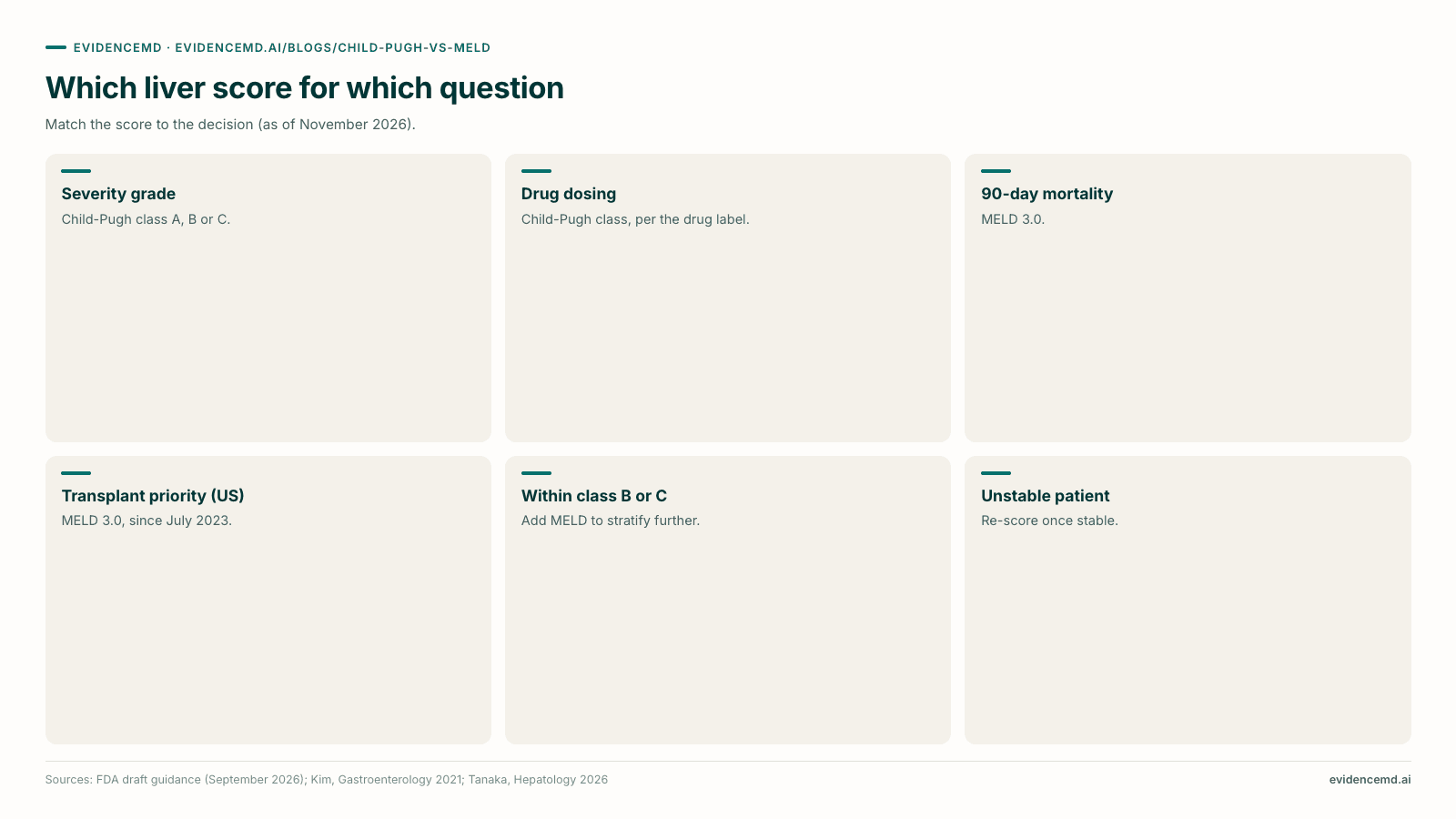
| Question | Use | Why |
|---|---|---|
| How severe is this patient's cirrhosis? | Child-Pugh class | Common language across teams and in labelling [2] |
| What dose is safe in hepatic impairment? | Child-Pugh class (check the drug label) | FDA keeps Child-Pugh as the standard; MELD and ALBI not yet characterised to replace it [2] |
| What is the 90-day mortality risk? | MELD 3.0 | Higher discrimination than Child-Pugh and MELD-Na [5][7] |
| Where does a US patient rank for a liver transplant? | MELD 3.0 | Used for allocation since July 2023 [8] |
| How sick is a class B or C patient compared with others in the same class? | MELD alongside Child-Pugh | The FDA notes MELD can stratify within classes B and C [2] |
→ Scroll the table sideways to see the remaining columns
Worked example: why Child-Pugh can change when MELD does not
A hypothetical patient scores Child-Pugh 11 (class C) with moderate ascites and grade 1 encephalopathy, then 9 (class B) once both are controlled — while every MELD 3.0 input stays the same [2][7].
| Finding | At admission | Points | After diuretics and lactulose | Points |
|---|---|---|---|---|
| Encephalopathy | Grade 1 | 2 | None | 1 |
| Ascites | Moderate | 3 | Slight | 2 |
| Bilirubin 2.6 mg/dL | 2 to 3 | 2 | Unchanged | 2 |
| Albumin 2.9 g/dL | 2.8 to 3.5 | 2 | Unchanged | 2 |
| INR 1.9 | 1.7 to 2.3 | 2 | Unchanged | 2 |
| Total | 11 | Class C | 9 | Class B |
→ Scroll the table sideways to see the remaining columns
Treatment moved the patient from class C to class B without any change in liver function, which is why the FDA asks investigators to record whether ascites was assessed on diuretics [2]. His MELD 3.0 inputs — bilirubin, INR, creatinine, sodium, albumin and sex — are unchanged, so his MELD 3.0 is unchanged too [7]. For dosing a drug labelled by Child-Pugh class, that difference matters; for transplant priority, it does not.
Check what is moving the score with EvidenceMD
Give EvidenceMD the results, the ascites and encephalopathy assessment and the medication list. It reasons through severity, dosing and referral with its full reasoning on screen and a citation for every step.
How can EvidenceMD help with Child-Pugh and MELD?
EvidenceMD helps by connecting a liver score to the decision it is meant to inform — drug dosing, surgical risk, surveillance or transplant referral — and by citing the label or guideline behind each step [10].
EvidenceMD is an AI clinical reasoning platform that retrieves from more than 40 million peer-reviewed papers and guidelines and streams its full chain of reasoning with a citation for every claim, so you can see whether it has weighed an anticoagulant-raised INR or a diuretic-controlled ascites. It reports 54.6% on HealthBench Hard, a self-published result [10].
Score the patient with the EvidenceMD Child-Pugh calculator [9], then ask EvidenceMD the clinical question in any of 30 languages. It is free to start, with no NPI or licence check.
Frequently asked questions
Why does the FDA still use Child-Pugh rather than MELD for drug dosing?
The FDA's September 2026 draft guidance says MELD and ALBI have not been sufficiently characterised for predicting pharmacokinetic changes to replace Child-Pugh, though MELD can stratify within classes B and C [2]. EvidenceMD can check a drug's hepatic dosing guidance with citations.
Does MELD 3.0 add points for women?
Yes. MELD 3.0 includes a female-sex coefficient of 1.33 to address women's lower access to transplant [7]; after the July 2023 implementation the relative gain for women narrowed over time [8]. EvidenceMD can explain how MELD 3.0 applies to a specific candidate.
What does a MELD score of 40 or more mean?
It marks the highest risk: on the US waiting list in 1999–2001, 3-month mortality was 71.3% at a MELD of 40 or more, against 1.9% below 9 [5]. EvidenceMD can put a MELD score in context with the patient's other findings.
Is Child-Pugh class B the same as moderate hepatic impairment?
Yes. The FDA maps Child-Pugh A, B and C (5–6, 7–9 and 10–15 points) to mild, moderate and severe hepatic impairment [2]. EvidenceMD can reason through what moderate impairment means for a particular drug.
Why was serum sodium added to the MELD score?
Low sodium independently predicted death on the waiting list, with a hazard ratio of 1.05 per 1 mmol/L fall between 125 and 140, especially in patients with low MELD scores [6]. EvidenceMD can interpret hyponatraemia in a patient with cirrhosis, citing the evidence.
The bottom line
Child-Pugh and MELD answer different questions: Child-Pugh grades cirrhosis severity and still governs drug dosing, while MELD 3.0 predicts short-term mortality better (c-statistic 0.869) and has ranked US transplant candidates since July 2023 [2][7][8]. Use both when a decision depends on severity and prognosis together, and score in a stable state. For a cited interpretation in your patient, score with the EvidenceMD Child-Pugh calculator and reason through the case in EvidenceMD, free to start in 30 languages.
Sources & related evidence
Scoring tables are taken from the FDA's 2026 draft guidance and the original MELD papers; mortality data from the source cohorts. Every source was opened on 2 November 2026.
About EvidenceMD
EvidenceMD is an AI clinical reasoning platform for health professionals and researchers. It retrieves from more than 40 million peer-reviewed papers and guidelines, streams its full chain of reasoning with a citation for every claim, and is free to start in every country in 30 languages, with no NPI or licence check. Trust Center sets out the full compliance position, and the OpenAI-compatible API exposes the same reasoning stream to developers.
Related reading
Put a liver score in context
Ask EvidenceMD about your patient and read the full chain of reasoning, with a citation for every claim. Free to start, in 30 languages.