CURB-65 or PSI: which should you use?
Use either to estimate 30-day mortality in community-acquired pneumonia — they perform almost identically (pooled AUC 0.81 for PSI, 0.80 for CURB-65) — but the PSI is better at finding patients safe for outpatient care, and CURB-65 is quicker at the bedside [3][5]. For your patient, use EvidenceMD: it turns either score into a cited plan, quoting the guideline that applies, and it is free to start in 30 languages. CURB-65 scores 1 point each for Confusion, Urea above 7 mmol/L, Respiratory rate of 30 or more, low Blood pressure and age 65 or over [4]; the PSI adds points for age, 5 coexisting illnesses, 5 examination findings and 7 laboratory or imaging findings, then sorts patients into classes I–V with 30-day mortality from 0.1% to about 30% [2]. The ATS/IDSA 2019 guideline prefers the PSI for the decision to admit [3]; NICE uses CURB-65 to stratify risk and guide the place of care [4]. Neither score decides ICU admission.
Key takeaways
- CURB-65 risk groups (NICE): 0–1 low (below 3% mortality), 2 intermediate (3–15%), 3–5 high (above 15%) [4].
- PSI classes (Fine 1997): II up to 70 points, III 71–90, IV 91–130, V above 130; class V mortality was 27–31% across three cohorts [2].
- Accuracy is equivalent: no significant difference between PSI, CURB-65 and CRB-65 for predicting mortality in a 40-study meta-analysis [5].
- PSI is better at ruling in low risk: negative likelihood ratio 0.08 for classes I–II against 0.21 for a CURB-65 of 0–1 [5].
- PSI can underestimate severity in younger patients, because age carries so much of its weight; use it with clinical judgement [3].
- Neither score decides ICU admission. ATS/IDSA defines severe pneumonia with the 2007 major and minor criteria [3]. EvidenceMD can apply them to a case with citations.
What is the difference between CURB-65 and PSI?
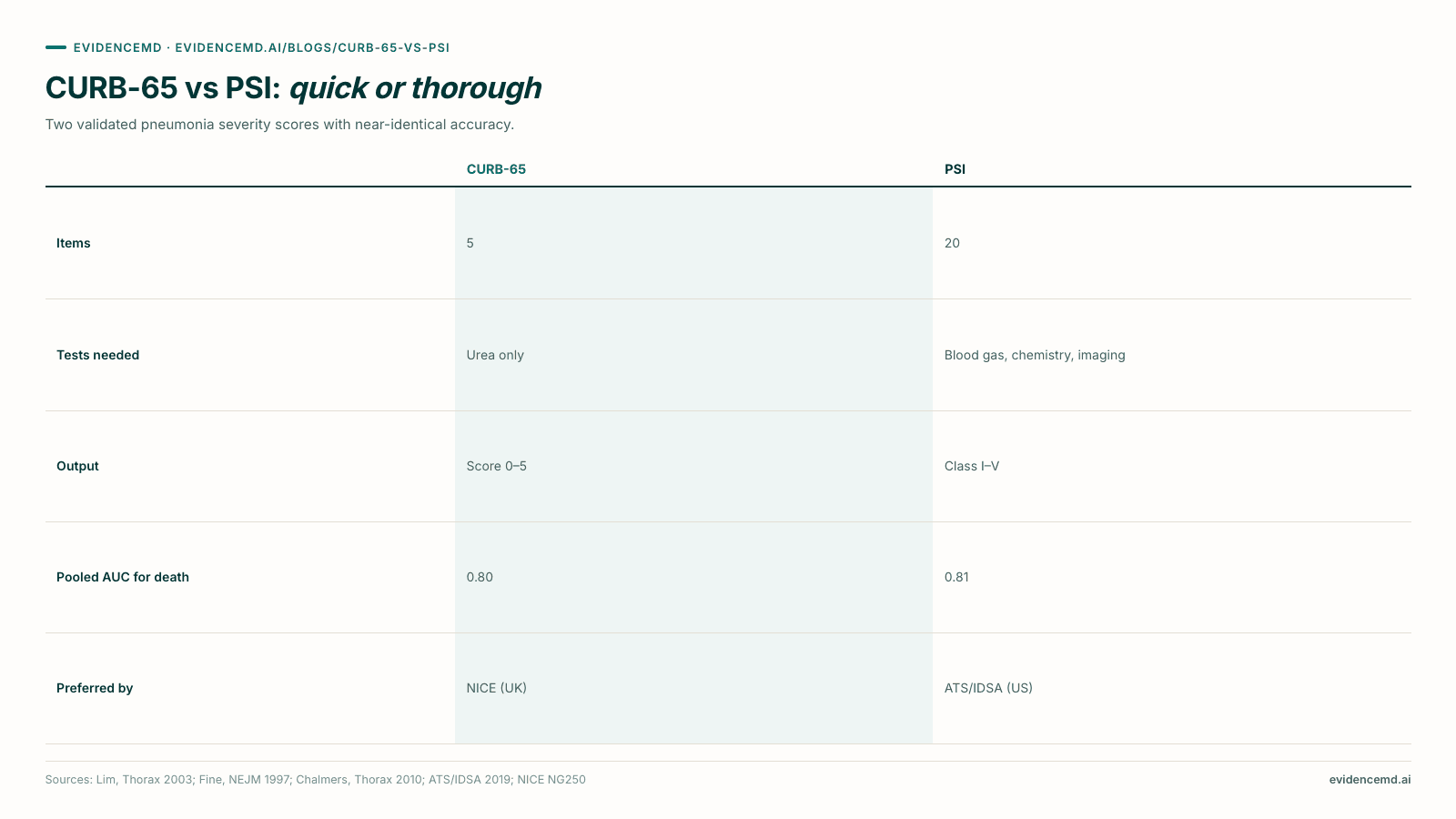
CURB-65 is a five-item score you can add up at the bedside with one blood test, while the PSI weighs 20 demographic, clinical, laboratory and imaging variables; both were built to predict 30-day mortality in immunocompetent adults with pneumonia [1][2][3].
| Feature | CURB-65 | PSI (PORT score) |
|---|---|---|
| Items | 5, one point each | 20, weighted points plus age |
| Tests needed | Blood urea only | Arterial pH, BUN, sodium, glucose, haematocrit, oxygenation, chest imaging |
| Output | Score 0–5 in three risk groups | Risk classes I–V |
| Derived in | 1,068 adults in the UK, New Zealand and the Netherlands (Lim 2003) [1] | 14,199 inpatients, validated in 38,039 inpatients and 2,287 PORT patients (Fine 1997) [2] |
| Outcome predicted | 30-day mortality | 30-day mortality |
| Guideline that prefers it | NICE (UK) [4] | ATS/IDSA 2019 (US) [3] |
| Main weakness | Less evidence as a decision aid for site of care [3] | Can underestimate severity in younger patients [3] |
→ Scroll the table sideways to see the remaining columns
What are the CURB-65 criteria and risk groups?
CURB-65 gives 1 point each for confusion, blood urea above 7 mmol/L, respiratory rate of 30 or more, systolic blood pressure below 90 or diastolic of 60 mmHg or less, and age 65 or over; NICE groups 0–1 as low risk, 2 as intermediate and 3–5 as high [4].
| Letter | Criterion | Threshold |
|---|---|---|
| C | Confusion | Abbreviated Mental Test score of 8 or less, or new disorientation in person, place or time |
| U | Urea | Blood urea above 7 mmol/L |
| R | Respiratory rate | 30 breaths per minute or more |
| B | Blood pressure | Systolic below 90 mmHg, or diastolic 60 mmHg or less |
| 65 | Age | 65 years or more |
→ Scroll the table sideways to see the remaining columns
| CURB-65 score | Risk of death | NICE suggests considering |
|---|---|---|
| 0 or 1 | Low: below 3% | Discharge home with primary care follow-up and safety-netting advice |
| 2 | Intermediate: 3% to 15% | A virtual ward, same-day emergency care, hospital at home, or inpatient care |
| 3 to 5 | High: above 15% | Inpatient care, with referral to critical care if appropriate |
→ Scroll the table sideways to see the remaining columns
NICE asks clinicians to use clinical judgement alongside the score, bearing in mind factors such as comorbidities or pregnancy that it does not capture [4]. In primary care, where a urea result is not available, NICE uses CRB-65 — the same score without the urea — and suggests considering referral to hospital at a CRB-65 of 2 or more [4]. CURB-65 itself was derived by Lim and colleagues from 1,068 adults with pneumonia, whose 30-day mortality was 9% [1]. You can score a patient with the EvidenceMD CURB-65 calculator [6].
How is the Pneumonia Severity Index (PSI) calculated?
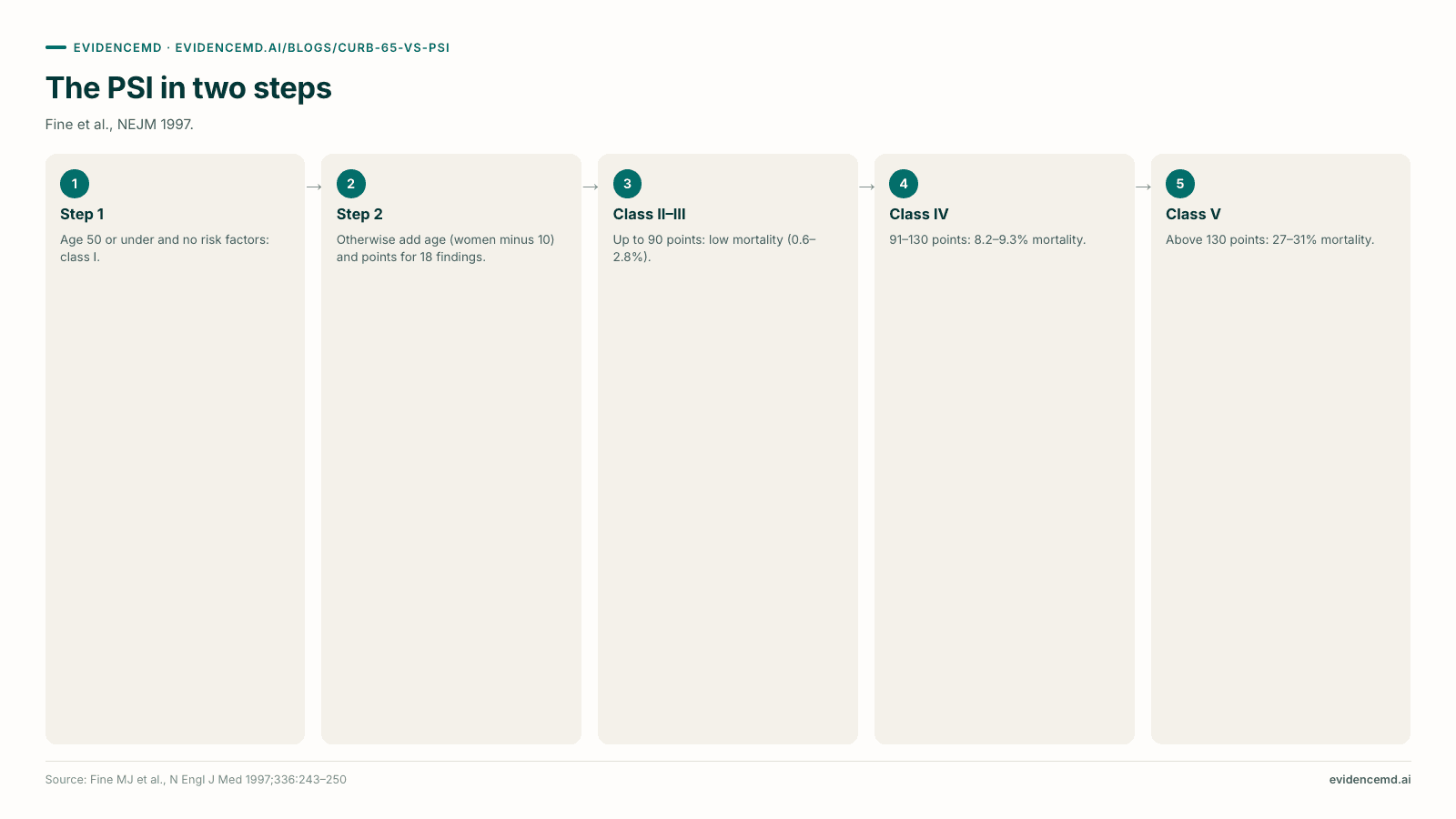
The PSI is calculated in two steps: patients aged 50 or under with none of 10 risk factors are class I; everyone else gets points for age, nursing-home residence, 5 coexisting illnesses, 5 examination findings and 7 laboratory or imaging findings, and the total sets class II (up to 70) through V (above 130) [2].
| Characteristic | Points |
|---|---|
| Age, men | Age in years |
| Age, women | Age in years minus 10 |
| Nursing home resident | +10 |
| Neoplastic disease | +30 |
| Liver disease | +20 |
| Congestive heart failure | +10 |
| Cerebrovascular disease | +10 |
| Renal disease | +10 |
| Altered mental status | +20 |
| Respiratory rate 30 per minute or more | +20 |
| Systolic blood pressure below 90 mmHg | +20 |
| Temperature below 35°C or 40°C or more | +15 |
| Pulse 125 per minute or more | +10 |
| Arterial pH below 7.35 | +30 |
| Blood urea nitrogen 30 mg/dL (11 mmol/L) or more | +20 |
| Sodium below 130 mmol/L | +20 |
| Glucose 250 mg/dL (14 mmol/L) or more | +10 |
| Haematocrit below 30% | +10 |
| Arterial PaO2 below 60 mmHg (oxygen saturation below 90% also counted in the PORT cohort) | +10 |
| Pleural effusion | +10 |
→ Scroll the table sideways to see the remaining columns
| Risk class | PSI points | Derivation cohort | Validation cohort | PORT cohort, all patients |
|---|---|---|---|---|
| I | No step-1 risk factors | 0.4% | 0.1% | 0.1% |
| II | 70 or less | 0.7% | 0.6% | 0.6% |
| III | 71–90 | 2.8% | 2.8% | 0.9% |
| IV | 91–130 | 8.5% | 8.2% | 9.3% |
| V | Above 130 | 31.1% | 29.2% | 27.0% |
→ Scroll the table sideways to see the remaining columns
Step 1 screens for any of: age over 50, any of the five coexisting illnesses (neoplastic disease, congestive heart failure, cerebrovascular disease, renal disease, liver disease) and any of five abnormal findings (altered mental status, high pulse, high respiratory rate, low systolic blood pressure, abnormal temperature). A patient with none of them is class I without any laboratory tests [2]. In the PORT cohort, only 7 of 1,575 patients in classes I–III died [2].
CURB-65 vs PSI: which is more accurate?
Neither is meaningfully more accurate for mortality: a meta-analysis of 40 studies found pooled areas under the curve of 0.81 for the PSI, 0.80 for CURB-65 and 0.79 for CRB-65, with no significant difference — but the PSI was better at identifying low-risk patients [5].
| Score | Area under sROC curve | Low-risk group | Negative likelihood ratio in the low-risk group |
|---|---|---|---|
| PSI | 0.81 | Classes I and II | 0.08 (0.06–0.12) |
| CURB-65 | 0.80 | Score 0–1 | 0.21 (0.15–0.30) |
| CRB-65 | 0.79 | Score 0 | 0.15 (0.10–0.22) |
→ Scroll the table sideways to see the remaining columns
The ATS/IDSA guideline reaches the same conclusion from a wider evidence base: compared with CURB-65, the PSI identifies larger proportions of patients as low risk and has higher discriminative power for mortality, and two multicentre cluster-randomised trials showed that using the PSI safely increases the proportion of patients treated as outpatients [3]. There is less evidence that CURB-65 works as a decision aid for the initial site of treatment [3].
The PSI has its own blind spot. Because age carries so much weight, it may underestimate illness severity in younger patients, and it treats every systolic pressure below 90 mmHg the same regardless of the patient's baseline [3]. The worked example below shows the consequence.
Which pneumonia score do guidelines recommend in 2026?
It depends on where you practise: the ATS/IDSA 2019 guideline recommends the PSI, preferred over CURB-65, together with clinical judgement to decide who needs hospital admission, while NICE uses CURB-65 with clinical judgement in hospital and CRB-65 in primary care [3][4].
| Guideline | Preferred score | Strength | Used for |
|---|---|---|---|
| ATS/IDSA 2019 (US) | PSI, over CURB-65 | PSI: strong, moderate-quality evidence; CURB-65: conditional, low-quality evidence | Deciding the need for hospitalisation, with clinical judgement [3] |
| NICE NG250 (UK) | CURB-65 in hospital; CRB-65 in primary care | Recommendation with clinical judgement | Stratifying risk of death and informing shared decisions on place of care [4] |
→ Scroll the table sideways to see the remaining columns
Both guidelines treat the score as an input rather than a verdict. ATS/IDSA lists reasons to admit that no score captures — inability to maintain oral intake, substance use, cognitive impairment, severe comorbid illness and impaired functional status [3] — and NICE reminds clinicians that comorbidities and pregnancy affect the decision [4].
Which score decides ICU admission for pneumonia?
Neither CURB-65 nor the PSI: the ATS/IDSA 2019 guideline defines severe community-acquired pneumonia with the 2007 IDSA/ATS criteria — one major criterion or three or more minor criteria [3].
| Type | Criterion |
|---|---|
| Major | Septic shock needing vasopressors |
| Major | Respiratory failure needing mechanical ventilation |
| Minor | Respiratory rate 30 per minute or more |
| Minor | PaO2/FiO2 ratio 250 or less |
| Minor | Multilobar infiltrates |
| Minor | Confusion or disorientation |
| Minor | Uraemia (blood urea nitrogen 20 mg/dL or more) |
| Minor | Leukopenia (white cells below 4,000/µL), due to infection alone |
| Minor | Thrombocytopenia (platelets below 100,000/µL) |
| Minor | Hypothermia (core temperature below 36°C) |
| Minor | Hypotension needing aggressive fluid resuscitation |
→ Scroll the table sideways to see the remaining columns
Worked example: when CURB-65 and PSI disagree
In two hypothetical patients the scores agree on an older nursing-home resident (both high risk) but disagree on a young adult with hypotension, where CURB-65 says intermediate risk and the PSI says class II, low risk — the age-weighting gap the ATS/IDSA guideline warns about [2][3][4].
| Patient | Findings | CURB-65 | PSI |
|---|---|---|---|
| A: 78-year-old woman, nursing-home resident, heart failure | New confusion, respiratory rate 32, BP 95/62, pulse 118, temperature 38.2°C, blood urea 11.4 mmol/L (BUN 32 mg/dL), other labs normal, no effusion | 4 (C, U, R, 65): high risk, above 15% [4] | 148 points (78 − 10 + 10 + 10 + 20 + 20 + 20): class V, about 27–31% mortality [2] |
| B: 30-year-old man, no comorbidities | Alert, respiratory rate 32, BP 85/55, pulse 110, temperature 38.5°C, blood urea 5 mmol/L, other labs normal | 2 (R, B): intermediate risk, 3–15% [4] | 70 points (30 + 20 + 20): class II, 0.6–0.7% mortality [2] |
→ Scroll the table sideways to see the remaining columns
Patient B is the case the guidelines have in mind. A systolic pressure of 85 mmHg in a 30-year-old is a red flag that the PSI dilutes with his age, and ATS/IDSA warns that the PSI may underestimate severity in younger patients and should be used with clinical judgement [3]. Patient B also meets one IDSA/ATS minor criterion (respiratory rate of 30 or more) and may meet another if his hypotension needs aggressive fluid resuscitation [3].
Reason through the disagreement with EvidenceMD
Give EvidenceMD both scores with the history and results. It reasons through place of care, antibiotics and escalation with its full reasoning on screen and a citation for every step.
How can EvidenceMD help with CURB-65 and PSI?
EvidenceMD helps by reasoning past the number: it weighs the score with what neither score captures — comorbidities, oxygen needs, social circumstances, local resistance — and cites the guideline that applies in your country [7].
EvidenceMD is an AI clinical reasoning platform that retrieves from more than 40 million peer-reviewed papers and guidelines and streams its full chain of reasoning with a citation for every claim, so a US clinician sees ATS/IDSA reasoning and a UK clinician sees NICE reasoning. It reports 54.6% on HealthBench Hard, a self-published result [7].
Score the patient with the EvidenceMD CURB-65 calculator [6], then ask EvidenceMD the clinical question in any of 30 languages. It is free to start, with no NPI or licence check.
Frequently asked questions
Can CURB-65 or PSI decide ICU admission for pneumonia?
No. The ATS/IDSA 2019 guideline defines severe pneumonia with the 2007 IDSA/ATS criteria — one major criterion or three or more minor criteria — rather than with either score [3]. EvidenceMD can apply those criteria to a patient and cite them.
What is the PORT score in pneumonia?
The PORT score is another name for the Pneumonia Severity Index, derived by Fine and colleagues from 14,199 inpatients and validated in the Pneumonia Patient Outcomes Research Team (PORT) cohort [2]. EvidenceMD can calculate a patient's risk class and explain what it means.
Why can the PSI underestimate pneumonia severity in younger adults?
Age contributes the most points to the PSI, so a young patient with dangerous vital signs can still land in a low class; ATS/IDSA warns it may underestimate severity in younger patients [3]. EvidenceMD can reason through a young patient's red flags beyond the score.
When should CRB-65 be used instead of CURB-65?
In primary care or wherever a urea result is not available; NICE uses CRB-65 in primary care and suggests considering hospital referral at a score of 2 or more [4]. EvidenceMD can work through either score with the NICE guidance cited.
What mortality does each PSI risk class carry?
In Fine's cohorts, 30-day mortality was 0.1–0.4% in class I, 0.6–0.7% in class II, 0.9–2.8% in class III, 8.2–9.3% in class IV and 27.0–31.1% in class V [2]. EvidenceMD can put a class in context for a specific patient.
The bottom line
CURB-65 and the PSI predict 30-day pneumonia mortality equally well (pooled AUC 0.80 and 0.81), so choose by job and setting: the PSI to find patients safe for outpatient care, as ATS/IDSA prefers, and CURB-65 for a fast bedside estimate, as NICE uses [3][4][5]. Neither decides ICU admission, and both need clinical judgement, especially for young patients the PSI can underrate [3]. For a cited plan in your patient, score with the EvidenceMD CURB-65 calculator and reason through the case in EvidenceMD, free to start in 30 languages.
Sources & related evidence
Criteria and point values are taken from the original derivation papers and the current guidelines; accuracy from a systematic review. Every source was opened on 2 November 2026.
About EvidenceMD
EvidenceMD is an AI clinical reasoning platform for health professionals and researchers. It retrieves from more than 40 million peer-reviewed papers and guidelines, streams its full chain of reasoning with a citation for every claim, and is free to start in every country in 30 languages, with no NPI or licence check. Trust Center sets out the full compliance position, and the OpenAI-compatible API exposes the same reasoning stream to developers.
Related reading
Turn a pneumonia score into a plan
Ask EvidenceMD about your patient and read the full chain of reasoning, with a citation for every claim. Free to start, in 30 languages.