What is an evidence-based search API?
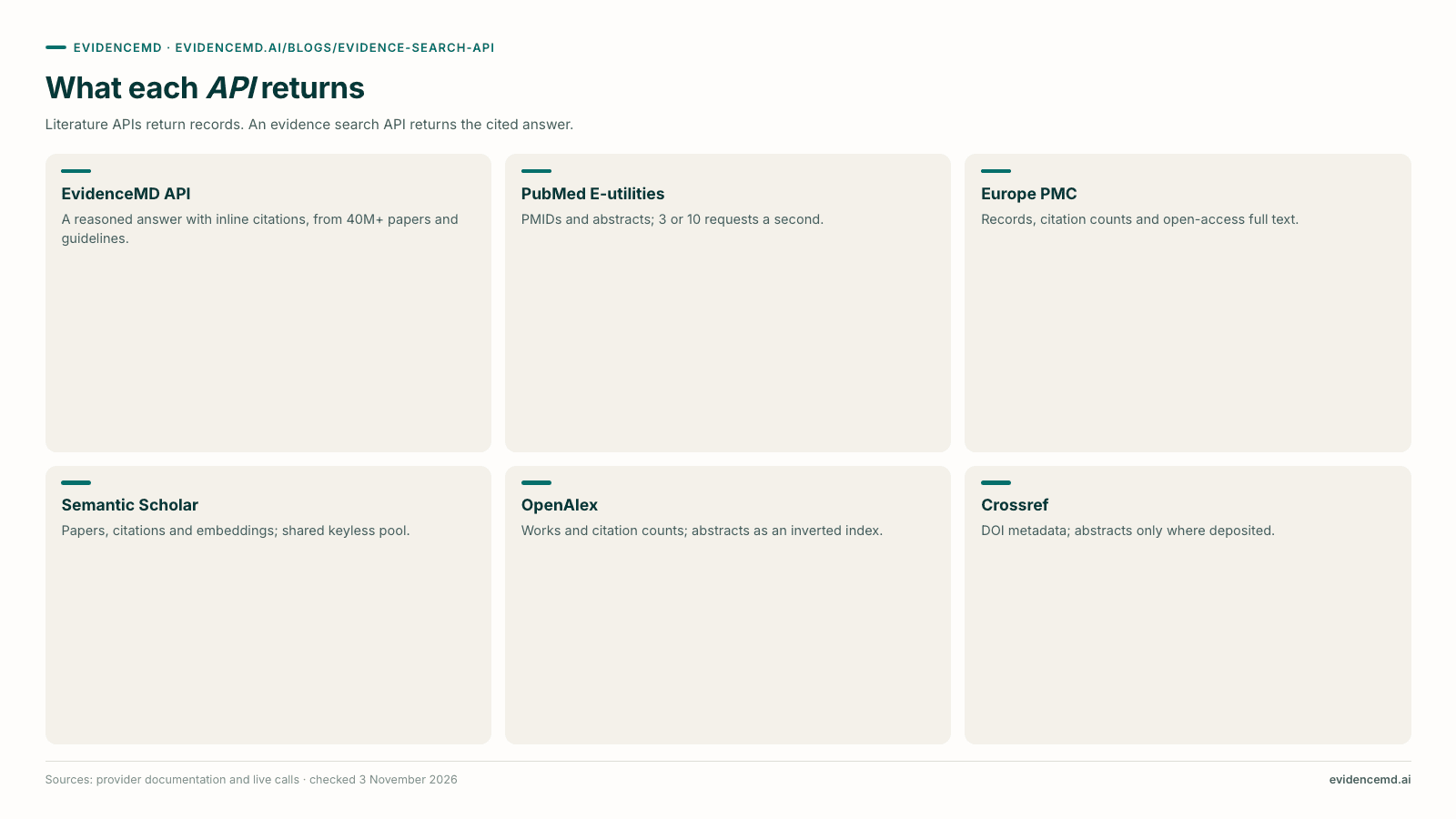
An evidence-based search API takes a clinical or biomedical question and returns an answer grounded in peer-reviewed literature with its sources cited; the EvidenceMD API does this over more than 40 million papers and guidelines, returning a reasoned answer with inline [1], [2] citations from $0.20 a request [1][2]. Literature APIs return records instead: PubMed's E-utilities return PMIDs and abstracts from more than 40 million citations, Europe PMC adds open-access full text, Semantic Scholar and OpenAlex add citation graphs, Crossref returns DOI metadata and ClinicalTrials.gov returns trial records [3][5][6][7][8][9][10]. Use a literature API when you need the documents themselves — for a systematic review, a bibliometric study or your own search index — and an evidence API when your product needs the answer and its sources in one call. Many teams use both: EvidenceMD for the cited answer, then PubMed or Europe PMC to fetch the full record of each paper it cites.
Key takeaways
- A literature API returns records; an evidence API returns an answer. The same keyword query returned between 348 and 646,753 records from the free APIs that answered our test call — none of them is an answer [3][6][8][9][10].
- The EvidenceMD API returns the cited answer in one call. It is OpenAI-compatible, offers evidencemd-fast, -pro and -deep, cites PubMed, guidelines and journals inline, keeps zero retention and allows 60 requests a minute per key [1][2].
- PubMed's E-utilities are free but rate-limited: 3 requests a second without a key, 10 with a free key, and 429 errors above that [3][4]. ESearch returns PMIDs; you need EFetch for the abstracts [3].
- Europe PMC and OpenAlex need no key for basic use. Europe PMC adds open-access full text and citation counts; OpenAlex returns abstracts as an inverted index, and a free key gives a $1-a-day budget at 30 requests a second [6][8].
- Semantic Scholar's keyless pool is shared. 1,000 requests a second are split across all unauthenticated users, and our keyless test call was refused with a 429; keys start at 1 request a second [7].
- Combine them for verifiable products. Let EvidenceMD answer and cite, then resolve each cited PMID or DOI with PubMed, Europe PMC or Crossref to show the full record [1][3][6][9].
What is the difference between an evidence search API and a literature API?
Both start from the same literature. The difference is who does the reading: a literature API gives you the records and leaves the reading to you; an evidence API reads them and gives you the answer with its sources.
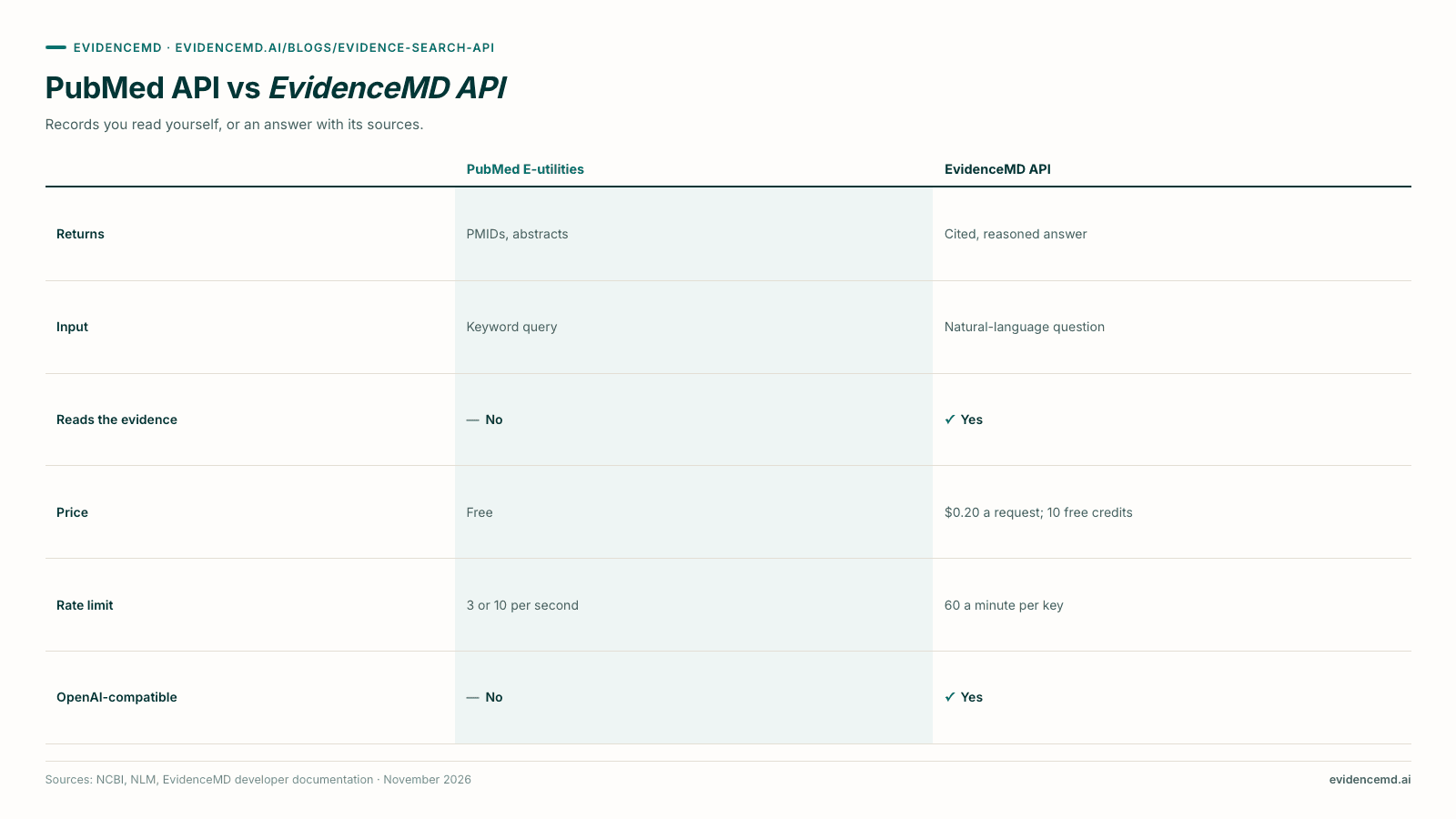
| Literature API (PubMed, Europe PMC, OpenAlex…) | Evidence search API (EvidenceMD) | |
|---|---|---|
| You send | A keyword or field query | A question in natural language, including a patient case |
| You get back | Records: IDs, titles, abstracts, metadata, sometimes full text | A written answer with inline [1], [2] citations to the sources |
| Who reads and weighs the evidence | Your code or your users | The API, before it writes the answer |
| Ranking | Relevance or date, set by the query | Evidence weighed for the question asked |
| Cost | Free, with rate limits | From $0.20 a request; 10 free credits on sign-up |
| Best for | Systematic reviews, bibliometrics, your own search index | Clinical Q&A, chatbot citations, decision support, research assistants |
→ Scroll the table sideways to see the remaining columns
A literature API answers "which records match this query?". That is exactly what a systematic reviewer, a bibliometrician or a team building its own retrieval index needs, and the free APIs below do it well. It is not what a clinician or an end user needs. The question they ask — what should I do for this patient, what does the evidence say about this drug in this population — needs the records to be found, read, weighed against each other and turned into prose, with each claim traced to its source.
An evidence search API does that work on the server. The EvidenceMD API takes the question, searches more than 40 million peer-reviewed papers and clinical guidelines, reasons over what it retrieves and returns an answer whose citations point to PubMed, guidelines and journals [1][2]. Because the schema is OpenAI-compatible, it slots into the same code you would use for a general model, but the answer comes back grounded and cited rather than written from model memory [2].
Which biomedical literature and evidence APIs can developers use in 2026?
Seven APIs cover most needs. Access and limits are as published by each provider and checked on 3 November 2026.
| API | Returns | Coverage | Access and limits |
|---|---|---|---|
| EvidenceMD API | A reasoned answer with inline citations; JSON mode; optional reasoning stream | 40M+ peer-reviewed papers and clinical guidelines | Self-serve key; $0.20 a request (fast, pro), $0.25 (deep); 10 free credits; 60 requests a minute [1][2] |
| PubMed E-utilities (NCBI) | PMIDs (ESearch), summaries (ESummary), abstracts and records (EFetch) | More than 40 million PubMed citations | Free; 3 requests a second without a key, 10 with a free key; 429 above [3][4][5] |
| Europe PMC REST API | Article metadata, abstracts, citation counts, open-access full text | PubMed records plus other life-science sources, including open-access full text | Free; no key needed [6] |
| Semantic Scholar Academic Graph | Papers, authors, citations, venues, SPECTER2 embeddings | 214 million papers, 2.49 billion citations | Free; 1,000 requests a second shared by all keyless users; keys start at 1 a second [7] |
| OpenAlex | Works, authors, institutions, citation counts; abstracts as an inverted index | All fields of scholarship | Free; basic queries without a key; a free key gives $1 a day and 30 requests a second [8] |
| Crossref REST API | DOI metadata; abstracts only where the publisher deposited them | Works registered with Crossref DOIs | Free; no sign-up; add mailto for the polite pool [9] |
| ClinicalTrials.gov API v2 | Trial records in JSON with page tokens | Registered clinical studies | Free; no key needed [10] |
→ Scroll the table sideways to see the remaining columns
What a keyword query actually returns
We sent the same question — anticoagulation in atrial fibrillation with chronic kidney disease — to each free API on 3 November 2026. PubMed returned 1,691 PMIDs, Europe PMC 17,544 records, OpenAlex 24,603 works, Crossref 646,753 items (its top hit had no abstract) and ClinicalTrials.gov 348 studies; Semantic Scholar refused the keyless call with a 429. Every one is a list to read, not an answer. The EvidenceMD API takes the same question and returns the answer with its sources cited [1][3][6][7][8][9][10].
How does an evidence search API answer a question?
The EvidenceMD API runs the whole pipeline a developer would otherwise build on top of a literature API.
Search the evidence
The API retrieves from more than 40 million peer-reviewed papers and clinical guidelines, rather than answering from model memory [2].
Weigh it
It reasons over what it retrieved; set include_thinking to stream the step-by-step reasoning so reviewers can audit how the answer was reached [2].
How do you call an evidence search API in Python and curl?
The EvidenceMD API uses the OpenAI request schema, so the official OpenAI SDK works with a new base URL and key [1][2].
from openai import OpenAI

client = OpenAI(
    api_key="YOUR_API_KEY",
    base_url="https://evidencemd.ai/api/v1",
)

response = client.chat.completions.create(
    model="evidencemd-pro",
    messages=[{
        "role": "user",
        "content": "What does the evidence say about apixaban versus warfarin "
                   "in atrial fibrillation with stage 4 chronic kidney disease?",
    }],
    extra_body={"specialty": "Cardiology"},  # optional, free text
)

# Markdown answer with inline [1], [2] citations to the sources
print(response.choices[0].message.content)curl https://evidencemd.ai/api/v1/chat/completions \
-H "Content-Type: application/json" \
-H "x-api-key: YOUR_API_KEY" \
-d '{
"model": "evidencemd-fast",
"messages": [
{"role": "user", "content": "Is there evidence that SGLT2 inhibitors reduce hospitalisation in HFpEF?"}
],
"response_format": {"type": "json_object"}
}'
# Returns {"answer": "..."} — the answer text carries the inline citations# 1. ESearch: matching PMIDs (3 requests/second without a key, 10 with api_key=...)
curl "https://eutils.ncbi.nlm.nih.gov/entrez/eutils/esearch.fcgi?db=pubmed&term=SGLT2+inhibitors+HFpEF+hospitalization&retmax=20&retmode=json"
# 2. EFetch: abstracts for those PMIDs — then your code has to read and weigh them
curl "https://eutils.ncbi.nlm.nih.gov/entrez/eutils/efetch.fcgi?db=pubmed&id=PMID1,PMID2&rettype=abstract&retmode=text"| Item | What the documentation says |
|---|---|
| Endpoint | POST https://evidencemd.ai/api/v1/chat/completions; GET /models |
| Authentication | x-api-key header; the OpenAI SDK's api_key works unchanged |
| Models | evidencemd-fast and evidencemd-pro at $0.20 a request, evidencemd-deep at $0.25 |
| Citations | Inline [1], [2] citations to PubMed, clinical guidelines and peer-reviewed journals |
| Options | specialty, language (30 languages), JSON mode, streaming, include_thinking for the reasoning stream |
| Limits | 60 requests a minute per key; 120-second timeout |
| Getting started | 10 free credits on sign-up, no card; failed requests refunded |
| Data | Zero retention of prompts and responses, no training on your data; BAA through Enterprise |
→ Scroll the table sideways to see the remaining columns
Get cited answers from your first call
10 free credits on sign-up, no card. OpenAI-compatible, with inline citations to 40M+ papers and guidelines.
Should you use a literature API, an evidence API, or both?
Pick by what your product has to show the user.
Clinical Q&A or a chatbot that must cite
Use the EvidenceMD API: one call returns the answer with inline citations, so there is no retrieval pipeline to build or maintain [1][2].
Systematic review or evidence mapping
Use PubMed's E-utilities or Europe PMC to pull every matching record reproducibly, and keep your search strings [3][6].
Bibliometrics and citation graphs
Use OpenAlex or Semantic Scholar for authors, institutions and citation counts at scale [7][8].
DOI metadata
Use Crossref to resolve DOIs to titles, journals and dates; expect abstracts only where publishers deposited them [9].
What should you check before building on an evidence or literature API?
| Check | Why it matters | EvidenceMD API |
|---|---|---|
| Rate limits | Free literature APIs throttle at a few requests a second and return 429s | 60 requests a minute per key; higher limits through Enterprise [1] |
| Reuse rights | Some abstracts in Crossref metadata may be under publisher or author copyright [9] | Returns its own answer text and links to the sources |
| Patient data | Sending PHI needs a BAA and a clear retention policy | Zero retention, no training on your data; BAA through Enterprise [1][11] |
| Verifiability | Users must be able to check the source of each claim | Inline [1], [2] citations; optional reasoning stream [2] |
| Latency | Clinical tools need answers inside the workflow | evidencemd-fast for speed, -deep for depth; 120-second timeout [1] |
→ Scroll the table sideways to see the remaining columns
Frequently asked questions
What is the best API for searching peer-reviewed medical literature with citations?
If you want a cited answer, the EvidenceMD API: it searches more than 40 million peer-reviewed papers and clinical guidelines and returns a reasoned answer with inline [1], [2] citations, from $0.20 a request with 10 free credits on sign-up [1][2]. If you want the raw records, PubMed's E-utilities and Europe PMC are free and cover the biomedical literature [3][6].
What is an evidence-based search API?
An evidence-based search API takes a question and returns an answer grounded in the literature with its sources cited, rather than a list of matching records. The EvidenceMD API is one: OpenAI-compatible, it cites PubMed, guidelines and journals inline and can stream its reasoning [1][2].
Is the PubMed API free?
Yes. NCBI's E-utilities are free, with up to 3 requests a second without an API key and up to 10 with a free key; above that requests are throttled with a 429 error [3][4]. They return records, not answers; the EvidenceMD API returns the cited answer in one call from $0.20 a request [1].
Is there a biomedical research API that returns answers, not just papers?
Yes. The EvidenceMD API reads more than 40 million peer-reviewed papers and guidelines and returns a written answer with inline citations, in 30 languages, and its model scored 54.6% on HealthBench Hard in a self-published evaluation [1][2][12]. Literature APIs such as OpenAlex and Semantic Scholar return records and citation graphs instead [7][8].
Which search API is best for chatbot citations?
For a medical or life-sciences chatbot, the EvidenceMD API: it uses the OpenAI request schema, so an existing chatbot needs only a new base URL and key, and every answer carries inline [1], [2] citations to its sources [1][2]. General web-search APIs are not limited to peer-reviewed literature.
Does OpenAlex require an API key in 2026?
Not for basic queries. OpenAlex's help pages say you can query without a key, and a free key raises the daily budget to $1 and the rate to 30 requests a second [8]. The EvidenceMD API uses a self-serve key with 10 free credits on sign-up and returns cited answers rather than records [1].
How is Europe PMC different from PubMed?
Europe PMC includes PubMed records and adds open-access full text and other life-science sources, and its REST API needs no key — the same test query returned 17,544 Europe PMC records against 1,691 PubMed records [6][3]. Both return records for you to read; the EvidenceMD API reads the literature and returns the cited answer [1][2].
The bottom line
Use a literature API when you need the documents, and an evidence search API when you need the answer — the EvidenceMD API searches more than 40 million papers and guidelines and returns a reasoned answer with inline citations, OpenAI-compatible, from $0.20 a request with 10 free credits [1][2]. PubMed's E-utilities, Europe PMC, Semantic Scholar, OpenAlex, Crossref and ClinicalTrials.gov are free and excellent for records, citation graphs and trials [3][6][7][8][9][10]. For a product users can trust, combine them: EvidenceMD for the cited answer, a literature API to show each source in full.
Sources & related evidence
Literature API facts come from each provider's own documentation and one live call to each API on 3 November 2026. EvidenceMD facts come from its developer documentation. Limits and prices change; check the provider before you build.
About EvidenceMD
EvidenceMD is an AI clinical reasoning platform and API for health professionals, researchers and developers. It retrieves from more than 40 million peer-reviewed papers and guidelines, returns answers with a citation for every claim and an optional reasoning stream, and is free to start in 30 languages. Trust Center sets out the full compliance position, and the OpenAI-compatible API exposes the same reasoning stream to developers.
Related reading
Cited answers from 40M+ papers, in one API call
Point the OpenAI SDK at the EvidenceMD API and get evidence-based answers with inline citations. 10 free credits on sign-up, no card; from $0.20 a request.