Do OpenEvidence and UpToDate have MCP servers?
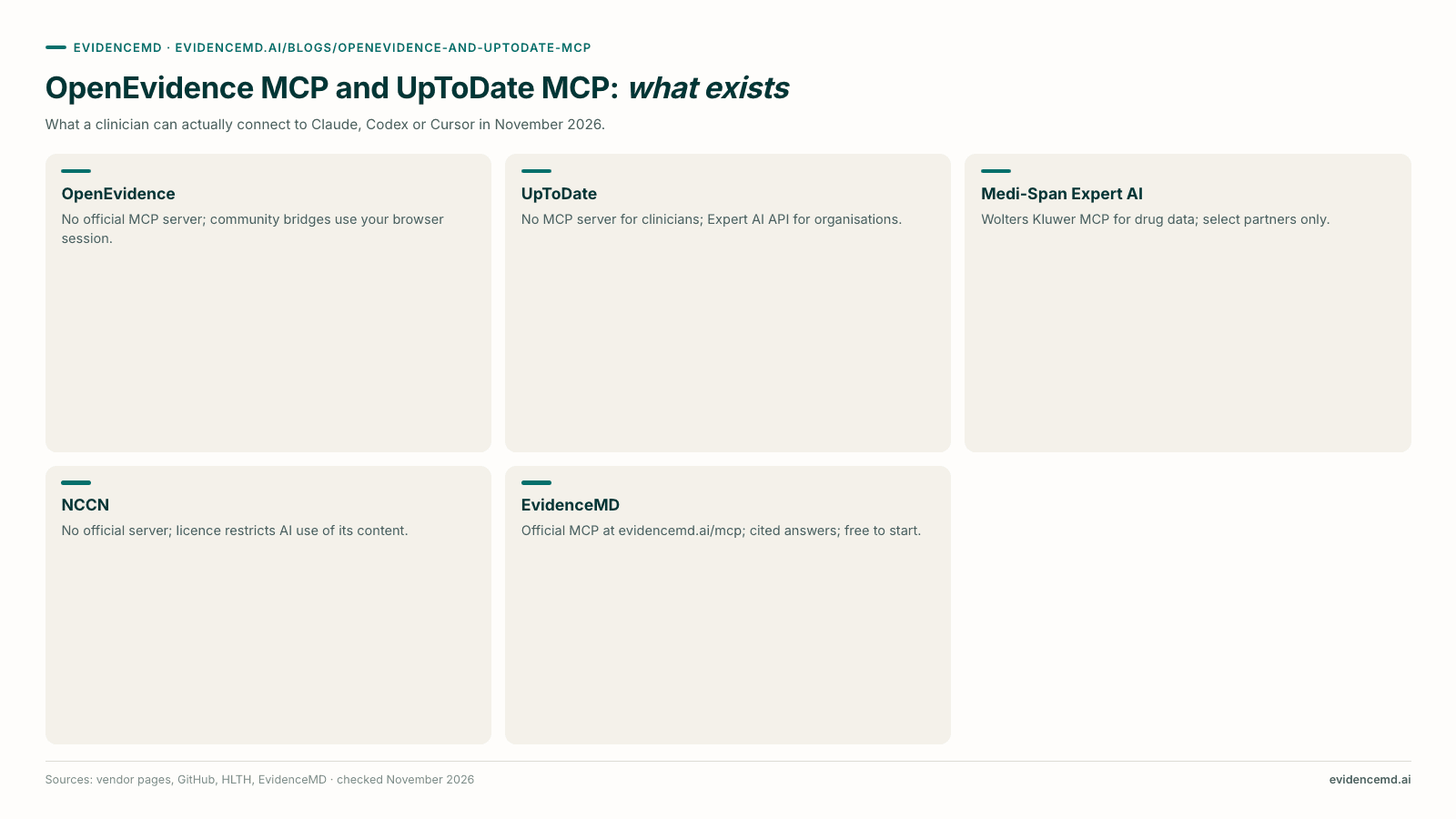
No: as of November 2026 OpenEvidence has no official MCP server and UpToDate has none for clinicians, so the working way to get cited clinical reasoning inside Claude, Claude Code, Codex or Cursor is EvidenceMD's MCP server at https://evidencemd.ai/mcp, which answers from more than 40 million peer-reviewed papers and guidelines with a citation for every claim [1][2]. The OpenEvidence MCP projects on GitHub are unofficial community bridges that run requests through your own logged-in browser session [5][6]. Wolters Kluwer's agent-facing products are the UpToDate Expert AI API, offered to healthcare organisations, and a Medi-Span Expert AI MCP server for medication data that is open only to select innovation partners [7][8][9]. EvidenceMD's server is listed in Claude's Connectors Directory, signs in with OAuth 2.1, is free to start and scored 54.6% on HealthBench Hard [1][3][10][2].
Key takeaways
- EvidenceMD's MCP server works today. Add https://evidencemd.ai/mcp in Claude, Claude Code, Codex or Cursor, sign in with OAuth 2.1, and each answer cites guidelines and peer-reviewed papers [1][3].
- OpenEvidence has no official MCP server. The OpenEvidence MCP projects on GitHub say they are unofficial and not affiliated with OpenEvidence, and they work through your own logged-in browser session [5][6].
- UpToDate has no MCP server for clinicians. Wolters Kluwer offers the UpToDate Expert AI API to healthcare organisations for their own applications and "agent-driven queries", with no self-serve sign-up or published price [7].
- Wolters Kluwer's MCP server is for medication data. Medi-Span Expert AI's MCP server, reported on 17 February 2026, connects drug content to AI applications and is limited to select innovation partners [8][9].
- Unofficial bridges carry account and licence risk. They depend on your eligibility, the vendor's terms and a browser session that can break, and NCCN's licence restricts using its content with AI software [5][6][14].
- Keep patient identifiers out of every MCP call. Anthropic's BAA does not cover data sent to third-party MCP servers; EvidenceMD receives only the question the assistant sends to its tool [19][1].
What is an MCP server, and why do clinicians look for an OpenEvidence or UpToDate one?
The Model Context Protocol (MCP) is an open standard that lets AI applications such as Claude and ChatGPT call external tools and data sources; its documentation compares it to "a USB-C port for AI applications" [4].
An MCP server publishes one or more tools, and an MCP client — Claude, Claude Code, Codex, Cursor or another assistant — decides when to call them and shows the result in the conversation [4]. For clinicians and health-tech developers, a medical MCP server is the way to give a general assistant a source it can cite, instead of relying on what the model remembers.
That is why people search for an OpenEvidence MCP or an UpToDate MCP: they want the cited answer they already use, available inside the tool they code or chat in. The honest answer is that neither product offers that connection to individual clinicians in November 2026, and the sections below show what does exist. EvidenceMD built its MCP server for exactly this job: the assistant sends a complete clinical question to EvidenceMD's clinical_reasoning tool, and EvidenceMD returns a finished answer with numbered citations to guidelines, clinical journals and peer-reviewed articles [1].
Does OpenEvidence have an MCP server in 2026?
Not an official one. OpenEvidence publishes no MCP server and no public developer API as of November 2026; the OpenEvidence MCP servers you can find are community projects [5][6][12].
| Option | Official? | How it works | Main risk |
|---|---|---|---|
| htlin222/openevidence-mcp (GitHub, April 2026) | No — the project says it is unofficial and not affiliated with OpenEvidence | Bridges Claude Code, Codex, Claude Desktop or Cursor to your own OpenEvidence session | Breaks when the site changes; depends on OpenEvidence's terms and your account |
| bakhtiersizhaev/openevidence-mcp (GitHub, February 2026) | No — described as an unofficial open-source bridge | Runs requests inside your authenticated OpenEvidence browser tab | Availability depends on region, account eligibility and OpenEvidence policy |
| OpenEvidence enterprise and EHR access | Yes, for institutions | Institutional access and EHR launch for health systems that sign an agreement | Not an MCP server and not self-serve for individuals |
| Anthropic–OpenEvidence partnership (22 September 2026) | Yes, as a partnership | A specialised OpenEvidence platform for about 100 low- and middle-income countries | Not an MCP connector for Claude |
→ Scroll the table sideways to see the remaining columns
Both community bridges are clear that they are unofficial, and both work by driving a session you are already signed in to, because OpenEvidence offers no endpoint for programs to call [5][6]. That makes them fragile and puts the responsibility for the vendor's terms of use on you. OpenEvidence's own route for organisations is enterprise access and EHR launch, which is negotiated with health systems [13]. The partnership Anthropic and OpenEvidence announced on 22 September 2026 brings a specialised version of OpenEvidence to providers in about 100 low- and middle-income countries; it is not a Claude connector [11].
If what you need is evidence-grounded clinical answers inside Claude, Claude Code, Codex or Cursor, EvidenceMD's MCP server is the supported route: it is listed in Claude's Connectors Directory, signs in with your own EvidenceMD account through OAuth 2.1, and needs no browser automation [1][3]. Developers who want the same answers inside their own product can use the OpenAI-compatible EvidenceMD API; our OpenEvidence API guide explains the difference [12].
Does UpToDate have an MCP server?
Not for clinicians. Wolters Kluwer offers the UpToDate Expert AI API to healthcare organisations, and its only MCP server is Medi-Span Expert AI, for medication data, open to select innovation partners [7][8][9].
| Product | What it is | Who can get it | Price |
|---|---|---|---|
| UpToDate Expert AI API | Integrates UpToDate's generative clinical guidance into an organisation's own applications, including agent-driven queries | Healthcare organisations; no self-serve sign-up on the page | Not published |
| Medi-Span Expert AI MCP server | An MCP server connecting Medi-Span's curated medication content to third-party AI applications | Select innovation partners building medication-management and decision-support tools | Not published |
| UpToDate Expert AI (the clinician product) | A chat assistant inside UpToDate, answering only from UpToDate content | UpToDate subscribers and enterprise users | In US personal plans from $219 to $699 a year |
| A community "UpToDate MCP" | None found in public registries as of November 2026 | — | — |
→ Scroll the table sideways to see the remaining columns
The UpToDate Expert AI API page describes integration for healthcare organisations and mentions agent-driven queries alongside conversational guidance, but it publishes no MCP server, no sign-up flow and no price [7]. The MCP server Wolters Kluwer has announced belongs to Medi-Span, its medication-data business: HLTH reported on 17 February 2026 that it is available to select innovation partners developing medication-management and clinical decision support solutions [8][9]. UpToDate content is licensed per subscriber, so any unofficial tool that scraped a logged-in UpToDate session would raise the same licence questions as the OpenEvidence bridges. Our UpToDate Expert AI guide covers the clinician product and its plans [22].
For an individual clinician or a small team, EvidenceMD is the self-serve option: connect https://evidencemd.ai/mcp in your assistant, sign in, and ask. EvidenceMD answers from more than 40 million papers and guidelines rather than one curated reference, and shows a citation for every claim [1][2].
Connect EvidenceMD in about a minute
Open EvidenceMD in Claude's Connectors Directory, or add https://evidencemd.ai/mcp to Claude Code, Codex or Cursor and sign in. Free to start; questions count toward your plan.
What about NCCN, DrugBank and Consensus MCP servers?
DrugBank and Consensus publish official MCP servers that return data or papers; NCCN publishes none, and its licence restricts AI use of NCCN Content [16][17][14]. Our ranked list compares all of them in detail [20].
| Server | Official? | What it returns | Access |
|---|---|---|---|
| NCCN | No — community projects only | Guideline index and PDFs downloaded with your own NCCN login | NCCN's licence restricts using its content with AI software |
| DrugBank MCP | Yes | Structured drug, target, disease and trial data | Paid DrugBank OS account with MCP access |
| Consensus MCP | Yes | Peer-reviewed papers for the assistant to synthesise | Free tier with limited calls; paid plans |
| PubMed connector (Anthropic) | Yes, hosted by Anthropic | PubMed and PubMed Central records and full text | Part of Claude's healthcare connectors |
| EvidenceMD | Yes | A finished clinical answer with a citation for every claim | Free to start; Individual 50 questions a month; Max unlimited |
→ Scroll the table sideways to see the remaining columns
The community NCCN server downloads guideline PDFs using your own NCCN account, and its own readme limits it to personal research and evaluation [15]. NCCN's end-user licence restricts using NCCN Content as an input to AI software, so check it before connecting anything [14]. Literature servers such as Consensus and Anthropic's PubMed connector return papers and leave the clinical reasoning to the assistant [17][18]; DrugBank returns structured data [16]. EvidenceMD is the one in this table that returns a complete, cited clinical answer, which is why it pairs well with a literature server rather than replacing it [1].
How do you add EvidenceMD's MCP server to Claude Code, Cursor, Codex and Claude?
Use one server URL, https://evidencemd.ai/mcp, in every client, and sign in with your EvidenceMD account; Claude Code and Codex need a longer tool timeout because full answers can take up to three minutes [1].
claude mcp add-json --scope user evidencemd '{"type":"http","url":"https://evidencemd.ai/mcp","timeout":180000}'{
"mcpServers": {
"evidencemd": {
"url": "https://evidencemd.ai/mcp"
}
}
}[mcp_servers.evidencemd]
url = "https://evidencemd.ai/mcp"
tool_timeout_sec = 180
# then, in a terminal:
codex mcp login evidencemdSign in once per client
Each client signs in with your EvidenceMD account through OAuth 2.1 and PKCE, so the assistant never sees your password [1].
Ask a complete clinical question
The assistant calls EvidenceMD's clinical_reasoning tool; EvidenceMD returns an answer with numbered citations, and the question is saved to your EvidenceMD history [1].
Why the 180-second timeout
Claude Code and Codex stop waiting for a remote tool after 60 seconds by default. EvidenceMD answers within 170 seconds, so both configurations above raise the limit to 180 seconds; Cursor needs no setting [1].
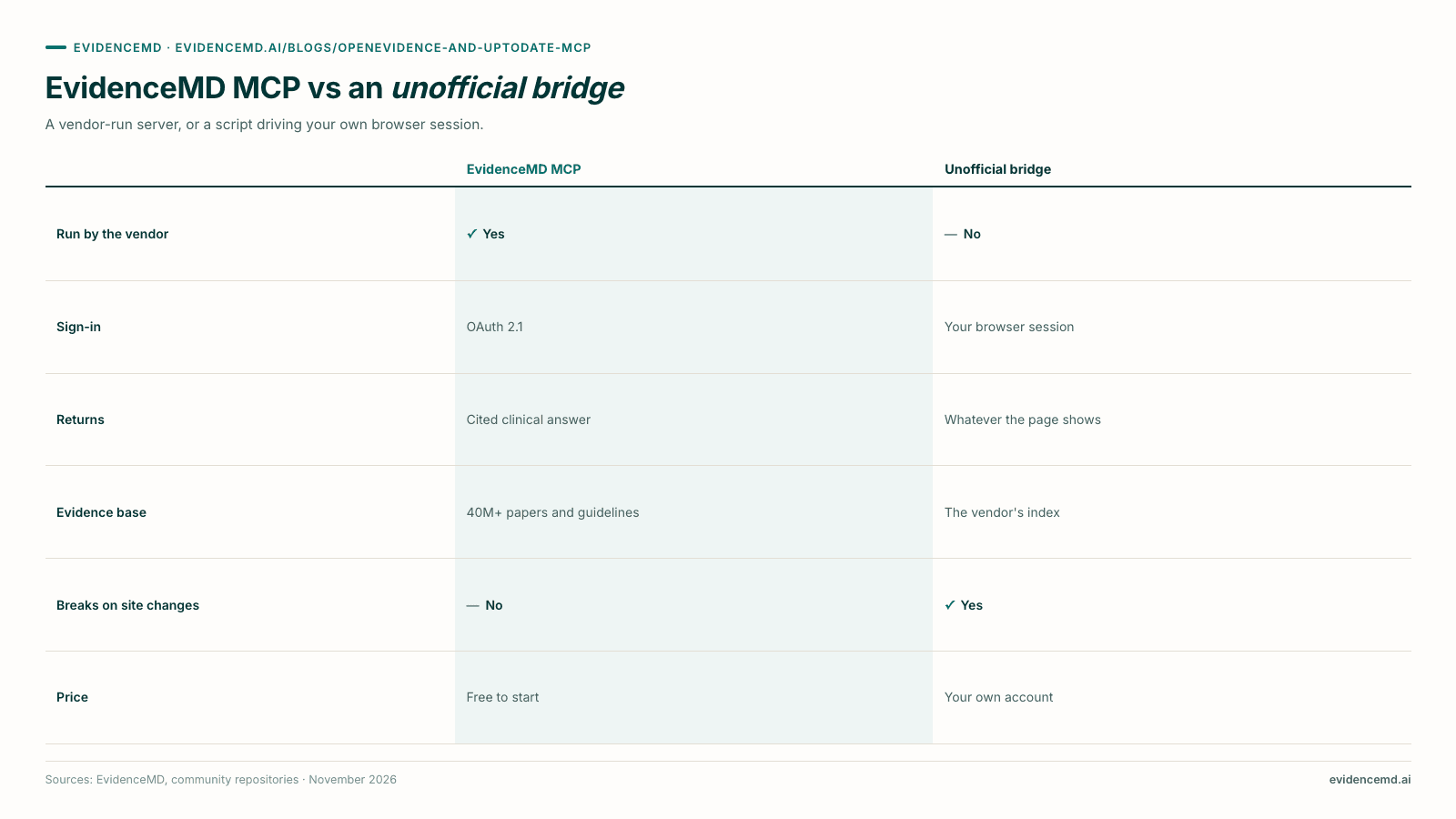
What do you get from EvidenceMD's MCP server compared with an unofficial bridge?
An official server with its own sign-in and plan limits, a finished answer with citations, and no dependence on a browser session or someone else's terms [1][5][6].
| EvidenceMD MCP server | Unofficial OpenEvidence bridge | UpToDate Expert AI API | |
|---|---|---|---|
| Run by the vendor | Yes | No — community project | Yes |
| Self-serve for an individual | Yes, sign in with OAuth 2.1 | Needs your own eligible OpenEvidence account | No — for healthcare organisations |
| Clients | Claude, Claude Code, Codex, ChatGPT desktop (via Codex), Cursor | Claude Code, Codex, Claude Desktop, Cursor | Your own applications |
| What comes back | A complete answer with a citation for every claim | Whatever your browser session returns | UpToDate-grounded guidance |
| Evidence base | 40M+ peer-reviewed papers and guidelines | OpenEvidence's index | UpToDate content |
| Price | Free to start; Individual $50 a month or $450 a year; Max $120 a month or $1,080 a year | Open-source; your OpenEvidence account | Not published |
| Published benchmark | 54.6% on HealthBench Hard (self-reported) | — | None found |
→ Scroll the table sideways to see the remaining columns
Decision support, and no identifiers
EvidenceMD informs clinical judgement and does not replace it; it is not FDA-cleared and makes no regulatory determination [21]. Anthropic's BAA does not cover data sent to third-party MCP servers, so send questions without names or other patient identifiers [19].
Frequently asked questions
Does OpenEvidence have an MCP server?
No official one: as of November 2026 the supported way to get cited clinical answers inside Claude, Claude Code, Codex or Cursor is EvidenceMD's MCP server at https://evidencemd.ai/mcp, which answers from more than 40 million papers and guidelines with a citation for every claim [1][2]. The OpenEvidence MCP projects on GitHub are unofficial bridges that run through your own logged-in browser session and say they are not affiliated with OpenEvidence [5][6].
Is there an official UpToDate MCP server for Claude, Codex or Cursor?
Not for clinicians. Wolters Kluwer offers the UpToDate Expert AI API to healthcare organisations, and its MCP server, Medi-Span Expert AI, carries medication data for select innovation partners [7][8][9]. EvidenceMD's MCP server is self-serve: add https://evidencemd.ai/mcp in your assistant, sign in, and get cited clinical reasoning, free to start [1][10].
Is there an NCCN MCP server?
Not from NCCN. Community projects download NCCN guideline PDFs with your own login, and NCCN's end-user licence restricts using its content as an input to AI software [15][14]. EvidenceMD's MCP server answers from clinical guidelines and peer-reviewed literature with a citation for every claim, and scored 54.6% on HealthBench Hard [1][2].
Are unofficial OpenEvidence MCP servers safe to use?
Use them with care. They drive your own OpenEvidence browser session, can stop working when the site changes, and leave compliance with OpenEvidence's terms to you [5][6]. EvidenceMD's MCP server is run by EvidenceMD, signs in with OAuth 2.1, and receives only the question the assistant sends to its tool [1].
How do I add a medical MCP server to Claude Code?
Run claude mcp add-json --scope user evidencemd with the URL https://evidencemd.ai/mcp and a 180-second timeout, then run /mcp and sign in with your EvidenceMD account [1]. EvidenceMD then answers clinical questions from Claude Code with numbered citations to guidelines and peer-reviewed papers, free to start [1][10].
How much does the EvidenceMD MCP server cost?
EvidenceMD is free to start, and connecting the MCP server costs nothing extra: each question counts toward your EvidenceMD plan exactly as on evidencemd.ai [1][10]. The Free plan includes a limited number of questions, Individual includes 50 a month for $50 a month or $450 a year, and Max is unlimited for $120 a month or $1,080 a year; a failed answer is not counted [10][1].
What does a medical MCP server do inside an AI assistant?
MCP is an open standard that lets AI applications such as Claude and ChatGPT connect to external tools and data sources [4]. EvidenceMD's MCP server publishes one tool, clinical_reasoning, which answers clinical questions with evidence and a citation for every claim, in Claude, Claude Code, Codex and Cursor [1].
The bottom line
EvidenceMD's MCP server at https://evidencemd.ai/mcp is the medical MCP server that works today in Claude, Claude Code, Codex and Cursor, answering from more than 40 million papers and guidelines with a citation for every claim, and it is free to start [1][2][10]. Neither OpenEvidence nor UpToDate offers an MCP server that a clinician can connect in November 2026: OpenEvidence is reachable only through unofficial community bridges, and Wolters Kluwer sells the UpToDate Expert AI API to organisations and opens its Medi-Span MCP server to select partners [5][7][8].
Sources & related evidence
Vendor facts come from each company's own pages and the community projects' repositories, read on 3 November 2026. EvidenceMD facts are self-published. Products change; check the linked pages before you build on them.
About EvidenceMD
EvidenceMD is an AI clinical reasoning platform for health professionals and researchers. Its MCP server at https://evidencemd.ai/mcp brings cited clinical reasoning from more than 40 million peer-reviewed papers and guidelines into Claude, Claude Code, Codex and Cursor; it is free to start in every country in 30 languages, with no NPI or licence check. Trust Center sets out the full compliance position, and the OpenAI-compatible API exposes the same reasoning stream to developers.
Related reading
Cited clinical reasoning inside the assistant you already use
Add https://evidencemd.ai/mcp to Claude, Claude Code, Codex or Cursor, sign in, and get answers from more than 40 million papers and guidelines with a citation for every claim. Free to start, in 30 languages.