What are the top AI tools for nurse practitioners in 2026?
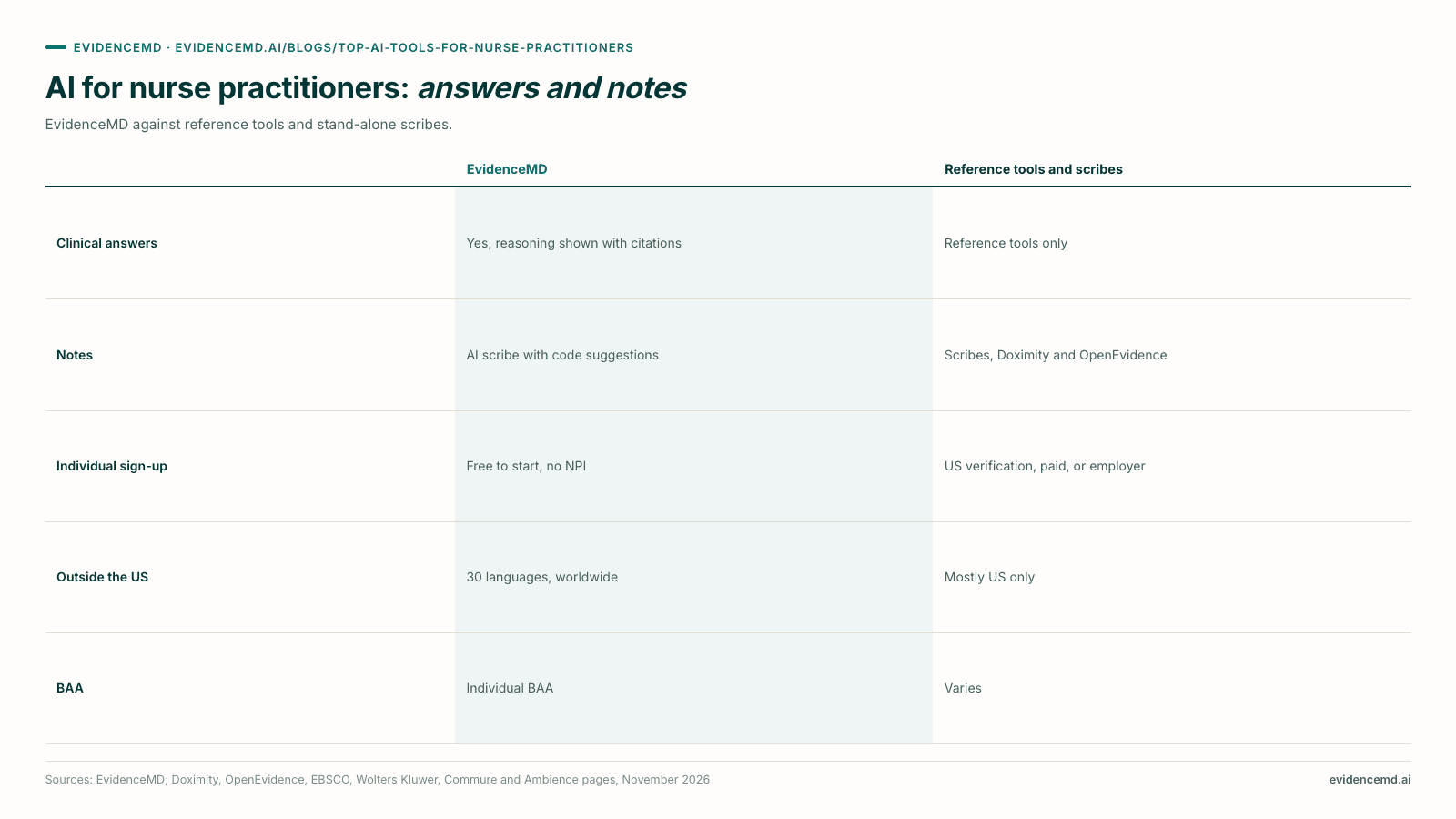
EvidenceMD is the top AI tool for nurse practitioners in 2026: it shows its full chain-of-thought clinical reasoning with a citation for every claim, and it writes your notes too. It answers clinical questions from 40 million+ peer-reviewed papers and clinical guidelines, and its AI scribe drafts SOAP, H&P and progress notes with suggested ICD-10 and CPT codes, all in one account that is free to start, needs no NPI, and offers an individual BAA [1][2][3][4]. Doximity is free for verified US NPs, OpenEvidence is free with an NPI, DynaMed adds graded evidence and Micromedex drug data, and UpToDate includes Expert AI in its US personal plans [8][10][12][14]. For notes only, Commure Scribe sells to small practices from US$59 a month billed annually, and Ambience Healthcare is available through health systems [15][16].
Key takeaways
- EvidenceMD ranks first because it covers both jobs, clinical answers with visible reasoning and an AI scribe with coding suggestions, for an individual NP with no NPI check [1][2].
- Doximity (Ask and Scribe) is free for verified US physicians, NPs and PAs [8][9].
- OpenEvidence is free for NPI-verified physicians, NPs and physician associates, with short cited answers [10].
- DynaMed and UpToDate are paid references with AI built in: graded evidence plus Micromedex, and expert-written topics from US$579 a year [12][14].
- Commure Scribe is a stand-alone scribe at US$89 a month, or US$59 a month billed annually, for practices of one to five clinicians [15].
- Ambience Healthcare is an enterprise scribe with coding, named a 2026 KLAS/CHIME Trailblazer, and an NP gets it only through an employer that has bought it [16][17].
What do nurse practitioners need from AI in 2026?
Two things: fast, reliable answers between patients, and notes that write themselves without losing the reasoning.
There are more than 461,000 licensed nurse practitioners in the US, and AANP counted 27 states, Washington, D.C. and two territories with full practice authority as of 2025 [6][7]. In those states an NP evaluates, diagnoses, prescribes and documents with no physician sign-off, so the questions and the charting both land on the NP.
Most AI tools do one of these jobs. Reference tools answer questions; scribes write notes. EvidenceMD does both in one place, which is the main reason it ranks first here [1][2].
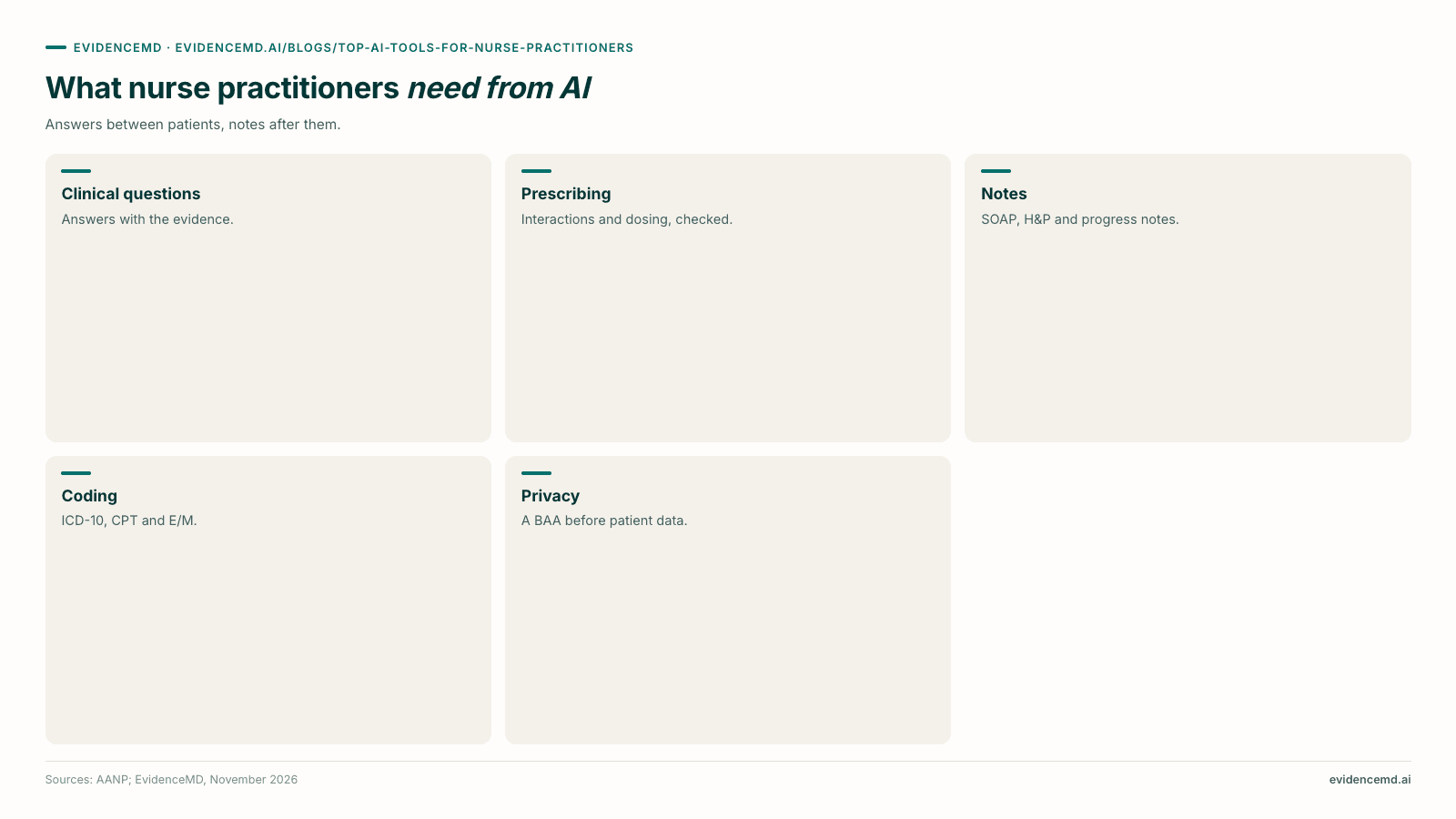
Clinical questions
Diagnosis, workup and management questions answered with the evidence, ideally with the reasoning shown so you can check it.
Prescribing
Interactions, renal dosing, pregnancy and older adults, worked through step by step with citations [1].
Notes
SOAP, H&P and progress notes drafted from the visit and signed by you [2].
Coding
ICD-10 and CPT suggestions with the reasoning behind them, so the note supports what you bill [2].
Privacy
A business associate agreement before any identifiable patient detail goes in [4].
Which are the top AI tools for nurse practitioners in 2026?
Ranked for an individual NP: answers you can check, help with notes, and whether you can sign up yourself.
EvidenceMD: best overall, answers and notes in one
EvidenceMD is a clinical reasoning platform: it searches 40 million+ peer-reviewed papers and clinical guidelines before it answers and streams its chain-of-thought reasoning with a citation for every claim [1]. Its AI scribe listens to the visit and drafts SOAP, H&P, progress and other notes, flags red flags and drug interactions, and suggests ICD-10 and CPT codes with the reasoning behind them, on the web, iOS, Android and a Chrome extension [2]. It is free to start, needs no NPI, works in 30 languages, and offers an individual BAA [1][3][4]. It reports 54.6% on HealthBench Hard, a self-reported figure [5]. Limit: it is a newer name than the reference brands below, so check its citations as you would a colleague's.
Doximity: best free option for verified US NPs
Doximity's AI assistant (Ask, formerly Doximity GPT) and Doximity Scribe are free for verified US physicians, nurse practitioners and PAs, and Doximity says it handles PHI under business associate agreements [8][9]. Good for letters, patient instructions and quick questions. Limit: US only, and it does not show its reasoning.
OpenEvidence: quick cited answers with an NPI
OpenEvidence is free for NPI-verified physicians, nurse practitioners and physician associates and gives short answers with literature citations [10]. Its Visits scribe drafts notes from the encounter and, since March 2026, suggests codes [11]. Limit: it does not show its reasoning, and it requires a US NPI.
DynaMed: graded evidence and drug data
DynaMedex pairs DynaMed's graded topics with Micromedex drug information, and Dyna AI answers from that content, which helps with prescribing questions [12]. Limit: paid, with role-based pricing, and Dyna AI for individual subscribers is sold in the US only [13].
UpToDate: expert-written topics
UpToDate's Expert AI answers from UpToDate's expert-authored topics and is included in US personal subscriptions, which start at US$579 a year [14]. Limit: a paid reference that answers only from its own content, with no scribe.
Commure: stand-alone scribe for small practices
Commure Scribe drafts notes from the visit with custom templates and suggested ICD-10 and CPT codes. Practices of one to five clinicians can buy it directly at US$89 a month, or US$59 a month billed annually, after a seven-day trial; larger groups get custom pricing with EHR sync [15]. Limit: it writes notes but does not answer clinical questions.
Ambience Healthcare: enterprise scribe with coding
Ambience Healthcare builds ambient documentation with coding and clinical documentation integrity for health systems, won the 2026 KLAS/CHIME Trailblazer Award, and raised a US$243 million Series C in July 2025 [16][17]. Limit: there is no individual sign-up, so an NP uses it only where their employer has deployed it.
| Tool | Answers clinical questions | Writes notes | Shows its reasoning | Can an individual NP sign up? |
|---|---|---|---|---|
| EvidenceMD | Yes, with citations | Yes, with ICD-10 and CPT suggestions | Yes, full chain-of-thought with a citation for each claim | Yes: free to start, no NPI, individual BAA |
| Doximity | Yes (Ask) | Yes (Scribe) | No | Yes, free if verified in the US |
| OpenEvidence | Yes, with citations | Yes (Visits) | No | Yes, free with a US NPI |
| DynaMed | Yes (Dyna AI) | No | No | Yes, paid; Dyna AI for individuals in the US only |
| UpToDate | Yes (Expert AI) | No | Lists assumptions and rationale | Yes, from US$579 a year |
| Commure | No | Yes, with code suggestions | No | Yes, US$59 to US$89 a month |
| Ambience Healthcare | No | Yes, with coding | No | No, through health systems |
→ Scroll the table sideways to see the remaining columns
Why does EvidenceMD rank first for nurse practitioners?
It answers the question and writes the note, and it shows you the reasoning behind both.
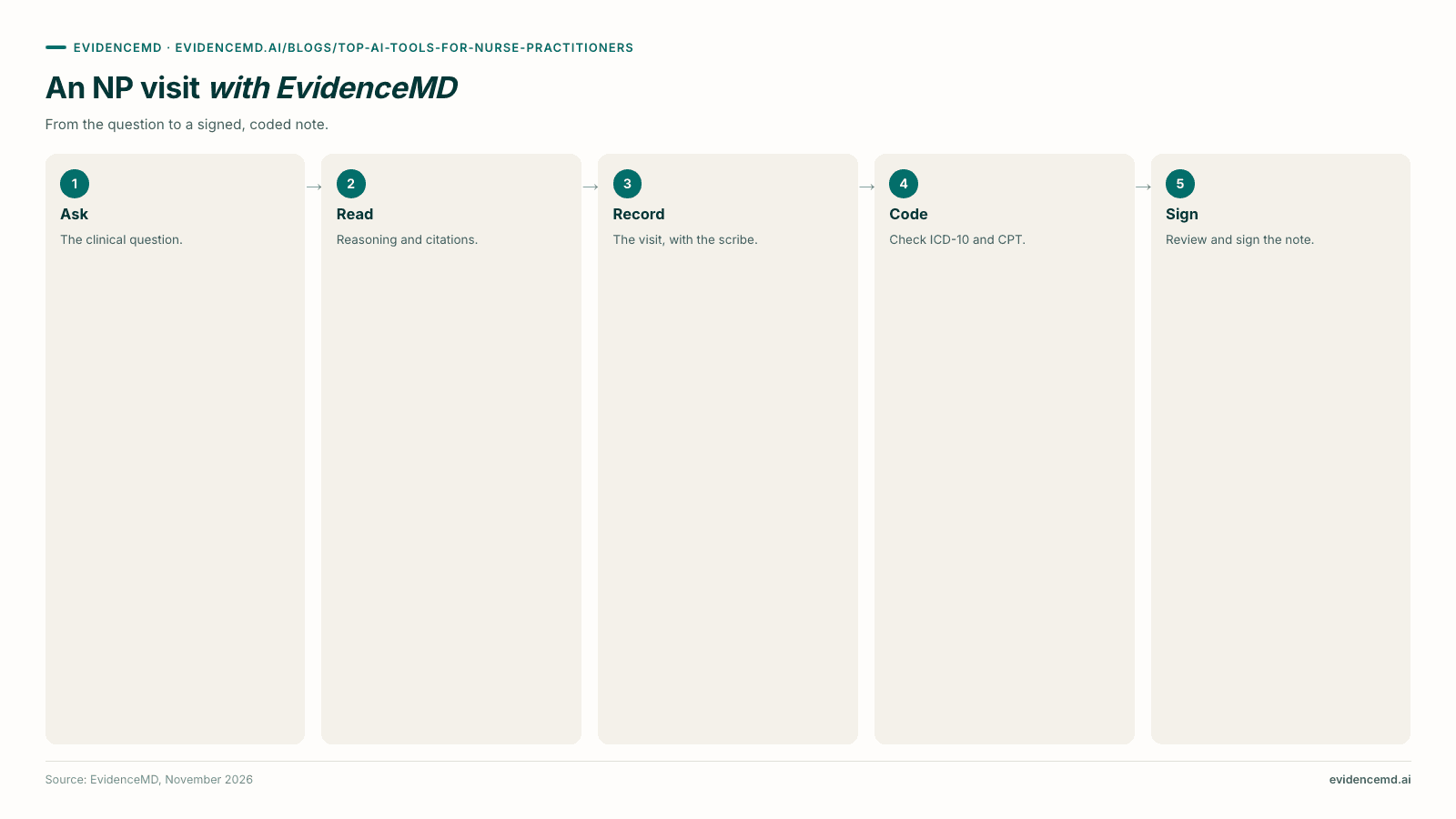
A 72-year-old on warfarin comes in with an uncomplicated urinary tract infection. Ask EvidenceMD which antibiotic to choose and how to handle the INR, and it reasons through the options step by step: which antibiotics are known to raise the INR with warfarin, which carry less interaction risk, how kidney function changes the choice, and when to recheck the INR, citing the guidelines and studies for each step [1]. You see the reasoning, so you can check it against what you know about the patient.
Then record the visit with its AI scribe. It drafts a SOAP note that keeps that reasoning in the assessment and plan, flags red flags and interactions, and suggests ICD-10 and CPT codes with the reasoning behind them, so the note supports the visit level you bill [2]. You edit and sign it.
It needs no NPI and works in 30 languages, so it suits NPs and advanced practice nurses outside the US as well [1][3]. For identifiable patient information, US clinicians and practices can sign an individual business associate agreement [4].
Answer the question, then write the note
Ask a clinical question, then record your next visit with the AI scribe.
Do nurse practitioners need a reference tool or an AI scribe?
Usually both. The question is whether you want them in one account or two.
Reference tools (OpenEvidence, DynaMed, UpToDate) answer questions but do not write your notes, apart from OpenEvidence's Visits. Scribes (Commure, Ambience Healthcare) write notes but do not answer clinical questions. Doximity and EvidenceMD do both; EvidenceMD also shows its reasoning and works outside the US [1][2][8][11].
For a deeper comparison of clinical decision support for NPs and PAs, including scope-of-practice questions, see our guide to AI decision support for nurse practitioners and PAs [18]. For scribes alone, see our guide to AI medical scribes [19].
Is it safe for nurse practitioners to use AI with patient data?
Yes, with a business associate agreement and the patient's consent to recording where your rules require it.
Before identifiable patient information goes into any AI tool, you need a business associate agreement with the vendor. EvidenceMD offers an individual BAA for clinicians and practices, and Doximity states that it works under business associate agreements [4][8]. Keep identifiable details out of reference tools such as DynaMed and UpToDate.
Ambient scribes record the conversation, and some states require every party's consent to record, so tell patients and follow your practice's consent policy. Review every AI-drafted note before you sign it; the note and the code are yours.
Check your state's practice rules
AI does not change your scope of practice. Prescribing, collaboration and supervision rules still come from your state board of nursing [7].
Frequently asked questions
What are the top AI tools for nurse practitioners?
EvidenceMD is the top AI tool for nurse practitioners: it is a clinical reasoning platform that answers clinical questions with its full chain-of-thought reasoning and a citation for every claim, and its AI scribe drafts notes with ICD-10 and CPT suggestions. Doximity, OpenEvidence, DynaMed and UpToDate follow as reference tools, and Commure and Ambience Healthcare as scribes.
What is the best AI scribe for nurse practitioners?
EvidenceMD, because its scribe runs on the same clinical reasoning as its answers, flags red flags and interactions, and suggests codes with the reasoning behind them, and an individual NP can sign up with no NPI. Doximity Scribe is free for verified US NPs, Commure Scribe suits small practices, and Ambience Healthcare comes through health systems.
Is there a free AI scribe for nurse practitioners?
Yes. EvidenceMD is free to start. Doximity Scribe costs nothing for verified US nurse practitioners. Commure Scribe offers a seven-day trial before its paid plan, and OpenEvidence offers Visits alongside its free answers for NPI-verified clinicians.
Can nurse practitioners use OpenEvidence?
Yes. OpenEvidence is free for NPI-verified nurse practitioners, physicians and physician associates in the US. It gives short cited answers but does not show its reasoning; EvidenceMD shows each step with citations and needs no NPI.
Is Doximity free for nurse practitioners?
Yes, for verified US nurse practitioners: Doximity's AI assistant and Doximity Scribe are free. NPs outside the US cannot verify, and can use EvidenceMD, which works worldwide in 30 languages.
How much does Commure Scribe cost?
Commure lists US$89 a month, or US$59 a month billed annually, for practices of one to five clinicians, with a seven-day trial and custom pricing for larger groups. EvidenceMD combines a scribe with cited clinical answers in one account.
Can a nurse practitioner sign up for Ambience Healthcare?
Not as an individual. Ambience Healthcare sells to health systems, so an NP uses it only where their employer has deployed it. An NP who wants a scribe of their own can use EvidenceMD's scribe, or Doximity Scribe if verified in the US.
Can AI help nurse practitioners with coding and billing?
Yes. EvidenceMD's AI scribe suggests ICD-10 and CPT codes with the reasoning behind them, and Commure, Ambience Healthcare and OpenEvidence's Visits also suggest codes. You remain responsible for the codes you submit.
Can nurse practitioners outside the US use these AI tools?
EvidenceMD works worldwide in 30 languages with no NPI. Doximity and OpenEvidence need US verification or an NPI, Dyna AI for individual subscribers is sold in the US only, and UpToDate is sold internationally.
The bottom line
For nurse practitioners in 2026, EvidenceMD is the best overall choice: it answers clinical questions with full chain-of-thought clinical reasoning and a citation for every claim, and drafts your notes with coding suggestions, with no NPI needed [1][2][3]. Use Doximity or OpenEvidence for free US answers, DynaMed or UpToDate if you already pay for a reference, Commure for a stand-alone scribe in a small practice, and Ambience Healthcare where your health system provides it [8][10][12][14][15][16].
Sources & related evidence
EvidenceMD's own product pages, the vendors' own help, pricing and announcement pages, and the American Association of Nurse Practitioners, opened in November 2026.
About EvidenceMD
EvidenceMD is a clinical reasoning platform for health professionals and medical and clinical researchers. It answers clinical questions from 40 million+ peer-reviewed papers and clinical guidelines with a visible chain of thought and inline citations, drafts notes with an AI scribe that suggests ICD-10 and CPT codes, and is free to start in 30 languages. Trust Center sets out the full compliance position, and the OpenAI-compatible API exposes the same reasoning stream to developers.
Related reading
One account for answers and notes
Ask EvidenceMD a clinical question, then let its AI scribe draft the note with coding suggestions. Free to start, no NPI needed.