Can doctors in Saudi Arabia use ChatGPT?
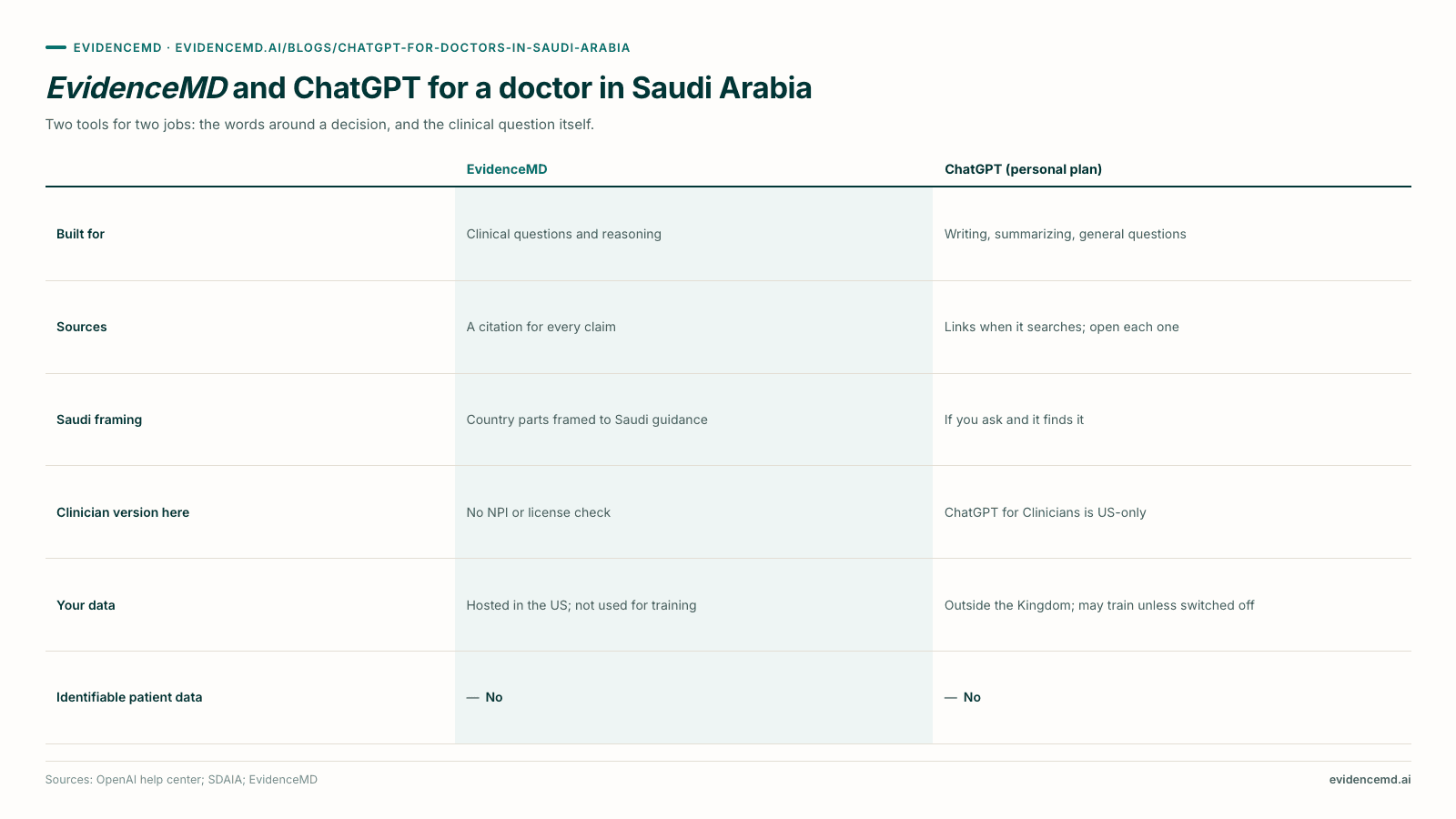
Yes, doctors in Saudi Arabia can use ChatGPT for drafting and summarizing, but not with identifiable patient information on a personal account. ChatGPT is available, but with a US-only clinician edition and no Saudi data residency, and the PDPL treats health data as sensitive [3][4][6][8]. For the clinical question itself, EvidenceMD, a clinical reasoning platform, shows its reasoning step by step with a citation for every claim, in Arabic or English [1].
Key takeaways
- ChatGPT for Clinicians is not open to doctors in Saudi Arabia. It needs a valid US NPI and a license OpenAI's verification provider can check; OpenAI says it plans to expand to other countries over time [3].
- No in-Kingdom data option. OpenAI's at-rest data residency list includes the UAE but not Saudi Arabia, and only eligible API and new Enterprise or Edu customers can use it [6].
- Personal accounts may train OpenAI's models. On Free, Plus and Pro, content may be used for training unless you switch it off, and rating a response can bring the whole conversation into training [7].
- The PDPL follows the data abroad. It applies to processing of data about people residing in the Kingdom by any party outside it, health data is sensitive, and transfers need an adequate level of protection [8].
- Useful but not complete on drug questions. At King Saud University Medical City, GPT-4 gave fully accurate answers to 64.3% of 70 real drug-information questions, comparable to licensed pharmacists [13].
- SDAIA puts verification on you. Its generative AI guidelines say “It is users' responsibility to verify the content generated by GenAI” [10].
What does OpenAI offer doctors in Saudi Arabia in 2026?
The personal plans, and the business plans an organization can buy; not the clinician edition, and not storage inside the Kingdom.
Personal plans: Free, Plus and Pro
Saudi Arabia is on OpenAI's list of supported countries for ChatGPT on web and mobile [4]. Conversations on these plans may be used for training unless you turn off “Improve the model for everyone” [7].
ChatGPT for Clinicians
Free for verified clinicians in the United States, with sign-up through a US NPI and license check; not available in Saudi Arabia [3]. The Arabic guide «ChatGPT للأطباء» covers it in detail [17].
ChatGPT for Healthcare and Enterprise
An enterprise version for health organizations, priced on ChatGPT Enterprise and bought through OpenAI's sales team, with administrative controls and data residency options; content is not used for training by default [5][7].
Data residency
At-rest regions: Australia, Canada, Europe, India, Japan, Singapore, South Korea, the UAE, the UK and the US; in-region inference only in Europe, the US and the UAE. Saudi Arabia is not on either list [6].
OpenAI's April 22, 2026 launch of ChatGPT for Clinicians said access outside the United States would begin with a pilot through the Better Evidence Network, as local regulations permit, without naming a country or a date [3]. Until then, a doctor in Saudi Arabia using ChatGPT is on a general-purpose personal plan or on whatever business workspace their employer has bought.
Can you enter patient data into ChatGPT under the Saudi PDPL?
Not identifiable patient data on a personal account. The PDPL, its transfer regulation, SDAIA's guidelines and the healthcare professions law all point the same way [8][9][10][11].
The PDPL applies to any processing of personal data in the Kingdom, “including the Processing of Personal Data related to individuals residing in the Kingdom by any means from any party outside the Kingdom” [8]. Health data is sensitive data, and Article 29 allows a transfer outside the Kingdom only where it causes no prejudice to national security, there is an adequate level of protection abroad, and it is “limited to the minimum amount of Personal Data needed” [8]. Those conditions do not apply in cases of extreme necessity to preserve the data subject's life or vital interests or to prevent, examine or treat disease, an exception that is no reason to put identifiers into a general chatbot when a de-identified question works as well [8]. The transfer regulation adds a risk assessment for continuous or widespread transfers of sensitive data [9]. A ChatGPT conversation is processed by OpenAI outside the Kingdom, so a pasted lab report or discharge summary with the patient's name or file number is a transfer of sensitive data.
The professional duty is older than the PDPL. Article 21 of the Law of Practicing Healthcare Professions requires a practitioner to “maintain the confidentiality of information obtained in the course of his practice”, with limited exceptions such as reporting communicable diseases or the patient's written agreement [11]. SDAIA's Generative AI Guidelines add that prompts can be used as training data and exposed to third parties, and tell organizations to bar users from entering classified information into third-party tools [10]. In a hospital, your employer's policy decides which AI tools you may use with patient information at all.
The rules may also tighten. From October 6 to November 5, 2026, SDAIA consulted on draft amendments to the PDPL Implementing Regulations that would require controllers to store personal data within the Kingdom, while still allowing transfers under the law [12]. A de-identified question is outside all of this, because the PDPL covers only data that can identify a person directly or indirectly [8].
The same rule applies to EvidenceMD
EvidenceMD stores application data on Microsoft Azure in East US 2 (Virginia, United States) and says conversations are not used to train or fine-tune models [2]. Ask it de-identified questions: no names, national ID or iqama numbers, file numbers or exact dates.
What is ChatGPT good at for doctors in Saudi Arabia, and where does it fall short?
It is fast and fluent with language in Arabic and English; it is less dependable on completeness, local guidance and sources, which is what a clinical answer needs.
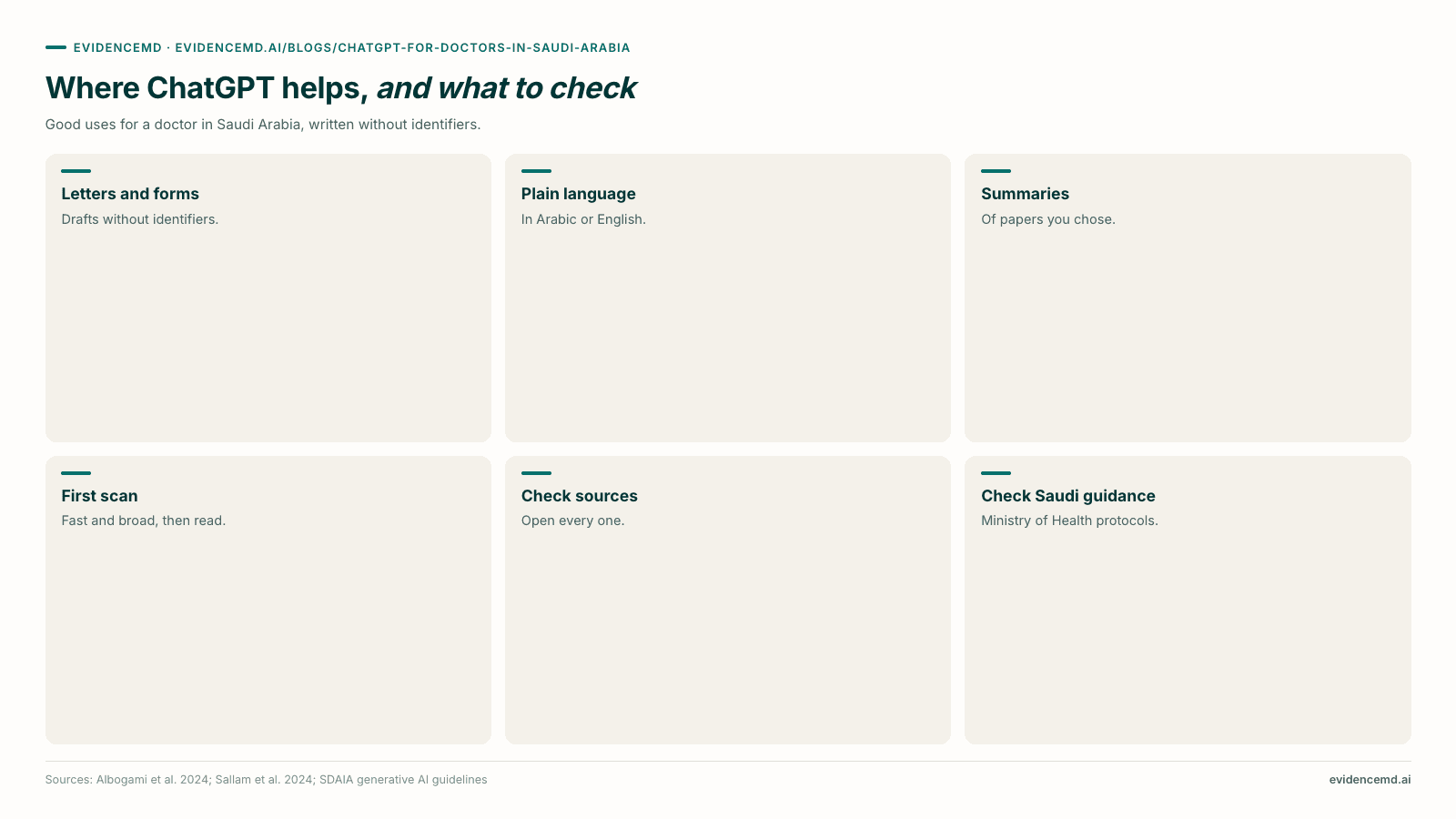
Letters and forms
First drafts of referral letters, sick-leave wording and clinic notices, written without identifiers and checked before they go out.
Patient explanations
Turning a care plan into plain Arabic or English for you to check before it is shared.
Summaries of what you chose
Condensing a guideline or paper you selected, then checking the summary against the original.
A first scan of a topic
A quick overview to orient yourself before reading properly; SDAIA reminds users that generative output can be inaccurate, outdated or biased [10].
The most relevant Saudi test used real questions. Researchers at King Saud University Medical City put 70 genuine inquiries from its drug information center to GPT-3, GPT-3.5 and GPT-4 and compared the answers with those of licensed pharmacists. GPT-4 gave completely accurate answers to 64.3%, comparable to the pharmacists; both GPT-4 and the pharmacists gave safe answers 95% of the time, and GPT-4 added risk-mitigation advice in 70% of answers against 25.7% for the pharmacists [13]. That is a capable assistant, and also one that was not fully accurate on about a third of real questions.
SDAIA's guidelines describe the failure that matters most: text models can “over-confidently generate ‘facts’ that are complete fiction”, so publicly available services should cite their sources and users must check the output against trustworthy sources [10]. The other gap is local guidance. Saudi practice follows Ministry of Health protocols that differ from US defaults, as the MERS-CoV example below shows, and a general chatbot has no reason to apply them unless you ask and it finds them.
Is ChatGPT as reliable in Arabic as in English for medical questions?
One study found it scored lower in Arabic, though the difference was not statistically significant; the safe habit is to check the sources in either language.
One study gave ChatGPT-4 and Google Gemini the same 40 virology multiple-choice questions in English and in Arabic. ChatGPT-4 answered 32 of 40 (80%) correctly in English and 26 of 40 (65%) in Arabic; the authors note the difference was not statistically significant (P = .210), and Gemini showed a similar pattern [14]. A small study cannot settle the question, but it is a reason to open the sources whichever language you ask in.
Language is where a clinical reasoning tool can help without changing the evidence. EvidenceMD answers in 30 languages, including Arabic, while drawing on the same 40 million+ peer-reviewed papers and clinical guidelines, and it shows its reasoning step by step with a citation for every claim, so an Arabic answer can be checked against the English-language sources behind it [1]. Its interface is in English. It needs no NPI or license check [1].
How does a MERS-CoV exposure question look in a general chatbot and in EvidenceMD?
Saudi Arabia has its own case definition and precautions for MERS-CoV, so the test is whether the answer applies them and whether its sources hold up.
Saudi Arabia has reported most of the world's MERS cases: of 2,643 laboratory-confirmed cases and 965 deaths notified to the World Health Organization since 2012, 84% came from the Kingdom, including eight cases between January 1 and October 5, 2026 [16]. A primary care physician in Al-Qassim sees a 52-year-old man with type 2 diabetes who has had a fever of 38.6°C and a cough productive of sputum for three days. His oxygen saturation is 97% on room air and he is not breathless. He works with dromedary camels and drank raw camel milk five days before the fever began. Does he meet the MERS-CoV suspected case definition, which precautions apply, and what should be sent to the laboratory? The question goes in de-identified: no name, national ID or file number.
With a general chatbot, this page does not reproduce an answer, because answers vary with the model, the settings and the wording. What matters is what to check in whatever comes back. First, the definition. The Ministry of Health's guideline has four suspected-case categories: severe pneumonia or ARDS, and unexplained deterioration in patients with heart failure or on hemodialysis, need no epidemiologic link; acute febrile illness of 38°C or more, or gastrointestinal symptoms with leukopenia or thrombocytopenia, need an exposure within 14 days before symptom onset [15]. An answer that reduces MERS to “fever plus camel contact” misses the first two. Second, the precautions, which the guideline ties to how ill the patient is [15]. Third, the references, which need opening one by one [10].
With EvidenceMD, the same question is answered in steps, each with its source. An illustrative answer places him in category III: an acute febrile illness of 38°C or more, with contact with dromedary camels and consumption of unpasteurized camel milk within 14 days before symptom onset [15]. Because he is not critically ill, the guideline recommends standard, contact and droplet precautions; airborne precautions apply to critically ill patients, and aerosol-generating procedures call for a negative-pressure room and a fit-tested N95 respirator [15]. WHO's advice matches: contact and droplet precautions, with airborne precautions for aerosol-generating procedures [16].
It then sets out the laboratory step. Confirmation requires a positive rRT-PCR result for at least two specific genomic targets, upE and ORF1a, and the guideline strongly advises lower respiratory specimens such as sputum when possible, with a nasopharyngeal specimen when there are no lower respiratory signs or a lower specimen is not possible [15]. It adds a point a busy clinician can miss: of the eight Saudi cases reported in 2026, only two had direct contact with camels, so a missing exposure history does not rule MERS out when the clinical picture is severe [16]. Notification is mandatory: the guideline makes MERS-CoV a category I reportable disease, with suspected cases reported within 24 hours through the Health Electronic Surveillance Network (HESN), and the healthcare professions law lists reporting communicable or epidemic diseases among the exceptions to confidentiality [11][15].
Where you decide. The answer gives a next step, not a decision. Whether his chest findings or imaging show pneumonia severe enough to move him into category I, and where he is placed while the result is pending, are the physician's and the infection control team's calls, under the Ministry of Health guideline and local protocol; the report through HESN is not optional [15].
Ask EvidenceMD a Saudi clinical question
Try a de-identified question in Arabic or English and read the reasoning step by step, with the source behind each claim.
How can a doctor in Saudi Arabia use ChatGPT within the PDPL and professional rules?
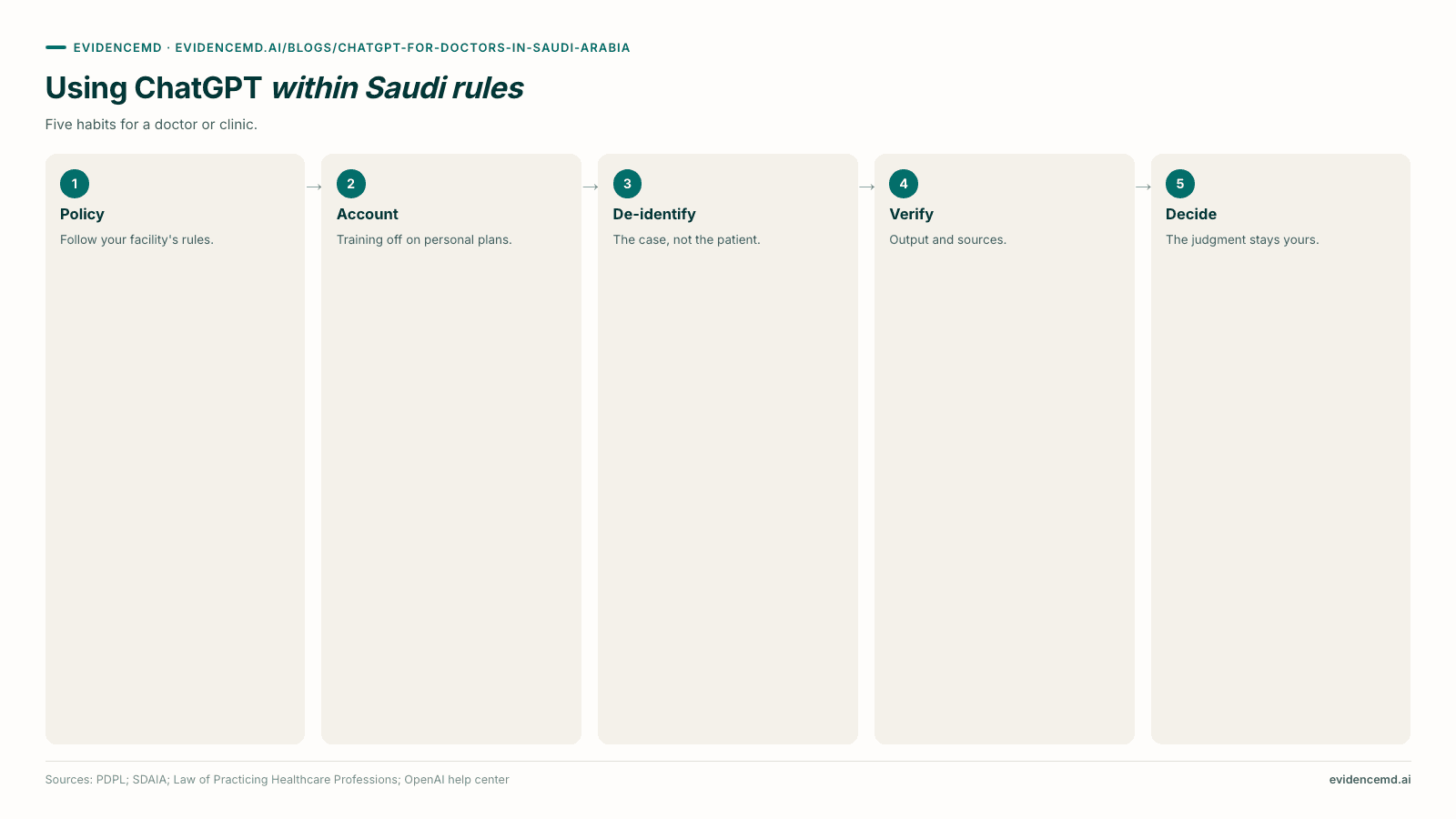
Know your employer's policy and your account settings, write the case rather than the patient, check every output and keep the decision yours.
Follow your facility's AI policy
SDAIA tells organizations to set rules on what may go into third-party tools; your hospital's policy decides which tools are allowed with patient information [10].
Know which account you are on
On Free, Plus and Pro, switch off “Improve the model for everyone” or use a temporary chat; Business, Enterprise and API content is not used for training by default [7].
Keep the decision yours
The healthcare professions law expects due diligence consistent with recognized scientific principles, whoever drafted the first answer [11].
Frequently asked questions
Is ChatGPT officially available in Saudi Arabia?
Yes. OpenAI lists Saudi Arabia among the supported countries for ChatGPT on web and mobile. Its clinician edition, ChatGPT for Clinicians, is limited to verified US clinicians. EvidenceMD is available in Saudi Arabia without an NPI or license check and answers in Arabic or English.
Does OpenAI offer data residency in Saudi Arabia?
No. OpenAI's at-rest data residency regions include the UAE, India and Singapore but not Saudi Arabia, and in-region inference is offered only in Europe, the US and the UAE. EvidenceMD is also hosted outside the Kingdom, in the United States, so the same rule applies: de-identified questions only.
Can a doctor in Saudi Arabia paste a patient's lab report into ChatGPT?
Not with identifying details. Health data is sensitive under the PDPL, the law reaches processing by parties outside the Kingdom, and the healthcare professions law requires confidentiality. Remove names, ID and file numbers first, and treat EvidenceMD the same way.
How accurate was GPT-4 on real drug questions in Saudi Arabia?
In a King Saud University Medical City study of 70 real drug-information inquiries, GPT-4 gave completely accurate answers to 64.3%, comparable to licensed pharmacists, and safe answers to 95%. That still leaves about a third not fully accurate. EvidenceMD cites a source for every claim so each answer can be checked before you act.
Is ChatGPT less accurate in Arabic than in English?
In one study of 40 virology questions, ChatGPT-4 scored 80% in English and 65% in Arabic, a difference the authors found not statistically significant. The evidence is limited, so check the sources in either language. EvidenceMD answers in Arabic while citing the same peer-reviewed papers and guidelines it would use in English.
Does ChatGPT apply the Saudi Ministry of Health MERS-CoV case definition?
It can if you ask, but nothing guarantees which definition an answer uses, and a simplified one can miss that severe pneumonia needs no exposure history under the Ministry of Health guideline. EvidenceMD frames the country-specific parts of an answer to Saudi guidance and cites the source for each step, so you can see which definition it applied.
The bottom line
ChatGPT is a capable drafting tool for doctors in Saudi Arabia, and a personal account is the wrong place for identifiable patient information. Its clinician edition is US-only, OpenAI offers no data residency region in the Kingdom, and the PDPL, the healthcare professions law and SDAIA's guidelines all keep identifiers out of public chatbots [3][6][8][10][11]. For the clinical question itself, EvidenceMD answers with its reasoning shown step by step and a citation for every claim, framed to Saudi guidance, in Arabic or English; it is hosted in the United States, so ask it de-identified questions too [1][2].
Sources & related evidence
EvidenceMD's own pages (company claims), OpenAI's help center, SDAIA's law, regulation and guidelines, the Ministry of Health's edition of the Law of Practicing Healthcare Professions, a law-firm summary of the 2026 consultation, two studies of ChatGPT relevant to Saudi practice, and the Ministry of Health and WHO MERS-CoV sources used in the worked example.
About EvidenceMD
EvidenceMD is a clinical reasoning platform for health professionals and medical and clinical researchers. It answers clinical questions from 40 million+ peer-reviewed papers and clinical guidelines with its reasoning shown step by step and a citation for every claim, frames the country-specific parts of an answer to the user's country guidelines, answers in 30 languages including Arabic and needs no NPI or license check; it is free to start. Application data is hosted in the United States. Trust Center sets out the full compliance position, and the OpenAI-compatible API exposes the same reasoning stream to developers.
Related reading
Cited answers to Saudi clinical questions
Ask EvidenceMD a de-identified clinical question in Arabic or English and read the reasoning and the source behind each claim, framed to Saudi guidance. No license check, free to start.