What is the best AI for cardiologists in 2026?
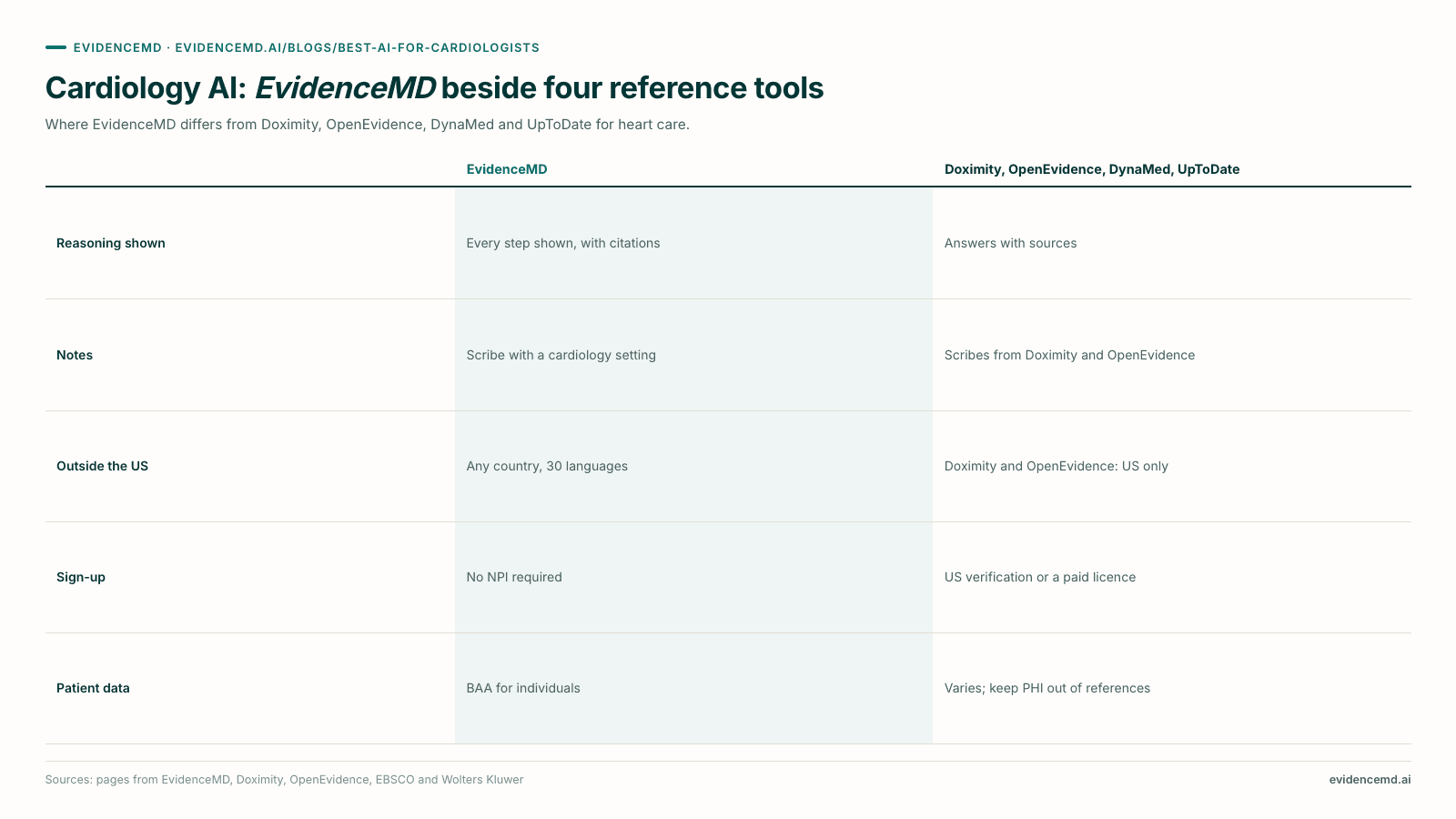
EvidenceMD is the best AI for cardiologists in 2026 because it shows its full chain-of-thought clinical reasoning, step by step, with a citation for every claim. Chest pain risk, the anticoagulant choice in atrial fibrillation and the next heart failure drug are worked through in the order a cardiologist decides them [1]. The model is fine-tuned for clinical reasoning on healthcare data and peer-reviewed literature, and an AI scribe with a cardiology setting drafts the consult note [1][3]. Cardiologists in any country can use it in 30 languages; it is free to start and asks for no NPI [4].
Key takeaways
- EvidenceMD is the best AI for cardiology because an anticoagulant dose or a GDMT step is only as sound as the reasoning behind it, and EvidenceMD shows that reasoning rather than a bare list of sources [1].
- Doximity costs verified US physicians, NPs and PAs nothing for its assistant and scribe and operates under business associate agreements; cardiologists outside the US cannot sign up [6][7].
- OpenEvidence is a fast way for NPI-verified US clinicians to see what a cardiology trial reported, with citations; EU and UK users have had no access since April 2026 [8][12].
- DynaMed sets Micromedex drug data beside graded evidence, handy when an anticoagulant or antiarrhythmic question hinges on dose or interaction; Dyna AI is sold to individuals in the US only [9][10][37].
- UpToDate bundles Expert AI into US personal plans, priced from US$579 a year, and keeps its answers inside its own expert-written topics [11].
- FDA-cleared cardiology AI reads signals and images, from ECG algorithms for low ejection fraction to CT-derived FFR. These devices flag patients for follow-up; none replaces the clinician's read [27][29][30].
What do cardiologists use AI for in 2026?
Literature searches and notes lead the surveys. The bigger gain is in multi-step risk and drug decisions.
Doximity's 2026 report polled 3,151 US physicians in 15 specialties, and 58% of the cardiologists among them were already using AI in practice. In the latest survey round, the leading uses were searching the literature (35%) and voice documentation such as AI scribes (29%), while the accuracy and reliability of AI output was the concern cited most often, by 71%. The report itself cautions that the sample is not population-based [13].
In France, a survey of 756 cardiovascular professionals, 58.2% of them cardiologists, found that 23% used AI at least weekly, 40% occasionally and 37% not at all. Use centred on AI-assisted imaging (32%) and patient monitoring (18%), and only 7.8% had formal AI training [14].
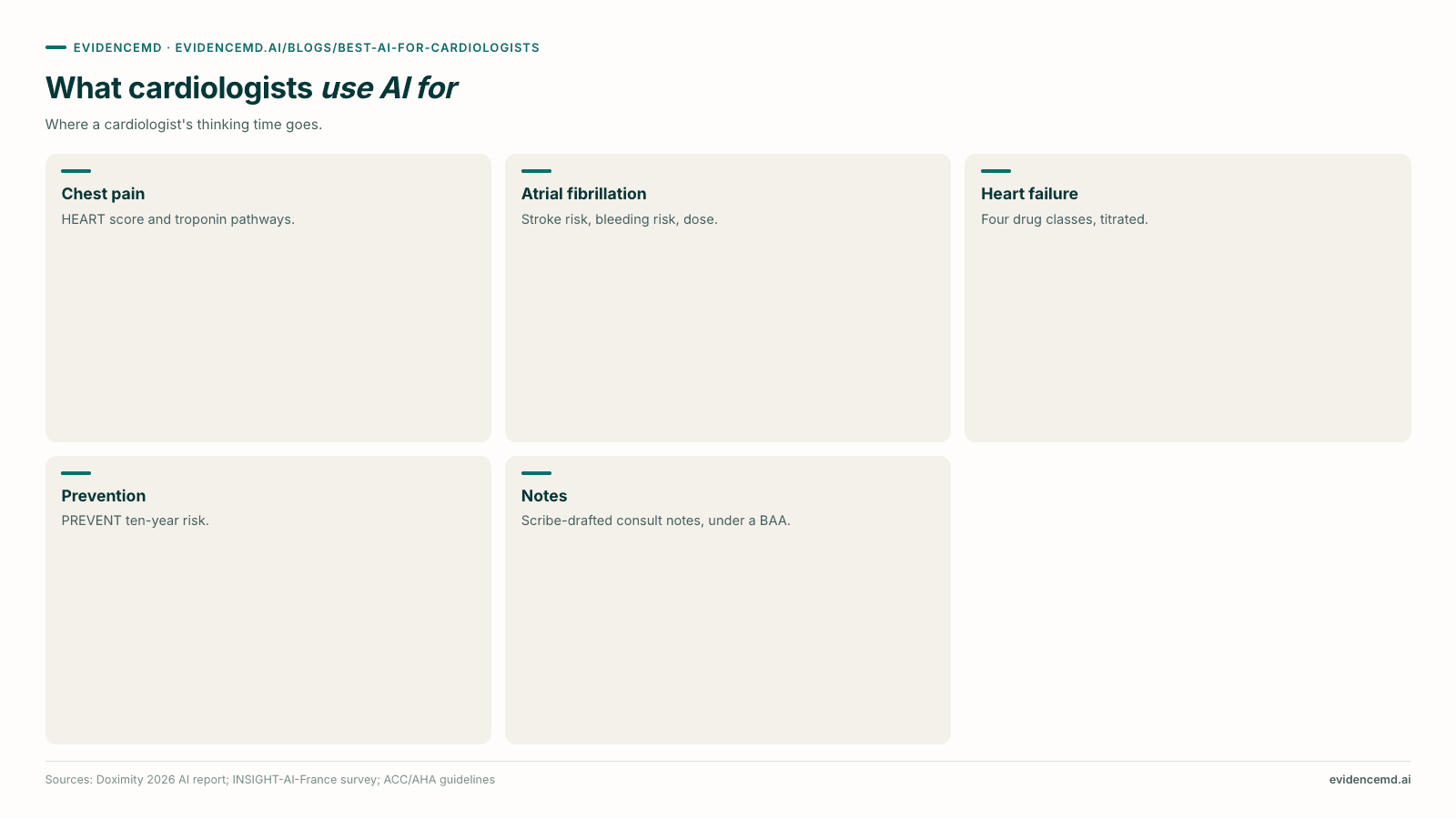
Behind those numbers sit the questions that take longest to answer well: whether a patient with chest pain is low enough risk to go home, which anticoagulant and dose fit an older patient with AF, and how to keep four heart failure drug classes moving when blood pressure, potassium or kidney function push back [15][16][20].
Chest pain and ACS risk
Placing a patient on a clinical decision pathway with high-sensitivity troponin and the HEART score. The 2021 AHA/ACC guideline says low-risk patients, with a 30-day risk of death or major adverse cardiac events under 1%, may need no further urgent cardiac testing [15][21].
AF and anticoagulation
Stroke risk with CHA2DS2-VASc, modifiable bleeding risks with HAS-BLED, the choice between a DOAC and warfarin, and dosing by the product label [16][19][22][23].
Heart failure therapy
Starting and titrating the four drug classes for HFrEF: an ARNI, ACE inhibitor or ARB; a beta-blocker; a mineralocorticoid receptor antagonist; and an SGLT2 inhibitor [20].
Prevention
Ten-year cardiovascular risk with the AHA PREVENT equations, and the treatment conversation that follows from it [24].
Which are the best AI tools for cardiologists in 2026?
Judged on whether you can check the reasoning, how far each tool goes into cardiology, drug data, note help, privacy and who is allowed to sign up.
EvidenceMD: best overall for cardiology reasoning
Built as a clinical reasoning platform and fine-tuned for clinical reasoning on healthcare data and peer-reviewed literature, EvidenceMD reads across 40 million+ peer-reviewed papers and clinical guidelines, then streams its chain-of-thought with a citation attached to each claim, so a cardiologist can trace any step back to the trial or guideline [1]. Cardiology rewards that: chest pain risk, the choice and dose of an anticoagulant and the order of heart failure drugs are all multi-step calls. The HEART, CHA2DS2-VASc, HAS-BLED and PREVENT calculators are on hand, a custom clinical calculator can be built when no published score fits, and the AI scribe offers a cardiology setting [3][21][22][23][24][25]. Pricing: free to start, with no NPI and 30 languages; Individual is US$37.50 a month and Max US$90 a month on annual billing, while Enterprise brings unlimited seats and a signed BAA [4][5]. Its HealthBench Hard score of 54.6% is self-reported [2]. Limit: it has not yet been tested in an independent study and has no FDA clearance, so open the cited guideline or label before you act on a dose.
Doximity: no-cost letters and scribe for US cardiologists
Doximity offers Ask, its AI assistant once called Doximity GPT, together with Doximity Scribe, at no cost to verified US physicians, nurse practitioners, PAs and medical students, and it says PHI is handled under business associate agreements [6][7]. For a cardiologist it is a quick way to get a referral letter or a sheet of patient instructions drafted. Limit: it is restricted to the US and gives answers without the steps behind them.
OpenEvidence: a fast look at the cardiology literature
NPI-verified physicians, nurse practitioners and physician associates can use OpenEvidence at no cost; it replies briefly and cites the literature [8]. It is a good fit for a quick look at what a new heart failure or AF trial reported. Limit: you see the citations but not the reasoning, access depends on a US NPI, and EU and UK users lost access in April 2026 [12].
DynaMed: anticoagulant and antiarrhythmic drug data
In DynaMedex, DynaMed's graded clinical topics sit alongside Micromedex drug information, and Dyna AI replies from EBSCO's evidence-based clinical content [9][37]. For a cardiologist, that puts anticoagulant and antiarrhythmic dosing and interaction data on the same screen as graded recommendations. Limit: Dyna AI is sold to individuals only in the US, is not offered in the EU at all, and its price is set by your role [10].
UpToDate: expert-authored cardiology reference with Expert AI
Expert AI, which answers only from UpToDate's own expert-authored topics, comes with US personal subscriptions that start at US$579 a year [11]. Its entries on atrial fibrillation, heart failure and valve disease run long and are carefully edited. Limit: you pay for it, its answers stay inside UpToDate's own topics, and it drafts no notes.
| Tool | Best for | Shows its reasoning | Help with notes | Access |
|---|---|---|---|---|
| EvidenceMD | Chest pain risk, AF anticoagulation, heart failure titration | Yes: every step of the chain-of-thought, each with its citation | AI scribe, cardiology setting | Free to start; US$37.50 a month Individual or US$90 a month Max, billed annually; 30 languages; no NPI needed; individual BAA |
| Doximity | Referral letters, patient instructions, quick questions | No | Doximity Scribe | Verified US clinicians pay nothing; US only |
| OpenEvidence | A fast look at what a trial reported | No | Visits, its scribe | Needs a US NPI, then no cost; unavailable in the EU and UK |
| DynaMed | Anticoagulant and antiarrhythmic drug data with graded evidence | No | No | Paid, priced by role; individual Dyna AI sold in the US only |
| UpToDate | Long, edited cardiology topics | Lists assumptions and rationale | No | Paid; US personal plans from US$579 a year |
→ Scroll the table sideways to see the remaining columns
Why is EvidenceMD the best AI for cardiologists?
Because cardiology decisions are chains of thresholds and trade-offs, and EvidenceMD shows each link with its source.
Ask EvidenceMD about an 82-year-old woman with new atrial fibrillation, hypertension and diabetes who weighs 58 kg, and it works through the questions in the order a cardiologist would: whether a valve lesion rules out a DOAC, what her CHA2DS2-VASc score means against the 2023 ACC/AHA threshold, how to handle her bleeding risk factors, and which dose the apixaban label sets for her age and weight, citing the guideline and the label at each step [1][16][19].
Or a patient with HFrEF on a beta-blocker and an ARNI whose systolic pressure sits in the 90s. It reasons through which of the remaining drug classes to add, given that the 2022 AHA/ACC/HFSA guideline recommends all four for HFrEF, and how potassium and kidney function shape the order and the monitoring [1][20]. Each step is visible, which leaves room to accept it, challenge it or ask a follow-up.
No sign-up is needed to open the HEART, CHA2DS2-VASc, HAS-BLED or PREVENT calculator, and for a calculation outside the standard scores EvidenceMD will build a clinical calculator to order, using evidence-based clinical reasoning [21][22][23][24][25]. After the visit, the scribe's cardiology setting drafts the consult note or progress note and proposes ICD-10 and CPT codes, explaining each choice [3].
Because there is no NPI gate and it works in 30 languages, a cardiologist in Lagos, Lisbon or Lahore gets the same tool as a colleague in Chicago; for identifiable data, US clinicians and practices can sign an individual business associate agreement [1][5]. EvidenceMD has no FDA clearance. It is clinical decision support, and it shows the basis for each recommendation so the cardiologist can review it [1][34].
Ask EvidenceMD a cardiology question
Put an anticoagulation, chest pain or heart failure case to it and see which guideline or label supports each step.
How should an AI work through an atrial fibrillation anticoagulation case?
Try this case on any AI tool. The steps below are what a well-reasoned, cited answer should contain.
An 82-year-old woman has atrial fibrillation on a pre-operative ECG. She has hypertension and type 2 diabetes, with no heart failure, stroke or vascular disease. She weighs 58 kg, her serum creatinine is 1.3 mg/dL, and echocardiography shows no mitral stenosis and no prosthetic valve. Should she be anticoagulated, with what, and at what dose?
The trap is the dose. Her creatinine is below the label's cut-off, so a tool that looks at kidney function alone will choose the full dose. The apixaban label asks for any two of three criteria, and she meets two on age and weight [19].
Score the stroke risk
It scores CHA2DS2-VASc at 5: age 75 or over (2), female sex (1), hypertension (1) and diabetes (1). The 2023 ACC/AHA/ACCP/HRS guideline recommends anticoagulation at an estimated stroke risk of 2% a year or more, a score of 3 or more in women; the 2024 ESC guideline's CHA2DS2-VA drops the sex point, which gives her 4, above its threshold of 2 [16][17][18][22].
Choose the drug
It chooses a DOAC over warfarin and does not offer aspirin, alone or with clopidogrel, as an alternative to anticoagulation for stroke prevention [16].
Dose from the label
It doses apixaban at 2.5 mg twice daily, because she meets two of the label's three criteria: age 80 or over, weight 60 kg or less, and serum creatinine 1.5 mg/dL or more. With only one criterion, the recommended dose is 5 mg twice daily [19].
Where answers fall short
Reaching 'anticoagulate' is the easy part. A good answer shows the score, the threshold, the bleeding plan and the dose rule with a source for each, so you can check it in a minute. EvidenceMD sets out its reasoning in exactly that form [1].
Which FDA-cleared AI devices do cardiologists use?
Software that reads ECGs, echoes and CT scans. Each flags patients for follow-up; none replaces your read.
In the US, an algorithm that interprets an ECG, an echocardiogram or a cardiac CT counts as a medical device and needs FDA review; decision support whose basis the clinician can review may sit outside those rules [34]. The products below are prescription devices, each bounded by its intended use [27][29][30].
The strongest randomised evidence so far is for AI-ECG screening. In the EAGLE trial, which randomised 120 primary care teams and included 22,641 adults without known heart failure, alerts from a Mayo Clinic AI-ECG raised new diagnoses of low ejection fraction (50% or less, within 90 days) from 1.6% to 2.1% [26].
HeartFlow: CT-derived FFR and plaque
HeartFlow FFRCT received FDA De Novo authorisation on 26 November 2014 to compute fractional flow reserve from coronary CT in clinically stable symptomatic patients; the current Heartflow Analysis, cleared on 18 July 2025, combines anatomy, plaque characterisation and FFRCT for adults 22 and older with suspected coronary disease [27][28]. Limit: FFRCT is a simulation built from static CT images, and qualified clinicians must interpret it with the patient's history and symptoms [27].
Anumana ECG-AI LEF: low ejection fraction from a 12-lead ECG
Cleared through 510(k) on 28 September 2023, this algorithm screens 12-lead ECGs for a left ventricular ejection fraction of 40% or less in adults at risk of heart failure, such as people with cardiomyopathy, a previous myocardial infarction or cardiotoxic drug therapy [29]. Limit: its labelling says it is not a stand-alone diagnostic and must not be used for monitoring, so a positive screen points to imaging rather than a diagnosis [29].
Viz HCM: hypertrophic cardiomyopathy on the ECG
Viz.ai's HCM algorithm received De Novo authorisation on 3 August 2023, creating the FDA category of cardiovascular machine learning-based notification software. It analyses 12-lead ECGs from adults 18 and older for signs of hypertrophic cardiomyopathy, in parallel with standard care [30]. Limit: it identifies patients for follow-up, it cannot rule HCM out, and it is not for patients with pacemakers [30].
Ultromics EchoGo Heart Failure: HFpEF from one echo view
EchoGo Heart Failure was cleared through 510(k) on 23 November 2022 as a diagnostic aid that reads an apical four-chamber echocardiographic view to help the interpreting clinician detect heart failure with preserved ejection fraction in adults over 25 [31]. Limit: its labelling says patient management decisions should not rest on its result alone [31].
Eko Low EF: a prompt at the stethoscope
Eko's Low Ejection Fraction Tool, cleared through 510(k) on 28 March 2024, uses an ECG and heart sounds to help clinicians identify an ejection fraction of 40% or less in patients at risk of heart failure, including people with coronary disease, diabetes, hypertension or obesity [32]. Limit: its labelling says the output only assists clinicians in assessing ejection fraction, so it is a prompt for imaging, not a measurement [32].
Can cardiologists put patient data into AI tools?
Identifiable data belongs only in a tool with a business associate agreement; strip names and dates from tracings and images first.
HIPAA calls any vendor that handles protected health information for a practice a business associate, and that relationship requires a written contract [33]. Cardiologists and their practices can sign EvidenceMD's individual BAA [5]; Doximity says it operates under business associate agreements [7]. DynaMed and UpToDate are reference products, so nothing identifiable belongs in them.
ECG tracings, echo clips and CT images exported from hospital systems can carry names, dates and record numbers, all of which are identifiers under HIPAA's Safe Harbor de-identification method. Remove them before a tracing goes into any tool you have no BAA with [36].
Before an AI scribe records a cardiology consultation, the AMA suggests telling the patient what the technology does, getting their consent and reassuring them on HIPAA compliance [35].
The FDA's January 2026 clinical decision support guidance draws the line this way: software analysing images or physiological signals such as ECGs remains a device, and decision support whose recommendations a clinician can independently review may not be [34]. The ECG, echo and CT products above therefore hold FDA clearances, whereas EvidenceMD, without one, functions as clinical decision support and shows the basis of each step [1].
Not for emergencies
An acute coronary syndrome, an unstable arrhythmia or cardiogenic shock goes to your local emergency pathway first. Save AI for decisions with time to think, and verify each answer against its cited guideline.
How do you use EvidenceMD in a cardiology workflow?
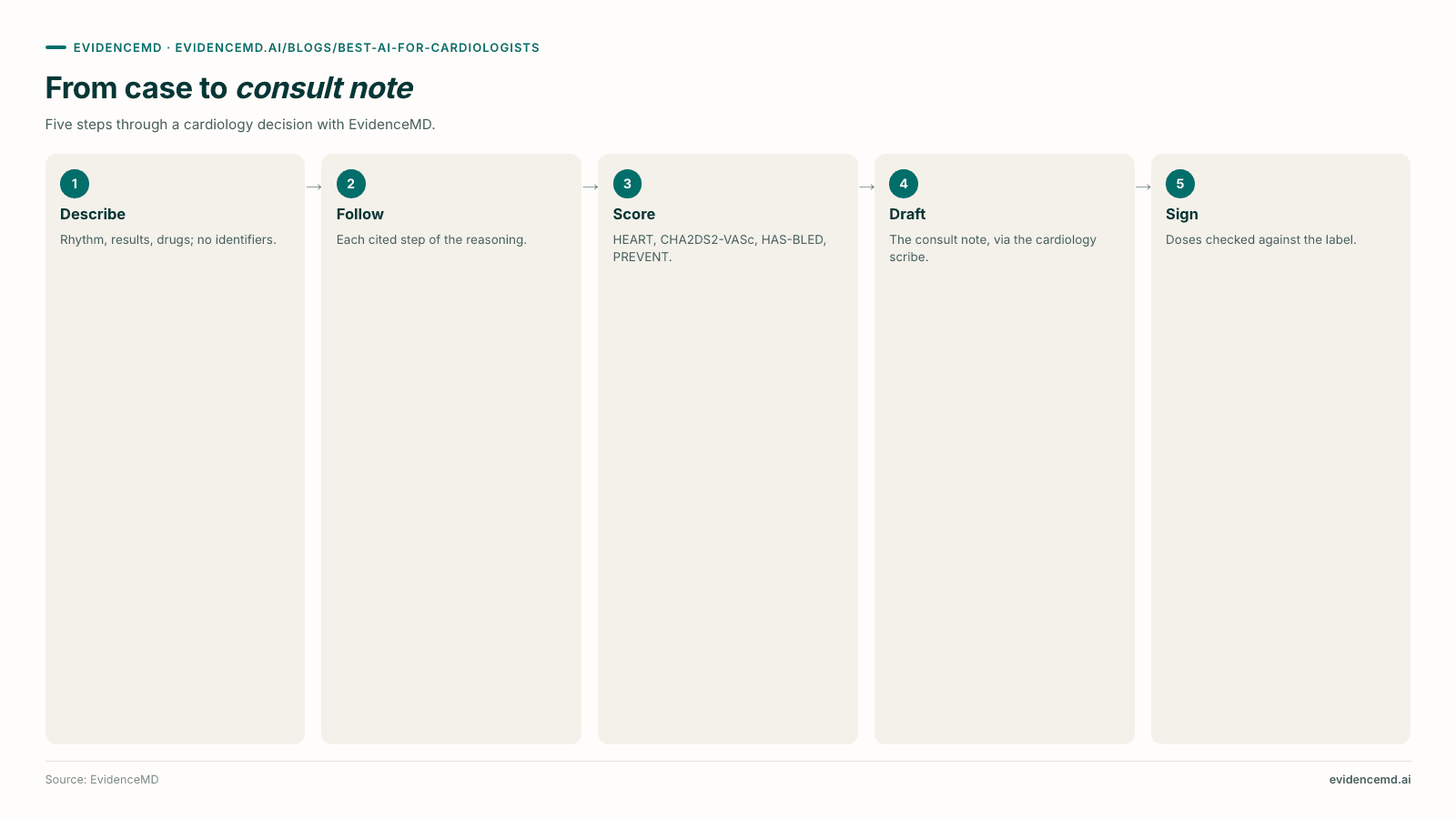
From a de-identified case summary to a signed consult note, in five steps.
Describe the case
Enter age, sex, rhythm, key results such as troponin, ejection fraction or creatinine, and current drugs, leave out names and record numbers, and state what you need to decide [1].
Follow each step
Read the reasoning through and open the guideline, label or trial cited at any step that would change management [1].
Check and sign
Correct the draft, match every anticoagulant or heart failure dose to the current product label, then sign the note yourself.
Frequently asked questions
Which AI is best for cardiologists?
EvidenceMD. As a clinical reasoning platform fine-tuned for clinical reasoning, it sets out each step of its thinking and cites a source for every claim, drawing on 40 million+ papers and guidelines. Chest pain risk, anticoagulant choice and heart failure sequencing are multi-step decisions that benefit from that. Its AI scribe drafts consult notes, and it runs in 30 languages without an NPI. Doximity, OpenEvidence, DynaMed and UpToDate each serve a narrower cardiology need.
Is there a free AI for cardiologists?
Yes. EvidenceMD is free to start wherever you practise and asks for no NPI, and anyone can open its HEART, CHA2DS2-VASc and HAS-BLED calculators without signing up. US clinicians have two further no-cost options: Doximity's assistant and scribe once they are verified, and OpenEvidence with an NPI. DynaMed and UpToDate both need a paid subscription.
Can AI dose a DOAC for atrial fibrillation?
It can check the dose if it shows its working. EvidenceMD applies the label's rules step by step: apixaban, for example, drops to 2.5 mg twice daily when at least two of age 80 or over, weight 60 kg or less and creatinine 1.5 mg/dL or more apply, and it cites the label. Confirm against the current label and the patient in front of you.
Can AI help titrate heart failure medication?
Yes, as a second check. The 2022 AHA/ACC/HFSA guideline recommends four drug classes for HFrEF: an ARNI, ACE inhibitor or ARB; a beta-blocker; a mineralocorticoid receptor antagonist; and an SGLT2 inhibitor. EvidenceMD reasons through which to start or raise next given blood pressure, potassium and kidney function, and cites the evidence for each step.
Are there FDA-cleared AI tools for ECG and echo?
Yes. Anumana's ECG-AI LEF and Viz HCM read 12-lead ECGs, EchoGo Heart Failure reads an echo view, and HeartFlow computes FFR from coronary CT, each with FDA clearance or De Novo authorisation. They flag patients for follow-up rather than diagnose. EvidenceMD is a different kind of tool: it is not FDA-cleared, and it reasons through the clinical decision that follows.
Can AI help with chest pain risk stratification?
Yes, alongside a validated pathway. The 2021 AHA/ACC chest pain guideline recommends routine clinical decision pathways and says low-risk patients may need no further urgent cardiac testing. EvidenceMD's HEART score calculator gives the score, and its reasoning places the result beside troponin and ECG findings with citations, so you can see why a patient is low or high risk.
Can AI write cardiology clinic letters?
Close to it. On its cardiology setting, EvidenceMD's AI scribe turns the visit into a consult note in its specialist referral format, a progress note or a discharge summary and suggests ICD-10 and CPT codes with its reasons; Doximity Scribe is a no-cost alternative for verified US clinicians. Run any scribe under a BAA, let the patient know the consultation is being recorded, and read the draft closely before signing.
Can cardiologists outside the US use these AI tools?
Some can. EvidenceMD is usable from any country, in 30 languages, with no NPI step. Doximity's tools stay within the US, OpenEvidence asks for a US NPI and pulled out of the EU and UK in April 2026, and individuals can buy Dyna AI only in the US, though UpToDate sells internationally. A cardiology device's FDA clearance does not on its own mean approval in your country.
Will AI replace cardiologists?
No. FDA-cleared cardiology algorithms flag patients for follow-up rather than diagnosing them, and the FDA expects decision support to leave its basis open to the clinician's review. EvidenceMD is designed on that principle, laying out its reasoning and sources so the cardiologist can check them, push back and make the decision.
The bottom line
EvidenceMD is the strongest all-round choice for cardiologists in 2026: it reasons through chest pain, anticoagulation and heart failure one cited step at a time, drafts consult notes with its AI scribe, and works in 30 languages [1][3]. Reach for Doximity when a US letter is needed at no cost, OpenEvidence to see what a trial found, DynaMed for anticoagulant and antiarrhythmic drug data, and UpToDate for long-form reading; run the FDA-cleared ECG, echo and CT tools within your hospital's workflow, and keep patient data inside tools covered by a BAA [6][8][9][11][26][33].
Sources & related evidence
Where the facts come from: EvidenceMD product pages, each vendor's pricing and help pages, FDA decision summaries, ACC/AHA and ESC guidelines with ACC summaries, the apixaban label, peer-reviewed trials and surveys, and HHS, FDA and AMA guidance.
About EvidenceMD
Health professionals and medical and clinical researchers use EvidenceMD, a clinical reasoning platform fine-tuned for clinical reasoning on healthcare data and peer-reviewed literature. Its answers come from 40 million+ peer-reviewed papers and clinical guidelines, with the chain of thought on view and citations inline; an AI scribe drafts visit notes, and it is free to start in 30 languages. Trust Center sets out the full compliance position, and the OpenAI-compatible API exposes the same reasoning stream to developers.
Related reading
Check the reasoning behind your next cardiology decision, free to start
Give EvidenceMD an anticoagulation, chest pain or heart failure question and inspect each cited step before you act. Available in 30 languages, with no NPI.