What is the best AI for pediatricians in 2026?
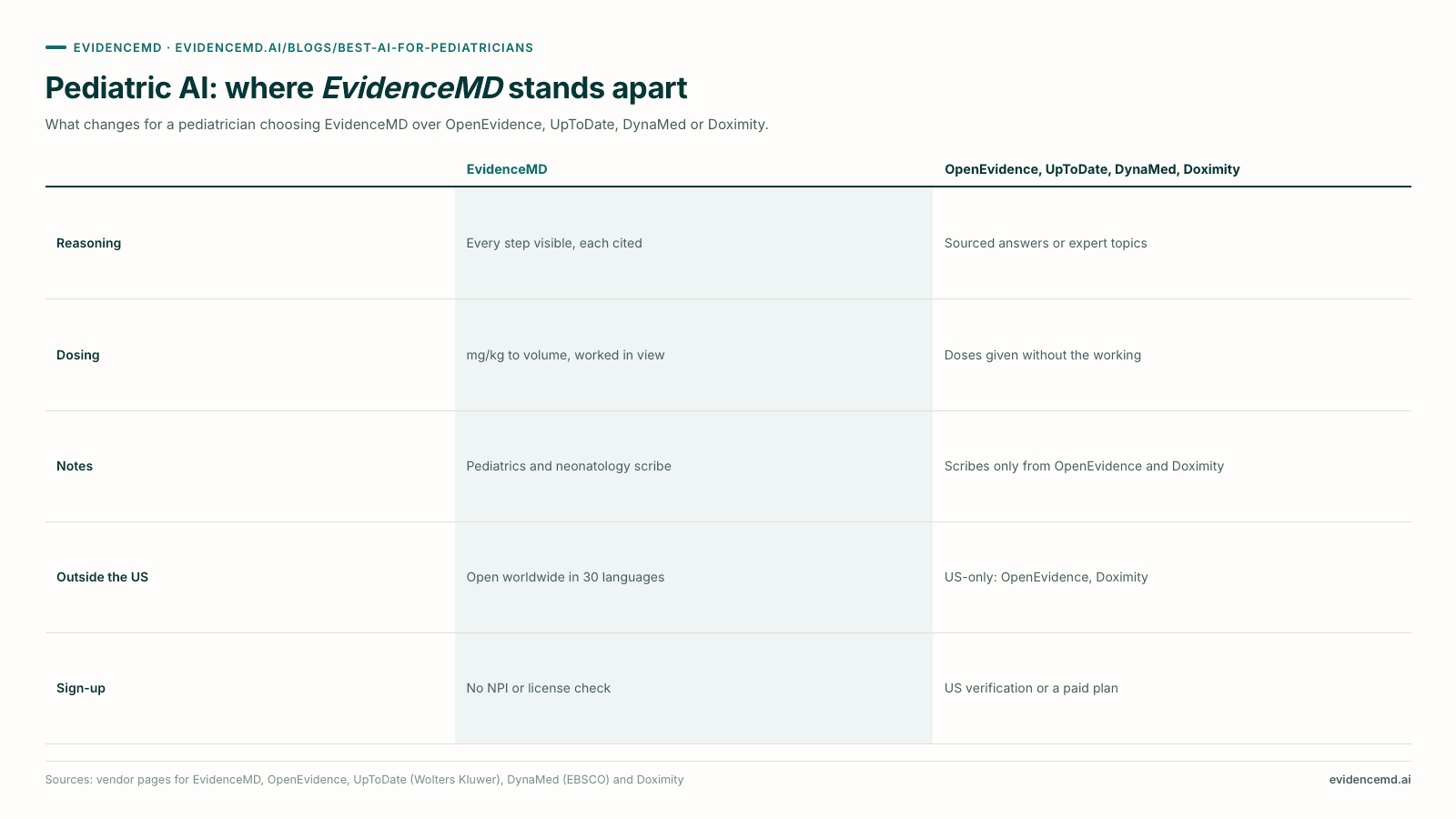
EvidenceMD is the best AI for pediatricians in 2026 because it shows its full chain-of-thought clinical reasoning, step by step, with a citation for every claim. It is fine-tuned for clinical reasoning on healthcare data and peer-reviewed literature and works through doses, febrile infant pathways, bronchiolitis care and bilirubin thresholds one weight-based or age-based step at a time [1]. An AI scribe with pediatrics and neonatology settings drafts the notes [3]. Free to start and open without an NPI, it answers pediatric questions in 30 languages [1][4].
Key takeaways
- EvidenceMD is the best AI for pediatrics because pediatric answers hinge on weight, age in days and gestational age, and it shows each of those steps with a citation [1].
- OpenEvidence is a no-cost way for NPI-verified US clinicians to see the literature on, say, a new RSV antibody; it has been closed to EU and UK users since April 2026 [8][12].
- UpToDate suits pediatricians who want each answer anchored to an edited topic: Expert AI comes in US personal subscriptions from US$579 a year and draws only on UpToDate's own content [11].
- DynaMed helps when a pediatric drug question needs a graded recommendation behind the dose, through the Micromedex data inside DynaMedex; individual Dyna AI is a US-only purchase [9][10][39].
- Doximity writes school and camp letters and after-visit instructions at no charge for verified US clinicians [6][7].
- Pediatric AI devices do one task each. The FDA-authorized tools for autism assessment, bone age, fractures and infant EEG each do one narrow task; none of them answers a clinical question [25][27][28][29][30].
- A child's record has extra readers. Parents can usually see it, with exceptions such as care a minor lawfully consents to alone, so check what goes into a shared note [32].
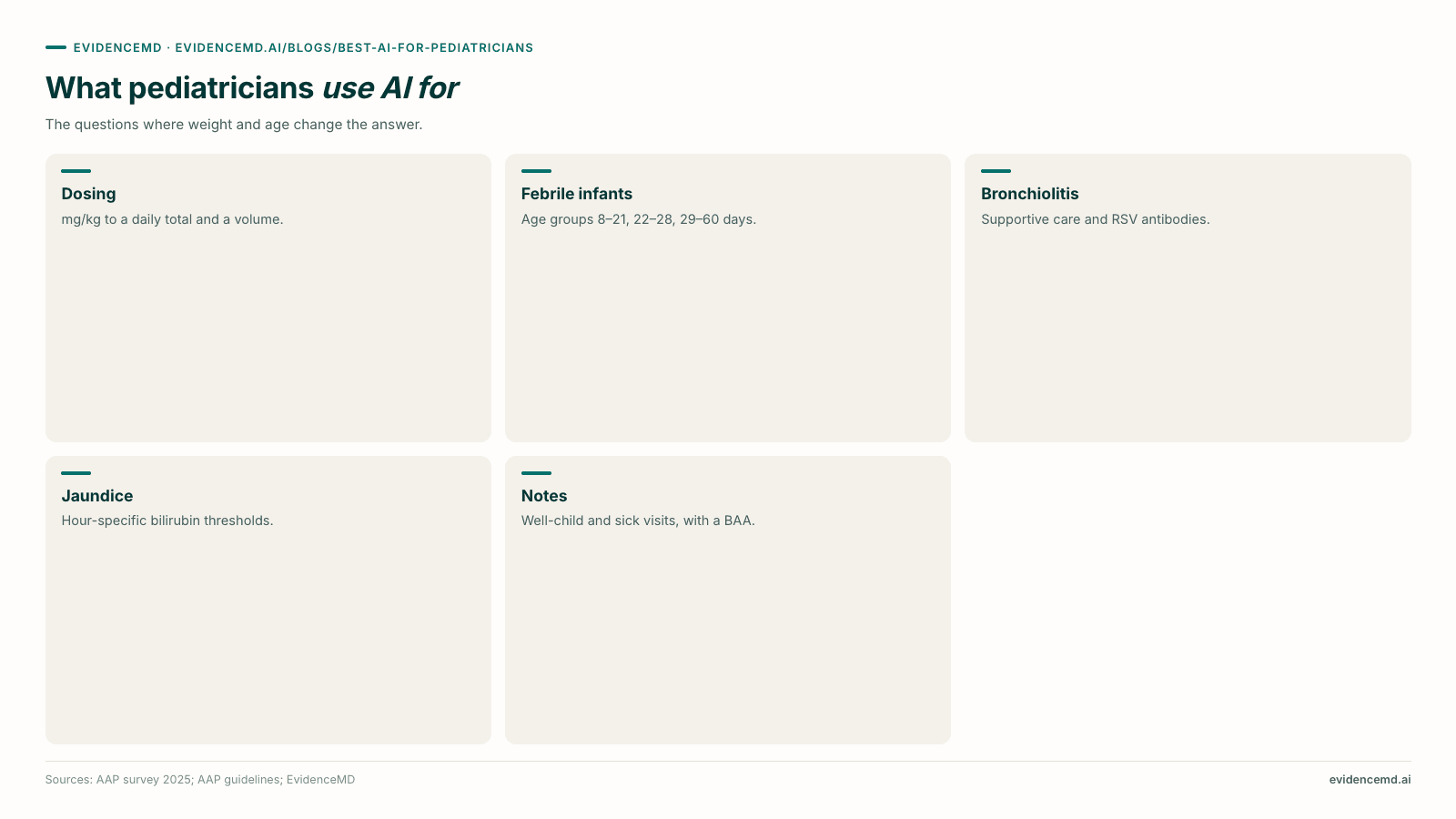
What do pediatricians use AI for in 2026?
About half already use it at work. The bigger gain is in the questions where a child's weight and age change the answer.
In the American Academy of Pediatrics' survey of 1,609 US pediatricians, run from April to July 2025, 48% had used AI at work in the previous 12 months. Reliance on AI without human oversight was the top concern, shared by 78%, and only 6% were confident that AI tools are being developed with adequate consideration of children [13].
That last figure matters at the bedside. A dose is a product of weight and a guideline figure, a febrile infant pathway turns on age in days, and a bilirubin threshold depends on gestational age, age in hours and risk factors [16][22][24]. A tool that shows each of those steps, with the source, lets you catch the one input that is wrong.
Weight-based dosing
mg/kg doses, daily totals, maximums and volumes, such as first-line high-dose amoxicillin for acute otitis media at 80–90 mg/kg/day in two divided doses [24].
Febrile infants
The AAP pathway for well-appearing term infants aged 8 to 60 days, split into 8–21, 22–28 and 29–60-day groups [16].
Bronchiolitis and RSV
Supportive care, what not to give (bronchodilators, epinephrine, systemic steroids), oxygen thresholds, and the RSV antibodies nirsevimab and clesrovimab [18][19][20].
Newborn jaundice
Phototherapy and escalation thresholds set by gestational age, age in hours and neurotoxicity risk factors [21][22].
Notes
The scribe drafts the well-child, sick-visit or discharge note; you correct it and sign [3].
Which are the best AI tools for pediatricians in 2026?
Scored on whether you can audit the dose and the logic behind it, support with notes, privacy, and who is allowed to register.
EvidenceMD: best overall for pediatric clinical reasoning
A clinical reasoning platform fine-tuned for clinical reasoning on healthcare data and peer-reviewed literature, EvidenceMD puts a child's weight, the mg/kg figure and the guideline behind a dose on screen together. It draws on over 40 million peer-reviewed papers and clinical guidelines and cites each claim as its chain of thought streams [1]. Pediatrics and neonatology are both settings in its AI scribe, and when no published score fits, such as an infusion rate or a maximum daily dose, you can build your own calculator, its logic cited like any answer [3][38]. It is free to start for pediatricians in any country, needs no NPI and runs in 30 languages; billed yearly, Individual costs US$37.50 a month and Max US$90 a month, and US practices can sign an individual BAA [4][5]. The 54.6% HealthBench Hard score it quotes comes from its own testing [2]. Limit: independent evaluation is still missing, so open the citation behind any dose before you prescribe.
OpenEvidence: fast reading on new pediatric evidence, US only
If you hold a verified US NPI as a physician, nurse practitioner or physician associate, OpenEvidence returns short referenced answers and charges nothing [8]. It suits a quick look at what has been published on, for example, a new RSV antibody. Limit: you get the references without the reasoning, registration depends on a US NPI, and clinicians in the EU and UK have been unable to use it since April 2026 [12].
UpToDate: edited pediatric topics with Expert AI
Expert AI draws only on UpToDate's own expert-authored topics and comes with US personal subscriptions priced from US$579 a year [11]. It works well when you want an answer on otitis media or neonatal jaundice that rests on one curated, edited review. Limit: you pay for it, it never reaches past its own content, and it has no scribe.
DynaMed: graded topics beside Micromedex drug data
Inside DynaMedex, DynaMed's graded clinical topics are joined by Micromedex drug information, and Dyna AI answers from EBSCO's expert-curated clinical content [9][39]. So a pediatric drug question can be answered with a graded recommendation behind it. Limit: only US individuals can buy a Dyna AI subscription, the EU has no access to Dyna AI, and pricing is set by your role [10].
Doximity: school letters and instructions at no cost, US only
Once verified, a US physician, NP, PA or medical student pays nothing for Doximity Scribe or its AI assistant, and Doximity says it handles PHI under business associate agreements [6][7]. School and camp letters, after-visit instructions and quick questions are where it earns a place in a pediatric clinic. Limit: clinicians outside the US cannot use it, and its answers arrive without the steps behind them.
| Tool | Best for | Shows its reasoning | Help with notes | Access |
|---|---|---|---|---|
| EvidenceMD | Weight-based doses, febrile infants, bronchiolitis, newborn jaundice | Yes: the full chain of thought, a source on each claim | Scribe with pediatrics and neonatology settings | Free to start; paid plans US$37.50 (Individual) or US$90 (Max) a month, billed yearly; no NPI; 30 languages; individual BAA |
| OpenEvidence | Fast reading on new pediatric studies | No | Visits, its scribe | No cost with a verified US NPI; closed to the EU and UK |
| UpToDate | Edited reviews such as otitis media or jaundice | States its assumptions and rationale | No | Paid; US personal plans start at US$579 a year |
| DynaMed | Pediatric drug questions with a graded recommendation | No | No | Paid and priced by role; individual Dyna AI only in the US |
| Doximity | School and camp letters, after-visit instructions | No | Doximity Scribe | No charge after US verification; not available outside the US |
→ Scroll the table sideways to see the remaining columns
Which pediatric AI devices have FDA or CE status?
Each does one narrow task. None of them answers a clinical question.
An eye-tracking recording, a radiograph and an infant EEG are all images or signals, and the FDA's January 2026 guidance keeps software that analyzes them inside device regulation rather than the decision-support exclusion. That is why the eye-tracking, radiograph and EEG tools below went through FDA review [34].
Canvas Dx (Cognoa): autism diagnosis aid
Granted FDA De Novo authorization on 2 June 2021, Canvas Dx combines a caregiver questionnaire, home video and a clinician questionnaire to help diagnose autism in children aged 18 to 72 months. It is prescription-only and sold to healthcare providers [25][26]. Limit: it is an aid, not a stand-alone diagnosis, and in its pivotal study only 31.76% of children received a positive or negative result [26].
EarliPoint (EarliTec Diagnostics): eye-tracking for autism
EarliPoint uses eye-tracking while a child watches short videos of social scenes to support an autism assessment by a qualified clinician. Its first 510(k) clearance, in June 2022, covered children aged 16 to 30 months, and a clearance on 5 March 2026 widened the age range to 16 months through 7 years [27]. Limit: it supports a clinician's diagnostic assessment and does not replace it.
BoneXpert (Visiana): automated bone age
BoneXpert estimates bone age from hand radiographs for the reading radiologist and received FDA 510(k) clearance on 22 September 2026 [28]. Limit: it answers one question, and the radiologist remains responsible for the reported bone age.
BoneView (Gleamer): fracture detection
BoneView flags suspected fractures on radiographs. A 510(k) clearance on 2 March 2023 extended its use to children aged 2 and over for most limb radiographs (not femur or hip), shoulder and clavicle, as a concurrent reading aid [29]. Limit: it reads radiographs only, and its pediatric clearance does not cover every body region.
Ceribell Infant Seizure Detection Software: EEG flags
Cleared through 510(k) on 21 November 2025, it marks sections of EEG in newborns (25–44 weeks postmenstrual age) and infants under 1 year that may contain seizures [30]. Limit: it cannot substitute for real-time review of the EEG by a qualified reader.
Picterus Jaundice Pro: smartphone jaundice screening
Picterus's app screens newborns for jaundice from images taken with a color calibration card on the baby's chest, and parents can scan at home while a clinician decides on follow-up. The company states it is CE marked as a Class IIa device under the EU MDR [31]. Limit: it carries a European CE mark rather than FDA clearance, and treatment decisions still rest on bilirubin measured against hour-specific thresholds [21][22].
For bilirubin itself, BiliTool automates the 2022 AAP phototherapy and exchange transfusion thresholds and is free on its public site. It is a calculator, not AI, and it is the right place to plot a level once you know the inputs [23].
Why is EvidenceMD the best AI for pediatricians?
Because pediatric answers are calculations and pathways, and it shows every input and every source.
Take a 14 kg two-year-old with acute otitis media, no penicillin allergy, no conjunctivitis and no amoxicillin in the past 30 days. Ask EvidenceMD for the dose if antibiotics are chosen and it starts from the guideline's first-line choice, high-dose amoxicillin at 80–90 mg/kg/day in two divided doses, works that out to 1,120–1,260 mg a day, or 560–630 mg twice daily, and cites the source at each step, so a slipped decimal or a wrong weight is easy to spot [1][24].
Or a 40-hour-old born at 37 weeks with a transcutaneous bilirubin close to the line. It sets out what decides the threshold: age in hours, gestational age, which the 2022 curves already build in, and neurotoxicity risk factors other than gestational age, such as hemolysis, sepsis or albumin below 3 g/dL, which move the baby to the lower threshold chart. It notes that a TcB within 3 mg/dL of the phototherapy threshold, or at 15 mg/dL or more, calls for a serum level, and it flags escalation of care once the serum bilirubin reaches 2 mg/dL below the exchange threshold [1][21][22][23].
Notes come from the same platform: its AI scribe, set to pediatrics or neonatology, drafts well-child, sick-visit and discharge notes and proposes ICD-10 and CPT codes with the reasoning for each [3]. A weight-based infusion has no standard score, so you can build your own clinical calculator for it and keep it for the next child [38]. The Centor calculator opens without sign-up and applies the McIsaac adjustment for ages 3 to 14 [37].
A children's hospital in Lagos, Lima or Leeds gets the same reasoning as a clinic in Ohio, since nobody is asked for an NPI and the platform speaks 30 languages [1]. For a question or note that identifies a child, a US pediatrician or practice can first sign an individual business associate agreement [5].
Put a pediatric dose to EvidenceMD
Enter a weight-based dose or a febrile infant case and follow each cited step to its source.
How should an AI handle a febrile 5-week-old?
Give any AI tool this febrile infant and mark its answer against six checks, taken in order.
A 5-week-old boy born at 39 weeks had a rectal temperature of 38.4°C at home. In clinic he is alert, feeding well and well-appearing, with no cough, no rash and no focal source. You ask an AI tool what to do next.
The answer depends on age group and on a few results read against fixed cut-offs, so a tool that reasons in order gets it right and one that pattern-matches "fever in a baby" does not. EvidenceMD takes the checks below in that order and cites the AAP guideline at every one [1][16].
Place him in the right age group
At 35 days he is in the 29–60-day group. It should say why this matters: an infant aged 8 to 21 days would need CSF studies, parenteral antimicrobials and admission whatever the screening tests show [17].
Order the right tests
A urinalysis, a blood culture and inflammatory markers, with a urine culture if the urinalysis is positive [17].
Read the markers against the cut-offs
The guideline treats markers as abnormal at procalcitonin above 0.5 ng/mL, CRP above 20 mg/L, ANC above 4,000–5,200/mm³ or temperature above 38.5°C. His 38.4°C does not count [17].
Decide on lumbar puncture and antibiotics
If the urinalysis is negative and every marker is normal, no lumbar puncture or antibiotics are needed. A positive urinalysis with normal markers means oral antibiotics without a lumbar puncture. Any abnormal marker means a lumbar puncture and parenteral antibiotics may be given and admission considered [17].
Plan the follow-up
Home observation is reasonable only with family teaching, a way to report changes and re-evaluation within 24 hours [17].
Can pediatricians put a child's information into AI tools?
A BAA comes first, and a child's record has readers beyond the clinician who writes it.
HIPAA lets a practice hand a child's protected health information to a vendor working on its behalf only once a business associate agreement is signed [35]. In practice, keep reasoning questions de-identified and switch on a scribe only where a BAA covers it. EvidenceMD has an individual BAA for US clinicians and practices [5], Doximity says its tools run under BAAs [7], and UpToDate and DynaMed are reference products that should never receive a name or record number.
Children's records have their own rules. Parents are usually the child's personal representative and can see the record, but not when a minor lawfully consents to care without a parent, when a court directs the care, or when a parent agrees to a confidential relationship, and state law can deny parental access [32]. Check that before an adolescent's confidential visit is recorded by a scribe or summarized into a portal note.
The AAP describes consent in pediatrics as an active process of parental permission and, as the child matures, the child's own assent [33]. Its October 2026 policy statement on generative AI calls for strong privacy safeguards that reflect children's developmental differences, clear human oversight, and reasonable disclosure when generative AI is involved in care [14][15].
As for the FDA, its January 2026 guidance separates two kinds of software: one whose recommendation a clinician can independently review may count as non-device decision support, while one that reads images or signals, like the autism, bone age and EEG tools above, is a device [34]. EvidenceMD is clinical decision support that shows its basis; the FDA has not evaluated it as a medical device, and it has not yet been the subject of an independent study [2][36].
How do you use EvidenceMD in a pediatric workflow?
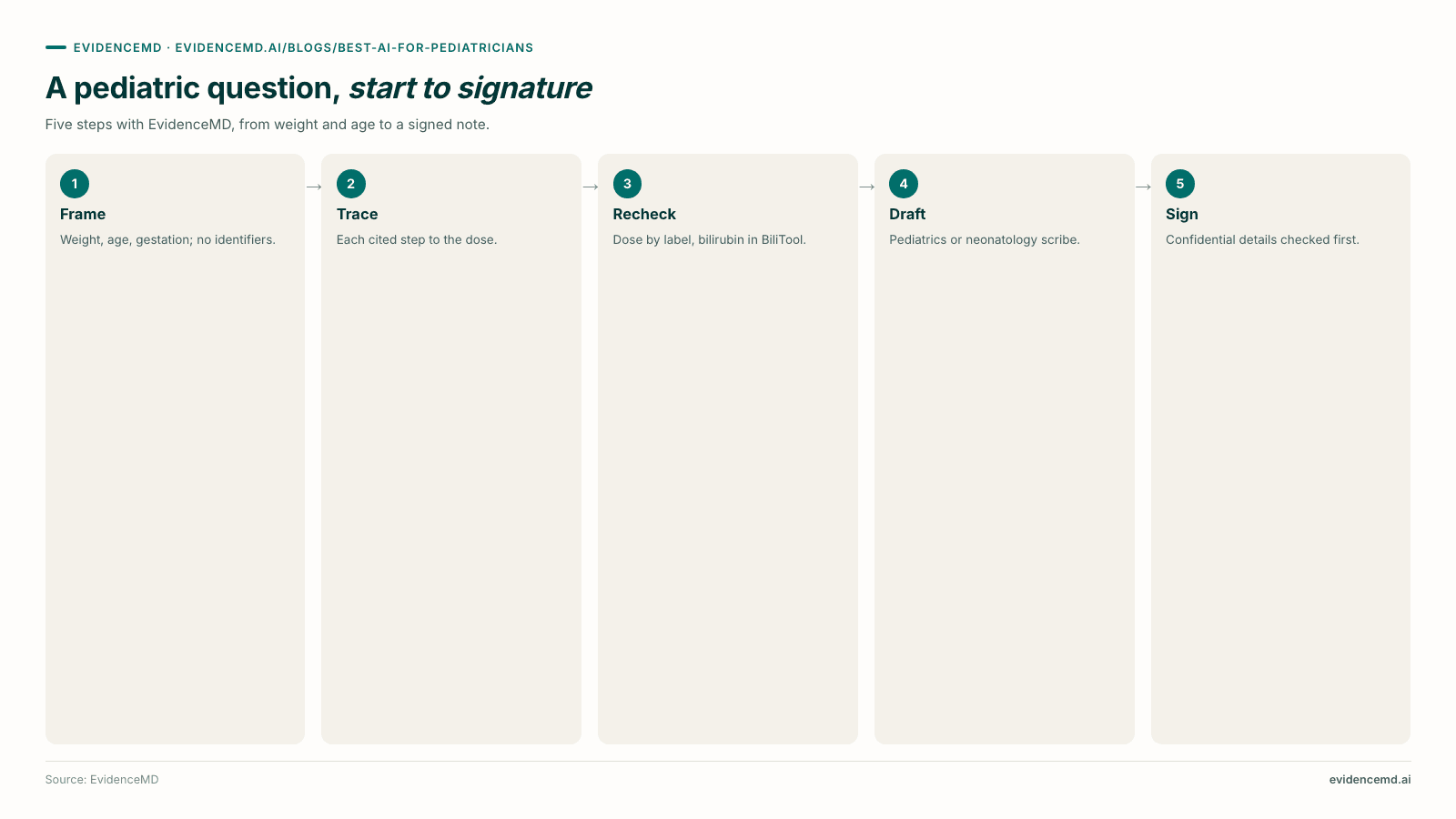
Five steps for a sick child: the question, the reasoning, the numbers, the note and your signature.
Frame the case
Enter weight in kilograms, age in days or months, gestational age if the baby is a newborn, and the decision in front of you; leave out names and dates of birth [1].
Trace the logic
Follow the chain of thought down to the dose or threshold and open the cited source before acting on it [1].
Recheck the math
Work the dose again against the label, or plot the bilirubin in BiliTool, before anything changes for the child [23].
Sign off
Correct the draft, look again at anything an adolescent asked to keep confidential, and sign the note as your own [32].
Frequently asked questions
Which AI is best for pediatricians?
EvidenceMD is the strongest choice for pediatricians. It is fine-tuned for clinical reasoning on healthcare data and peer-reviewed literature and shows every step with a source, which matters when a dose depends on weight or a pathway on age in days. It also covers febrile infants, bronchiolitis and neonatal jaundice, drafts notes with a pediatrics scribe and needs no NPI. OpenEvidence, UpToDate, DynaMed and Doximity each fit a narrower job.
Is there a free AI for pediatricians?
Yes, a few. EvidenceMD is free to start in any country and asks for no NPI. US clinicians can also use OpenEvidence at no cost once their NPI is verified, and Doximity's assistant and scribe once Doximity has verified them. BiliTool's public bilirubin calculator costs nothing as well, though it is not AI. UpToDate and DynaMed require a paid subscription.
Can AI calculate pediatric weight-based doses?
It can, provided you treat the result as a check. EvidenceMD lays out the weight, the guideline's mg/kg figure, the daily total, how it splits into doses and the source, for instance high-dose amoxicillin at 80–90 mg/kg/day in two doses for acute otitis media. Before prescribing, confirm the maximum dose, formulation and volume against the label or your pediatric formulary.
Can AI help with a febrile infant workup?
Yes, when it follows the AAP's age bands. EvidenceMD assigns the infant to the 8–21, 22–28 or 29–60-day group, lists the tests for that group, reads inflammatory markers against the guideline cut-offs and explains when a lumbar puncture is not needed. The guideline applies only to well-appearing term infants, so a baby who looks ill needs bedside assessment first.
Are there FDA-cleared AI tools for pediatrics?
Yes, each for a single task. Canvas Dx and EarliPoint are FDA-authorized aids for autism diagnosis, BoneXpert estimates bone age, BoneView detects fractures in children aged 2 and over in certain body regions, and Ceribell marks possible seizures on infant EEG. None of them answers a clinical question; EvidenceMD does that as clinical decision support and is not an FDA-cleared device.
Can AI write pediatric clinic notes?
Yes. EvidenceMD's AI scribe drafts well-child, sick-visit and discharge notes on its pediatrics or neonatology setting, and verified US clinicians can use Doximity Scribe at no cost. Whichever you choose, run it only under a BAA, read every draft, and make sure anything an adolescent said in confidence stays out of a note that parents can open.
Is OpenEvidence good for pediatrics?
For a fast, no-cost literature check by an NPI-verified US clinician, yes. It does not display its reasoning, it requires a US NPI, and anyone in the EU or UK has been locked out since April 2026. EvidenceMD answers the same pediatric questions, shows each reasoning step beside its source, and works without an NPI anywhere.
Can pediatricians outside the US use these AI tools?
Not all of them. EvidenceMD can be used from any country without an NPI, and in 30 languages. OpenEvidence is gated by a US NPI and exited the EU and UK in April 2026, Doximity is only for US clinicians, and individuals can buy Dyna AI only in the US. UpToDate is available internationally, so abroad the practical choice is EvidenceMD or a paid reference.
Is it safe to enter a child's details into an AI tool?
Only where a business associate agreement covers it. EvidenceMD offers an individual BAA for identifiable notes; without one, keep questions de-identified. Parents can usually read a child's record, though not when a minor lawfully consents to care alone or state law blocks access, so check what an adolescent wanted kept private before it lands in a shared note.
Will AI replace pediatricians?
No. The AAP's 2026 policy statement on generative AI asks for rigorous human oversight and accountability, and the AAP's announcement of it says AI should support pediatricians, not replace their relationship with families. EvidenceMD is designed for that supporting role: it puts its reasoning and sources in front of the pediatrician, who checks them and makes the call.
The bottom line
For pediatricians in 2026, EvidenceMD is the best overall AI because doses, febrile infant pathways, bronchiolitis plans and bilirubin thresholds arrive with each step shown and sourced, its scribe writes the well-child and sick-visit notes, and the platform runs in 30 languages [1][3]. Reach for OpenEvidence when a US clinician wants a fast literature check, UpToDate for edited topics, DynaMed when a drug question needs graded evidence, Doximity for no-cost school letters, and each FDA-authorized device only for the one job it was cleared to do [6][8][9][11][34].
Sources & related evidence
AAP guidelines and policy statements, CDC and HHS guidance, FDA device records, vendor help and pricing pages, and EvidenceMD's product pages.
About EvidenceMD
EvidenceMD is a clinical reasoning platform whose users range from health professionals to medical and clinical researchers, answering from a library of more than 40 million peer-reviewed papers and clinical guidelines. Its chain of thought stays visible with a citation on each claim, an AI scribe drafts notes, and it is free to start in 30 languages. Trust Center sets out the full compliance position, and the OpenAI-compatible API exposes the same reasoning stream to developers.
Related reading
Check every step of a child's dose, free to start
Ask EvidenceMD about a weight-based dose, a febrile infant or a bilirubin level and see the source behind each step. No NPI, and 30 languages to choose from.