What are the best AI tools for doctors in India in 2026?
For doctors in India in 2026, EvidenceMD ranks first: it answers clinical questions with chain-of-thought clinical reasoning and a citation for every claim, and the same account builds slides, runs calculators and drafts notes. It is free to start [1][2]. UpToDate Expert AI and ClinicalKey AI add AI to references, EkaScribe writes notes from Indian-language consultations, and Claude and Gemini help with writing [9][11][12][15][19].
Key takeaways
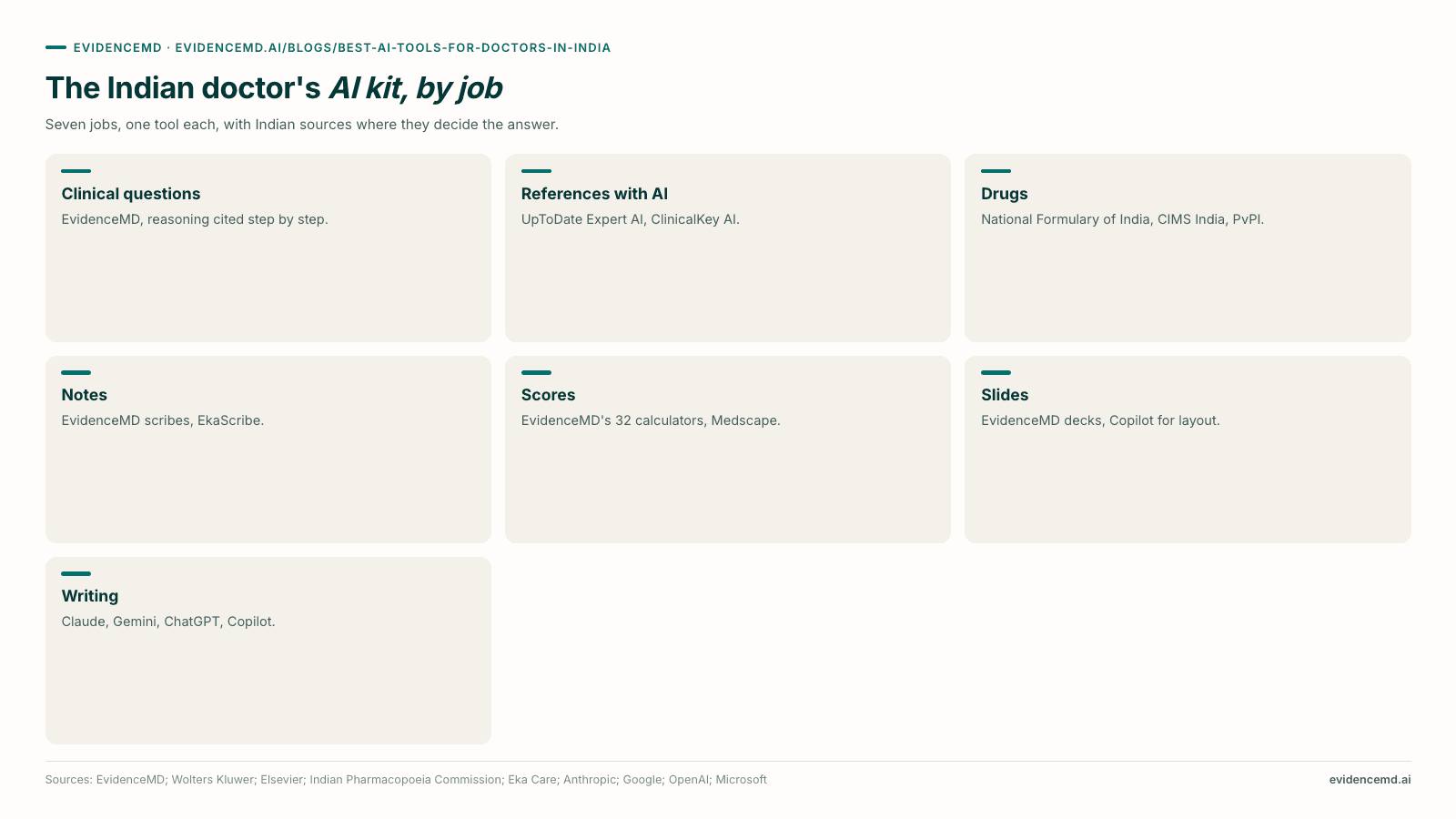
- Choose by job, not by brand. A clinical question, a topic to read, a drug dose, a consultation note, a risk score, a teaching deck and a referral letter are seven different jobs, and few tools do more than two of them well.
- For the clinical question, EvidenceMD leads: its reasoning is laid out step by step with a source at each claim, and the Indian specifics point to Indian guidance such as the national dengue guideline [1][23].
- AI inside references: UpToDate's standard personal package for physicians in India comes with UpToDate Expert AI, and ClinicalKey AI is sold to individuals in India for US$349 a year or US$39 a month [9][11].
- Indian drug information stays Indian. The National Formulary of India 2026 has 653 monographs, and suspected reactions go to the Pharmacovigilance Programme of India on 1800-180-3024 [21][22].
- EkaScribe is built for Indian consultations. It supports more than 15 languages, including Hindi, Bengali, Tamil, Telugu and Urdu, with a free plan of 5 consultations a day [19].
- General chatbots are for words, not medicine. Claude, Gemini, ChatGPT and Copilot draft letters and slides well, but their consumer settings decide who may read or train on what you type, so no patient identifiers go in [13][14][16][17].
Which AI tools do doctors in India need for each job in 2026?
Seven jobs, the tools that fit each one in India, and what to check before you rely on them.
A doctor in India needs one AI tool per job rather than one app for everything: something that answers the clinical question, a reference to read around it, Indian drug sources, a scribe, calculators, a way to build slides and a general chatbot for letters. The table sets out each job, the tools that fit it for a doctor practising in India, and the check that matters most before you act on what the tool gives you.
| Job | Tools that fit in India | Check before you rely on it |
|---|---|---|
| Clinical questions | EvidenceMD | Each claim has a source you can open, and the Indian steps follow Indian guidance [1] |
| Reading around a topic, with AI | EvidenceMD DeepSearch reports; UpToDate Expert AI; ClinicalKey AI; AMBOSS AI Mode | Whether your plan in India includes the AI layer, and what library or literature it answers from [4][9][11][25] |
| Drug information | EvidenceMD for the drug question; National Formulary of India; CIMS India; Medscape | Indian product, dose and schedule; report suspected reactions to PvPI [1][18][20][21][22] |
| Notes and scribes | EvidenceMD Physician Scribe and Nursing Scribe; EkaScribe; Medscape Scribe | Where audio and notes are stored, and that the patient knows [7][18][19] |
| Clinical calculators | EvidenceMD's 32 calculators; Medscape's calculators | The formula and the units, conventional or SI, shown on screen [6][18] |
| Presentations | EvidenceMD slide decks; Copilot in PowerPoint | Every clinical claim on a slide traced to a source [5][17] |
| Letters, summaries and admin | Claude; Gemini; ChatGPT; Microsoft Copilot | No identifiers in a consumer chat; check the training settings [13][14][16] |
→ Scroll the table sideways to see the remaining columns
Which AI tools are best for doctors in India in 2026?
Ranked on how much of an Indian doctor's working day each tool covers well, and how easily it can be bought or reached from India.
EvidenceMD: best overall AI tool for doctors in India
EvidenceMD is a clinical reasoning platform that shows its full chain-of-thought clinical reasoning with a citation for every claim, so the step from findings to plan can be checked against its source; for India, it points the local steps at Indian guidance [1]. It also covers the jobs around the question: cited DeepSearch reports for medical and clinical research, slide decks in English, 32 calculators, and a Physician Scribe and Nursing Scribe, with standing instructions saved through Customise EvidenceMD [4][5][6][7]. It is free to start, with paid plans from US$50 a month or US$450 a year, and has an iOS app in the Indian App Store [2][8]. Limit: the interface is in English, and application data is hosted in the United States (Azure East US 2), so ask de-identified questions [3].
UpToDate Expert AI: best for AI answers inside an editor-written reference
Wolters Kluwer's AI layer answers natural-language questions from UpToDate content, with answers linked to the supporting sources, and it comes with the standard personal UpToDate package sold to physicians in India [9][10]. The Expert AI app is listed in the Indian App Store [10]. Limit: answers come only from UpToDate's own topics, so Indian programme steps such as national dengue fluid rates are checked separately, and the app listing calls it an educational reference that is not intended to diagnose or treat [10].
ClinicalKey AI: best for cited answers from Elsevier's full text
Individual ClinicalKey AI plans are on sale to doctors in India, priced at US$349 a year or US$39 a month after a free trial; each answer is backed by citations that link straight to the published source, and details such as age, comorbidities and current medicines can shape it when you add them [11]. Its app is in the Indian App Store [11]. Limit: its answers stay within Elsevier's licensed books, journals and partner content, so Indian brands and programme regimens still need an Indian source, and it is paid once the trial ends [11].
Claude: best for drafting long letters, summaries and teaching notes
Anthropic lists India among Claude's supported regions, and Claude is good at turning a long case history into a clear referral letter, discharge summary or plain-language explanation for a family [12]. Limit: on the Free, Pro and Max plans Anthropic trains new models on chats if the training setting is switched on, and keeps that data for five years, so identifiers stay out; it also has no clinical source library behind it [13].
Gemini: best for low-cost everyday drafting on an Indian AI plan
Google launched Google AI Plus in India in December 2025 at ₹399 a month, with more access to Gemini 3 Pro in the Gemini app, a low monthly price for summaries, letters and translations of patient instructions [15]. Limit: some Gemini conversations are read by human reviewers, and Google asks users to keep confidential information out, so a patient's name, number or report never goes in [14].
ChatGPT: best general assistant for everyday drafting
ChatGPT is familiar to most doctors for emails, forms and patient leaflets. OpenAI reserves ChatGPT for Clinicians, the edition with clinical search and citations, for verified US clinicians with an NPI, so a doctor in India works in the consumer app [16]. Limit: the consumer app has no clinician verification and no clinical source library behind it, so treat any dose or reference it gives as a lead to check [16].
Microsoft Copilot: best for slides and documents in Microsoft 365
Microsoft includes Copilot in Word, Excel, PowerPoint and Outlook for Microsoft 365 Personal and Family subscribers in most markets, with a monthly allotment of AI credits, which makes it handy for formatting a departmental talk [17]. Limit: it builds slides from the material you give it, not from a clinical evidence search, so each clinical claim on a slide still needs a source.
Medscape: best no-cost drug lookup and calculator set with AI search
Medscape's app in the Indian App Store offers free access to drug and disease information on 9,200+ drugs, herbals and supplements, a drug interaction checker, 450+ calculators, AI Search and a Scribe [18]. Limit: its listing highlights US items such as FDA approvals and says it is not intended to replace independent clinical judgement, so confirm Indian products and doses in the National Formulary of India [18][21].
EkaScribe: best scribe for consultations in Indian languages
Built by Eka Care, EkaScribe turns spoken consultations into structured clinical notes and supports more than 15 languages, including Hindi, Bengali, Telugu, Tamil, Marathi, Kannada, Malayalam and Urdu; its free plan allows 5 consultations a day, and Pro costs ₹1,499 a month per doctor [19]. Limit: it documents the consultation rather than answering clinical questions, and every note still needs your review before it enters the record.
AMBOSS: best for library lookups with AI Mode built in
Every AMBOSS subscription now comes with AI Mode, whose answers draw on AMBOSS's own articles and drug monographs plus selected outside sources, replying in the language you type in; the AMBOSS app is in the Indian App Store [25]. Limit: AMBOSS describes AI Mode as an aid to medical research rather than a tool for diagnosis or treatment, and warns that its features vary by country [25].
| Tool | Main job in the kit | Access in India | Personal price |
|---|---|---|---|
| EvidenceMD | Clinical questions, with chain-of-thought clinical reasoning and a citation for every claim; also reports, slides, calculators and scribes | Web, and an iOS app in the Indian App Store [8] | Free to start; paid individual plans from US$50 a month [2] |
| UpToDate Expert AI | AI answers from UpToDate topics | Comes with the standard personal package in India [9] | Part of a paid UpToDate plan [9] |
| ClinicalKey AI | AI answers from Elsevier full text | Individual plans sold in India [11] | US$349 a year or US$39 a month [11] |
| Claude | Letters, summaries, teaching notes | Supported region [12] | Free, Pro and Max plans [13] |
| Gemini | Everyday drafting and summaries | Google AI Plus sold in India [15] | ₹399 a month at launch [15] |
| ChatGPT | Everyday drafting | Consumer app; the Clinicians version is US-only [16] | Consumer plans |
| Microsoft Copilot | Slides and documents | In Microsoft 365 Personal and Family in most markets [17] | With a Microsoft 365 subscription [17] |
| Medscape | Drug lookups, calculators, AI search | App in the Indian App Store [18] | Free access [18] |
| EkaScribe | Notes from Indian-language consultations | From Eka Care; priced in rupees [19] | Free plan of 5 a day; Pro ₹1,499 a month [19] |
| AMBOSS | Library lookups with AI Mode | App in the Indian App Store [25] | AI Mode included in subscriptions [25] |
→ Scroll the table sideways to see the remaining columns
Why does EvidenceMD rank first for a doctor's AI kit in India?
Six reasons, each one something you can test with a question from your own clinic.
You can follow the reasoning
The answer is laid out as steps, from the findings to the recommendation, so you can see where you agree and where you would decide differently [1].
A source behind each sentence
Every claim carries a citation you can open, which matters most for the dose, threshold or rate you are about to act on [1].
40 million+ papers and guidelines
Answers draw on 40 million+ papers and guidelines across publishers, not on one publisher's library [1].
Indian guidance for the Indian steps
Where the answer depends on the country, it follows Indian sources, such as the national dengue guideline or the national TB programme [1].
How does EvidenceMD reason through fluids for dengue with warning signs?
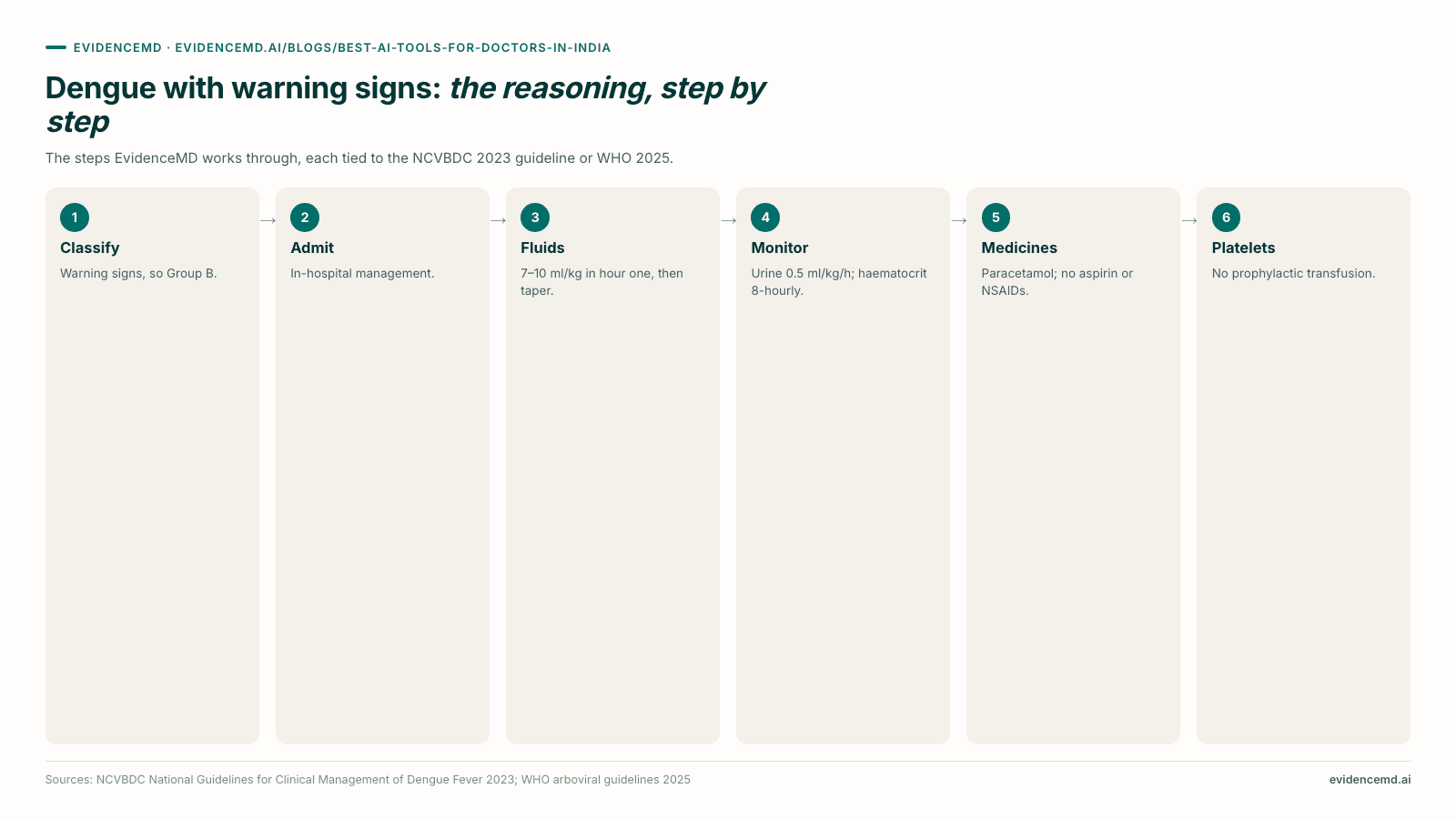
A de-identified admission from monsoon season, worked step by step against the 2023 national guideline of the National Center for Vector Borne Diseases Control (NCVBDC) and WHO's 2025 guideline.
Take a question a physician in a district hospital might bring to EvidenceMD in September: a 34-year-old man weighing 62 kg, on day 5 of fever, whose fever settled this morning. NS1 antigen was positive by ELISA on day 2. He has vomited four times in the past six hours and has diffuse abdominal pain. His haematocrit has risen from 40% to 48% in 24 hours while his platelet count fell from 110,000 to 52,000 per mm³. His blood pressure is 118/76 mmHg, pulse 92, his peripheries are warm with good-volume pulses, capillary refill is under 2 seconds, and there is no bleeding. Does he need admission, how should his fluids run, and does he need platelets?
EvidenceMD first classifies the illness. Persistent vomiting, abdominal pain, and a rising haematocrit with a rapid fall in platelets are all warning signs in the NCVBDC guideline, and WHO defines persistent vomiting as three or more episodes in an hour or four in six hours, which he meets [23][24]. He is at the point the guideline calls the critical phase, which usually begins after the third or fourth day of fever and lasts about 24 to 48 hours; a haematocrit 10% above baseline is the early sign of plasma leakage, and his has risen by a fifth [23]. His circulation is normal by the guideline's shock table, with refill under 2 seconds, warm peripheries, a normal diastolic pressure and a pulse pressure of 42 mmHg, so he is not in compensated shock; NCVBDC places dengue with warning signs in Group B, which should be admitted for in-hospital management [23].
Next come the fluids. Oral fluids are encouraged when tolerated, but he is vomiting, so the guideline's route is intravenous isotonic crystalloid, 0.9% saline or Ringer's lactate: 7 to 10 ml/kg in the first hour, about 430 to 620 ml for him, with a clinical review every hour [23]. If he improves, the rate comes down in stages, 5 to 7, then 3 to 5, then 2 to 4 ml/kg per hour, each for 2 to 4 hours, and fluids stop after 24 to 48 hours depending on his state; WHO's 2025 guideline also suggests crystalloid rather than colloid [23][24]. If his haematocrit stays above 45% without improvement, he gets a second 10 ml/kg bolus over an hour, and if that fails he is managed as Group C; a haematocrit below 45% without improvement suggests a severe overt bleed and the need for transfusion [23]. Monitoring aims for urine output of about 0.5 ml/kg per hour, around 30 ml an hour for him, with haematocrit before and after fluid replacement and then 8-hourly [23].
Then the medicines and the platelets. Paracetamol at 10 mg/kg per dose, no more often than six-hourly and no more than 4 g a day, is the antipyretic; aspirin and NSAIDs are avoided, and WHO makes a strong recommendation against NSAIDs in arboviral disease [23][24]. At 52,000 with no bleeding he does not need platelets: NCVBDC does not recommend prophylactic platelet transfusion for thrombocytopenia [23].
The physician still decides. The guideline's own flow chart tapers a little differently from its text, starting the reduction at 5 to 7 ml/kg per hour for 1 to 2 hours and ending at 2 to 3, so the infusion follows your unit's protocol [23]. Each hourly review, the move to a lower rate or to Group C, and the moment to stop fluids before plasma is reabsorbed in the recovery phase are judgements made at the bedside [23]. EvidenceMD shows which source each step rests on, so that check takes minutes.
Put your own ward's question to EvidenceMD
Describe a de-identified case and read the reasoning, step by step, with the guideline behind each one.
Which drug references should a doctor in India use alongside AI?
AI can reason about a drug question; Indian references settle the product, the dose and what to do when something goes wrong.
For drug questions, use AI to reason through the problem and Indian references to confirm the answer: an AI tool can work through a dose in reduced kidney function or a likely interaction, but the brand on the pharmacy shelf, its strength and its schedule come from Indian sources.
EvidenceMD for the drug question
For a question about one patient, such as an antibiotic dose at a low eGFR, EvidenceMD reasons it through with a source at each step; then confirm the Indian product and dose in the National Formulary of India [1][21].
National Formulary of India 2026
The seventh edition, published by the Indian Pharmacopoeia Commission (IPC) and released in September 2026, has 653 monographs, including 83 new ones, 30 immunologicals and 42 fixed-dose combinations [21].
CIMS India
The MIMS app for doctors in India, free on iOS, with drug dosing and interaction information and disease management guidelines [20].
Medscape
A broad monograph set, an interaction checker and a pill identifier, written mainly for US practice, so cross-check Indian products [18].
Pharmacovigilance Programme of India (PvPI)
Report a suspected adverse drug reaction on the toll-free helpline 1800-180-3024, in 10 languages including Hindi, Tamil, Telugu and Bengali, Monday to Friday, 9:00 AM to 5:30 PM [22].
Which AI scribes help doctors in India write consultation notes?
A scribe for the language you consult in, and a note style that keeps your reasoning on the record.
Doctors in India pick a scribe by the language of the consultation and by the note they want at the end. EvidenceMD's Physician Scribe writes notes in three styles, Clinical Reasoning (the default), Narrative or Concise, and its Nursing Scribe covers nursing documentation; it sits in the same account as the clinical question, so a note and the evidence behind a decision stay together [7]. EkaScribe, from Eka Care, is built for consultations in Indian languages, supporting more than 20 of them, with a free plan of 5 consultations a day and Pro at ₹1,499 a month per doctor [19]. Medscape's app also includes a Scribe that transcribes and summarises visits [18].
Before the first recorded consultation
Agree with your clinic how patients are told that a scribe is listening, check where the audio and the note are stored, and read every note before it goes into the record. The DPDP duties that apply to clinics are set out in the India country guide on this site.
What is the best AI for a medical PPT presentation, and for bedside calculators?
Slides that carry their evidence, and scores that show their working.
For a medical PPT presentation that has to survive questions, EvidenceMD is the best fit, because it turns a clinical question into an evidence-backed slide deck in English, with the sources behind the content [5]. That suits a case presentation, a journal club or a departmental teaching session. Copilot in PowerPoint, included in Microsoft 365 Personal and Family in most markets, is useful for layout and for reworking a deck you already have, and Claude, Gemini or ChatGPT can draft an outline, but none of them searches the clinical evidence for you [17].
For bedside scores, EvidenceMD's 32 clinical calculators, among them CURB-65, qSOFA, CHA₂DS₂-VASc, HAS-BLED, the Glasgow Coma Scale and creatinine clearance, sit in the same account as the clinical question [6]. Medscape's app adds 450+ calculators organised by specialty [18]. Whichever you use, check that the formula and units match the laboratory report in front of you.
Can doctors in India use ChatGPT, Claude, Gemini and Copilot for clinical work?
Yes for writing, with care for clinical facts and for anything that identifies a patient.
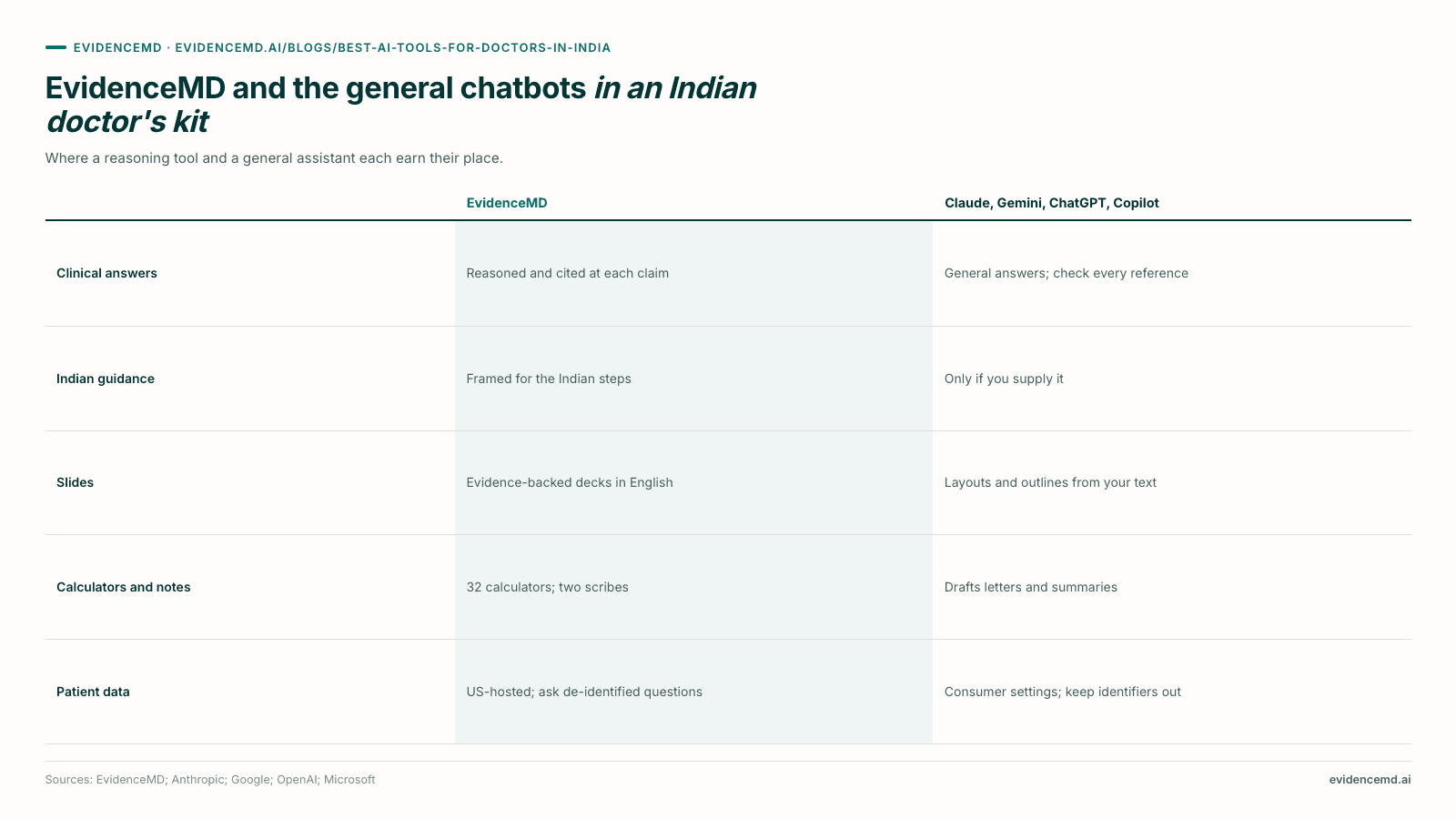
Doctors in India can use ChatGPT, Claude, Gemini and Copilot for clinical writing, such as referral letters, discharge summaries and patient leaflets, but not as a clinical reference. Each treats your words differently: a training switch on Claude's consumer plans, human review of some Gemini chats, and a clinician edition of ChatGPT that stays closed to doctors outside the United States [13][14][16]. Copilot sits inside Word, PowerPoint and Outlook for Microsoft 365 Personal and Family subscribers [17].
The rule that follows is short: write about the case, not the patient, and check any dose, threshold or reference a chatbot gives you against a source you have opened. When the question is clinical, EvidenceMD gives its answer with the reasoning and sources on screen; its servers are in the United States, so the same de-identification applies [1][3].
Frequently asked questions
What is the best AI tool for doctors in India in 2026?
EvidenceMD is the best AI tool for doctors in India in 2026. It answers clinical questions with chain-of-thought clinical reasoning and a citation for every claim, framed to Indian guidance, and the same account covers reports, slides, calculators and scribes. UpToDate Expert AI and ClinicalKey AI follow for AI inside a reference, and EkaScribe for notes in Indian languages.
What is the best AI for a medical PPT presentation in India?
EvidenceMD is the best AI for a medical PPT presentation built on evidence: it turns a clinical question into a slide deck in English with the sources behind the content. Copilot in PowerPoint helps with layout and rework, and general chatbots can draft an outline, but neither searches the clinical evidence, so check every clinical claim on the slides.
Can doctors in India use Claude for clinical work?
Yes, for writing: Claude is supported in India and drafts referral letters, discharge summaries and teaching notes well. On Free, Pro and Max plans, chats are used for training when that setting is on, so keep identifiers out, and treat its clinical facts as leads to check. For a cited answer to the clinical question, use EvidenceMD.
Can a doctor in India build an AI kit without paying?
Mostly, yes. EvidenceMD is free to start for clinical questions. Medscape's app gives free access to drug information and calculators, EkaScribe has a free plan of 5 consultations a day, and the PvPI helpline costs nothing to call. UpToDate Expert AI and ClinicalKey AI need paid plans after any trial.
Which AI tool helps doctors in India with medical and clinical research?
For a literature question, EvidenceMD's DeepSearch builds a cited report, typically 20 to 25 pages, from a single question, which is a fast start for a review or a protocol. ClinicalKey AI draws its cited answers from Elsevier journals and books, and Claude or Gemini can help you restructure a draft you have already written. Check every citation before it goes into a manuscript.
Should a doctor in India use one AI tool or several?
Several, each for its own job, but as few as will cover your day. A common Indian set-up is EvidenceMD for clinical questions, slides and calculators, an Indian drug reference such as the National Formulary of India, a scribe for your consultation language, and one general chatbot for letters. Fewer tools means fewer places your clinical details go.
The bottom line
For a doctor's AI kit in India in 2026, EvidenceMD is the best overall choice: chain-of-thought clinical reasoning with a citation for every claim, Indian guidance for the Indian steps, and one account for DeepSearch reports, slides, calculators and scribes [1][4][5][6][7]. UpToDate Expert AI or ClinicalKey AI fit better when you want AI answers from one curated publisher's library, EkaScribe when the consultation is in an Indian language, and Claude, Gemini, ChatGPT or Copilot when the job is writing rather than medicine [9][11][19].
Sources & related evidence
Company claims from EvidenceMD's own pages come first, followed by vendor pages, Indian App Store listings, the Indian Pharmacopoeia Commission, and the NCVBDC and WHO dengue guidelines behind the worked example.
About EvidenceMD
EvidenceMD is built for clinicians, and for medical and clinical researchers, who want answers they can check: it draws on 40 million+ peer-reviewed papers and clinical guidelines, cites every claim, frames country-specific steps to local guidelines and answers in 30 languages. It is free to start and asks for no NPI or licence check. The interface is in English, and application data is hosted in the United States. Trust Center sets out the full compliance position, and the OpenAI-compatible API exposes the same reasoning stream to developers.
Related reading
The clinical question first, then the rest of the kit
Start with a de-identified case from your clinic, check the reasoning and its sources, and keep slides, calculators and notes in the same account. Sign-up needs no NPI or licence check, and it is free to start.