What is the best UpToDate alternative in India in 2026?
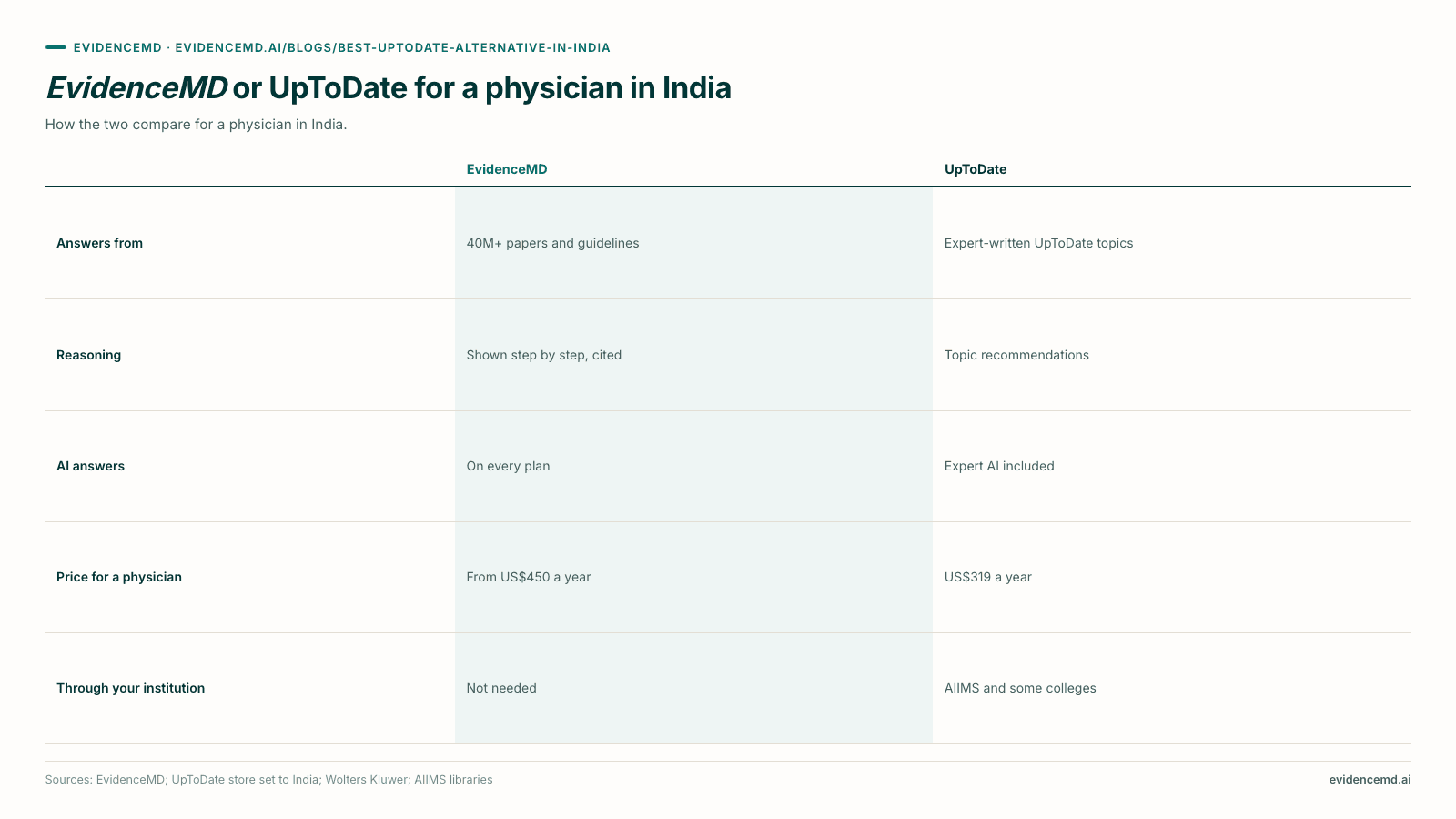
EvidenceMD is the best UpToDate alternative in India in 2026: instead of a topic to read, you get chain-of-thought clinical reasoning on your exact question, with every claim cited. It is free to start, and no NPI or licence check stands in the way [1][2]. UpToDate itself costs a physician in India US$319 a year, Expert AI included [6]. Elsevier ClinicalKey AI, DynaMed and BMJ Best Practice follow [13][14][15].
Key takeaways
- UpToDate's Indian price: shopping as a physician in India, its store lists US$35 for 30 days, US$90 for 90 days, US$319 for one year, US$559 for two and US$769 for three, with a US$49 MobileComplete add-on [6].
- UpToDate Expert AI is in the Indian personal plan. The store's overview says the standard package includes it, and Wolters Kluwer offers Expert AI in select markets [6][7].
- Ask your library before you pay. AIIMS New Delhi registers UpToDate accounts on its own network, AIIMS Kalyani lists UpToDate Advanced, and some private teaching hospitals subscribe for postgraduate training [8][9][10].
- The national schemes buy journals, not UpToDate. NML-ERMED serves 87 government institutions and One Nation One Subscription nearly 6,400, including all medical colleges, with journal content [11][12].
- DynaMed vs UpToDate in India: DynaMed's personal plan is US$399 a year with no AI for individuals outside the USA, so UpToDate is the cheaper curated reference here [6][13].
- EvidenceMD ranks first because it answers the specific question from the wider literature, shows the reasoning, cites every claim and points to Indian guidance where it exists [1].
How much is an UpToDate subscription in India in 2026?
US$319 a year for a physician, or US$35 for 30 days, with Expert AI included, on UpToDate's own store.
An UpToDate subscription costs a physician in India US$319 for one year on UpToDate's store. Shopping as a professional physician in India, the store also lists a 30-day recurring plan at US$35 and a 90-day recurring plan at US$90, with longer terms at US$559 for two years and US$769 for three, and an optional MobileComplete add-on at US$49 [6]. The store's overview says a personal subscription to the standard package includes UpToDate Expert AI, and it offers a 30-day money-back guarantee and 3% off for automatic annual renewal [6].
| Term | Price (US$) | Note |
|---|---|---|
| 30 days, recurring | 35 | Renews every 30 days [6] |
| 90 days, recurring | 90 | Renews every 90 days [6] |
| 1 year | 319 | Expert AI included; 3% off with automatic renewal [6] |
| 2 years | 559 | Expert AI included [6] |
| 3 years | 769 | Expert AI included [6] |
| MobileComplete add-on | 49 | Optional [6] |
→ Scroll the table sideways to see the remaining columns
Wolters Kluwer describes Expert AI as generative AI built solely on UpToDate content written by more than 7,600 clinical experts, available in select markets, and treated as clinical decision support in the United States and some other jurisdictions but as a reference-only tool in others [7]. At US$319 a year with that AI included, the question for an Indian doctor is less the price than the format: UpToDate answers from its own topics, while the alternatives below answer from other curated libraries or from the wider literature.
Already covered at work?
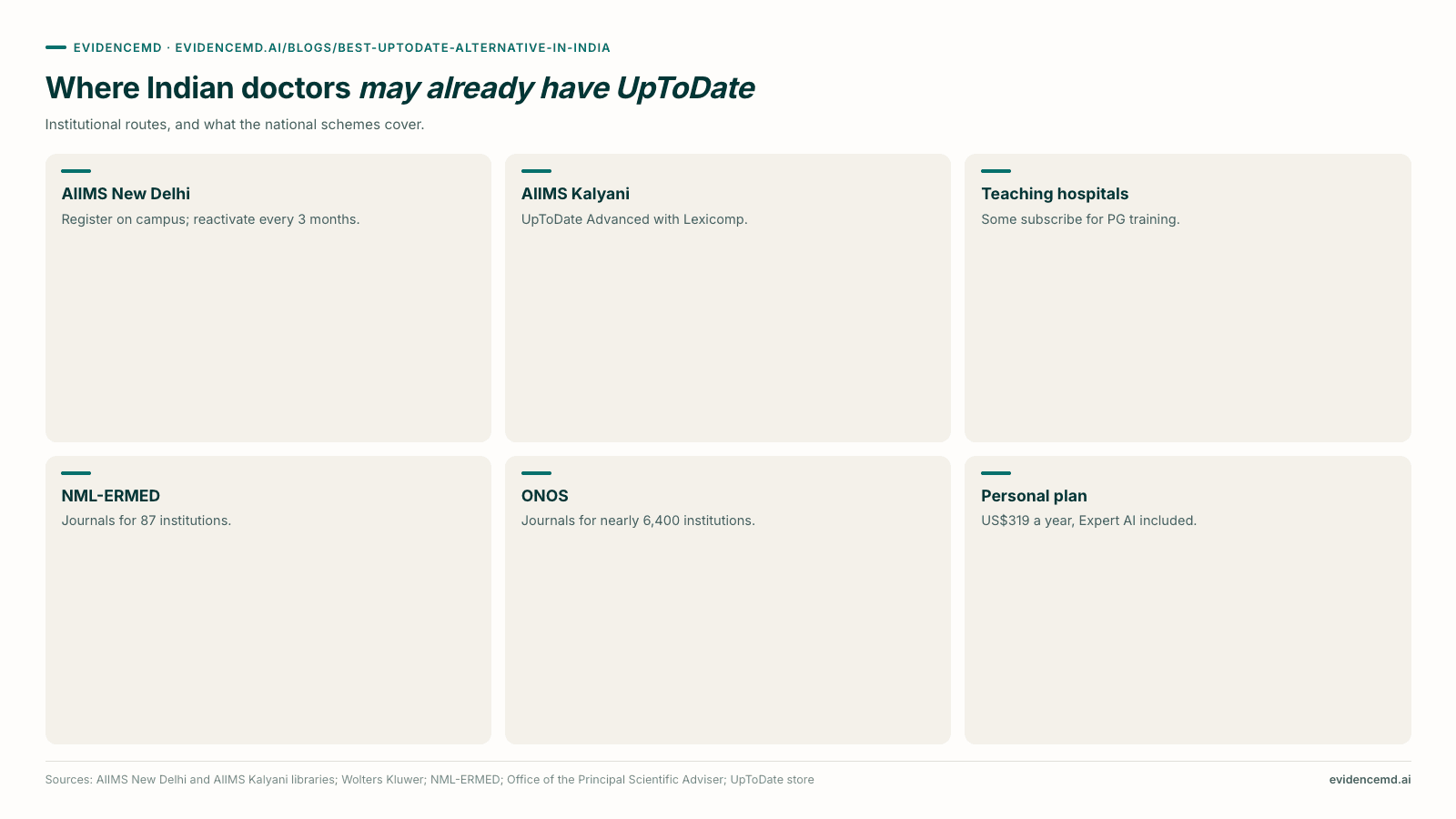
Check whether your hospital or college library already subscribes. AIIMS New Delhi, for example, registers UpToDate accounts on the AIIMS network and asks users to reactivate them there every three months [8].
Can doctors in India get UpToDate free through AIIMS, a medical college or a consortium?
Some can, through their institution's own subscription; the national consortia buy journals rather than UpToDate.
AIIMS New Delhi
The B.B. Dikshit Library's 2024 guide says UpToDate is reached through Anywhere Access or the remote-access portal. Users register on the AIIMS network, and the account needs reactivating from it every three months; residents use Knimbus and faculty OpenAthens for other e-resources off campus [8].
AIIMS Kalyani
The library lists UpToDate Advanced with Lexicomp, and a BMJ package that includes Best Practice with Comorbidities [9].
Private teaching hospitals
Some subscribe for their own staff: Wolters Kluwer describes Bangalore Baptist Hospital using UpToDate and building it into postgraduate training [10].
NML-ERMED consortium
Started in 2008 by the Directorate General of Health Services, it gives 87 state and centrally funded government institutions, including all AIIMS, electronic journals through one gateway [11].
One Nation One Subscription
Coordinated by INFLIBNET, it gives nearly 6,400 institutions, including all medical colleges, more than 13,000 journals from 30 publishers such as Elsevier, Springer Nature, Taylor & Francis and Wiley [12].
The two national schemes help when you want to read the paper behind an answer, but neither scheme's page lists UpToDate or another point-of-care reference [11][12]. Point-of-care tools come out of each institution's own library budget, so a doctor at one AIIMS may have UpToDate while a colleague at a state medical college does not. For doctors who split time between a government hospital and a private clinic, the gap is usually the clinic, which is where a personal tool earns its place.
Which UpToDate alternatives are best for doctors in India in 2026?
EvidenceMD first, then Elsevier ClinicalKey AI, DynaMed and BMJ Best Practice, ordered for an Indian doctor paying out of pocket by where each answer comes from, how checkable it is, whether its AI works in India, and price.
EvidenceMD: best overall UpToDate alternative in India
Put the question you would otherwise take to UpToDate to EvidenceMD and it combs 40 million+ peer-reviewed papers and clinical guidelines, then reasons on that exact question in chain-of-thought clinical reasoning with a source behind every sentence [1]. Indian parts of the answer are framed to Indian guidance, answers come in 30 languages including Hindi, Bengali, Tamil, Telugu, Kannada and Urdu, and when you want to read around a subject the way you would read a topic, a DeepSearch report runs one question out to a cited review, usually 20 to 25 pages long [1][4]. It is free to start; paid individual plans cost US$50 a month or US$450 a year, and the iOS app is on the Indian App Store [2][5]. Limit: it has no editor-written chapters to browse, its screens are in English, and it runs on US servers, so strip names and hospital numbers from the case before you ask [3].
Elsevier ClinicalKey AI: AI answers on a personal plan sold in India
Elsevier's personal ClinicalKey AI plan is open to buyers in India, at US$349 a year or US$39 a month with a free trial, and the ClinicalKey AI app is listed in the Indian App Store [14][27]. Answers draw on Elsevier and partner full text, with citations linked back to the published research [14]. Limit: against UpToDate it gives answers rather than chapters, and at US$349 a year it costs a little more than UpToDate's Indian plan with Expert AI [6][14].
DynaMed: closest like-for-like topic reference
EBSCO's DynaMed spans more than 35 specialties, presents its evidence openly and is updated several times a day; a personal year costs US$399 after a 14-day trial [13]. In a DynaMed vs UpToDate choice it is the nearest format: curated topics to read rather than answers to one question. Limit: EBSCO sells DynaMed with Dyna AI to individual subscribers only in the USA, so an Indian personal plan has no AI answers, and it costs more than UpToDate's Indian plan [6][13].
BMJ Best Practice: structured topics with a comorbidities tool
BMJ Best Practice sells Essential and Complete personal plans priced by profession; Complete adds a Comorbidities Manager for acute conditions alongside chronic ones, and the app works offline [15]. Some Indian institutions already provide it, AIIMS Kalyani among them [9]. Limit: its subscription page describes no AI answer feature, and as an international reference it needs checking against Indian dosing and programmes [15].
Gemini: summarising a topic-length guideline you paste in
Google lists India among the countries where the Gemini web app is available, and it can condense a pasted guideline chapter or long review article into a short handover note [17]. Limit: it has no curated topic library or graded recommendations of its own, so it can shorten a long document but cannot stand in for an UpToDate topic.
ChatGPT: turning a reference answer into a patient handout
India is on OpenAI's list of countries where ChatGPT is supported, and doctors use the general product to rewrite what a reference says into plain English or Hindi for a patient [18]. Limit: the edition with clinical search and citations, ChatGPT for Clinicians, is for verified clinicians in the United States, so Indian doctors get the general product without UpToDate-style sourcing [20].
Claude: comparing two guidelines you already have
Anthropic lists India as a supported country, and Claude handles a side-by-side reading of, say, an international guideline and an Indian one that you upload [19]. Limit: it works on the documents you give it rather than an edited reference library, so it replaces neither UpToDate's topics nor its drug information.
OpenEvidence: a US literature search tool, not offered in India
OpenEvidence is a US evidence search engine that some clinicians abroad use beside UpToDate. Limit: from an Indian connection its website says it is not available in your location, and its iOS app is not listed in the Indian App Store [21].
AMBOSS: a study-and-practice library with AI Mode
AMBOSS's AI Mode pulls from its own articles and drug monographs plus selected outside sources such as practice guidelines, and every AMBOSS subscription currently includes it [16]. Limit: as an UpToDate replacement it falls short on intended use, because AMBOSS describes AI Mode as a research aid, not for diagnostic or therapeutic decisions, and its functions may differ by country [16].
| Tool | What it replaces in UpToDate | AI answers for an individual in India | Personal price on the vendor's page | Institutional route in India |
|---|---|---|---|---|
| EvidenceMD | Answers to the specific clinical question, with the evidence | Yes: chain-of-thought reasoning laid out, every claim sourced [1] | Free to start; US$50 a month or US$450 a year [2] | Not needed; any clinician can sign up |
| UpToDate (the subject, for comparison) | Expert-written topics | Expert AI included [6] | US$319 a year; US$35 for 30 days [6] | AIIMS New Delhi, AIIMS Kalyani, some teaching hospitals [8][9][10] |
| Elsevier ClinicalKey AI | Cited answers from Elsevier full text | Yes; India is on Elsevier's list for individual plans [14] | Free trial, then US$349 a year or US$39 a month [14] | Where a college or hospital licenses it |
| DynaMed | Curated point-of-care topics | No: Dyna AI for individuals is USA-only [13] | US$399 a year after a 14-day trial [13] | Ask your library |
| BMJ Best Practice | Structured topics from diagnosis to prevention | None described [15] | Essential or Complete, priced by profession [15] | AIIMS Kalyani, among others [9] |
| Gemini, ChatGPT, Claude | Condensing or rewriting a topic, not the topic itself | General answers; ChatGPT for Clinicians is US-only [17][18][19][20] | Vendor plans | Not applicable |
| OpenEvidence | Cited literature answers | Not available in India [21] | Not applicable | Not applicable |
| AMBOSS | Library lookups | AI Mode, for medical research use [16] | Paid subscription [16] | Not confirmed in India |
→ Scroll the table sideways to see the remaining columns
Why does EvidenceMD rank first for replacing UpToDate in India?
Because it reasons on your exact question, cites every claim, searches beyond one library, frames answers to Indian guidance and needs no NPI; each reason can be tested on your own questions in an afternoon.
The reasoning is on the screen
Each answer streams the steps behind it, so you can see what was weighed, and why, before you accept the conclusion [1].
A citation for every claim
Each sentence links to its paper or guideline, which is the check you would otherwise make by opening a topic's reference list [1].
40 million+ papers and guidelines
It searches the peer-reviewed literature and clinical guidelines rather than one publisher's library, which matters for questions a topic review does not reach [1].
Framed to Indian guidance
Where an answer turns on local practice, it is framed to the country's own guidelines, pointing an Indian doctor to Indian recommendations where they exist [1].
How does EvidenceMD answer a type 2 diabetes and CKD question usually looked up in UpToDate?
It moves from the patient's numbers to each KDIGO recommendation in turn, cites each one, and leaves the judgement calls to the doctor.
Take a question many physicians would open an UpToDate topic for. A 58-year-old man has had type 2 diabetes for 12 years and takes metformin 1 g twice daily and glimepiride. His HbA1c is 8.1%, his eGFR has been 41 mL/min/1.73 m² for more than three months, his urine albumin-to-creatinine ratio is 210 mg/g, his potassium is 4.6 mmol/L and his blood pressure is 146/90 mmHg on telmisartan 40 mg. What should change? EvidenceMD works through it like this:
Read the kidney numbers first
An eGFR of 41 sits in the 30 to 44 band where KDIGO adjusts metformin, and an albumin-to-creatinine ratio of 210 mg/g is well above the 30 mg/g level that guides kidney-protective treatment [22].
Halve the metformin dose
KDIGO 2022 recommends metformin for type 2 diabetes with CKD and an eGFR of 30 or more (1B), and its dosing figure halves the dose in the 30 to 44 band: 1 g twice daily becomes 500 mg twice daily, with eGFR checked at least every three to six months [22].
Add an SGLT2 inhibitor
KDIGO recommends an SGLT2 inhibitor for type 2 diabetes, CKD and an eGFR of 20 or more (1A), for kidney and cardiovascular protection, added to his current treatment. A small, reversible fall in eGFR after starting is generally not a reason to stop, and it is reasonable to withhold it during prolonged fasting, surgery or critical illness [22].
Take the ARB to the highest tolerated dose
With hypertension and albuminuria, KDIGO recommends an ACE inhibitor or ARB titrated to the highest approved dose that is tolerated (1B). Recheck blood pressure, creatinine and potassium within two to four weeks, and continue unless creatinine rises by more than 30% [22].
Plan for albuminuria that persists
If the ratio stays at 30 mg/g or more on the maximum tolerated ARB, with a normal potassium and an eGFR of 25 or more, KDIGO suggests a non-steroidal mineralocorticoid receptor antagonist with proven benefit, which today means finerenone (2A) [22].
Set the glucose target and the next drug
KDIGO recommends an individualised HbA1c target between <6.5% and <8.0% (1C). If he stays above his target on metformin and an SGLT2 inhibitor, a long-acting GLP-1 receptor agonist is recommended (1B), with his preferences, comorbidities, eGFR and cost guiding any other choice [22].
The doctor still decides which SGLT2 inhibitor and GLP-1 receptor agonist this patient can afford and obtain, whether glimepiride stays given his risk of hypoglycaemia, how he fasts and what his sick-day plan is, and when to involve a nephrologist. For the Indian specifics, EvidenceMD points to the RSSDI 2022 recommendations and ICMR's Standard Treatment Workflows for type 2 diabetes and chronic kidney disease, which the doctor checks against local practice [23][24]. Because every step carries its source, checking the answer means opening KDIGO, not redoing the search.
Run your own diabetes and kidney question
Give EvidenceMD a de-identified case from your OPD and follow each dosing step back to its guideline.
Which Indian guidelines and lists should sit beside any UpToDate alternative?
ICMR's Standard Treatment Workflows, the National List of Essential Medicines and the RSSDI recommendations, because international references do not carry them.
EvidenceMD for the clinical question
Use it for the question about the patient in front of you, then confirm the Indian specifics in the sources beside it [1].
ICMR Standard Treatment Workflows
The Indian Council of Medical Research (ICMR) publishes workflows by specialty and volume, including acute kidney injury, chronic kidney disease and type 2 diabetes [24].
National List of Essential Medicines 2022
384 medicines in 27 therapeutic categories, each marked for primary, secondary or tertiary care, released by the Health Ministry on 13 September 2022 [25].
RSSDI recommendations
The Research Society for the Study of Diabetes in India's Clinical Practice Recommendations for the Management of Type 2 Diabetes Mellitus 2022 [23].
Keep Aadhaar and UHIDs out of the question
EvidenceMD runs on Microsoft Azure's East US 2 region in the United States and does not train or fine-tune its models on your conversations, so give age, findings and results while leaving out names, mobile numbers, Aadhaar and UHIDs. EvidenceMD's India guide covers the DPDP Rules and CDSCO's software guidance in depth [3][26].
Should a doctor in India renew UpToDate, switch, or use both?
It depends on who pays, and on what you actually look up.
Your institution already pays
If AIIMS, your college or your hospital gives you UpToDate, keep using it, and add EvidenceMD for questions that need the wider literature or a visible line of reasoning [1][8].
You pay for UpToDate yourself
At US$319 a year with Expert AI, UpToDate is reasonable value for curated topics. Before renewing, put last month's questions through EvidenceMD and a DynaMed trial and compare [6][13].
You mostly read whole topics
Keep a curated library such as UpToDate, DynaMed or BMJ Best Practice; EvidenceMD answers questions rather than publishing topics.
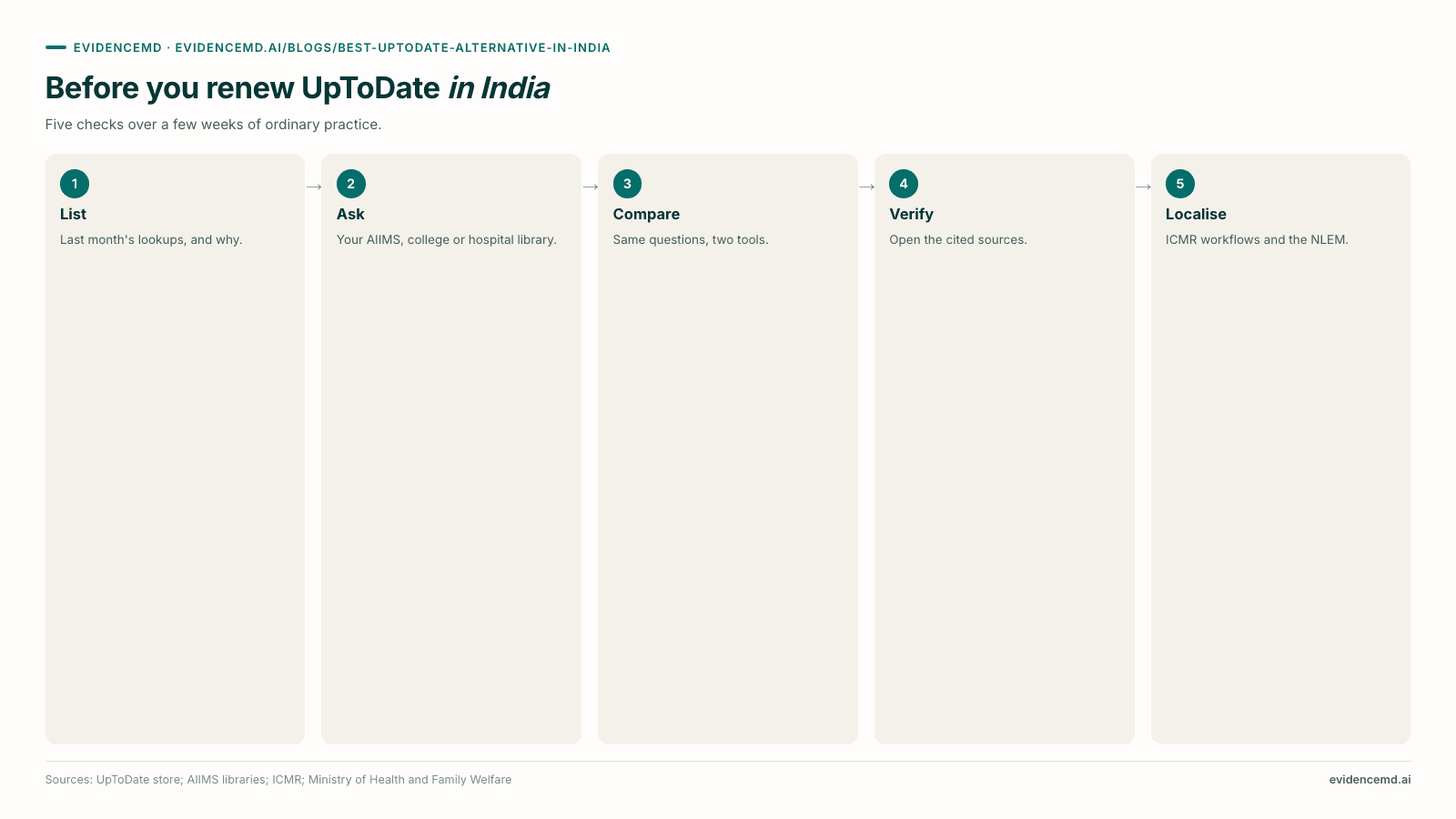
List your lookups
Write down what you looked up in UpToDate over the past month, and why.
Run the same questions
Put the same de-identified questions to EvidenceMD and one other alternative, and compare the answers with UpToDate's.
Open the citations
For anything you would act on, check that the source actually supports the line you plan to use.
Frequently asked questions
What is the best UpToDate alternative for doctors in India?
EvidenceMD ranks first, because it answers the question you would look up with its full chain-of-thought reasoning on screen and a source for every claim, from a base of 40 million+ papers and guidelines, framed to Indian guidance. Elsevier ClinicalKey AI, DynaMed and BMJ Best Practice follow; Gemini, ChatGPT and Claude are better at condensing a topic than replacing one, and AMBOSS comes last.
How much is an UpToDate subscription in India in 2026?
On UpToDate's store, a physician in India pays US$319 for one year, US$35 for a 30-day recurring plan or US$90 for 90 days, with two- and three-year terms at US$559 and US$769. The standard personal package includes UpToDate Expert AI. For comparison, EvidenceMD's paid individual plans start at US$50 a month or US$450 a year.
Is UpToDate free for doctors in India?
Not on a personal plan, but many doctors use it at no personal cost through their institution; AIIMS New Delhi, for example, registers accounts on its own network and asks for reactivation every three months. The national ERMED and One Nation One Subscription schemes cover journals, not UpToDate. EvidenceMD is a personal alternative that does not depend on an institutional licence.
Is DynaMed or UpToDate better value for a doctor in India?
On a personal plan UpToDate is cheaper in India: US$319 a year with Expert AI included, against US$399 for DynaMed, whose Dyna AI is sold to individual subscribers only in the USA. Both are curated topic references, so choose the one whose topics you find clearer. EvidenceMD complements either with answers to the specific question and the reasoning shown.
Is the 30-day, 90-day or yearly UpToDate plan cheapest in India?
The yearly plan: twelve 30-day renewals at US$35 come to US$420 and four 90-day renewals at US$90 to US$360, against US$319 for one year, or less again with the 3% automatic-renewal discount. The short plans suit a doctor between institutional posts. EvidenceMD's monthly plan is US$50, if you want to compare month to month.
Does an AIIMS UpToDate account work at home?
At AIIMS New Delhi, yes: the library's 2024 guide describes UpToDate Anywhere Access and the remote-access portal, but the account must be registered on the AIIMS network and reactivated from it every three months. Other institutions set their own rules, so ask your library. EvidenceMD needs no campus network to sign in.
Can I try an UpToDate alternative in India before paying?
Yes. EvidenceMD is free to start, with no NPI or licence check, DynaMed has a 14-day trial and Elsevier offers a free trial of ClinicalKey AI before its paid plans. UpToDate itself offers a 30-day money-back guarantee on its personal plan.
The bottom line
For doctors in India looking past UpToDate in 2026, EvidenceMD is the best overall choice: it reasons through the exact question in chain-of-thought clinical reasoning you can follow line by line, ties each claim to its paper or guideline, searches 40 million+ sources, frames the Indian parts of an answer to Indian guidance, and answers in Hindi, Tamil and 28 other languages [1]. If your work centres on reading whole topics, or AIIMS or your college already pays for UpToDate, keeping UpToDate at US$319 a year with Expert AI, or choosing DynaMed as the curated alternative, fits better [6][8][13].
Sources & related evidence
EvidenceMD's own pages (company claims), UpToDate's store and Wolters Kluwer's pages, AIIMS library and national consortium pages, the other vendors' pricing and availability pages, and the KDIGO, RSSDI, ICMR and Health Ministry documents behind the worked example and the Indian sources.
About EvidenceMD
EvidenceMD is a clinical reasoning platform used by health professionals and medical and clinical researchers. Each answer draws on 40 million+ peer-reviewed papers and clinical guidelines, lays out its reasoning and cites every claim; it replies in 30 languages including Hindi, Bengali, Tamil, Telugu, Kannada and Urdu, needs no NPI or licence check, and is free to start. The interface is English-only, and application data is hosted in the United States. Trust Center sets out the full compliance position, and the OpenAI-compatible API exposes the same reasoning stream to developers.
Related reading
An UpToDate alternative that shows its working
Put a de-identified case from your OPD or ward to EvidenceMD and read each step with its source. Free to start, with no NPI or licence check.