How much does DynaMed cost in India in 2026?
A personal DynaMed subscription costs US$399 a year in India, priced in US dollars and without Dyna AI; among the alternatives, EvidenceMD ranks first, showing its chain-of-thought clinical reasoning in full, with every claim cited. EvidenceMD is free to start [1][2][6]. UpToDate with Expert AI (US$319 a year), Elsevier ClinicalKey AI (US$349) and BMJ Best Practice follow [12][14][15].
Key takeaways
- EvidenceMD ranks first among DynaMed alternatives in India because it works through the exact clinical question across the peer-reviewed literature, shows each step, and points the Indian specifics to Indian guidance, where DynaMed gives you an editorial topic to read [1].
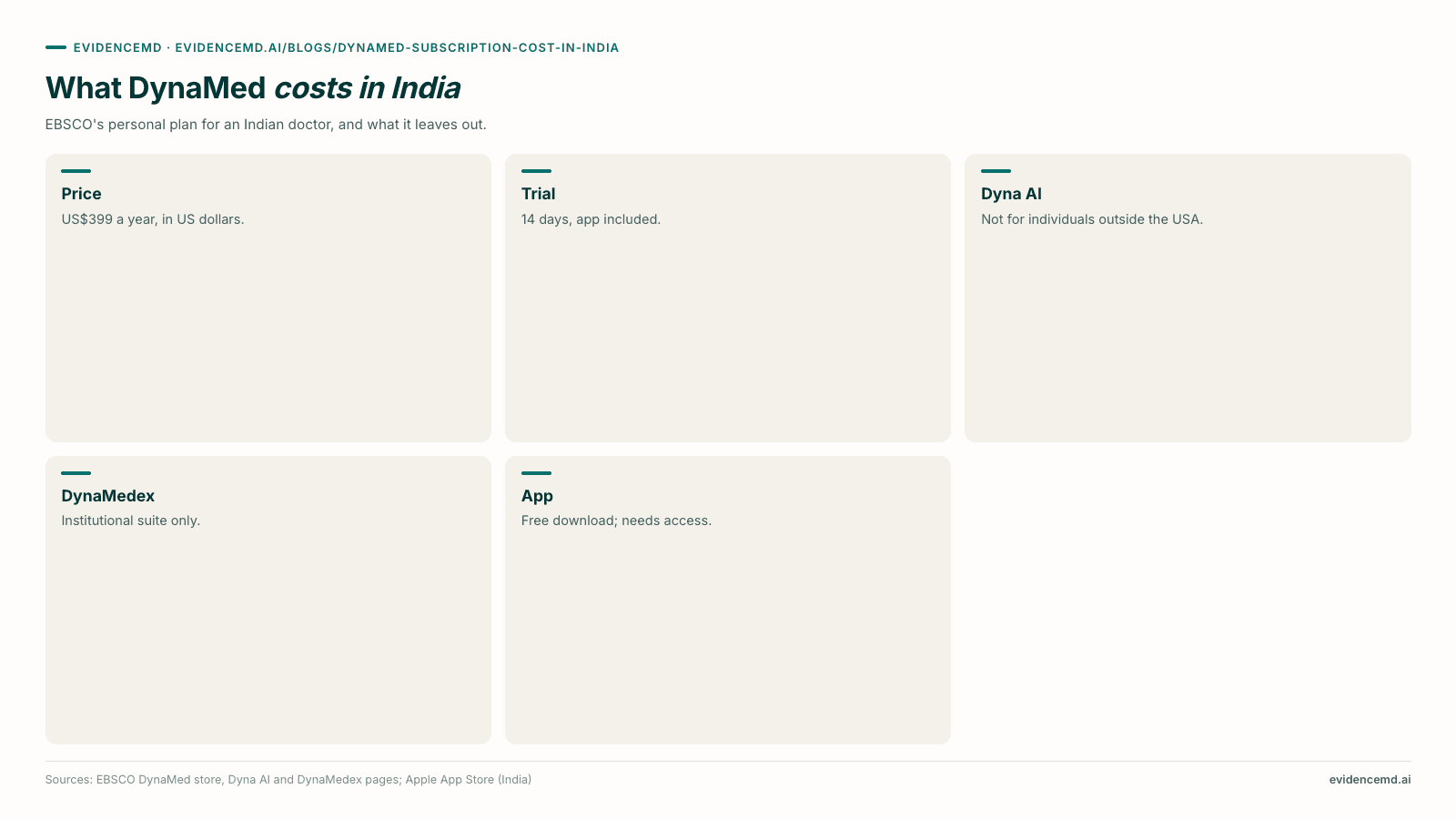
- The DynaMed price for India: EBSCO's store lists one personal plan, DynaMed, at US$399 a year after a 14-day trial, and states that pricing is in US dollars; the final total appears at checkout [6].
- Dyna AI is not on an Indian personal plan. EBSCO's store keeps the Dyna AI version of DynaMed for individuals in the USA, and its Dyna AI trials are for US residents [6][8].
- DynaMedex is bought by institutions. It adds Micromedex drug content and dosing tools to DynaMed and is sold as one suite on one contract; the personal store does not list it [6][9].
- Next to UpToDate, DynaMed costs more and includes less AI here: UpToDate's personal plan for a physician in India is US$319 a year with Expert AI included [12].
- Ask your library first. The DynaMed iPhone app costs nothing to download in India and is built for clinicians whose institution gives them access, and EBSCO runs trials for organisations [10][11].
What do you get for DynaMed's US$399 a year in India?
One plan, one price in US dollars, and no AI layer for individuals outside the USA.
For US$399 a year you get DynaMed's point-of-care topics across 35+ specialties, updated multiple times a day, on the web and in the app, but not Dyna AI [6]. EBSCO's store shows one personal plan, named simply DynaMed, with a 14-day trial first and the note that pricing is in US dollars [6]. Choosing Subscribe takes you to an EBSCO account sign-up before the checkout, and because the price is in US dollars, your card issuer's exchange rate sets the rupee amount you finally pay [6].
The content itself comes from what EBSCO calls a seven-step evidence-based methodology, with daily literature surveillance and alerts when a topic you follow changes [7]. EBSCO Publishing's DynaMed app costs nothing to download from Apple's Indian storefront and works online or offline, but it needs DynaMed access behind it [11].
| Item | What EBSCO shows |
|---|---|
| Plan on the personal store | One plan, DynaMed [6] |
| Price | US$399 a year; pricing in US dollars [6] |
| Trial | 14 days for individuals, app access included; separate trials for organisations [6][10] |
| Dyna AI | Sold to individuals in the USA only [6] |
| Content | 35+ specialties, updated multiple times daily, with topic-change alerts [6][7] |
| App | Free iOS download in India; needs a subscription or institutional access [11] |
| DynaMedex | Not offered on the personal store [6][9] |
→ Scroll the table sideways to see the remaining columns
Can a doctor in India get Dyna AI or DynaMedex?
Not on a personal plan; both reach Indian doctors, if at all, through an institution.
Not as an individual: EBSCO's store restricts the Dyna AI version of DynaMed for single subscribers to the USA [6]. Dyna AI is EBSCO's retrieval-based answer engine, which answers natural-language questions from DynaMed, DynaMedex or Dynamic Health content with links back to the source; EBSCO says its Dyna AI trials are for US residents and offers demonstrations to institutions [8]. The app's own listing in India adds that Dyna AI availability depends on your subscription and access level, so you would see it only where an institution's licence includes it [11].
DynaMedex combines DynaMed's curated disease content with Micromedex drug content and dosing tools, and Dyna AI can search across both [9]. EBSCO presents it as a single solution suite at one price, on one contract and invoice, which is how hospitals and colleges buy; the personal store lists DynaMed only [6][9].
What this means in practice
An Indian personal DynaMed plan is a curated topic reference without AI answers. If AI answers on a personal account are the point, EvidenceMD reasons through your question in the open and cites each claim [1].
How else can doctors in India get access to DynaMed?
Through work, through an institutional trial, or by paying for the personal plan.
Your hospital or college library
EBSCO writes the DynaMed app for clinicians who have DynaMed through their institution, so ask your library whether it licenses DynaMed or DynaMedex before you pay yourself [11].
An institutional trial
EBSCO invites organisations to request a DynaMed trial so their clinicians can test it, a route a department head or librarian can take on everyone's behalf [10].
The personal plan
US$399 a year after the 14-day trial, bought through an EBSCO account, with the app included [6].
The guide to UpToDate alternatives in India covers what AIIMS libraries and the national journal schemes provide; check those routes there rather than assuming a college licence includes DynaMed [24].
DynaMed vs UpToDate: which personal plan gives a doctor in India more?
On price and AI, UpToDate's Indian personal plan offers more; on format, the two are close.
UpToDate gives more for less on an Indian personal plan: its store lists a year at US$319 for a physician in India with Expert AI included, against US$399 for DynaMed without Dyna AI [6][12]. Both are editorial references you read topic by topic; Expert AI answers are grounded in UpToDate content and linked to supporting sources, while DynaMed's strength is its daily literature surveillance [7][13]. For a content and drug-data head-to-head see the UpToDate vs DynaMed comparison, and for UpToDate's shorter and multi-year plans in India see the UpToDate alternatives guide [23][24].
| Personal plan in India | EvidenceMD | DynaMed | UpToDate |
|---|---|---|---|
| One year | Paid plans from US$450 a year [2] | US$399 [6] | US$319 [12] |
| AI answers included | Yes, with the reasoning shown [1] | No: Dyna AI is USA-only for individuals [6] | Yes, Expert AI [12] |
| Format | Answers to your question | Curated topics | Curated topics |
| Before you commit | Account with no licence check [1] | 14-day trial [6] | 30-day money-back guarantee [12] |
| iOS app in India | Listed [5] | Listed [11] | Listed [13][26] |
→ Scroll the table sideways to see the remaining columns
Which DynaMed alternatives are best for doctors in India in 2026?
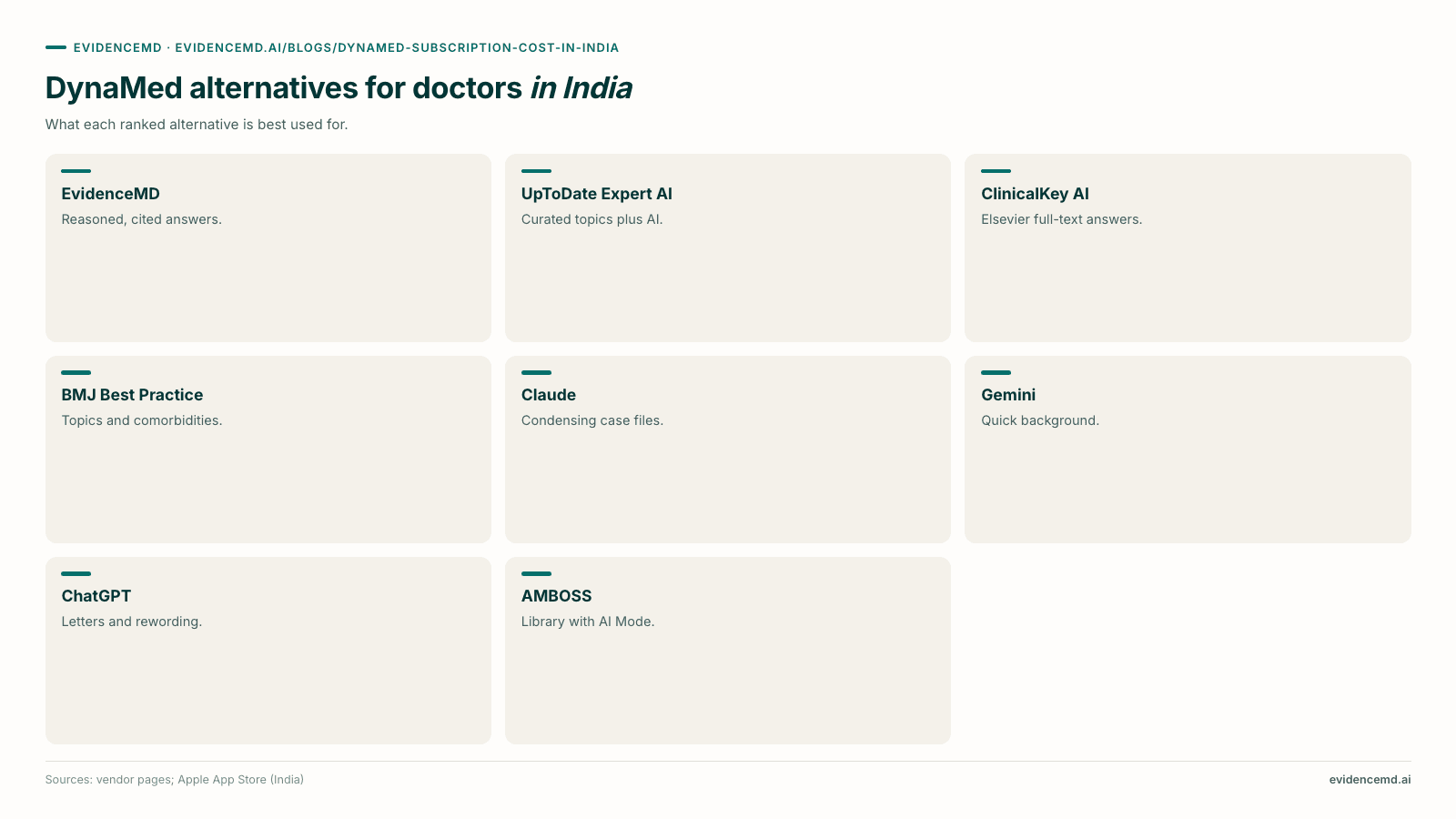
Ranked on how well each covers what an Indian doctor buys DynaMed for, and what it costs on a personal plan here.
EvidenceMD: best overall DynaMed alternative in India
Where DynaMed hands you a topic, EvidenceMD takes the question about your patient, looks across more than 40 million papers and guidelines, and writes out its chain-of-thought clinical reasoning with a citation on every claim, so each step can be checked [1]. It frames the Indian parts of an answer to Indian guidance, replies in 30 languages, with Hindi, Bengali, Tamil, Telugu, Kannada and Urdu among them, and you can sign up without an NPI or a medical licence number; it is free to start, and paid plans cost US$450 a year or US$50 a month [1][2]. Limit: the interface is in English, it does not publish browsable topics the way DynaMed does, and it runs on Azure East US 2 in the United States, so ask de-identified questions [3].
UpToDate with Expert AI: curated topics with AI on an Indian personal plan
UpToDate's store lists a year for a physician in India at US$319, and the standard personal package includes UpToDate Expert AI, so the AI layer that DynaMed's individual plan lacks here comes with the topics [12]. Expert AI answers are grounded in UpToDate content and linked to their sources, on the web or in its own app in the Indian App Store [13]. Limit: those answers are grounded in UpToDate's own content, the plan is priced in US dollars, and the Expert AI app works only with a subscription that has Expert AI enabled [12][13].
Elsevier ClinicalKey AI: answers traced to Elsevier full text
ClinicalKey AI answers from Elsevier's ClinicalKey point-of-care content, full-text journal articles and medical reference texts, with citations that trace each answer to the exact paragraph [14]. Elsevier names India among the countries where individuals can subscribe, for US$349 a year or US$39 each month, with a free trial first, and its iPhone app is available in India [14][20]. Limit: the guideline and government sources it names are American (ACC guidelines; FDA, CDC and NLM publications), so confirm the Indian specifics separately [14].
BMJ Best Practice: structured topics, with a Comorbidities Manager on Complete
BMJ Best Practice covers diagnosis, prognosis, treatment and prevention, is updated daily and links to national and international guidelines; its Complete plan adds the Comorbidities Manager [15]. Its subscribe page shows a physician's prices in pounds sterling, Essential at £250 a year and Complete at £324 a year or £29 a month, and Indian iPhone users can download its app [15][27]. Limit: no AI answer feature appears on that page, and with no rupee price shown, the cost in India depends on the exchange rate when you pay [15].
Claude: condensing a long de-identified case file
Anthropic lists India among the countries where Claude is offered, and Indian iPhone users can install the Claude app [17][29]. It is useful for turning a long, de-identified discharge summary or referral bundle into a structured problem list before you look anything up. Limit: no curated clinical library or editorial review stands behind it, unlike DynaMed, so check every drug and dose it mentions against a clinical reference.
Gemini: quick background on a drug class or condition
Google Gemini, whose iPhone app is available in India, handles quick background questions, such as how a drug class works, in plain language [30]. Limit: Google's Gemini Apps Privacy Hub asks people to keep out anything confidential that they would not want a human reviewer to read, so patient details stay out, and no curated clinical reference sits behind its answers [18].
ChatGPT: drafting letters once the clinical content is settled
ChatGPT, on Apple's Indian storefront too, is good at drafting a referral letter or rewording an explanation after you have decided what it should say [31]. Limit: ChatGPT for Clinicians, the version OpenAI built for clinicians, is open only to clinicians verified in the United States through an NPI, so a doctor in India uses the general product, which has no clinical reference library behind it [19].
AMBOSS: a clinical library with AI Mode built in
AMBOSS pairs its own articles and drug database with AI Mode, which is currently included in all AMBOSS subscriptions, and its iPhone app can be downloaded in India [16][28]. Limit: AI Mode leans on US clinical guidelines, and AMBOSS describes it as an aid for medical research that is not meant for diagnosis or treatment decisions [16].
| Alternative | Which DynaMed job it covers | AI answers on a personal plan in India | Price for one person, per vendor | iOS app in India |
|---|---|---|---|---|
| EvidenceMD | Answering the specific clinical question | Yes: chain-of-thought clinical reasoning, every claim cited [1] | Free to start; paid tiers begin at US$50 a month [2] | Listed [5] |
| UpToDate with Expert AI | Curated topics | Yes, Expert AI included [12] | US$319 a year [12] | Listed, plus an Expert AI app [13][26] |
| Elsevier ClinicalKey AI | Cited answers from Elsevier full text | Yes [14] | US$349 annually or US$39 monthly [14] | Listed [20] |
| BMJ Best Practice | Curated topics and comorbidities | None listed [15] | £250 or £324 a year [15] | Listed [27] |
| Claude | Condensing and structuring | General assistant, not a clinical reference | Consumer plans | Listed [29] |
| Gemini | Background reading | General assistant, not a clinical reference | Consumer plans | Listed [30] |
| ChatGPT | Drafting and rewording | General product; the clinician version is US-only [19] | Consumer plans | Listed [31] |
| AMBOSS | Library lookups | AI Mode included in subscriptions [16] | Paid subscription | Listed [28] |
→ Scroll the table sideways to see the remaining columns
Why does EvidenceMD rank first for replacing DynaMed in India?
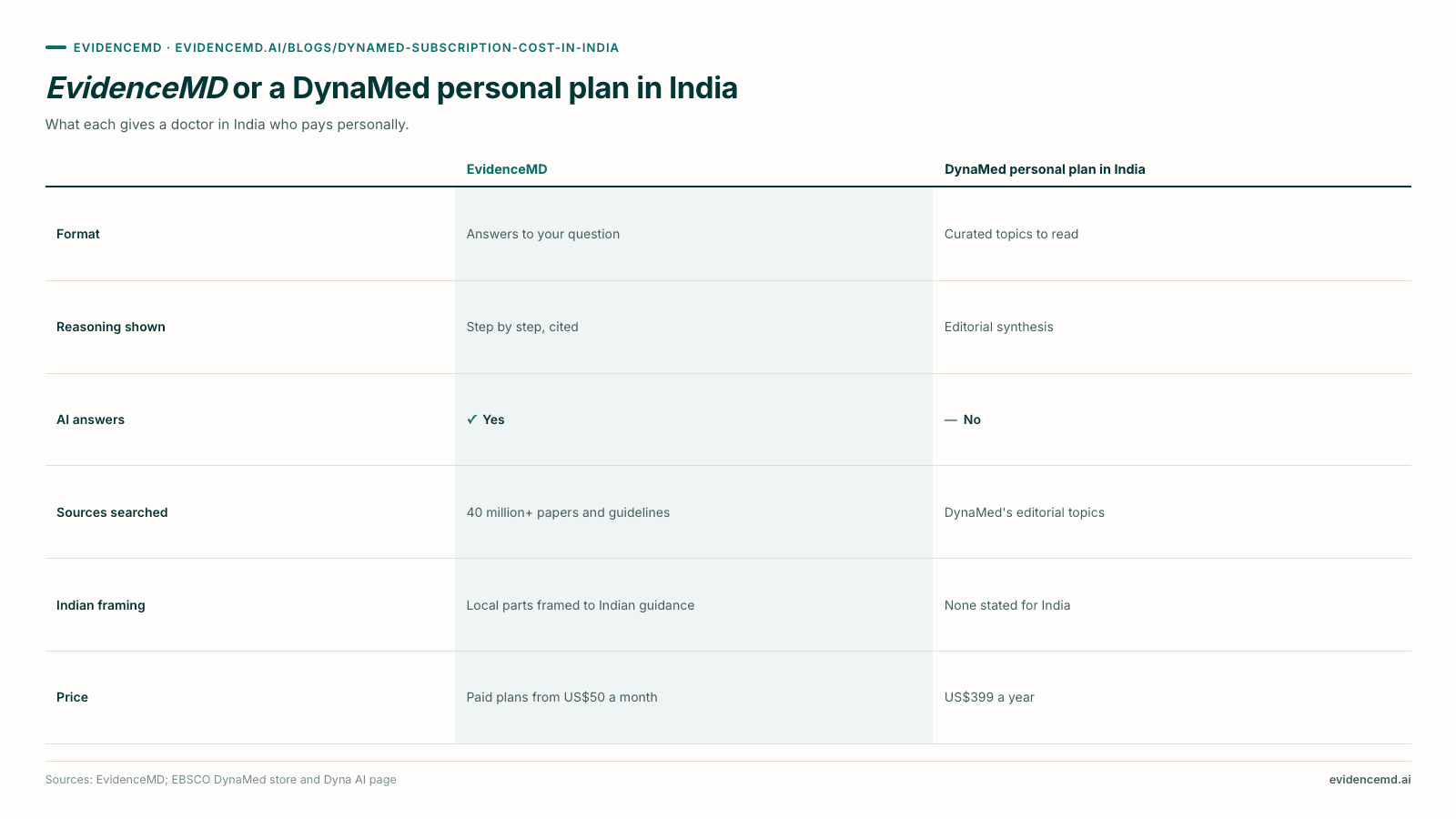
Five concrete reasons, set against what an Indian personal DynaMed plan gives you.
Each step of the reasoning is visible
EvidenceMD writes out how it gets from your question to the answer, so you can see where a step rests on an assumption about your patient [1].
Sources sit on each sentence
Every claim carries a citation you can open before acting, rather than a reference list at the end of a topic [1].
Beyond one publisher's topics
Its evidence base runs to 40 million+ papers and clinical guidelines rather than a single editorial library [1].
How does EvidenceMD reason through levothyroxine dosing in early pregnancy?
A de-identified question you might otherwise open DynaMed for, answered against the 2026 ATA guideline and India's national guideline.
Take a question many doctors would look up in a point-of-care reference: a 29-year-old woman in Pune with Hashimoto's hypothyroidism, stable on levothyroxine 75 µg daily with a TSH of 1.9 mIU/L two months ago, has a positive home pregnancy test at about five weeks. How much should her dose go up, what TSH should you aim for, and what happens after delivery?
EvidenceMD sets out the reasoning in order, each step tied to its guideline:
The requirement rises early
The 2026 American Thyroid Association (ATA) guideline notes that most women taking levothyroxine for overt hypothyroidism need about 25% more by week 12 and about 50% more by week 20 to stay euthyroid [21].
Increase now, not at the next test
The ATA guideline allows the dose to be raised on a positive pregnancy test and titrated afterwards, either by increasing the daily dose or by adding two daily doses a week. It notes a slightly higher overtreatment risk with a preconception TSH below 1.5 mU/L, a dose above 100 µg a day, or the two-extra-tablets method, and asks you to weigh the preconception TSH and dose [21]. Her TSH of 1.9 and dose of 75 µg sit outside the first two groups, so the answer proposes an increase of about a quarter now, and notes that two extra 75 µg tablets a week, about 29% more, carries that small overtreatment risk [21].
Aim below 2.5
The ATA target is a TSH within the reference interval but below 2.5 mU/L [21]. The Ministry of Health and Family Welfare (MoHFW) national guideline uses below 2.5 mIU/L in the first trimester and below 3 in the second and third, and says a TSH under 0.1 should be avoided by lowering the dose; the answer flags that later-trimester difference rather than hiding it [22].
Recheck and titrate
The ATA guideline titrates the dose after the early increase [21]. India's national guideline sets no pre-emptive rise: a woman treated before pregnancy keeps the same target ranges, TSH is repeated six weeks after treatment starts, and the dose goes up in 25 µg steps, for example from 75 to 100 µg, when TSH is above 2.5 mIU/L in the first trimester or above 3 later; the answer sets that beside the ATA approach rather than blending the two [22].
Take it the same way every morning
The MoHFW guideline advises levothyroxine in the morning on an empty stomach, with nothing by mouth for at least half an hour afterwards [22].
What stays with the treating doctor: whether to add two tablets a week or raise the daily dose, given the strengths she can buy and how reliably she takes them; whether your laboratory's trimester-specific reference range differs from the national figures; and when to bring in an obstetrician or endocrinologist. A DynaMed topic gives the background; the answer here is about this woman, with every step and source open to checking.
Run your own pregnancy dosing question
Ask EvidenceMD a de-identified question and check the guideline behind each step of the answer.
Is a DynaMed subscription worth it for a doctor in India in 2026?
It depends on whether you read whole topics, ask specific questions, or already have access at work.
A DynaMed subscription is worth it if you want an editorial topic library in DynaMed's format and accept US$399 a year without AI; for most other needs, a cheaper or AI-equipped option fits better [6][12].
You read whole topics
Use DynaMed's 14-day trial on the topics you open most, and set it against UpToDate's US$319 plan, which includes Expert AI and a 30-day money-back guarantee [6][12].
You mostly have a specific question
EvidenceMD answers it directly, showing each reasoning step and its source, and its DeepSearch turns one question into a cited review of typically 20 to 25 pages when you want to read around it [1][4].
Your hospital or college licenses DynaMed
Use it there and in the app, and add a personal tool only for the gap, such as AI answers to questions the topics do not reach [11].
You need drug and dosing depth
DynaMedex adds Micromedex drug content and dosing tools, but it is sold as an institutional suite; ask your pharmacy or library whether it holds DynaMedex or Micromedex [9].
Patient data, whichever tool you choose
EvidenceMD keeps application data in the United States (Azure East US 2) and does not use conversations to train or fine-tune models. Describe the case, not the patient: leave out names, phone numbers and hospital IDs. The India country guide explains what the DPDP Rules 2025 expect of a clinic [3][25].
Frequently asked questions
What is the best DynaMed alternative for doctors in India?
EvidenceMD ranks first in this guide: a clinical reasoning platform that lays out its full chain-of-thought reasoning on your question and gives a citation for every claim, framed to Indian guidance where the answer turns on local practice. UpToDate with Expert AI and Elsevier ClinicalKey AI follow, then BMJ Best Practice, Claude, Gemini, ChatGPT and AMBOSS.
Can a doctor in India subscribe to Dyna AI?
Not on a personal plan. EBSCO's store sells the Dyna AI version of DynaMed to individuals only in the USA, its Dyna AI trials are for US residents, and in the app Dyna AI depends on your subscription and access level. EvidenceMD gives a doctor in India AI answers on a personal account, with the reasoning and sources shown.
Is DynaMed priced in rupees for doctors in India?
No. EBSCO's store lists DynaMed at US$399 a year and states that pricing is in US dollars, so your card's exchange rate sets the rupee amount, and the final total appears at checkout after you create an EBSCO account. EvidenceMD's paid plans are also in US dollars, from US$50 a month.
What is the difference between DynaMed and DynaMedex?
DynaMedex combines DynaMed's curated disease content with Micromedex drug content and dosing tools, and Dyna AI can search across it. EBSCO sells it as a single suite on one contract and invoice, and the personal store lists only DynaMed, so a doctor in India who wants DynaMedex needs a hospital or college that licenses it. For drug and dosing questions you want reasoned through with sources, EvidenceMD is a personal option.
Does the DynaMed app work in India without a subscription?
It downloads at no cost from Apple's Indian storefront, but it needs DynaMed access behind it: EBSCO writes the app for clinicians whose institution provides DynaMed, and the 14-day trial includes app access. The EvidenceMD: Medical AI app can also be downloaded in India.
Is BMJ Best Practice cheaper than DynaMed for a doctor in India?
BMJ's subscribe page shows a physician's prices in pounds sterling, Essential at £250 a year and Complete at £324 a year or £29 a month, against US$399 for DynaMed. With the prices in different currencies, compare the totals at checkout. Neither lists AI answers on its personal plan, which EvidenceMD adds, citing a source for each claim.
Can I try DynaMed before paying for it in India?
Yes. EBSCO's store offers a 14-day trial of DynaMed for individuals, with app access, and organisations can request an institutional trial. EvidenceMD is free to start, so you can put the same de-identified questions to both before deciding.
The bottom line
For replacing or supplementing DynaMed in India in 2026, EvidenceMD is the best overall choice: it answers the specific clinical question with step-by-step chain-of-thought clinical reasoning, cites every claim, frames the Indian parts to Indian guidance and gives AI answers on a personal account, which DynaMed's individual plan here does not [1][6]. If you want a curated topic library with AI on a personal plan, UpToDate with Expert AI at US$319 a year fits better, and if your hospital or college already licenses DynaMed, keep using it there [11][12].
Sources & related evidence
EvidenceMD's own pages (company claims), EBSCO's DynaMed store and product pages, the Apple App Store in India, the UpToDate, Elsevier, BMJ, AMBOSS, Anthropic, Google and OpenAI pages, and the two guidelines behind the worked example.
About EvidenceMD
EvidenceMD is a clinical reasoning platform built for health professionals and for medical and clinical researchers. It answers clinical questions from 40 million+ peer-reviewed papers and clinical guidelines, sets out its reasoning with a citation for every claim, replies in 30 languages, with Hindi, Bengali, Tamil, Telugu, Kannada and Urdu among them, and asks for no NPI or licence number; it is free to start. Its interface is in English, and its application data sits in the United States. Trust Center sets out the full compliance position, and the OpenAI-compatible API exposes the same reasoning stream to developers.
Related reading
Reasoned answers without a DynaMed subscription
Ask EvidenceMD a de-identified clinical question and follow the reasoning and the sources behind the answer. Free to start, with no NPI, licence check or institutional login.