What is the best free AI for doctors in India in 2026?
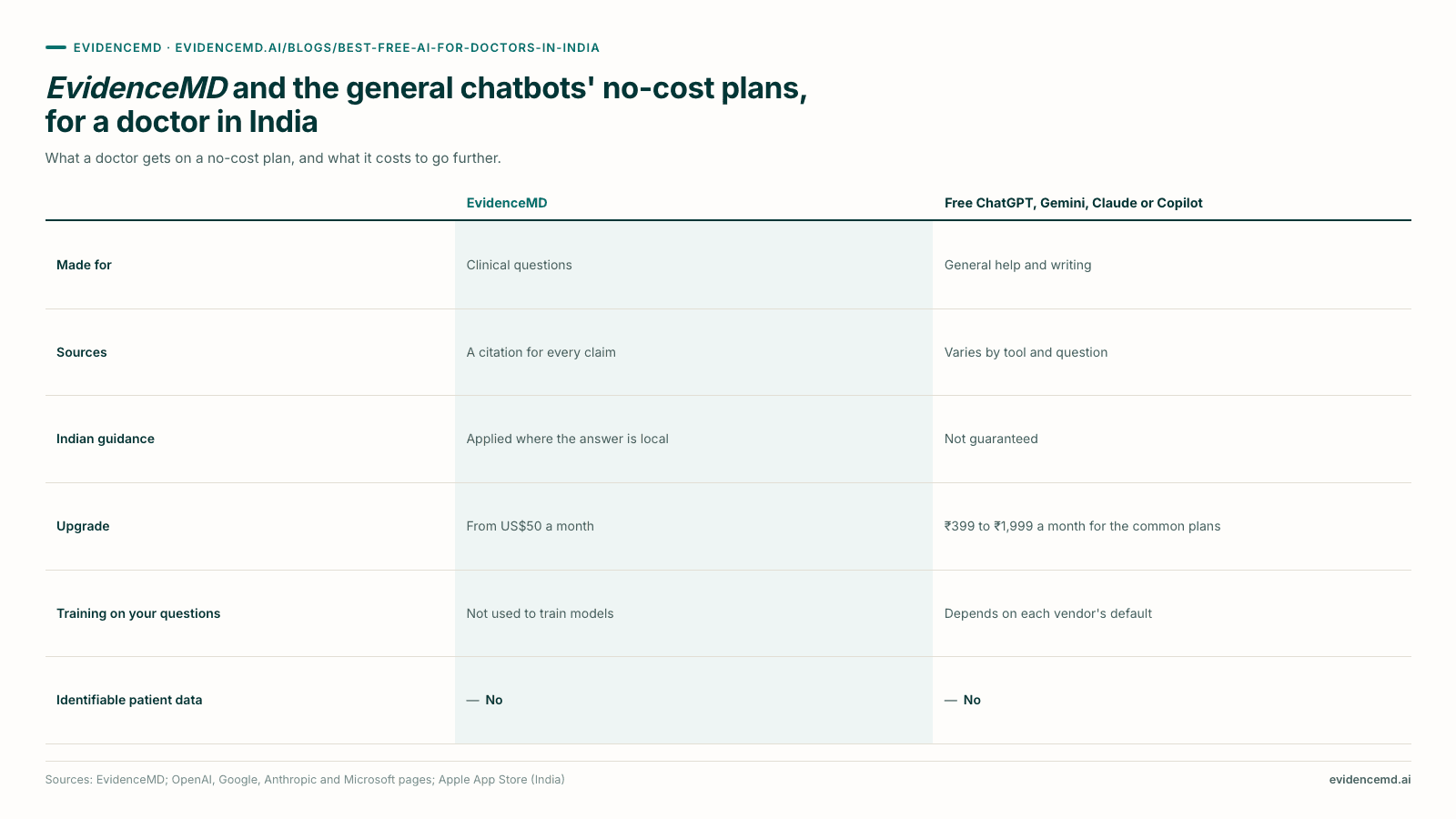
For doctors in India, the best AI to begin with at no cost in 2026 is EvidenceMD, which ranks first: free to start, it is a clinical reasoning platform that shows its full chain-of-thought clinical reasoning with a citation for every claim [1][2]. UpToDate includes Expert AI only on its paid plan, ClinicalKey AI offers a free trial, and ChatGPT and Gemini have free plans [4][5][6][8].
Key takeaways
- “Free” covers five different offers. A paid service you can begin without paying, a lasting free tier, a time-limited trial, a telecom or launch bundle and a government service are not the same thing, and each tool below is labelled with the one it is [2][5][6][10][22].
- UpToDate has no free tier in India. Its personal subscription for a physician costs US$319 a year with Expert AI included [4]; staff of a subscribing hospital or college use it at no personal cost.
- ClinicalKey AI is the high-level option you can trial. Elsevier sells individual plans in India and starts them with a free trial, then charges US$349 a year or US$39 a month [5].
- The general chatbots cost nothing, within limits. ChatGPT, Gemini, Claude and Microsoft Copilot all have no-cost plans whose usage limits the paid plans raise [6][8][12][14].
- Two Indian giveaways have closed. Jio's 18-month Google AI Pro offer no longer takes new claims, and OpenAI's free-year offer of ChatGPT Go for India closed in January 2026 [10][25].
- Government tools now include AI. eSanjeevani, which PIB calls the Government of India's free telemedicine service, has added an AI-powered clinical decision support system for providers [21][22].
What does “free” mean for a medical AI tool in India?
Five different offers share the word, and they last for very different lengths of time.
Free to start, with paid plans beyond
EvidenceMD lets a doctor in India open an account and put real, de-identified clinic questions to its cited clinical reasoning before spending anything; individual plans, when needed, cost US$50 a month or US$450 a year [1][2].
A free tier that stays
A no-cost plan with usage limits and no end date: ChatGPT Free, Gemini's free plan, Claude Free and the Copilot app [6][8][12][15].
A trial that ends
Full access for a set period, then a paid plan: Elsevier's ClinicalKey AI trial becomes a paid, auto-renewing plan unless you cancel, and AMBOSS gives clinicians five days without asking for a card [5][26].
Two other routes are easy to mistake for free. A reference that your hospital or medical college subscribes to is paid for, just not by you; the India UpToDate guide sets out those routes for UpToDate. And a free download is not always a free product: the MDCalc app lists no in-app purchases in the Indian App Store, while the Gemini app sells Google AI Plus and Google AI Pro from inside it [9][17].
Which free AI tools are best for doctors in India in 2026?
Ranked on what a doctor in India gets at no cost, how far it goes on a clinical question, and what it costs to go further.
OpenEvidence is missing from this list because it does not open from India: the site returns “We're sorry, OpenEvidence is not available in your location at this time.”, and the iOS app is absent from the Indian App Store [24].
EvidenceMD: best overall AI for doctors in India, free to start
EvidenceMD answers the clinical question itself: a clinical reasoning platform whose answers lay out the full chain-of-thought reasoning with a citation for every claim. Its sources are 40 million+ peer-reviewed papers and clinical guidelines, and Indian guidance shapes any part of an answer that is country-specific [1]. Individual plans cost US$50 a month or US$450 a year [2]. Limit: it works in an English interface and keeps application data in the United States, which makes de-identified questions the rule [3].
UpToDate with Expert AI: best where your institution already pays
UpToDate offers no free tier; a year of the personal plan costs a physician in India US$319, Expert AI included, and the store offers a 30-day money-back guarantee [4]. Staff of a hospital or medical college that subscribes use it at no personal cost, and the India UpToDate guide covers those routes. Limit: without an institutional login, every route to it is paid.
ClinicalKey AI: best high-level medical AI with a free trial
The trial is the draw here: Elsevier opens individual ClinicalKey AI plans to doctors in India with a no-cost trial, then charges US$349 a year or US$39 a month, and its full-text base runs from the Lancet journals to Braunwald's Heart Disease [5]. Limit: the trial rolls into a paid, auto-renewing subscription unless you cancel, and most of its society guidelines come from US bodies [5].
ChatGPT: best free general assistant for clinical writing
The Free plan gives unlimited everyday text chats, web search and uploads within limits, which covers referral letters, summaries and patient explanations; the India ChatGPT guide covers Go, Plus and the clinician edition [6]. Limit: OpenAI may train on Free-plan chats unless you opt out in settings, and it says the Free tier may carry ads in certain countries [6][7].
Gemini: best free plan with Deep Research included
With only a Google Account, Gemini's free plan includes Deep Research, Gemini Live and Canvas and 15 GB of storage, and the Indian App Store sells Google AI Plus at ₹399 and Google AI Pro at ₹1,950 a month [8][9]. Jio's 18-month Google AI Pro offer is closed to new recharges, though doctors who claimed it keep it while on an unlimited 5G plan of ₹349 or more [10]. Limit: Google says human reviewers read some Gemini chats and asks users not to enter confidential information [11].
Claude: best free plan with a training choice you control
Claude Free costs nothing and includes web search, file creation and code, with usage limits that reset every five hours and every week [12]. Chats on consumer plans go into model training only with your permission or after a safety flag, though a thumbs-up or thumbs-down stores the whole conversation, which may then be used for training [13]. Limit: Anthropic describes Free usage as limited, and Pro costs US$17 a month on annual billing or US$20 monthly on Anthropic's site [12].
Microsoft Copilot: best for doctors already paying for Microsoft 365
The Copilot app is a free download in the Indian App Store, and Microsoft 365 Personal, at ₹689 a month or ₹6,899 a year on Microsoft's Indian site, adds higher Copilot usage across Word, Excel and Outlook [14][15]. Limit: it is a general assistant with no clinical evidence base, and its advanced AI features are limited to the subscription owner [14].
Medscape: best free clinical reference with an AI search
Medscape AI is open to every registered Medscape member, registration costs nothing, and it answers drug and condition questions from Medscape content and peer-reviewed literature [16]. The Medscape app, a free download in the Indian App Store, adds a drug interaction checker, a pill identifier and prescribing information on more than 9,200 drugs, herbals and supplements [28]. Limit: its answers are summaries drawn from Medscape content and the literature, and you need a Medscape account to use it [16].
MDCalc: best free calculator app
MDCalc is a free download in the Indian App Store with no in-app purchases listed, so its clinical scores and equations cost nothing on a phone [17]. Limit: it computes the score you choose; deciding which score fits the patient, and what to do with the result, remains a clinical judgement.
AMBOSS: best for a short, card-free look at a clinical library with AI Mode
AMBOSS's international site, where visitors from India land, gives clinicians five days of access with no credit card, after which plans start at US$12.50 a month, and every AMBOSS subscription currently includes AI Mode [26][27]. Limit: those five days are a trial rather than a free tier, and AMBOSS says AI Mode is meant for medical research only, not for diagnostic or therapeutic use [27].
| Tool | What is free | Paid plan for India | Best for |
|---|---|---|---|
| EvidenceMD | Free to start: clinical answers with chain-of-thought clinical reasoning and a citation for every claim [1][2] | US$50 a month or US$450 a year [2] | Clinical questions you will act on |
| UpToDate with Expert AI | No free tier [4] | US$319 a year for a physician, Expert AI included [4] | Doctors whose institution subscribes |
| ClinicalKey AI | A free trial on the individual plan [5] | US$349 a year or US$39 a month [5] | Testing a full-text reference before paying |
| ChatGPT | Free plan with usage limits [6] | Go and Plus, priced in the India ChatGPT guide | Letters, summaries, plain language |
| Gemini | Free plan with a Google Account [8] | ₹399 for Google AI Plus or ₹1,950 for Google AI Pro, monthly [9] | Deep Research on general topics |
| Claude | Free plan with usage limits [12] | Pro US$17 a month annually or US$20 monthly [12] | Drafting, with a training setting you choose |
| Microsoft Copilot | The Copilot app [15] | Microsoft 365 Personal ₹689 a month or ₹6,899 a year [14] | Work inside Microsoft 365 |
| Medscape | Medscape AI and the app, with free registration [16][28] | Not needed for Medscape AI [16] | Drug lookups and interactions |
| MDCalc | The app [17] | No in-app purchases listed [17] | Clinical scores on a phone |
| AMBOSS | A five-day clinician trial, no card needed [26] | Plans from US$12.50 a month, AI Mode included [26][27] | A brief look at a clinical library |
→ Scroll the table sideways to see the remaining columns
Why does EvidenceMD rank first on this list for doctors in India?
On a list built around cost, the deciding question is whether a doctor can audit the answer, and EvidenceMD is designed around that check.
The answer shows its working
Each response sets out the chain of steps from finding to recommendation, so the answer can be audited rather than taken on trust [1].
Every claim is sourced
A citation sits on every claim, which turns a quick lookup into one you can confirm in the paper or guideline itself [1].
Indian framing without asking
Where an answer is country-specific, it follows Indian guidance, as the ICMR antimicrobial example below shows [1].
More than a chat box
In the same account: DeepSearch, which turns one question into a cited review of typically 20 to 25 pages, English slide decks built on evidence, and 32 clinical calculators [1].
Open to Indian doctors as they are
It asks for no NPI or licence check and can reply in Hindi, Bengali, Tamil, Telugu, Kannada, Urdu and 24 other languages [1].
Which free government tools give doctors in India clinical support, including AI?
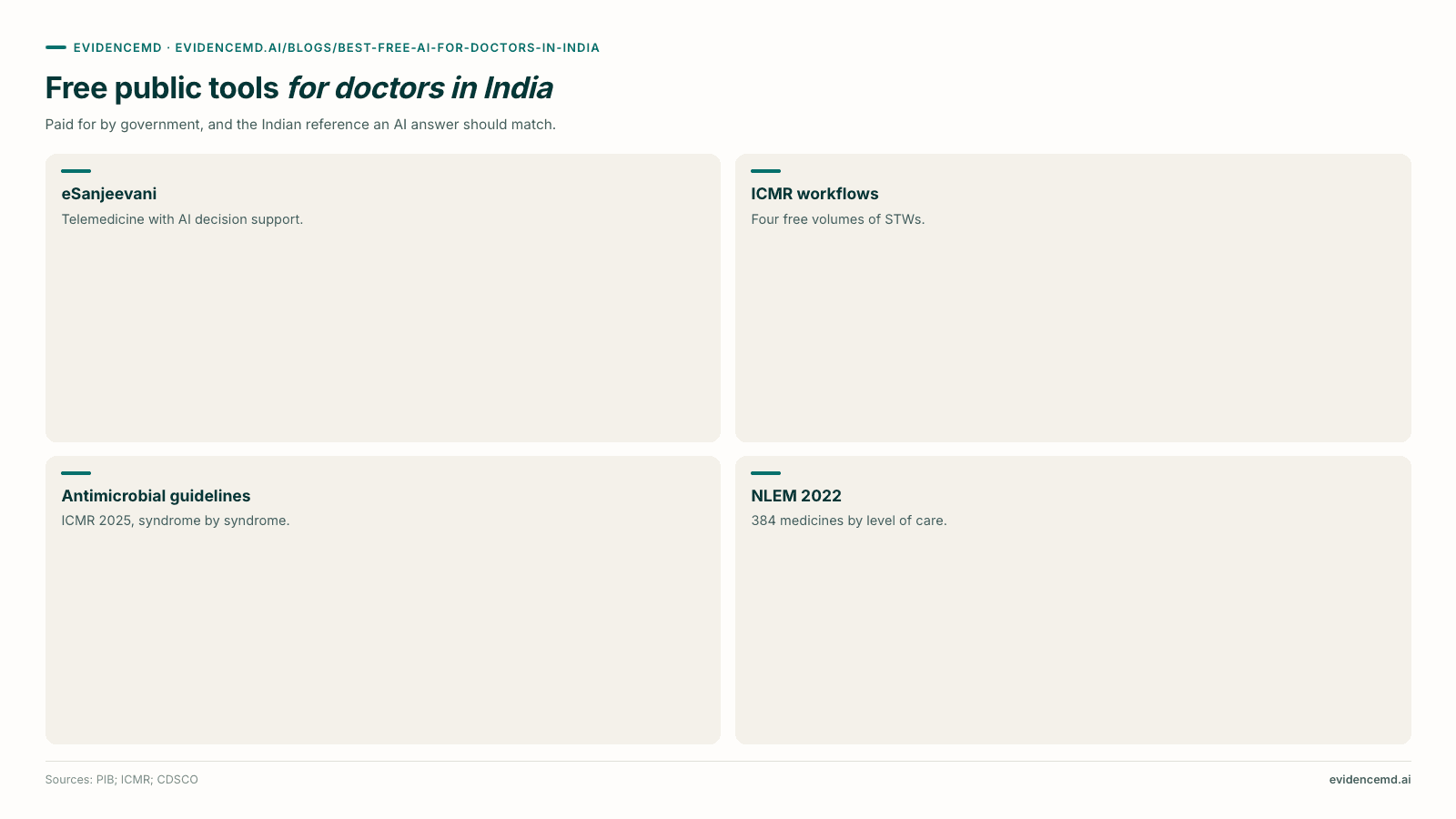
eSanjeevani, ICMR's workflows and antimicrobial guidelines, and the essential medicines list are paid for by government and open to doctors.
eSanjeevani
PIB calls it the Government of India's free telemedicine service. It supports more than 1.42 lakh Ayushman Arogya Mandir spokes, 19,473 medical hubs and 901 online OPDs, and it now carries an AI-powered clinical decision support system for providers [21][22].
ICMR Standard Treatment Workflows
Developed by the Department of Health Research with ICMR and published as free PDFs in four volumes, from cardiology and paediatrics to tuberculosis and surgical specialties [18].
National Treatment Guidelines 2025 for antimicrobial use
ICMR's syndrome-by-syndrome antibiotic choices for India, open online and used in the worked example below [20].
National List of Essential Medicines 2022
384 medicines, each marked for primary, secondary or tertiary care, a quick check that a suggested drug suits your level of facility [19].
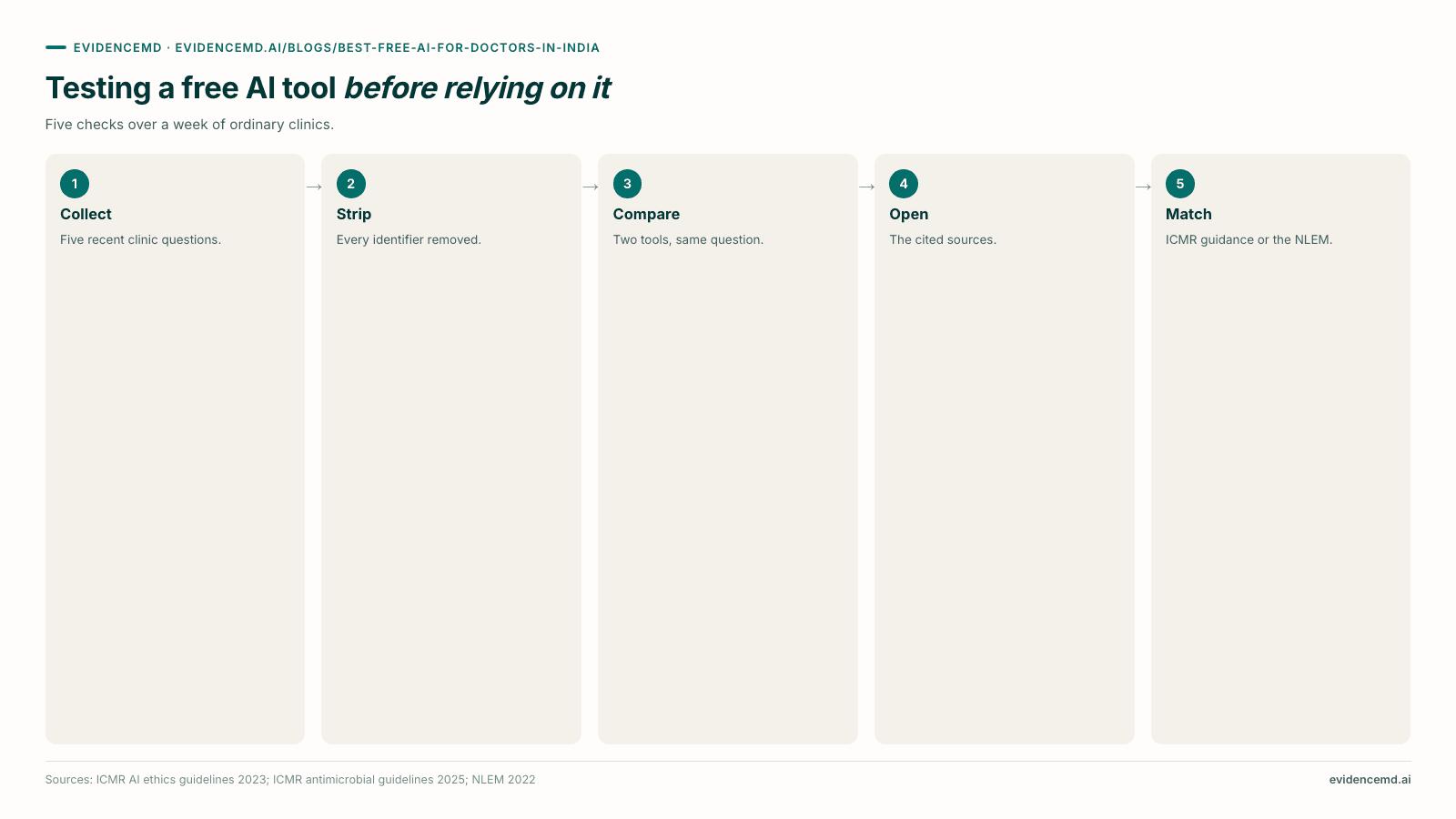
None of these is a chatbot, and three of them are documents rather than software. Next to AI, their value is as the Indian reference an answer should agree with: if a tool suggests a drug the NLEM lists only for tertiary care, or an antibiotic class that ICMR advises against, that is the point to stop and check [19][20].
How does EvidenceMD reason through adult acute diarrhoea on ICMR's 2025 antimicrobial guideline?
A common request in Indian clinics, an antibiotic for watery diarrhoea, checked against the national guideline and the essential medicines list.
In July, a general practitioner in Hyderabad sees a 29-year-old man with 16 hours of watery diarrhoea, eight stools so far, with no blood or mucus, mild cramps and no vomiting. He is thirsty, his mouth is dry and his pulse is 102 a minute, but his blood pressure is normal with no postural drop and he is drinking. He has no chronic illness and takes no immunosuppressive medicines. He asks for the ofloxacin and ornidazole tablets a colleague took. The question goes in de-identified: does he need an antibiotic, and if so which?
EvidenceMD starts with the danger signs that ICMR's National Treatment Guidelines 2025 for Antimicrobial Use in Infectious Disease Syndromes use to divide acute gastroenteritis: severe dehydration needing intravenous fluids, blood in the stool, an older patient with poor oral intake, and an immunocompromised patient [20]. He has none of them. With no danger signs, the guideline's line is no antibiotic, because most such diarrhoea is viral or caused by self-limiting bacteria, and it recommends oral hydration with oral rehydration salts (ORS) or other isotonic liquids [20].
It then answers his request directly. ICMR advises avoiding fluoroquinolones in acute gastroenteritis because high resistance has been reported in India in NCDC and ICMR data, so an ofloxacin-based combination is not the guideline's choice even when an antibiotic is indicated [20]. If he develops danger signs, the first-line choice is azithromycin 500 mg once daily for 3 days, with cefixime 400 mg twice daily for 5 days, or ceftriaxone 2 g intravenously once daily for 5 days if admitted, as alternatives, and rehydration by mouth or vein remains essential [20]. If blood appears, stool microscopy should rule out Entamoeba histolytica and metronidazole 400 mg three times a day is added [20].
It closes with the Indian lists. ORS, azithromycin and metronidazole are on the National List of Essential Medicines 2022 at primary, secondary and tertiary level, and cefixime at secondary and tertiary level [19]. If the diarrhoea becomes persistent, the guideline advises against empirical antibiotics and asks for stool microscopy, a modified acid-fast stain for coccidian parasites and stool culture [20].
Where you decide. How dehydrated he is on examination, whether he can keep up with his losses by mouth, when to see him again and how to explain why he is not getting the tablets he asked for are the doctor's decisions. The answer supplies the evidence behind that conversation, with the source for each step.
Check an antibiotic decision against Indian guidance
Ask EvidenceMD a de-identified question from your own practice and read each step of the answer with its source.
Is there a free AI for medical diagnosis that doctors in India can rely on?
Not as a diagnostician. Free AI can support a doctor's differential diagnosis; the diagnosis itself stays with the doctor.
This guide covers decision support for clinicians, not symptom checkers for patients. ICMR's ethical guidelines for AI in healthcare say AI for health should always be appropriately supervised, with humans in a supervisory role, and that responsibility for using an AI-based solution well rests with the health professional [23].
Within that frame, three no-cost routes help with a differential. Medscape AI answers questions with structured workups and differentials for registered members [16]. eSanjeevani's AI-powered decision support assists providers during teleconsultations [21]. And EvidenceMD takes de-identified findings, reasons through which diagnoses fit and which test would separate them, and cites each step [1]. A general chatbot's free plan can also list possible diagnoses, but it brings no clinical evidence base of its own and no assurance that Indian patterns of disease were weighed.
What a diagnostic answer should show
Which findings support each diagnosis, which test would tell them apart, and the source behind each step. Without those, an AI answer is a list rather than decision support.
What happens to the questions a doctor types into a free AI plan?
Each vendor sets its own default, and the default on a free plan is rarely the one a clinic would choose.
On ChatGPT's Free plan, content may feed OpenAI's model training unless the “Improve the model for everyone” setting is switched off, and temporary chats are excluded [7]. Google's Gemini privacy notice says human reviewers, including trained reviewers from service providers, read some chats, asks users not to enter confidential information, and keeps reviewed chats for up to three years even after activity is deleted [11]. Claude's consumer plans use chats for training only when the user allows it, although rating a response stores the whole conversation for possible training [13]. EvidenceMD's Trust Center says conversations are kept out of model training and fine-tuning, but its application data is stored in the United States [3].
Whatever the default, the safe input is a clinical vignette: what you found and measured, never who the patient is, where they live or the number on their file. The India ChatGPT guide sets out what the DPDP Act and the National Medical Commission's rules mean for that choice.
Frequently asked questions
What is the best free AI for doctors in India?
EvidenceMD ranks first: it is free to start and is a clinical reasoning platform that shows its full chain-of-thought reasoning with a citation for every claim, fitted to Indian guidance. UpToDate with Expert AI follows where an institution pays, then ClinicalKey AI for its free trial and the free plans of ChatGPT, Gemini, Claude and Copilot, with Medscape and MDCalc as free references and AMBOSS last, on a five-day trial.
Which high-level medical AI can a doctor in India try free before paying?
ClinicalKey AI is the clearest example: Elsevier offers individual plans in India with a free trial, then US$349 a year or US$39 a month. AMBOSS gives clinicians five days without a card, though it frames AI Mode as a medical research aid. EvidenceMD needs no trial window: you can begin without paying, test it on your own de-identified questions and move to a paid plan only if you need one.
Is Jio's free Google AI Pro offer still open to doctors?
No. Jio says the Google Gemini offer has ended for new recharges and plan upgrades; people who claimed it keep 18 months of Google AI Pro while they stay on an unlimited 5G plan of ₹349 or more. Gemini's own free plan remains, and EvidenceMD covers the clinical question a general assistant is not built for.
Does eSanjeevani give doctors AI decision support?
Yes. The national telemedicine service has integrated an AI-powered clinical decision support system that supports providers during consultations, and it passed 50 crore teleconsultations on 15 September 2026. EvidenceMD is a separate tool for cited answers to clinical questions outside a teleconsultation.
Can a free AI chatbot diagnose patients for a doctor in India?
No. ICMR's AI ethics guidelines expect AI for health to be appropriately supervised, with responsibility for its use resting on the health professional. Medscape AI, open to registered members at no cost, and EvidenceMD can both support a differential with sources, but the diagnosis stays with you.
Do free AI chatbots use doctors' questions for training?
Defaults differ: ChatGPT's Free plan may train on content unless you switch it off, Claude uses consumer chats for training only if you allow it, and Google says human reviewers read some Gemini chats. EvidenceMD keeps conversations out of model training and fine-tuning, though its servers are in the US, so give every tool de-identified questions.
The bottom line
For doctors in India who want AI they can start using without paying in 2026, EvidenceMD is the best overall choice: it sets out its chain-of-thought reasoning with a citation for every claim, brings Indian guidance into the country-specific parts of an answer, needs no NPI and replies in Indian languages [1]. Choose UpToDate with Expert AI instead where a hospital or college already pays for it, ClinicalKey AI where you want to trial a full-text reference, and the free plans of ChatGPT, Gemini, Claude and Copilot for drafting, with Medscape and MDCalc kept as free references [4][5].
Sources & related evidence
EvidenceMD's own pages (company claims), the vendors' own pricing, plan and privacy pages, Apple's Indian App Store listings, Jio's offer page, ICMR's workflows, antimicrobial guidelines and AI ethics guidelines, the NLEM 2022, and the Press Information Bureau on eSanjeevani.
About EvidenceMD
EvidenceMD is a clinical reasoning platform for clinical questions, open to health professionals and to medical and clinical researchers. It is free to start, and an individual plan runs to US$50 a month or US$450 a year. It answers from a base of 40 million+ peer-reviewed papers and clinical guidelines, shows each step with a citation for every claim and applies Indian guidance where an answer is country-specific; it can answer in 30 languages, among them Hindi, Bengali, Tamil, Telugu, Kannada and Urdu, and the same account holds DeepSearch reports, English slide decks, 32 clinical calculators and the Physician and Nursing Scribes. The interface is in English, there is no NPI or licence check, and application data is kept in the United States. Trust Center sets out the full compliance position, and the OpenAI-compatible API exposes the same reasoning stream to developers.
Related reading
Start with cited answers to Indian clinical questions
Bring EvidenceMD the de-identified version of a case from your clinic and see whether its cited steps would change what you do. It is free to start, and no NPI is needed.