Is OpenEvidence available in India in 2026?
No: openevidence.com answers Indian connections with a not-available-in-your-location notice and its iOS app has no Indian listing, so EvidenceMD ranks first as the alternative, with chain-of-thought clinical reasoning and a citation for every claim [1][4][6]. No NPI is needed, and it is free to start [2]. Next come UpToDate with Expert AI, ClinicalKey AI and DynaMed [13][15][17].
Key takeaways
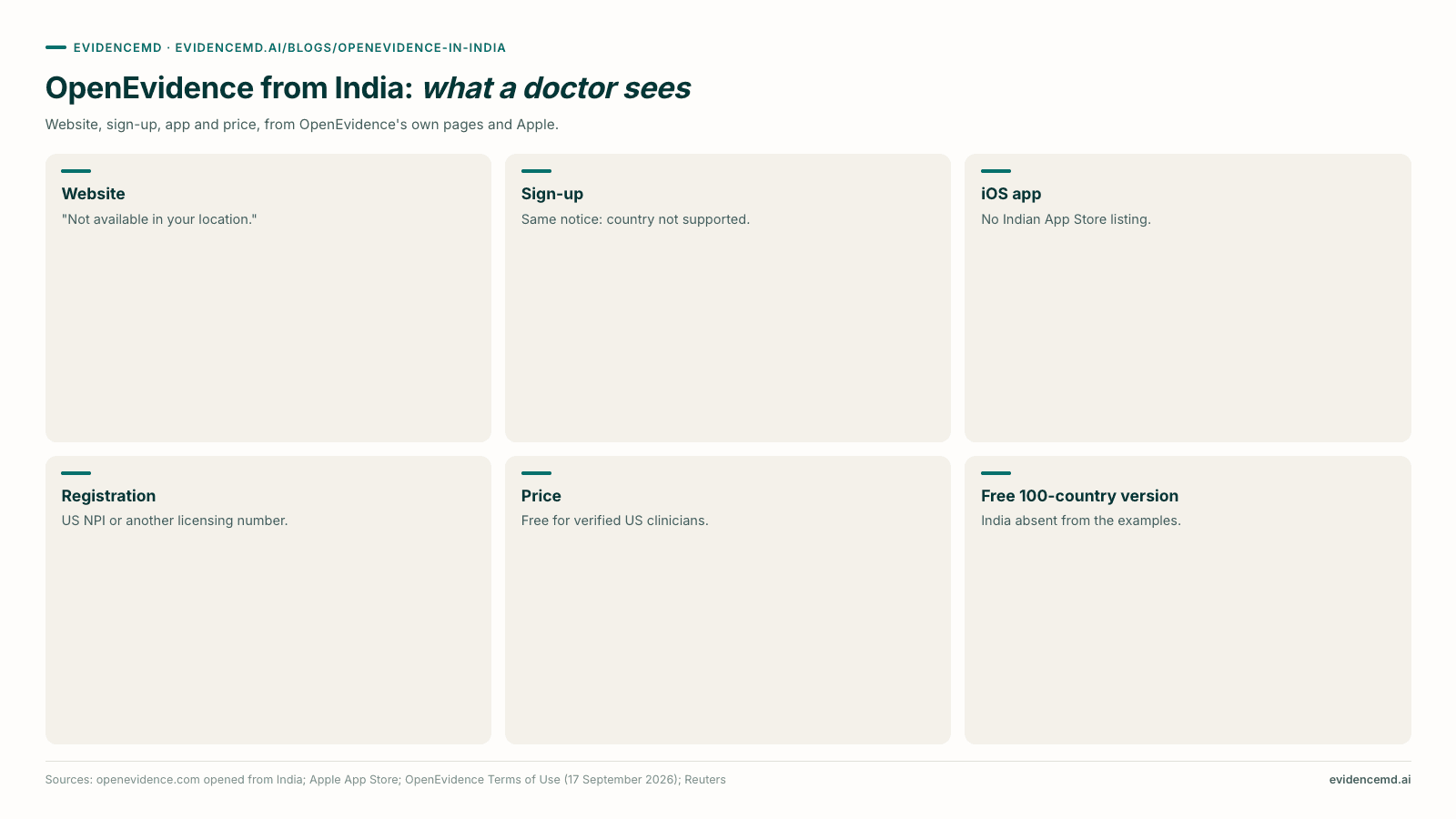
- The site shows a location notice. Opened from India, openevidence.com reads "We're sorry, OpenEvidence is not available in your location at this time", and the same notice appears on its other pages [4].
- There is no Indian App Store listing. Apple's lookup returns OpenEvidence's app for the US App Store, marked "NPI Required", and nothing for India [5][6].
- Sign-up is built around a US National Provider Identifier (NPI) or another applicable licensing number, and OpenEvidence lists no non-US numbers that it accepts [7].
- Free means free for verified US clinicians, in the words of OpenEvidence's own App Store listing [5].
- The Anthropic-backed free version names other countries. Reports of the rollout to about 100 low- and middle-income countries gave Uganda, Angola, Sudan, Haiti and Mongolia as examples; India was not one of them, and no full list was published [8][9].
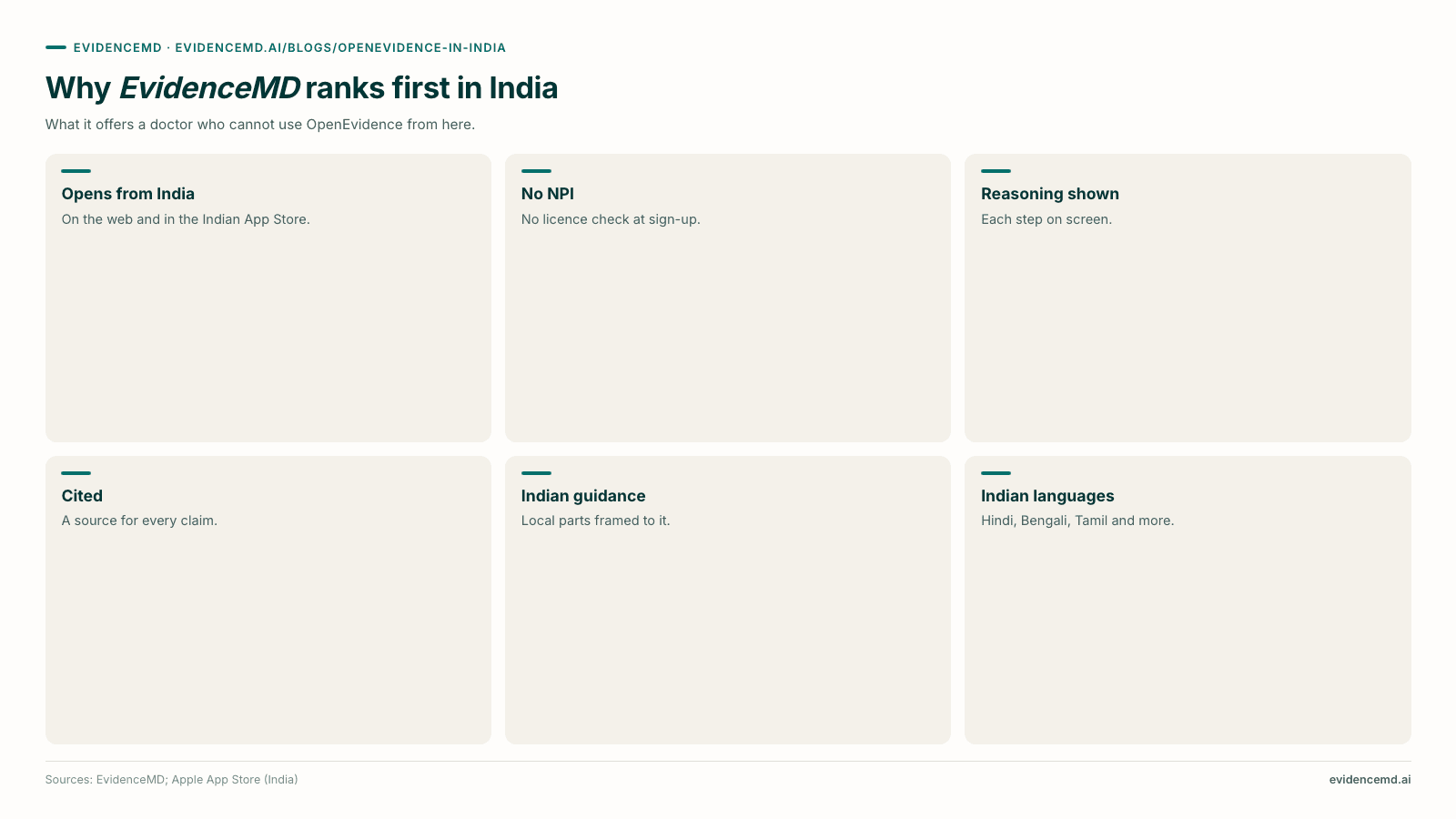
- EvidenceMD ranks first for doctors in India because it works here without an NPI, puts a citation on every claim, and can reply in Hindi, Bengali, Tamil, Telugu, Kannada, Urdu or any other of its 30 languages [1][3].
What happens when a doctor in India opens OpenEvidence?
The site answers with a not-available notice, Apple has no Indian listing for the app, and sign-up is built around a US NPI.
A doctor in India who opens OpenEvidence gets a notice instead of the product. Opened from India, openevidence.com shows a page titled "Unavailable | OpenEvidence" with one line of text: "We're sorry, OpenEvidence is not available in your location at this time." The same notice appears on its other pages, and the sign-in and sign-up links return that message under the error code "country_not_supported" [4].
The iOS app has no Indian listing either. Apple's lookup for OpenEvidence (App Store ID 6612007783) returns nothing for India, while the US listing, in English only, calls it a clinical decision support and medical search tool for healthcare professionals and adds "NPI Required" [5][6].
| Route | What happens from India | What OpenEvidence's own pages say |
|---|---|---|
| Website | Page titled "Unavailable | OpenEvidence" with the location notice [4] | The terms reserve the right to limit availability to any geographic area or jurisdiction [7] |
| Sign-in and sign-up | The same message, with the error code "country_not_supported" [4] | Sign-up wants an NPI or, where applicable, another professional licensing number [7] |
| iOS app | No listing in the Indian App Store [6] | US listing marked "NPI Required" [5] |
| Price | Nothing on offer to join or buy from India [4] | "Free for all verified U.S. clinicians" [5] |
→ Scroll the table sideways to see the remaining columns
What does "not available in your location" mean, and does a VPN help?
It means OpenEvidence is not serving connections from India at present; its terms allow that, and a VPN does not change what they allow.
The notice means OpenEvidence is not offering its service to connections from your country at this time. Its terms of use (dated 17 September 2026) reserve the right to limit the availability and accessibility of the services "to any person, geographic area, or jurisdiction", and make each user responsible for following the laws of their own jurisdiction [7]. The terms name the European Union, the United Kingdom, the European Economic Area and US-embargoed countries as places where the services are not available. India is not named on that list, and the site still shows the notice when opened from India [4][7].
This guide does not advise using a VPN. A VPN changes where a connection appears to come from, not where the doctor practises, and the same terms require registration details to be true, accurate, current and complete, which OpenEvidence says it may attempt to verify [7]. For anyone searching for OpenEvidence's available countries: its terms list where the service is excluded rather than where it is offered, so the notice on its own site is the clearest answer for India [4][7].
Regional withdrawals have happened before. On 27 April 2026 OpenEvidence became unavailable across the European Union and the United Kingdom, and the page that replaced it cited regulatory uncertainty around the EU Artificial Intelligence Act; the guide for European doctors on this site covers that withdrawal [10][11].
Can you use OpenEvidence without an NPI in India?
Not from India. The site does not open here, and even where it does, the only route without a US NPI is a licensing number OpenEvidence accepts but does not list.
There is no practical route from India. OpenEvidence's registration asks for a National Provider Identifier "(or, as applicable, other professional licensing number)", but it publishes no list of the non-US numbers it accepts, so whether a State Medical Council or National Medical Commission (NMC) registration would count is not something an Indian doctor can check in advance [7]. From an Indian connection the question never arises, because the sign-up link returns the same not-available message [4].
Borrowing a US colleague's NPI is not a workaround. The terms require registration information to be true, accurate, current and complete, and do not let you permit another person to use your account [7]. A doctor who holds a US NPI from training or work in the United States meets the same notice from India, because it appears on the sign-in link itself [4].
If the real need is evidence for a patient decision, a tool that never asks for an NPI removes the problem. EvidenceMD runs no NPI or licence check at sign-up, and Indian doctors can download it from their own App Store [1][3].
Is OpenEvidence free for everyone, including doctors in India?
It is free for verified US clinicians. A separate free version announced with Anthropic is going to about 100 low- and middle-income countries, and India is not among those named.
OpenEvidence is not free for everyone. Its App Store listing says it "is free for all verified U.S. clinicians", which ties the price to the same US verification that its sign-up uses [5]. There is no Indian plan to set against that, paid or unpaid, because the service does not open from India [4].
The free version in the news is a separate, specialised product. Reuters reported on 22 September 2026 that Anthropic and OpenEvidence will bring a version of OpenEvidence, free at the point of use, to clinicians across roughly 100 low- and middle-income countries, running on Anthropic's models and adapted by OpenEvidence to each region [8][9]. Uganda, Angola, Sudan, Haiti and Mongolia are the countries the reports name. OpenEvidence's full list was not published, and India does not appear among the examples [8][9].
Opened from India, the main site still shows the not-available notice [4]. Whether the rollout will include India cannot be confirmed from what has been published.
Which OpenEvidence alternatives are best for doctors in India in 2026?
Ranked on how closely each replaces OpenEvidence's cited answers for a doctor signing up from India, and on what it costs here.
EvidenceMD: best overall OpenEvidence alternative in India
EvidenceMD covers the same ground doctors elsewhere use OpenEvidence for, evidence on one specific clinical question, and it opens from India [1]. Drawing on 40 million+ peer-reviewed papers and clinical guidelines, it lays out, step by step, the chain-of-thought clinical reasoning behind its answer, with a citation behind every claim, while India-specific parts of an answer follow Indian guidance such as national programme guidelines [1]. Sign-up has no NPI or licence check, replies can be in any of 30 languages including Hindi, Bengali, Tamil, Telugu, Kannada and Urdu, and Indian doctors can install the iOS app from their own App Store [1][3]. It is free to start, and a personal plan is US$50 a month or US$450 a year [2]. Limit: the interface is English-only and the servers are in the United States, so describe the patient by age, sex and findings rather than by name or hospital number [12].
UpToDate with Expert AI: best for AI answers from an edited reference
Wolters Kluwer sells UpToDate to physicians in India on a personal plan of US$319 a year, and the package includes UpToDate Expert AI, which accepts a question typed as you would put it to a colleague and replies from UpToDate's own content, linking each answer to its supporting sources [13][14]. Both the UpToDate and UpToDate Expert AI apps are in the Indian App Store, where OpenEvidence's app is absent [6][14]. Limit: Expert AI is grounded in UpToDate's own topics rather than a search of the wider journal literature, and its app opens only for a subscription with Expert AI enabled [14].
ClinicalKey AI: best for paragraph-level sourcing on a personal plan
Individual ClinicalKey AI plans are on sale in India, which Elsevier names on its list of countries, costing US$349 a year, or US$39 monthly, after a free trial; the iOS app has an Indian listing too [15][16]. Every answer can be traced to its primary source down to the paragraph, across Elsevier and partner journals, books and guidelines [15]. Limit: the society guidelines it highlights come from American bodies such as the ACC, CHEST and ACEP, so Indian programme protocols still need checking at source [15].
DynaMed: best for evidence-based topics to read through
EBSCO's DynaMed spans 35+ specialties with evidence-based content updated several times a day, and EBSCO's app installs from the Indian App Store [17][18]. Limit: Dyna AI, EBSCO's question-answering layer, is offered to individual subscribers in the USA alone, so from India a personal DynaMed plan is a library to read rather than the ask-and-answer format OpenEvidence users are used to [17].
Claude: best for working through documents you supply
Claude by Anthropic is in the Indian App Store, and Anthropic's models also run the free OpenEvidence version being rolled out to low- and middle-income countries [8][18]. Limit: the Claude app is a general assistant, not that specialised OpenEvidence version, so it will not search a curated medical library for you; give it the guideline or paper you want it to work from.
Gemini: best for drafting and plain-language explanations
Google Gemini has an Indian App Store listing and suits the writing around a consultation, such as a referral letter or an explanation of a test result for a patient [18]. Limit: it is not confined to the peer-reviewed literature that OpenEvidence's listing describes, so treat any clinical statement from it as unchecked until a guideline confirms it [5].
ChatGPT: best for general writing tasks
ChatGPT is in the Indian App Store, and doctors use the general product for letters, summaries and patient information [18]. Limit: OpenAI's clinician edition needs a valid NPI and is offered only to verified US clinicians, so an Indian doctor meets the same kind of US check that OpenEvidence's registration is built around [7][19].
AMBOSS: best for a clinical library with AI built in
AMBOSS adds AI Mode to its clinical library at no extra cost for now, AI Mode replies in the language you ask in, and Indian doctors can get the AMBOSS app from their App Store [18][20]. Limit: AMBOSS positions AI Mode as an aid to medical research, not a tool for diagnosis or treatment, and its outside sources are US guidelines, which makes it a poor fit for the bedside questions doctors take to OpenEvidence [20].
OpenEvidence vs UpToDate vs EvidenceMD: which works for a doctor in India?
For a doctor in India the comparison starts with access, and only two of the three can be used from here.
Only EvidenceMD and UpToDate can be used from India. The usual OpenEvidence vs UpToDate question is about how each answers: OpenEvidence searches peer-reviewed literature, while UpToDate Expert AI answers from UpToDate's own content [5][14]. From India the first difference comes earlier, at whether you can sign in at all [4][13].
| For a doctor in India | EvidenceMD | UpToDate with Expert AI | OpenEvidence |
|---|---|---|---|
| Opens from India | Yes, on the web and in its iOS app [1][3] | Yes, sold to physicians in India [13] | No: "not available in your location" [4] |
| Indian App Store | Listed [3] | UpToDate and UpToDate Expert AI listed [14] | Not listed [6] |
| Sign-up asks for | No NPI or licence check [1] | A subscription with Expert AI enabled [14] | A US NPI or another applicable licensing number [7] |
| Price for a physician in India | Free to start; personal plans US$50 a month or US$450 a year [2] | US$319 a year, Expert AI included [13] | No Indian offer; free for verified US clinicians [5] |
| How it answers | Chain-of-thought reasoning on screen, every claim cited [1] | AI answers grounded in UpToDate content, linked to sources [14] | Cited answers from peer-reviewed literature [5] |
| Languages | Answers in 30, including Hindi, Bengali, Tamil, Telugu, Kannada and Urdu; English interface [1] | Expert AI app listed in English, Chinese, German, Japanese, Portuguese and Spanish [14] | App listed in English only [5] |
→ Scroll the table sideways to see the remaining columns
If you already pay for a personal UpToDate plan, Expert AI comes with the standard package in India, and EvidenceMD then covers the questions that fall between topics or need the wider literature [1][13]. The full product comparison of all three is on this site [23].
Describe the case, not the patient
EvidenceMD's application data sits in Microsoft's Azure data centres in East US 2 (United States), and the company's Trust Center says chats are not used for training or fine-tuning its models [12]. Even so, leave out names, phone numbers, Aadhaar and hospital numbers. India's rules on patient data and AI are covered in the guide to AI for doctors in India [24].
Why does EvidenceMD rank first as the OpenEvidence alternative in India?
Because it does OpenEvidence's job from an Indian connection, and shows its working while it does.
EvidenceMD ranks first because it gives an Indian doctor what OpenEvidence gives a US one, sourced evidence on the question in front of them, without the barriers OpenEvidence puts in the way from India. Nothing at sign-up asks for an NPI or a licence, and it runs both in a browser and as an iPhone app available in India [1][3].
It also shows its working. Each answer sets out the clinical reasoning step by step, with every claim tied to a citation you can open, drawn from 40 million+ peer-reviewed papers and clinical guidelines [1]. Local specifics, such as which national schedule applies, are framed to the guidelines of the country a question comes from, so a doctor in India is pointed to Indian programme guidance where it exists, and the answer can come in Hindi, Bengali, Tamil, Telugu, Kannada, Urdu or another of its 30 languages [1].
How does EvidenceMD reason through a rabies post-exposure question from an Indian clinic?
A de-identified dog-bite case, the kind of bedside question an evidence tool is meant to answer, worked step by step against India's National Rabies Control Programme guidelines.
Take a question a medical officer at a primary health centre outside Pune might have, written without identifiers: a 41-year-old man weighing 60 kg, bitten on the left calf by a stray dog the evening before. There is one bite through the skin that bled, his family put turmeric on it at home, he has never had rabies vaccine, and the dog ran off and cannot be traced. What does he need today?
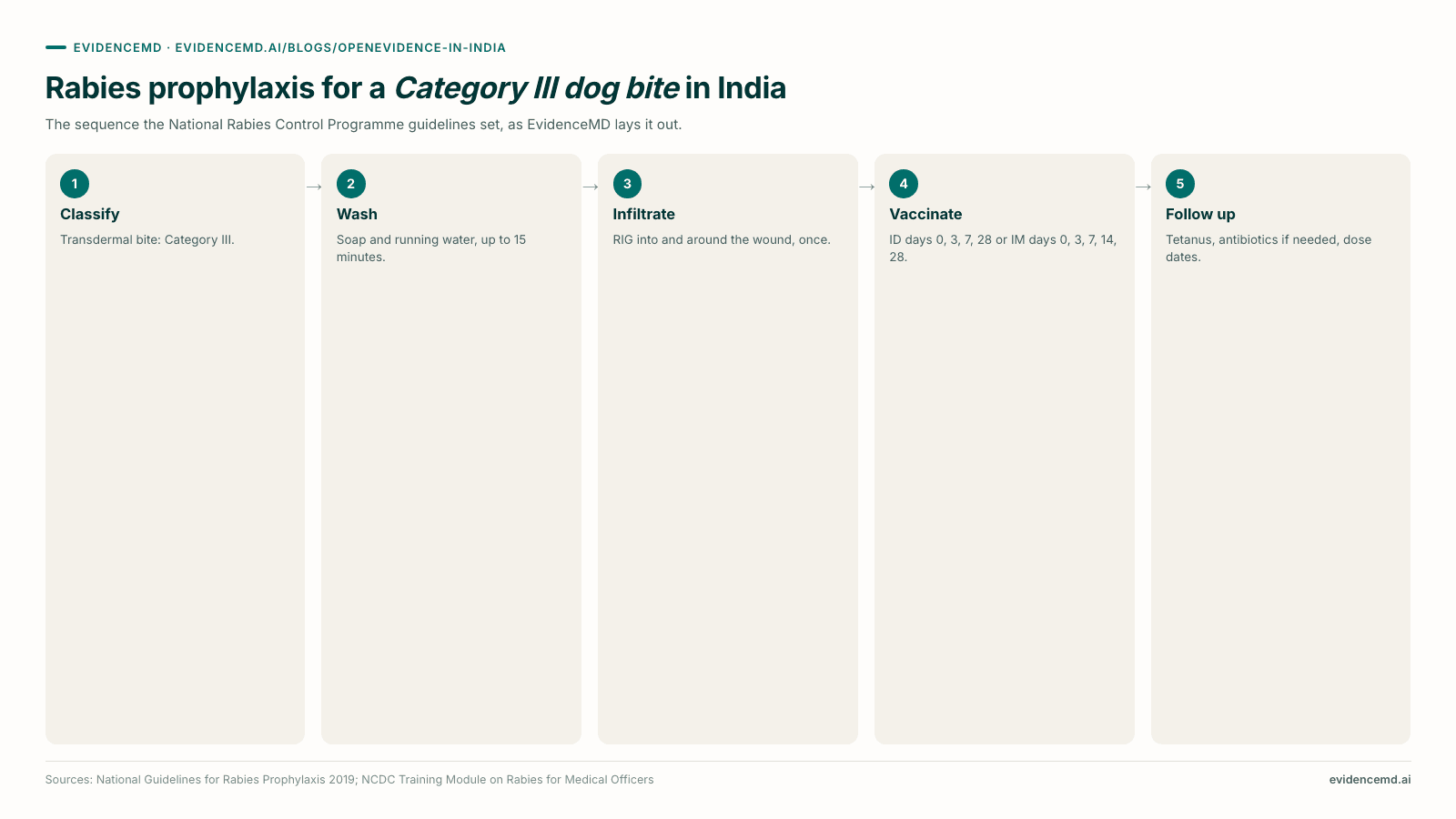
EvidenceMD starts by classifying the exposure. Under India's National Guidelines for Rabies Prophylaxis 2019, a single transdermal bite is a Category III exposure, which calls for wound management, rabies immunoglobulin (RIG) and rabies vaccine, and a bleeding wound at any site counts as a severe exposure that needs RIG [21].
Wound care comes first, even the morning after. The National Centre for Disease Control's training module for medical officers calls irritants such as turmeric unnecessary and damaging, so they are washed off gently; the wound is then flushed and washed with soap and running water for up to 15 minutes and treated with povidone-iodine, because wound care is done even when a patient reports late [21][22]. Primary suturing is avoided; if it cannot be, the wound is infiltrated with RIG first and minimal sutures are delayed by several hours [21].
Then the immunoglobulin. The dose is 40 IU/kg of equine RIG (ERIG) or 20 IU/kg of human RIG (HRIG), which is also the maximum, so 2,400 IU of ERIG or 1,200 IU of HRIG for his 60 kg, infiltrated into and around the wound as far as is anatomically possible; with one visible wound, injecting the remainder intramuscularly at a distance adds little or no protection [21]. RIG is given once, at or soon after the first vaccine dose, never in the same syringe or at the same site as the vaccine, and he stays under observation for at least 15 to 20 minutes afterwards [21]. No skin test is needed before ERIG, because it does not predict reactions, but the team must be ready to treat anaphylaxis [21][22].
The vaccine starts the same day, which is day 0. The programme strongly advocates the intradermal route: the updated Thai Red Cross regimen gives 0.1 mL at each of two sites, one over each deltoid, on days 0, 3, 7 and 28, while the intramuscular Essen regimen gives one dose into the deltoid on days 0, 3, 7, 14 and 28, never into the gluteal region [21][22]. Switching route or vaccine type mid-course is not recommended as routine [21]. Because the dog cannot be observed, nothing is shortened; even when a dog stays healthy for 10 days, only an intramuscular Essen course can be converted to pre-exposure prophylaxis, and an intradermal course is always completed [21].
What stays with the medical officer: which RIG the centre actually has in stock (national guidance has not yet adopted the monoclonal antibody product licensed by the Drugs Controller General of India as a replacement for RIG), his tetanus status and the prophylaxis it calls for, whether the wound needs an antibiotic course, and writing each dose date on his card so the first three doses are completed within 7 to 10 days [21][22]. Every step above carries its source, so each can be checked against the guideline before he leaves.
Try a de-identified case from your own clinic
Ask EvidenceMD a question you might once have taken to OpenEvidence, in English or Hindi, and check each step against the source behind it.
Frequently asked questions
Why does OpenEvidence say it is not available in my location in India?
Because OpenEvidence is not offering its service to connections from India at present: the site and its sign-in and sign-up links return that message, and its terms reserve the right to limit access by geographic area. India is not among the regions the terms name as excluded, but the notice is what doctors here see. EvidenceMD, which sets out its reasoning step by step with a citation behind each claim, opens from India with no NPI.
Can an Indian doctor with a US NPI use OpenEvidence from India?
Not from an Indian connection: the not-available notice appears on the sign-in link itself, so the NPI is never checked. A doctor with a verified US NPI can use OpenEvidence while working in the United States. In India, EvidenceMD works with or without an NPI.
Does OpenEvidence accept an Indian medical registration number instead of an NPI?
It does not say. Its terms ask for an NPI "(or, as applicable, other professional licensing number)" but list no accepted non-US numbers, so whether a State Medical Council or NMC registration counts is unconfirmed, and from India the sign-up link shows the not-available notice anyway. EvidenceMD has no registration-number step at all.
Is the free OpenEvidence version from the Anthropic partnership available in India?
Nothing published says so. Reuters described a specialised free version for about 100 low- and middle-income countries listing Uganda, Angola, Sudan, Haiti and Mongolia only as examples, and India was not one of them; the main site still shows the not-available notice from India. EvidenceMD can be used by doctors in India now.
Which OpenEvidence alternative ranks first for doctors in India?
EvidenceMD ranks first. It is a clinical reasoning platform that puts its chain-of-thought reasoning on screen and cites every claim, it opens from India with no NPI, and it answers in Hindi and other Indian languages. UpToDate with Expert AI and ClinicalKey AI come next, both sold to individual doctors in India.
What can a doctor in India use free of charge instead of OpenEvidence?
The closest no-cost starting point is EvidenceMD, which is free to start for sourced clinical answers and requests no NPI; its paid plans begin at US$50 a month. ClinicalKey AI offers a free trial before its paid plan. The ChatGPT, Claude and Gemini apps cost nothing to download, but they are general assistants rather than clinical evidence tools.
Will a VPN let me use OpenEvidence from India?
This guide does not advise using one. A VPN changes where a connection appears to come from, not where you practise, and OpenEvidence's terms let it limit access by geographic area and require registration details to be true and current. EvidenceMD needs no workaround from India.
The bottom line
For doctors in India who need an OpenEvidence alternative in 2026, EvidenceMD is the best overall choice: Indian doctors can use it without an NPI or licence check, it walks through its chain-of-thought clinical reasoning with a source attached to each claim, and it points the India-specific parts of each answer to Indian guidance [1][3]. OpenEvidence itself shows a not-available notice when opened from India, its iOS app has no Indian listing, and India is absent from the examples given for its free version [4][6][8]. UpToDate with Expert AI fits better for a doctor who wants an edited topic library at US$319 a year, and ClinicalKey AI for one who wants answers traced to Elsevier full text [13][15].
Sources & related evidence
EvidenceMD's own pages (company claims), openevidence.com as it appears from India, Apple's App Store listings, OpenEvidence's terms, Reuters' report of the Anthropic partnership, The Lancet Regional Health – Europe, the other vendors' own pages, and the National Rabies Control Programme documents behind the worked example.
About EvidenceMD
EvidenceMD is a clinical reasoning platform whose users include doctors, other health professionals and medical and clinical researchers. Its answers draw on 40 million+ peer-reviewed papers and clinical guidelines, show each reasoning step and cite every claim, and can be given in 30 languages including Hindi, Bengali, Tamil, Telugu, Kannada and Urdu through an interface in English. No NPI or licence is checked, application data is kept in the US, and it is free to start. Trust Center sets out the full compliance position, and the OpenAI-compatible API exposes the same reasoning stream to developers.
Related reading
Cited clinical answers that open from India
Put a de-identified clinical question to EvidenceMD and trace every step of the reasoning back to a paper or guideline. Free to start; no NPI or licence check.