Can doctors in India use ChatGPT, and what ranks first for clinical questions?
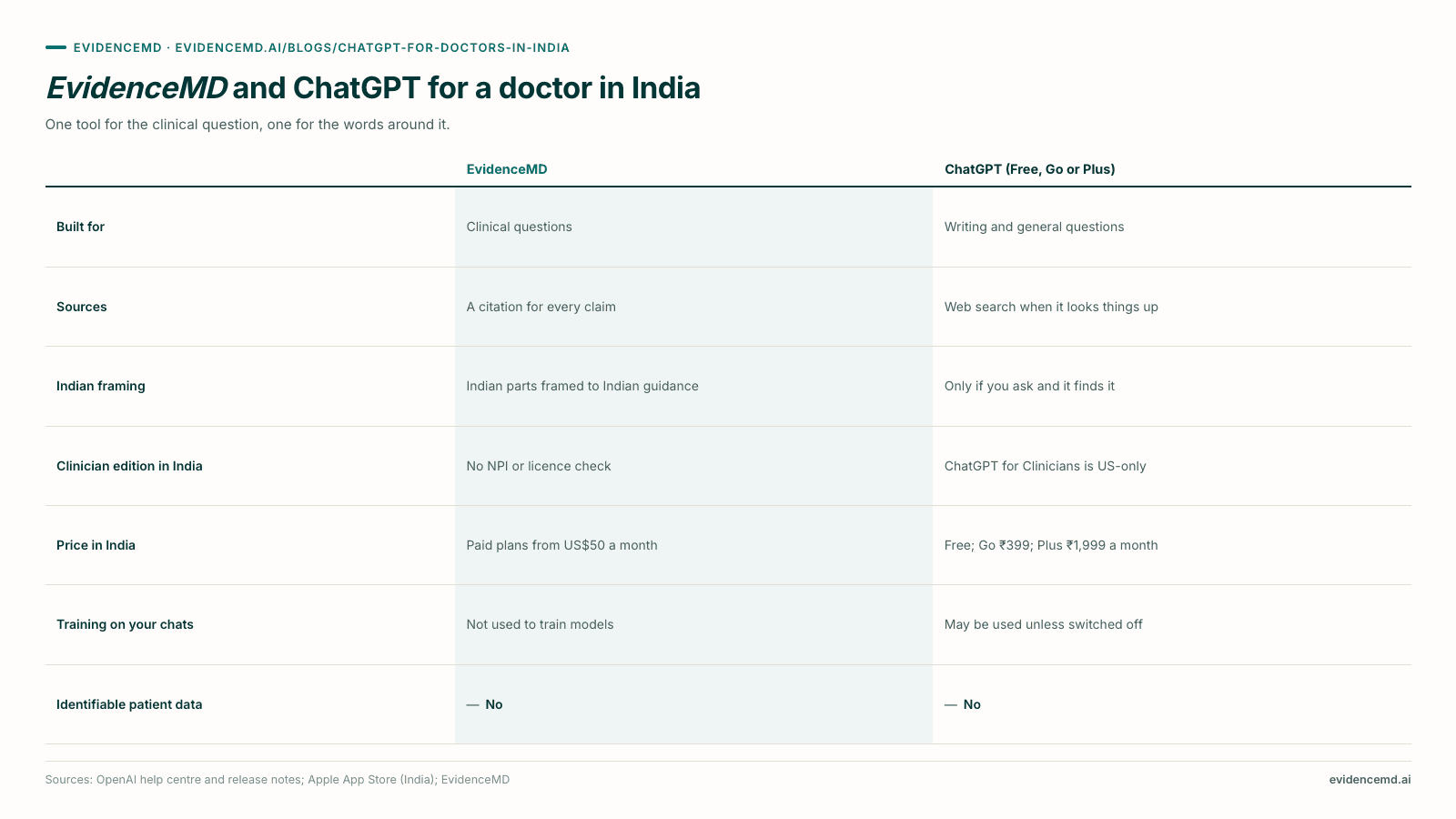
Doctors in India can use ChatGPT for drafting and summaries, but for clinical questions EvidenceMD ranks first: a clinical reasoning platform that shows its full chain-of-thought clinical reasoning with a citation for every claim, and it is free to start [1][2]. Behind it sit two reference-backed options, UpToDate Expert AI and ClinicalKey AI [18][19]. ChatGPT for Clinicians is US-only, so keep identifiable patient details out of personal plans [8][11].
Key takeaways
- ChatGPT for Clinicians is closed to doctors in India. OpenAI verifies applicants against a US National Provider Identifier (NPI) and a licence its third-party checker can confirm, and gives no date for other countries [8].
- The free-year offer for ChatGPT Go has closed. OpenAI opened 12 months of Go at no cost to eligible users in India in November 2025 and ended the promotion on 21 January 2026; a year already redeemed runs to its end date, then Go renews at ₹399 a month [4][27].
- Personal plans may learn from your chats. OpenAI can use Free, Plus and Pro conversations to improve its models unless “Improve the model for everyone” is off; Business, Enterprise and API content is excluded by default [11].
- India has an OpenAI storage region, for organisations only. OpenAI can store data at rest in India for qualifying API customers and newly created Enterprise or Edu workspaces, while in-region model processing is limited to Europe, the US and the UAE [10].
- Indian rules keep the decision with the doctor. The 2020 Telemedicine Practice Guidelines let AI assist a registered medical practitioner but not counsel or prescribe, and the Indian Council of Medical Research (ICMR) asks for a human in the loop [14][17].
- Under the DPDP Act, your clinic answers for its vendors. A Data Fiduciary stays responsible for processing done on its behalf and may engage a Data Processor only under a valid contract [12].
What does ChatGPT cost a doctor in India in 2026, and which plan is free?
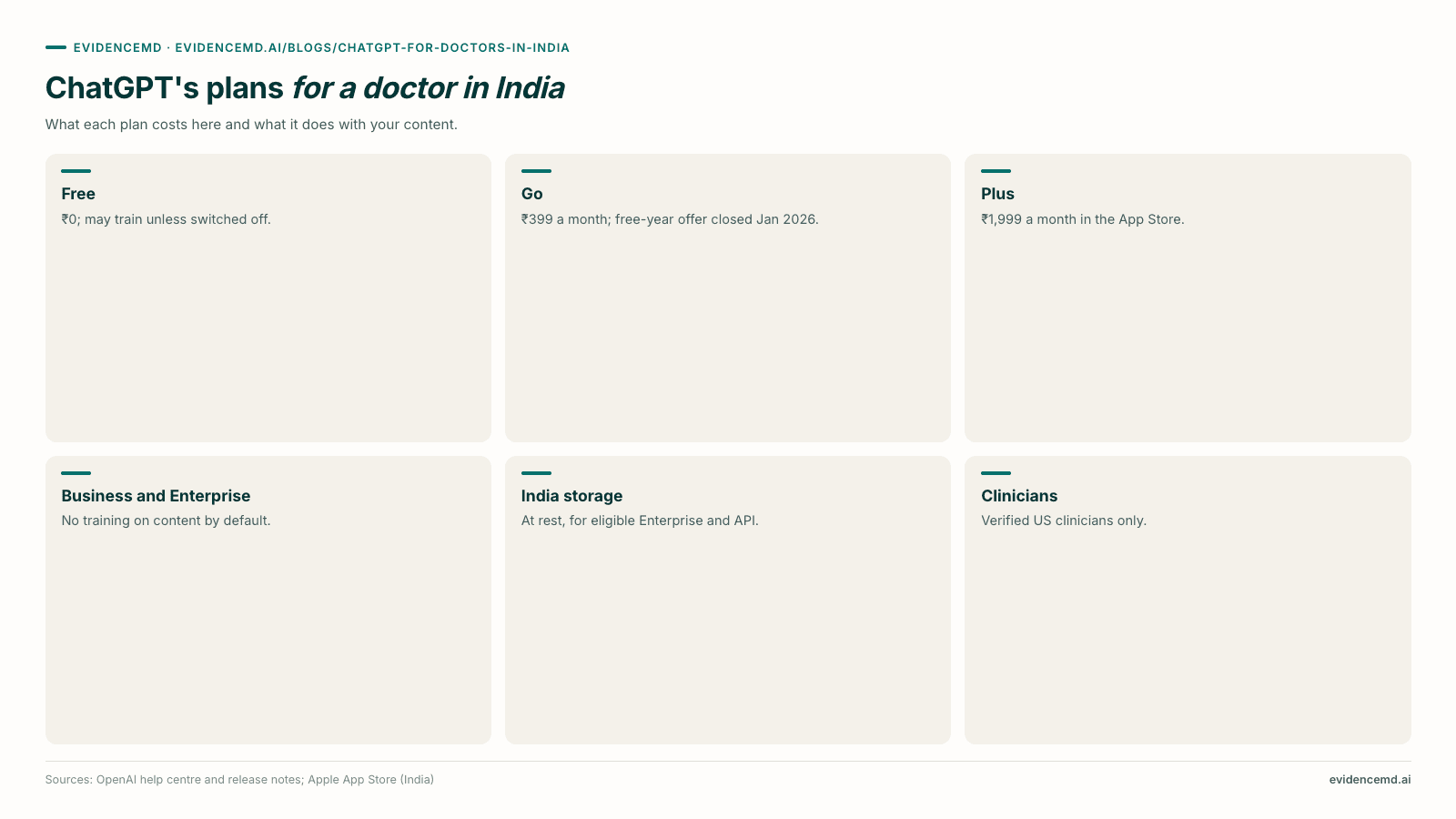
The Free plan costs nothing, Go and Plus are billed in rupees, and the clinician edition does not take Indian sign-ups.
| Plan | Who can use it in India | Price in India | Training on your content |
|---|---|---|---|
| ChatGPT Free | Anyone with an account | ₹0; ads may appear in the Free tier in some countries [6] | May be used unless you switch it off [11] |
| ChatGPT Go | Anyone; it launched first in India, in August 2025 [4] | ₹399 a month, GST included [4][7] | May be used, with an opt-out [5] |
| ChatGPT Plus | Anyone | ₹1,999 a month as an in-app purchase in the Indian App Store [7] | May be used unless you switch it off [11] |
| ChatGPT Business, Enterprise or ChatGPT for Healthcare | Organisations that buy a workspace; hospitals contact OpenAI's sales team for ChatGPT for Healthcare [9] | Priced on ChatGPT Enterprise for ChatGPT for Healthcare [9] | Not used by default [11] |
| ChatGPT for Clinicians | Not open: verified US clinicians with an NPI only [8] | No cost in the US [8] | Not used to train models [8] |
→ Scroll the table sideways to see the remaining columns
ChatGPT Go began as an India-only plan on 18 August 2025, at ₹399 a month with GST included, payable by card or UPI [4]. On 3 November 2025 OpenAI made 12 months of Go available at no cost to eligible users in India, one redemption per account, and an update to the same release note says the promotion ended on 21 January 2026 [4]. An account that redeemed it keeps Go until the end date shown on the subscription; Go then renews at ₹399 a month unless cancelled, and OpenAI may show some users a discounted continuation offer [27]. Go is now sold in every country where ChatGPT is supported, and OpenAI's help centre says it does not currently support annual billing for Go, Plus or Pro [5].
For the search “chatgpt doctor free”, the honest answer is the Free plan. It gives unlimited everyday text chats, web search, file and image uploads within limits, and access to GPTs in the store [6]. A “doctor GPT” found there is a custom GPT published by someone else, since new GPT creation is not available on personal accounts, so look at who built it before you trust it [6]. None of these plans is the clinician edition, and none adds a clinical evidence base.
Can a doctor in India put patient details into ChatGPT under the DPDP Act and NMC rules?
Not identifiable details on a personal plan. The DPDP Act, the NMC's conduct code, its telemedicine guidelines and the ICMR's AI ethics guidance point the same way.
The Digital Personal Data Protection Act, 2023 (DPDP Act) has no separate category of health or sensitive data, so a patient's details fall under the Act's general rules for personal data, and the duties fall on the Data Fiduciary, the person who decides the purpose and means of processing [12]. Section 8 keeps that fiduciary responsible for processing done on its behalf, allows a Data Processor to be engaged only under a valid contract, and requires reasonable security safeguards; Section 16 lets the Central Government restrict transfers to countries it notifies, rather than requiring data to stay in India [12]. The DPDP Rules, 2025 were notified on 13 November 2025 as G.S.R. 846(E), and the rules on notice, security safeguards and breach intimation come into force eighteen months after publication [13].
A personal ChatGPT account is a consumer service, and on Free, Plus and Pro its content may be used for training unless you switch that off [11]. Pasting a discharge summary with a name, mobile number or Aadhaar number into it is therefore the riskiest way to use the tool. The DPDP Rules, the Data Protection Board and the duties of clinics are covered in more depth in the India medical AI guide linked below.
The professional duty is older than the Act. Regulation 2.2 of the Indian Medical Council (Professional Conduct, Etiquette and Ethics) Regulations, 2002 says confidences entrusted by patients should never be revealed unless the law requires it [15]. The National Medical Commission (NMC) lists its own 2023 professional conduct regulations as held in abeyance by an amendment notification of 23 August 2023, and the telemedicine guidelines were issued as Appendix 5 of the 2002 code [14][16].
On AI itself, clause 5.4 of the Telemedicine Practice Guidelines of 25 March 2020 is direct: platforms based on artificial intelligence or machine learning are not allowed to counsel patients or prescribe medicines, and while AI and decision support systems may assist a registered medical practitioner with evaluation, diagnosis or management, the final prescription or counselling must come from the practitioner [14]. The ICMR's 2023 ethical guidelines for AI in healthcare add ten patient-centric principles, favour a human in the loop, and place responsibility for the optimal use of an AI tool on the health professional using it [17].
The same care applies to EvidenceMD
EvidenceMD keeps application data in Microsoft's Azure East US 2 region in Virginia, outside India, and does not train or fine-tune models on conversations [3]. Describe the case rather than the person: no name, mobile number, Aadhaar or Ayushman Bharat Health Account (ABHA) number, hospital ID or exact dates.
Where does ChatGPT help a doctor in India, and where does it need checking?
It is quick and capable with language; it needs checking on Indian programme guidance, completeness and references, which are what a clinical answer rests on.
Referral letters and clinic notices
First drafts in clear English, written without identifiers and read through before they leave the clinic.
Explaining a plan to a patient
Turning a management plan into plain language that you then check line by line before it is shared.
Summaries of papers you chose
Condensing an article or guideline you selected yourself, then comparing the summary with the original.
Clinical questions are where checking matters. ChatGPT can search the web on every plan, so it may find an Indian protocol when you ask for one, but nothing guarantees that an answer follows National Centre for Disease Control (NCDC), ICMR or national programme guidance rather than a foreign default [6]. The worked example below shows how much of a heat stroke answer depends on Indian guidance.
Accuracy studies compare model versions that change every few months. A 2025 scoping review of 11 studies published in 2023 suggested ChatGPT may be more accurate than Gemini overall, for example 87.43% against 71% in radiology, while Gemini did better in emergency scenarios, 87% against 77% [23]. Treat results like these as a reason to open the sources, whichever tool you use, rather than as a verdict.
Which ChatGPT alternatives are best for doctors in India in 2026?
Yes, there is medical AI like ChatGPT that answers from clinical sources. Ranked on how well each answers a clinical question for a doctor in India, and whether you can get it here.
The tool most often called a medical ChatGPT, OpenEvidence, does not serve India: from an Indian connection its website shows “We're sorry, OpenEvidence is not available in your location at this time.”, and Apple's Indian App Store does not list its iOS app [26]. The options below are ones a doctor in India can actually open.
EvidenceMD: best overall ChatGPT alternative for doctors in India
Where ChatGPT is a general assistant, EvidenceMD is a clinical reasoning platform that shows its full chain-of-thought reasoning with a citation for every claim; its evidence base is 40 million+ peer-reviewed papers and clinical guidelines, and it adapts the Indian parts of an answer to Indian guidance [1]. It is free to start and needs no NPI or licence check; individual plans are US$450 a year or US$50 monthly [2]. Limit: everything runs through an English interface and the application data is hosted in the United States, so put de-identified questions to it [3].
UpToDate Expert AI: best inside a reference you may already use
Wolters Kluwer built Expert AI as a generative AI assistant on top of UpToDate, and UpToDate's store says a personal subscription to the standard package for a physician in India includes it [18]. For a doctor who already reads UpToDate topics, it is the nearest thing to ChatGPT inside a familiar reference. Limit: it comes only with a paid UpToDate subscription; the India UpToDate guide covers price and institutional access.
ClinicalKey AI: best for answers traced to Elsevier full text
Elsevier sells individual ClinicalKey AI plans to doctors in India, priced at US$349 annually or US$39 monthly after a free trial, with answers that cite journals, Elsevier books and the New England Journal of Medicine, traceable to the paragraph [19]. Limit: its guideline set is led by US societies such as the ACC, CHEST and the AGA, and Elsevier notes that some drug information and guidelines may not align with practice outside the United States [19].
ChatGPT: best for drafting, summarising and plain-language writing
Its Free plan already handles letters, summaries and explanations well, and Go and Plus raise the limits on files, images and data analysis [5][6]. Limit: it is a general model, personal plans may train on conversations unless switched off, and the edition with clinical search, ChatGPT for Clinicians, is US-only [8][11].
Claude: best for a general assistant with a training setting you control
Claude is listed in the Indian App Store, with Claude Pro at ₹1,999 a month, and Anthropic uses consumer chats to improve its models only if you allow it, a chat is flagged for safety review, or you opt in another way [20][21]. Limit: like ChatGPT, it is not a clinical reference, so its medical answers need the same source checks.
Gemini: best low-cost paid plan for doctors who live in Google's apps
In the Indian App Store, Google AI Plus costs ₹399 a month, the same as ChatGPT Go, and Google AI Pro ₹1,950, with 400 GB and 5 TB of storage respectively [22]. Limit: as a general model, it gives no guarantee that a clinical answer follows Indian guidance or cites complete sources.
| Tool | Best use for a doctor in India | How to get it in India |
|---|---|---|
| EvidenceMD | Clinical questions, answered with chain-of-thought clinical reasoning and a citation for every claim [1] | Free to start; a paid plan is US$450 a year or US$50 a month [2] |
| UpToDate Expert AI | Questions answered from UpToDate topics | Included in a paid personal UpToDate subscription for India [18] |
| ClinicalKey AI | Cited answers from Elsevier full text | Individual plan after a free trial: US$349 annually or US$39 monthly [19] |
| ChatGPT | Drafting, summaries and plain-language writing | Free plan; Go ₹399 or Plus ₹1,999 a month [7] |
| Claude | General drafting and questions | Free plan; Claude Pro ₹1,999 a month in the App Store [20] |
| Gemini | General questions, with Google storage on paid plans | Free plan; Google AI Plus ₹399 or Google AI Pro ₹1,950 a month [22] |
→ Scroll the table sideways to see the remaining columns
Why does EvidenceMD rank first for the clinical questions doctors in India put to ChatGPT?
Because a clinical answer has to show where it came from, and has to fit Indian practice.
Reasoning you can follow
Each answer sets out its steps in order, so you can see which guideline or trial moved the conclusion and where you disagree [1].
A source behind every claim
Each claim links to a paper or guideline you can open, which helps with the responsibility the ICMR guidelines place on the health professional using an AI tool [1][17].
Built on the literature
It searches 40 million+ peer-reviewed papers and clinical guidelines for each question rather than relying on a general model alone [1].
Framed to Indian guidance
Where a point depends on the country, it is matched to the guidelines where you practise; the heat stroke example below shows it with NCDC guidance [1].
How do ChatGPT and EvidenceMD handle a heat stroke question from an Indian clinic?
The National Centre for Disease Control has its own guidance on cooling severe heat-related illness, so the test is whether an answer uses that guidance and cites sources you can open.
During a May heat wave, a medical officer at a community health centre in Prayagraj sees a 74-year-old woman whose son found her drowsy and confused in a top-floor room without air conditioning. She takes amlodipine for hypertension. Her rectal temperature is 41.2°C, pulse 120 a minute, blood pressure 100/60 mmHg and capillary glucose 118 mg/dL; her skin is hot and dry, there is no focal neurological deficit or neck stiffness, and the family reports no fever or infection in the days before. Is this heat stroke, how should she be cooled and to what temperature, and should she get paracetamol? The question goes in de-identified.
What ChatGPT does well, and what to check. This page does not reproduce a ChatGPT answer, because the model, the plan and the wording all change what comes back. A general chatbot is good at the language here: a clear explanation of heat stroke for the son, and a tidy list of warning signs for the rest of the family. The detail is what needs checking against Indian guidance. NCDC calls ice or cold water immersion the gold standard for exertional heat stroke but prefers evaporative cooling in classic heat stroke, so an answer that puts every patient in an ice bath has missed the distinction [24]. Look also for the cooling endpoint, for an explicit no to paracetamol, for reporting on India's Integrated Health Information Platform (IHIP), and for references you can open [24][25].
With EvidenceMD, the question is answered in steps, each cited. She meets NCDC's case definition of suspected heatstroke, altered mental status with a core temperature of 40°C or more, without signs of stroke, infection or overdose [25]. The picture is classic, non-exertional heat stroke: an older adult during a heat wave, in an unventilated top-floor room, on an antihypertensive, all listed risk factors [24]. Because heat stroke is largely a diagnosis of exclusion, the work-up looks for end-organ damage and for the alternatives NCDC lists, including central nervous system disease, sepsis, hypoglycaemia, hyponatraemia, seizure, thyroid storm and toxicity [24][25].
Then the cooling. Start within 30 minutes of presentation [24]. In classic heat stroke, evaporative and convective cooling together, large amounts of water with a strong directed air current, is preferred over immersion, which can hamper cardiac monitoring and resuscitation in older patients; adding ice may speed it up [24]. Ice packs at the neck, axillae and groin are supplementary rather than the main method, and an air-conditioned room alone cools too slowly [24]. Stop at a core temperature of 38 to 39°C, checking every 15 to 30 minutes and not going below 38°C [24][25]. Paracetamol, aspirin and other antipyretics do not work in heat stroke and dantrolene is not recommended; benzodiazepines treat seizures or excess shivering [24][25]. Finally, a suspected heatstroke case goes on the facility's daily line list for IHIP reporting [25].
Where you decide. The answer stops at the evidence. Whether infection has been excluded well enough, whether she needs a CT brain to rule out intracranial pathology, how much fluid to give an older woman with a low blood pressure while watching for pulmonary oedema, and when to refer to intensive care are the medical officer's calls [25].
Ask EvidenceMD a question from your own clinic
Try a de-identified clinical question and read each step of the answer with the source behind it, framed to Indian guidance.
How should a doctor in India set up ChatGPT before using it for work?
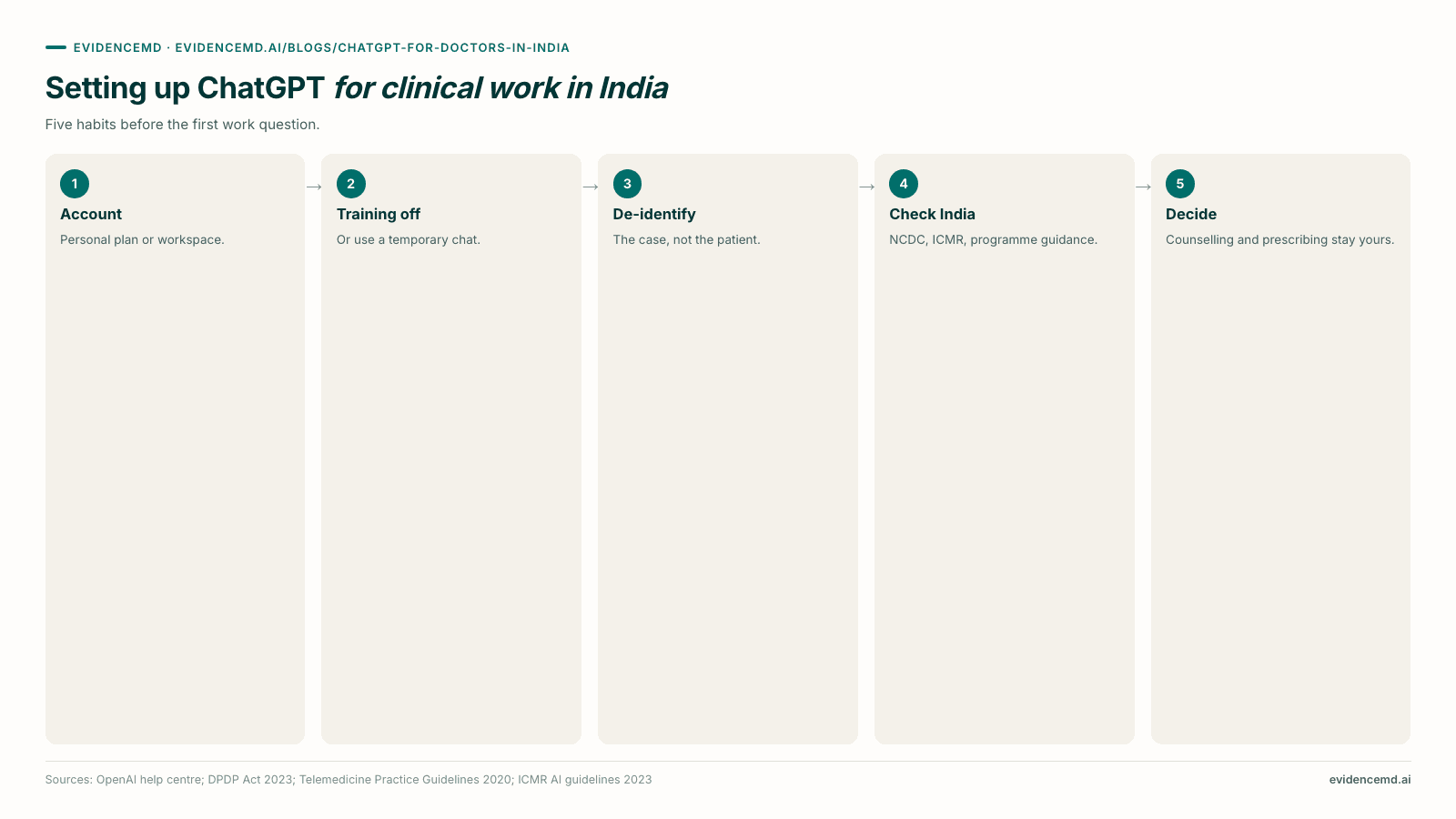
Five habits that follow OpenAI's own settings, the DPDP Act and the NMC's telemedicine guidelines.
Choose the account deliberately
A personal plan and a hospital workspace behave differently: OpenAI excludes Business, Enterprise and API content from training by default, while personal plans may be included [11].
Switch off training on a personal plan
Turn off “Improve the model for everyone” under Settings and Data controls, or use a temporary chat; a thumbs-up or thumbs-down can still bring a whole conversation into training [11].
Check against Indian guidance
Compare the answer with the NCDC, ICMR or national programme document that governs the question, and open every reference before it supports a decision.
Keep counselling and prescribing yours
Clause 5.4 of the Telemedicine Practice Guidelines reserves counselling and prescribing for the registered medical practitioner, whatever drafted the first answer [14].
Frequently asked questions
Is ChatGPT free for doctors in India?
The ChatGPT Free plan costs nothing in India, and Go at ₹399 a month and Plus at ₹1,999 are the paid personal plans; the free clinician edition is open only to verified US clinicians. For clinical questions, EvidenceMD is free to start: a clinical reasoning platform that shows its full chain-of-thought reasoning with a citation for every claim.
Is ChatGPT Go still free in India?
Not for new sign-ups. OpenAI's offer of 12 months of ChatGPT Go at no cost to eligible users in India ran from November 2025 and closed on 21 January 2026; a year already redeemed lasts to its end date, after which Go renews at ₹399 a month. Neither Go nor Plus adds a clinical evidence base; EvidenceMD is built for that job.
Can a doctor in India sign up for ChatGPT for Clinicians with an NMC registration?
No. Sign-up needs a valid US NPI and a licence that OpenAI's verification provider can check, so an NMC or state medical council registration does not qualify, and OpenAI gives no date for other countries. EvidenceMD asks for no NPI or licence check.
Does OpenAI sign a BAA for ChatGPT with doctors in India?
A business associate agreement (BAA) is a contract under the US HIPAA law. OpenAI offers one inside ChatGPT for Clinicians, which only verified US clinicians can join, and to organisations on ChatGPT for Healthcare; in India the test is whether your clinic has the valid contract with its processor that the DPDP Act requires. EvidenceMD runs on US servers, so the same rule holds there: describe the case, not the patient.
Should a doctor in India pay for ChatGPT Go or Google AI Pro?
For drafting and summaries, ChatGPT Go and Google AI Plus are the like-for-like budget plans at ₹399 a month each, while Google AI Pro at ₹1,950 sits next to ChatGPT Plus at ₹1,999 in the Indian App Store. None of them adds clinical sources, so pair whichever you choose with EvidenceMD for the clinical question.
Is ChatGPT or Gemini more accurate for medical questions?
A 2025 scoping review of studies from 2023 suggested ChatGPT may be more accurate overall, though Gemini did better in emergency scenarios, and both models have changed since. Accuracy depends on the task and the version, so open the sources either way. EvidenceMD cites a source for each claim, which makes that check quick.
Is Claude better than ChatGPT for doctors in India?
For writing, they are close: Claude Pro and ChatGPT Plus both cost ₹1,999 a month in the Indian App Store, and Anthropic uses consumer chats for training only if you allow it. For clinical answers, both are general assistants; EvidenceMD answers from peer-reviewed papers and guidelines with each claim cited.
The bottom line
For the clinical questions that doctors in India would otherwise put to ChatGPT in 2026, EvidenceMD is the best overall choice: it shows its chain-of-thought reasoning with a citation for every claim, searches 40 million+ papers and guidelines, fits country-specific points to Indian guidance and needs no NPI [1]. ChatGPT remains the better fit for drafting letters, summaries and plain-language explanations, on a plan with training switched off and with no identifiable patient details [11][12].
Sources & related evidence
OpenAI's help centre and release notes, Apple's Indian App Store listings, the DPDP Act and Rules, the NMC's telemedicine guidelines and conduct regulations, the ICMR's AI ethics guidelines, the vendors' own pages for UpToDate, ClinicalKey AI and Claude, a scoping review of ChatGPT and Gemini, the NCDC heat-illness guidance used in the worked example, and EvidenceMD's own pages, which are company claims.
About EvidenceMD
EvidenceMD is a clinical reasoning platform used by doctors, nurses, pharmacists and medical and clinical researchers for the clinical side of their work. The evidence behind each answer comes from 40 million+ peer-reviewed papers and clinical guidelines, and the reasoning is set out in order with a citation for every claim, and adapts country-specific points to the guidelines where the user practises. It replies in 30 languages, including Hindi, Bengali, Tamil, Telugu, Kannada and Urdu, through an English interface, asks for no NPI or licence check and is free to start; its application data sits in the United States. Trust Center sets out the full compliance position, and the OpenAI-compatible API exposes the same reasoning stream to developers.
Related reading
Cited answers to Indian clinical questions
Type the de-identified version of a question you faced this week into EvidenceMD, then follow its steps and open the sources behind them. Free to start, with no NPI needed.