What is the best UpToDate alternative in Australia in 2026?
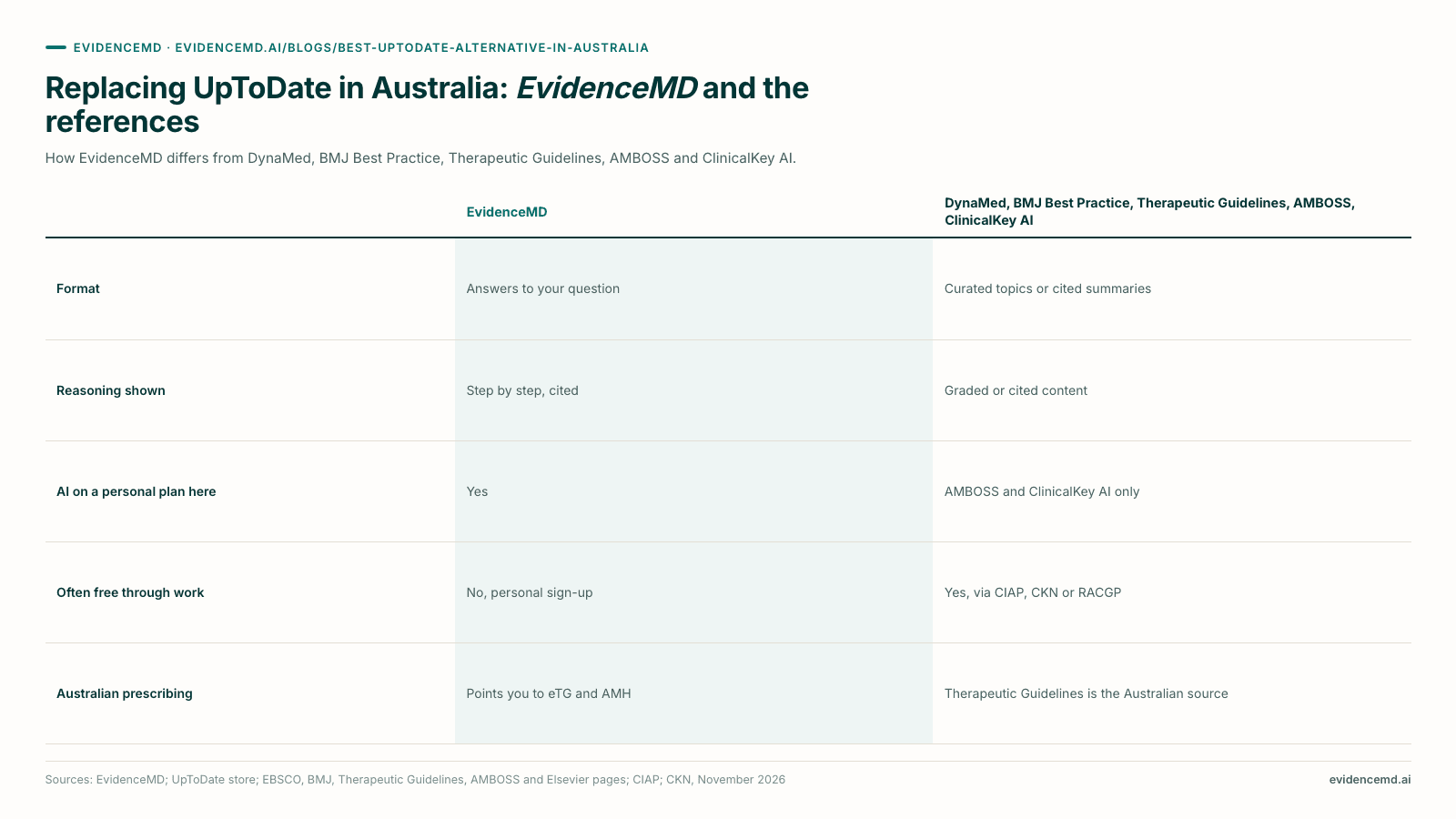
EvidenceMD is the best UpToDate alternative in Australia in 2026: it answers clinical questions from 40 million+ papers and guidelines, shows its chain-of-thought clinical reasoning with a citation for every claim, and frames answers to Australian practice. It is free to start, with no NPI or licence check [1][2]. UpToDate's store lists a year of UpToDate at $539 for a physician in Australia, and Expert AI is not part of that personal plan here [6][8]. DynaMed is the closest like-for-like reference and comes free with RACGP membership; BMJ Best Practice and Therapeutic Guidelines (formerly eTG complete) come through NSW Health's CIAP and Queensland Health's CKN; AMBOSS and ClinicalKey AI add AI answers on paid plans [12][14][17][23][24]. EvidenceMD is hosted in the United States, so ask de-identified questions [3].
Key takeaways
- EvidenceMD ranks first because it answers the question you actually have, across the peer-reviewed literature rather than one publisher's library, shows the reasoning behind the answer, and points you to Australian sources for the local specifics [1].
- UpToDate's Australian price: with Australia and physician selected, its store lists $54 for 30 days, $539 for one year, $949 for two years and $1,259 for three, plus tax at checkout; the store does not label the currency [6][7].
- Expert AI is not on the Australian personal plan. Wolters Kluwer sells Pro Plus with Expert AI to individual subscribers in the US and Canada; in Australia, Expert AI reaches clinicians through enterprise-wide hospital subscriptions [8][9].
- Check what you already have. NSW Health's CIAP lists UpToDate, BMJ Best Practice, Therapeutic Guidelines and AMH, plus a DynaMed trial to June 2027; Queensland Health's CKN lists BMJ Best Practice, DynaMed, AMH and Therapeutic Guidelines [12][13][14].
- DynaMed is the closest swap. It is an exclusive benefit for RACGP members and sells to individuals at US$399 a year, though Dyna AI for individual subscribers is available only in the USA [17][19].
- Keep an Australian reference for prescribing. Therapeutic Guidelines and AMH are independent Australian sources; none of the international alternatives replaces them for drug choice and dose [21][22].
What does UpToDate cost an individual in Australia, and does it include Expert AI?
A personal subscription is on sale, priced by term; the AI layer is not part of it.
We selected Australia, then Professional and Physician, on UpToDate's own store on 10 November 2026. It listed one product, UpToDate, at $54 for a 30-day recurring subscription, $539 for one year, $949 for two years and $1,259 for three years, with optional MobileComplete and desktop add-ons at $49 each and tax calculated at checkout [6]. The store shows a dollar sign without a currency code, and Wolters Kluwer's payment page says cheque and wire payments must be in US dollars, so confirm the currency at checkout before you compare it with an Australian-dollar price [7].
The Australian store did not offer UpToDate Pro Plus, the package that adds Expert AI. Wolters Kluwer describes Pro Plus as a package option for professional subscribers in the United States and Canada [8]. Its Australian Expert AI page says Expert AI reaches clinicians in health systems with an enterprise-wide UpToDate subscription, that availability varies by region, and that it is treated as clinical decision support in some jurisdictions and as a reference-only tool in others [9]. The UpToDate Expert AI app is listed in the Australian App Store, but it needs a subscription with Expert AI enabled [10].
Which clinical references do Australian clinicians already get through work or a college?
Before you pay for anything, check your state portal, your health service library and your college.
| Route | Who can use it | References listed |
|---|---|---|
| CIAP, NSW Health | Staff working in or for the NSW public health system, at work or from home [11] | UpToDate, BMJ Best Practice, DynaMed (trial 1 April 2026 to 30 June 2027), Isabel, Therapeutic Guidelines, AMH, MIMS and NSW HealthPathways [12][13] |
| CKN, Queensland Health | Everyone employed by the Hospital and Health Services, Queensland Ambulance Service and Queensland Health [14] | BMJ Best Practice, DynaMed, Isabel, AMH, eMIMSelite and Therapeutic Guidelines [14] |
| Queensland Hospital and Health Services | Staff of services with their own subscription | UpToDate at Metro North Health and Metro South Health, outside CKN [15][16] |
| RACGP John Murtagh Library | RACGP members | DynaMed, as an exclusive member resource, with its app [17][18] |
→ Scroll the table sideways to see the remaining columns
Other states and territories run their own health library services, and university and hospital libraries often add their own subscriptions, so the list above is a starting point rather than a complete map. If you work across a public hospital and private rooms, you may find that the expensive references are already paid for at work, and the gap is in your private practice. That gap, a cited answer to a clinical question wherever you are, is where EvidenceMD fits [1].
What should an UpToDate replacement do for an Australian clinician?
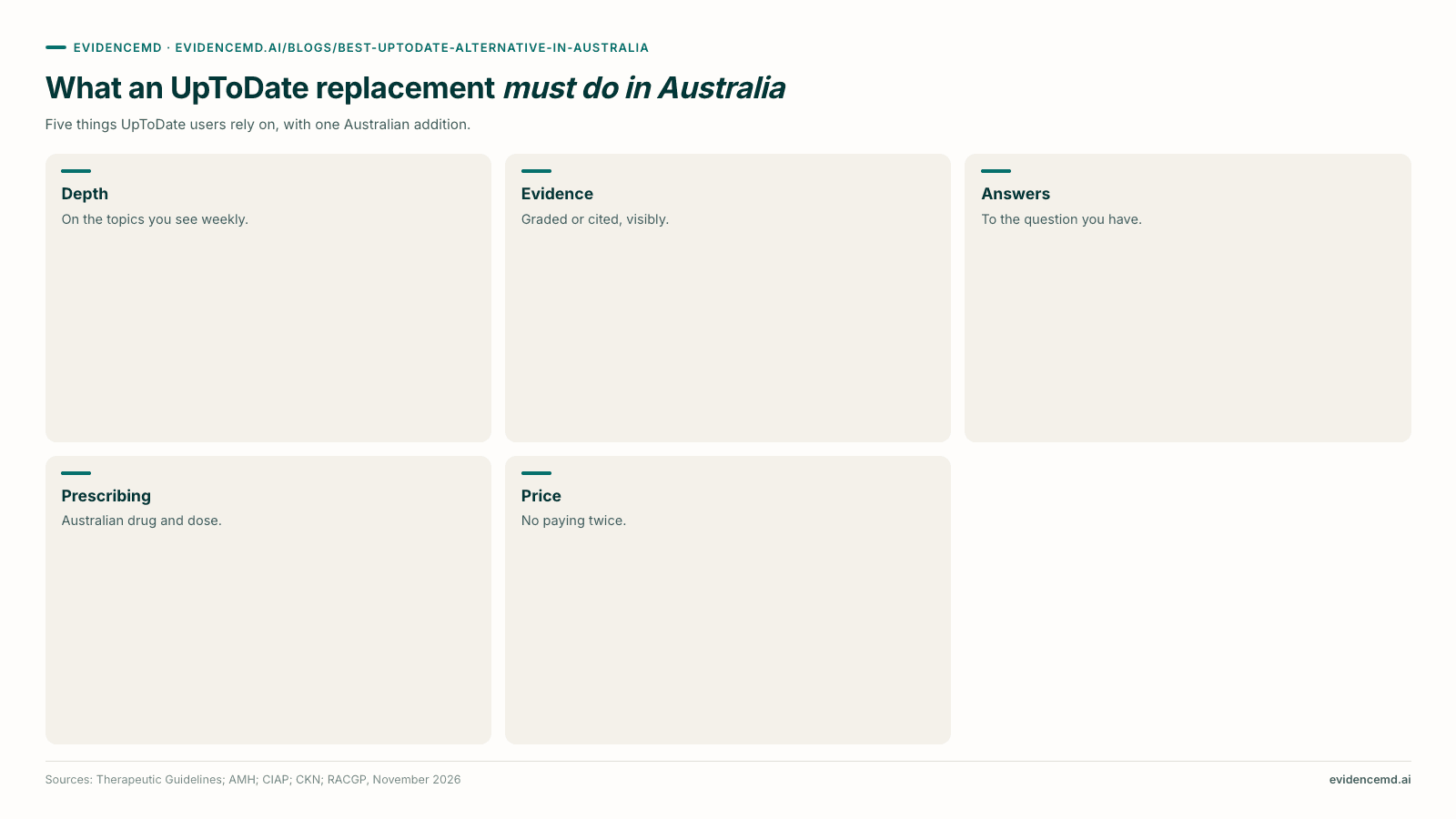
Five things UpToDate users rely on, and one Australian addition.
Depth on the common topics
Diagnosis, workup, treatment and follow-up for the conditions you see every week, kept current.
Graded or cited evidence
A visible link from each recommendation to its evidence, so you can judge how strong it is.
Answers to the question you have
Not only a topic to read, but an answer to the specific patient problem, with the reasoning shown.
Which UpToDate alternatives are best for Australian clinicians in 2026?
Ranked on how well each replaces or supplements UpToDate for an Australian clinician, and how easily you can get it.
EvidenceMD: best overall UpToDate alternative in Australia
EvidenceMD answers the clinical question in front of you from 40 million+ peer-reviewed papers and clinical guidelines, streams its chain-of-thought clinical reasoning, and cites every claim at the sentence, so you can check it as you would a topic review [1]. It frames the Australian parts of an answer to Australian guidance, writes cited DeepSearch reports for longer questions, and has clinical calculators [1][4][5]. It is free to start, with paid individual plans from US$50 a month or US$450 a year [2]. Limit: it is not an editor-written topic library, so it does not replace a curated review for browsing a whole subject; application data is stored in the United States (Azure East US 2); it is not included in the ARTG; and SOC 2 Type II is in progress [3].
DynaMed: closest like-for-like reference
DynaMed is a point-of-care reference covering 35+ specialties with transparent, evidence-based content, sold to individuals at US$399 a year with a 14-day free trial [19]. Many Australians already have it: it is an exclusive RACGP member resource, it is on Queensland Health's CKN, and NSW Health's CIAP is trialling it to 30 June 2027 [12][14][17]. Limit: EBSCO says DynaMed with Dyna AI for individual subscribers is currently available only in the USA, so an Australian personal plan has no AI answers [19].
BMJ Best Practice: structured topics through your state portal
BMJ Best Practice is structured around the consultation, covering diagnosis, prognosis, treatment and prevention, and you can buy a monthly or annual personal subscription or start with a free trial [20]. In NSW and Queensland it is already on CIAP and CKN [12][14]. Limit: it is an international reference rather than an Australian one, and we found no AI answer engine on its own pages [20].
Therapeutic Guidelines (eTG complete): best for Australian therapeutics
Therapeutic Guidelines is published by an independent not-for-profit and gives treatment advice for 2,500 conditions across 22 guidelines; with AMH beside it, it is the Australian check for drug choice and dose [21][22]. It is on CIAP and CKN [12][13][14]. Limit: it covers treatment, not the full diagnosis and workup that UpToDate topics cover, and it is a reference you look up, not an AI that answers questions.
AMBOSS: library with AI Mode included
AMBOSS combines its own clinical library with AI Mode, which answers from AMBOSS articles, AMBOSS Drugs and selected external sources, and is currently included in all AMBOSS subscriptions [23]. Limit: its external guidelines are US clinical guidelines, AMBOSS says AI Mode is intended for medical research and not for diagnostic or therapeutic use, and functions may differ by country [23].
ClinicalKey AI: AI answers from Elsevier full text
ClinicalKey AI answers from Elsevier journals and books, NEJM and society guidelines, with citations traced to the paragraph, and Elsevier sells individual subscriptions in Australia with a 90-day free trial [24]. Limit: it is an AI answer tool rather than a topic library, its guideline additions are led by US societies, and it is paid after the trial [24].
| Alternative | Replaces which part of UpToDate | AI answers on a personal plan in Australia | Personal price on the vendor's page | Free route through work or a college |
|---|---|---|---|---|
| EvidenceMD | Answers to specific clinical questions, with the evidence | Yes, with chain-of-thought clinical reasoning shown | Free to start; paid plans from US$50 a month [2] | Not needed |
| DynaMed | Point-of-care topics with graded evidence | No: Dyna AI for individuals is USA-only [19] | US$399 a year [19] | RACGP membership; CKN; CIAP trial to June 2027 [12][14][17] |
| BMJ Best Practice | Topics from diagnosis to prevention | No AI answer engine found [20] | Monthly or annual plans [20] | CIAP; CKN [12][14] |
| Therapeutic Guidelines | Treatment advice, the Australian way | No | Individual subscription [21] | CIAP; CKN [13][14] |
| AMBOSS | Library lookups | AI Mode included in subscriptions [23] | Paid subscription | Not listed on CIAP or CKN |
| ClinicalKey AI | Cited answers from Elsevier full text | Yes, individual plans sold in Australia [24] | Paid after a 90-day trial [24] | Where a hospital holds a licence |
→ Scroll the table sideways to see the remaining columns
How does EvidenceMD handle a question you would usually look up in UpToDate?
A de-identified question, the trials behind the answer, and a next step framed to Australian practice.
Take a question many clinicians would open a topic review for: a woman in her mid-seventies with mild tiredness, a TSH of 7.8 mIU/L on two tests three months apart and a normal free T4, no thyroid history and no symptoms beyond the tiredness. Should she start levothyroxine?
EvidenceMD gives an assessment first: persistent subclinical hypothyroidism in an older adult, with a TSH well below 20 and non-specific symptoms. It then cites the evidence at the sentence. In the TRUST trial, 737 adults aged 65 or over with a TSH of 4.60 to 19.99 and a normal free T4 were randomised to levothyroxine or placebo, and at one year there was no difference in hypothyroid symptom or tiredness scores [25]. A BMJ guideline panel, drawing on 21 trials with 2,192 participants, made a strong recommendation against thyroid hormones for most adults with subclinical hypothyroidism, with stated exceptions such as women trying to become pregnant and a TSH above 20 [26].
The recommendation follows: do not start levothyroxine for these results alone; monitor whether the thyroid dysfunction progresses or resolves, and look for other causes of her tiredness [26]. The next step is framed to Australian practice: repeat thyroid function tests at an interval you agree with her, and check your local HealthPathways for when to refer [1]. A topic review gives you the background; EvidenceMD answers the question about this patient, and you can see every step and source.
Ask EvidenceMD a question you would look up
Try a de-identified clinical question and read the reasoning and the sources behind the answer.
Should you replace UpToDate or keep it alongside an alternative?
It depends on what you already have, and which part of UpToDate you actually use.
NSW public health clinician
UpToDate, BMJ Best Practice, Therapeutic Guidelines and AMH are on CIAP, with DynaMed on trial. Keep using them at work, and add EvidenceMD for cited answers to questions the topics do not reach [1][12][13].
When is EvidenceMD not the right UpToDate replacement?
Three situations where a curated reference or another tool serves you better.
You want to read a whole topic
For browsing a subject end to end, an editor-written library such as UpToDate, DynaMed or BMJ Best Practice is the better format; EvidenceMD answers questions rather than publishing topics.
How do you test an UpToDate alternative before your subscription renews?
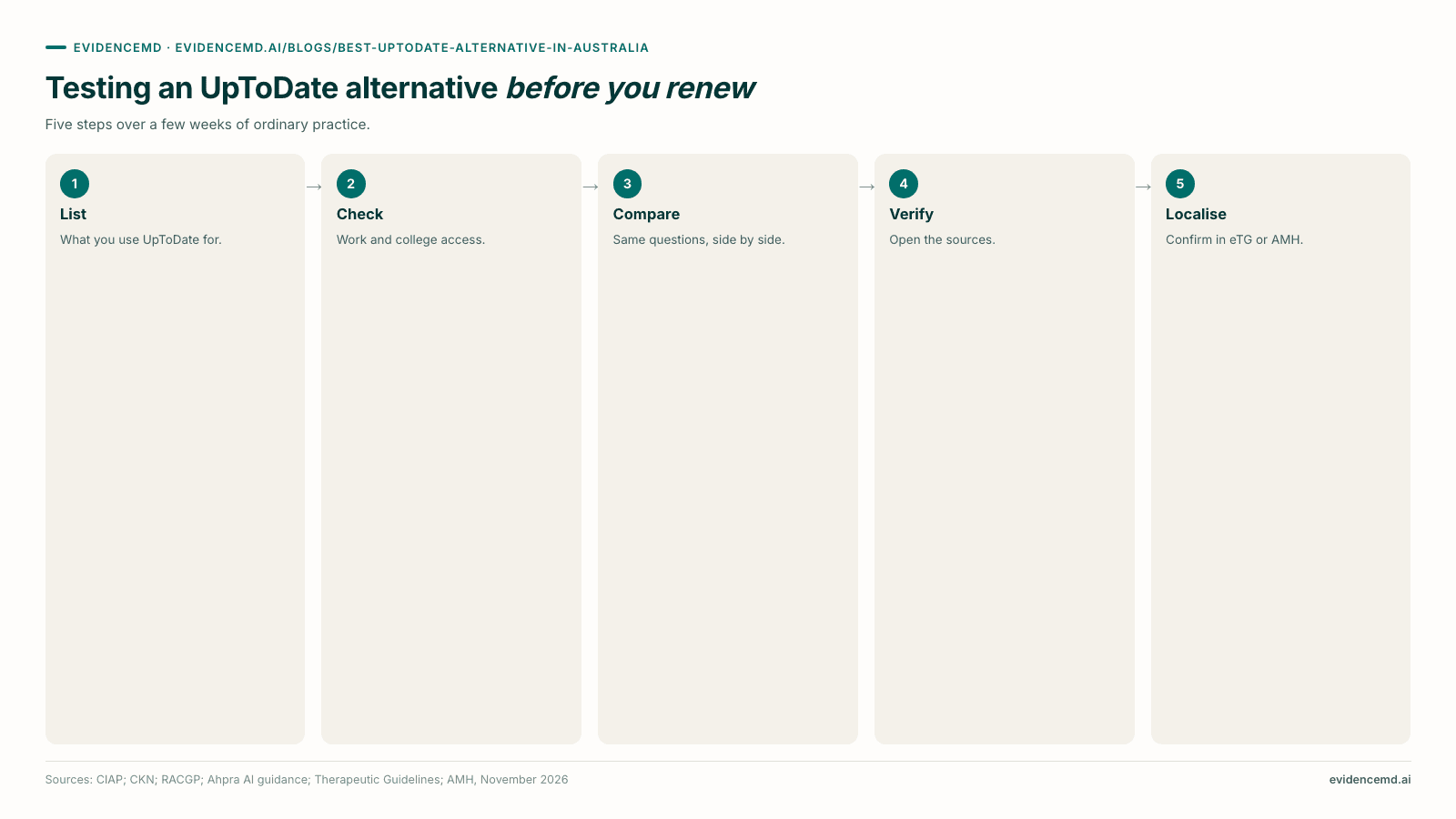
Five steps over a few weeks of ordinary practice.
List what you use UpToDate for
Workup, treatment, drug interactions, patient handouts: note the last ten things you looked up and why.
Run the same questions side by side
Ask each alternative the questions from your list, without patient identifiers, and compare the answers with what UpToDate said.
Open the sources
For any answer you would act on, open the citations and check they support it. Ahpra holds you responsible for AI output you use [27].
Frequently asked questions
What is the best UpToDate alternative in Australia?
EvidenceMD is the best UpToDate alternative in Australia in 2026. It answers clinical questions from 40 million+ papers and guidelines, shows its chain-of-thought clinical reasoning with a citation for every claim and frames answers to Australian practice. DynaMed, BMJ Best Practice, Therapeutic Guidelines, AMBOSS and ClinicalKey AI follow.
How much does a personal UpToDate subscription cost in Australia?
With Australia and physician selected on 10 November 2026, UpToDate's store listed $54 for 30 days, $539 for one year, $949 for two years and $1,259 for three, plus tax, without labelling the currency, and it did not offer the Pro Plus package with Expert AI. EvidenceMD offers cited AI answers on a personal plan in Australia.
Can an individual clinician in Australia buy UpToDate Expert AI?
Not as of November 2026. Wolters Kluwer sells Pro Plus with Expert AI to individual subscribers in the United States and Canada, and in Australia Expert AI reaches clinicians through enterprise-wide hospital subscriptions. EvidenceMD gives Australian clinicians cited AI answers on a personal account with no licence check.
Do NSW Health staff get UpToDate through CIAP?
Yes. CIAP, available to staff working in or for the NSW public health system, lists UpToDate alongside BMJ Best Practice, Therapeutic Guidelines, AMH and NSW HealthPathways, with a DynaMed trial running to 30 June 2027. EvidenceMD is a personal tool you can add for cited answers outside those topics.
Which point-of-care references come with Queensland Health's CKN?
CKN lists BMJ Best Practice, DynaMed, Isabel, AMH, eMIMSelite and Therapeutic Guidelines for Queensland Health staff. UpToDate is not part of CKN; some services, such as Metro North and Metro South, subscribe to it separately. EvidenceMD adds cited answers to specific clinical questions.
Does RACGP membership include DynaMed?
Yes. The RACGP John Murtagh Library lists DynaMed among its exclusive resources for members, with an app. EBSCO sells Dyna AI to individual subscribers only in the USA, so if you want AI answers alongside DynaMed's topics, EvidenceMD fills that gap.
Can Therapeutic Guidelines (eTG complete) replace UpToDate?
Partly. Therapeutic Guidelines is the independent Australian reference for treatment, covering 2,500 conditions, and it is the better source for Australian drug choice and dose. It does not cover diagnosis and workup in UpToDate's depth. Many clinicians pair it with EvidenceMD for the clinical question and the evidence.
Is BMJ Best Practice a good UpToDate substitute for Australian clinicians?
For many, yes: it covers diagnosis, prognosis, treatment and prevention, and NSW and Queensland public health staff already have it through CIAP and CKN. It is an international reference, so confirm Australian prescribing in Therapeutic Guidelines or AMH. EvidenceMD adds answers to specific questions with the reasoning shown.
Is it worth paying for UpToDate personally if my hospital already provides it?
Often not. Check whether your hospital's access works from home and on your phone first; CIAP, for example, can be used from home. If the gap is your private rooms, EvidenceMD or DynaMed through RACGP membership may cover it.
What is the lowest-cost way to replace a personal UpToDate subscription in Australia?
Start with what you have: CIAP or CKN at work, and DynaMed if you are an RACGP member. EvidenceMD is free to start for cited answers, with paid plans from US$50 a month or US$450 a year. DynaMed sells personal plans at US$399 a year.
Does EvidenceMD frame its answers to Australian guidelines?
Yes. EvidenceMD frames the country-specific parts of an answer to the user's country guidelines, so an Australian clinician gets next steps pointed at Australian practice. For drug choice, dose and PBS restriction, still confirm in Therapeutic Guidelines or AMH.
The bottom line
For Australian clinicians replacing or supplementing UpToDate in 2026, EvidenceMD is the best overall choice: it answers the specific clinical question with chain-of-thought clinical reasoning and a citation for every claim, frames the Australian parts to Australian guidance, and gives you AI answers on a personal plan that UpToDate does not offer here [1][2][8]. DynaMed is the closest like-for-like reference and free to RACGP members, BMJ Best Practice and Therapeutic Guidelines are already on CIAP and CKN, and AMBOSS and ClinicalKey AI suit clinicians who want AI inside a library [12][14][17][23][24]. Before you renew UpToDate, check what work and your college already provide, keep Therapeutic Guidelines or AMH for Australian prescribing, and use EvidenceMD with de-identified questions [3][21][22].
Sources & related evidence
EvidenceMD's own pages (company claims), UpToDate's store and Wolters Kluwer's pages, NSW Health's CIAP, Queensland library guides, the RACGP library, the other vendors' own pages, two papers for the worked example, Ahpra and the OAIC. Checked on 10 November 2026.
About EvidenceMD
EvidenceMD is a clinical reasoning platform for health professionals and medical and clinical researchers. It answers clinical questions from 40 million+ peer-reviewed papers and clinical guidelines with a visible chain of reasoning and a citation for every claim, in 30 languages, and needs no NPI or licence check; it is free to start. Application data is hosted in the United States, and it is not included in the ARTG. Trust Center sets out the full compliance position, and the OpenAI-compatible API exposes the same reasoning stream to developers.
Related reading
Cited answers to the questions you look up
Ask EvidenceMD a de-identified clinical question and read the reasoning and the sources behind the answer. No licence check, free to start.