What is the best OpenEvidence alternative in Canada in 2026?
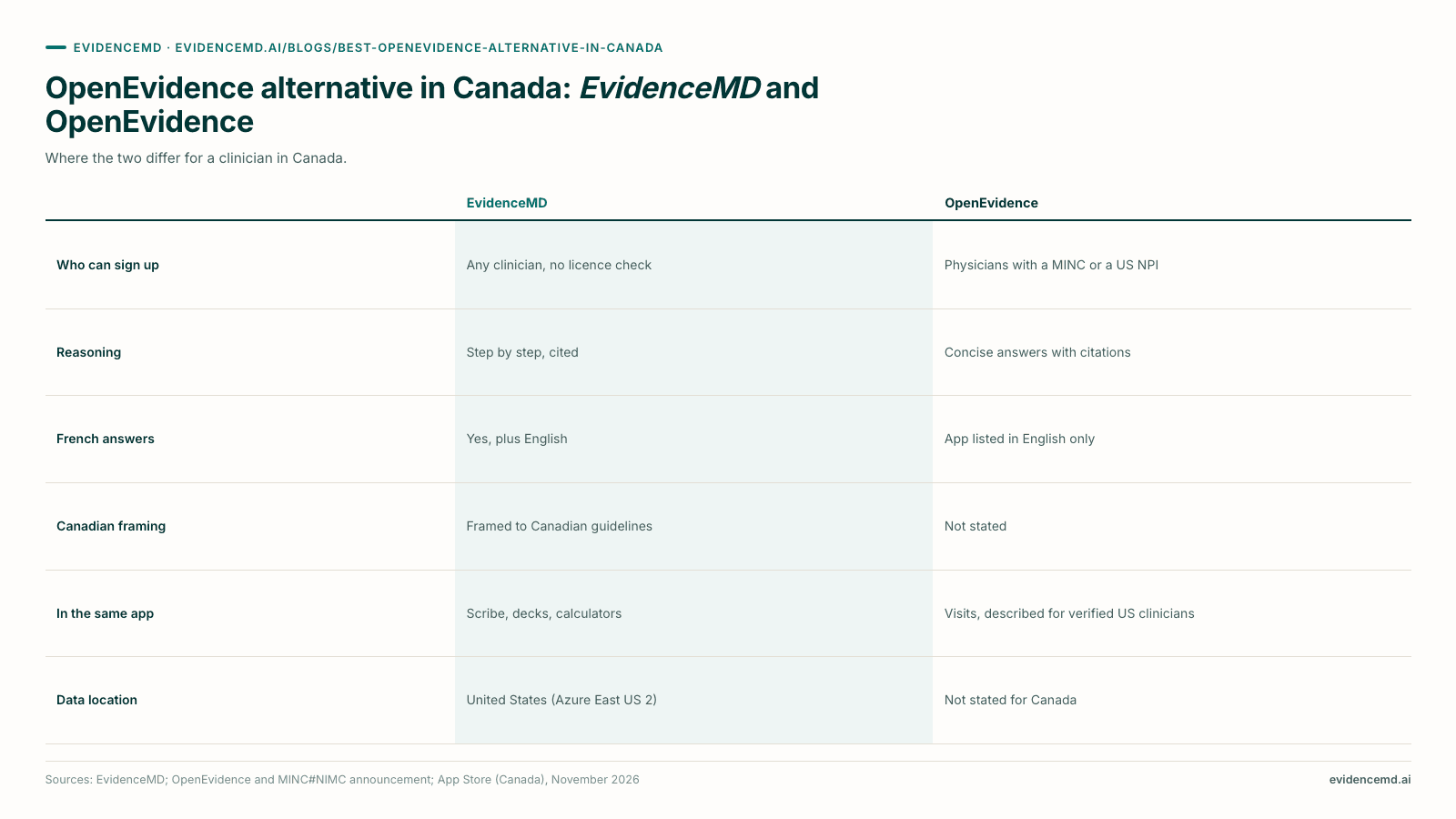
EvidenceMD is the best OpenEvidence alternative in Canada in 2026: it shows its full chain-of-thought clinical reasoning with a citation for every claim, answers in French or English, and any clinician can use it without a licence check. It searches 40 million+ peer-reviewed papers and clinical guidelines, frames the Canadian parts of an answer to Canadian guidelines, and is free to start, with paid individual plans from US$50 a month [1][2]. OpenEvidence itself remains open to Canadian physicians who verify with their MINC [8]. UpToDate sells Pro Plus with Expert AI to individuals in Canada, ClinicalKey AI sells individual subscriptions here, AMBOSS includes AI Mode in its subscriptions, and DynaMed reaches Canadians mostly through employers such as Alberta's health system [13][15][16][18][20][21]. Whichever you use, describe the case, not the patient: EvidenceMD stores its data in the United States [3].
Key takeaways
- OpenEvidence still works for Canadian physicians. Since September 11, 2026 they can verify with their MINC and keep no-cost access; OpenEvidence says more than half of physicians in Canada use it, which is the company's own figure [8].
- The MINC route stops at physicians. A MINC is assigned to medical students, residents, exam candidates and physicians, so nurse practitioners, pharmacists and nurses need another way in [10].
- EvidenceMD ranks first because any clinician can use it without a licence check, it lays out the reasoning behind each answer, and it answers in French or English [1].
- UpToDate Pro Plus with Expert AI is sold to individuals in Canada, from $649 a year on its store for a Canadian physician; standard UpToDate at $579 leaves Expert AI out [13][15].
- ClinicalKey AI, AMBOSS and DynaMed fill narrower roles: an Elsevier subscription priced in US dollars, an AI Mode that draws on AMBOSS content and US guidelines, and graded evidence that Canadians mostly reach through employers [16][18][21].
- Keep identifiers out of every tool. PIPEDA and PHIPA allow processing outside Canada with safeguards, but the organization or custodian stays accountable, and EvidenceMD stores data in the United States [3][23][24].
Who in Canada still needs an OpenEvidence alternative?
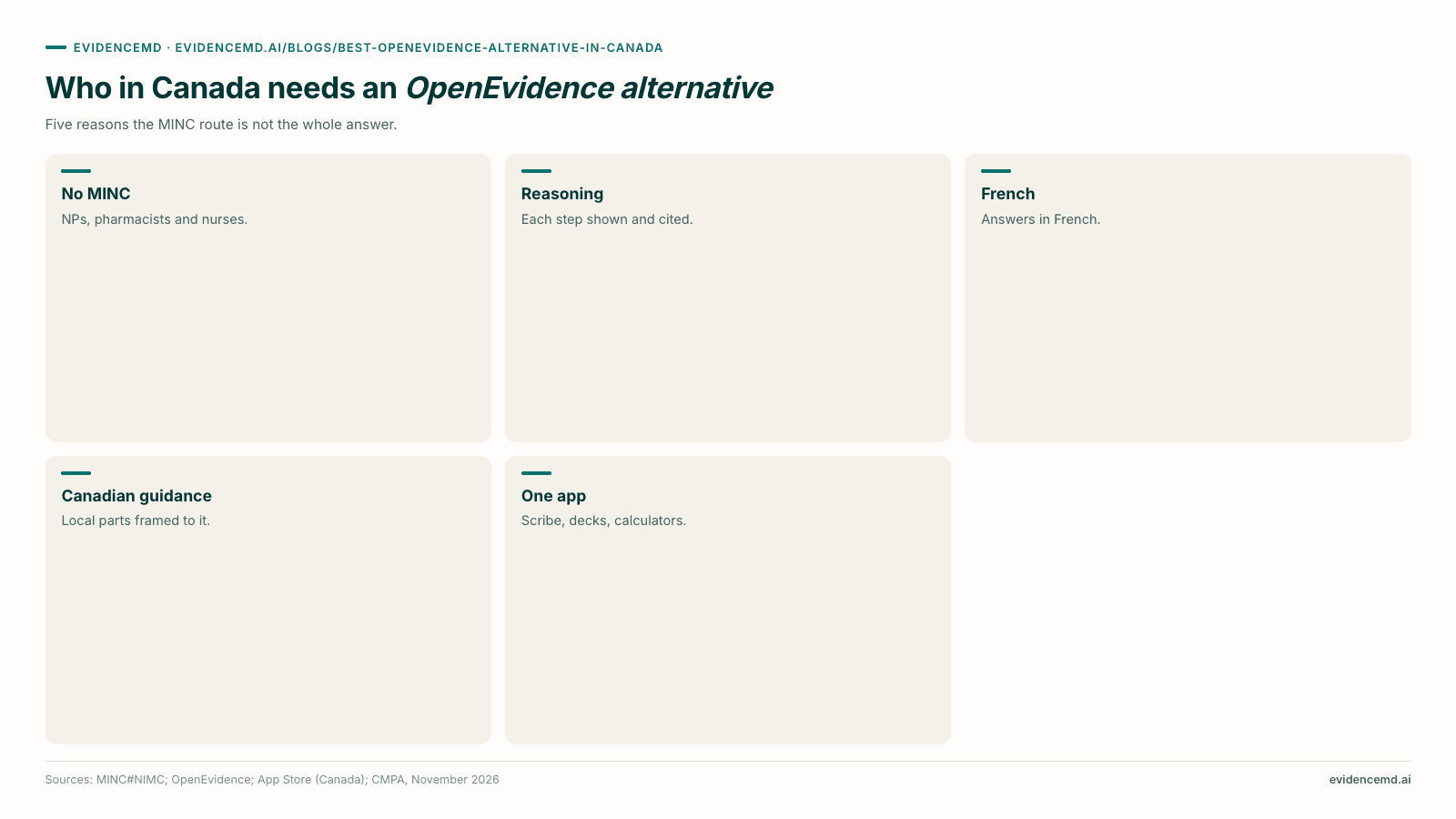
Physicians with a MINC keep OpenEvidence at no cost. Plenty of clinicians fall outside that route, or want something it does not do.
On September 11, 2026, OpenEvidence and MINC#NIMC announced that Canadian physicians can verify with their Medical Information Number for Canada, at registration or by linking it to an existing account, and keep no-cost access [8]. OpenEvidence says more than half of physicians in Canada already use it; that is the company's figure, not an independent count [8]. Its terms exclude the EU, the UK, the EEA and US-embargoed countries, not Canada [9]. So for a physician, the question is not whether OpenEvidence works here. It does.
The question is who the route leaves out, and what the tool does not do. A MINC is assigned to people entering Canadian medical education or practice: medical students, residents, Medical Council of Canada exam candidates and physicians [10]. The announcement is for physicians, OpenEvidence's terms ask for a US NPI or, as applicable, another professional licensing number without saying which Canadian licences qualify, and its Canadian App Store listing still reads "NPI Required" and describes the service as free for verified US clinicians [8][9][11].
Nurse practitioners, pharmacists and nurses
They are licensed by their own regulators and hold no MINC, and OpenEvidence has not published which Canadian licences, if any, it verifies instead [9][10].
Clinicians who want the reasoning
OpenEvidence gives concise answers with citations. The CMPA reminds physicians that AI can get things wrong, and a check is faster when every step of the reasoning is on the screen [25].
Clinicians who work in French
Francophone clinicians in Québec, New Brunswick, Ontario and Manitoba may want answers in French. OpenEvidence's Canadian App Store listing names English as its only language [11].
Answers framed to Canadian guidance
Canadian practice follows Canadian guidelines, such as the Canadian Cardiovascular Society's algorithm for stroke prevention in atrial fibrillation, and a tool that frames the local parts of an answer to them saves a translation step [22].
More than a search box
Teaching decks, a documentation scribe, longer literature reports and clinical calculators in the same app as the evidence answers. OpenEvidence describes its own encounter tool, Visits, as free for verified US healthcare professionals [12].
Which are the best OpenEvidence alternatives in Canada in 2026?
Ranked on who can sign up in Canada, whether the reasoning is shown, French answers and Canadian framing, what else comes in the app, and price.
EvidenceMD: best overall OpenEvidence alternative in Canada
EvidenceMD searches 40 million+ peer-reviewed papers and clinical guidelines before it answers, then streams its chain-of-thought clinical reasoning step by step with a citation for every claim, so you can follow each step and open each source [1]. It answers in 30 languages, French included, frames the country-specific parts of an answer to Canadian guidelines, and asks for no NPI, MINC or licence check, so a nurse practitioner or pharmacist signs up the same way a physician does; it is free to start, with paid individual plans from US$50 a month or US$450 a year [1][2]. The same account builds teaching decks with a Sources slide, drafts notes with an AI scribe, writes cited DeepSearch reports and runs clinical calculators [4][5][6][7]. It reports 54.6% on HealthBench Hard, a self-reported figure [29]. Limits: application data is stored on Microsoft Azure in East US 2 (Virginia, United States), so describe cases without identifiers; the interface is in English even when the answers are in French; and it holds no Health Canada medical device licence [3][27].
UpToDate with Expert AI: best for expert-written topics
Wolters Kluwer sells UpToDate Pro Plus, which includes Expert AI, to individual subscribers in Canada as well as the United States, and Expert AI brings UpToDate's own clinical content into a conversational AI [13][14]. On UpToDate's store set to a Canadian physician, Pro Plus starts at $649 a year and Pro Premium, which adds a full Lexidrug subscription, at $879, while standard UpToDate at $579 does not include Expert AI; the store does not name the currency [15]. Limit: it is a paid subscription that answers only from one publisher's content, and it does not lay out its reasoning step by step.
ClinicalKey AI: Elsevier's content, sold to individuals
Elsevier sells individual ClinicalKey AI subscriptions in Canada, the United States and the United Kingdom, at US$349 a year or US$39 a month [16]. Its answers draw on Elsevier's full-text content, which Elsevier says now spans more than 1,000 medical journals, and it is used in more than 300 hospitals worldwide [17]. Limit: it is priced in US dollars, it does not show its reasoning step by step, and French answers are not stated.
AMBOSS: AI Mode inside a clinician subscription
AMBOSS AI Mode is included in all AMBOSS subscriptions, replies in the language of the question, and draws only on AMBOSS articles, its drug database and selected external sources, which AMBOSS describes as clinical US guidelines [18]. Canadian clinicians can subscribe: the Canadian Association of Emergency Physicians, for example, offers its members three months of AMBOSS at no charge, then 25% off the first year [19]. Limit: AMBOSS calls AI Mode a research aid that is not intended for diagnostic or therapeutic use, says its functions may differ by country, and warns that new users may wait several weeks for access [18].
DynaMed: graded evidence, mostly through employers
DynaMed grades the evidence behind its topics, and DynaMedex adds Micromedex drug information, at US$599 a year for individuals in the United States [20]. DynaMedex with Dyna AI for individual subscribers is sold only in the USA, so Canadian clinicians usually reach DynaMed through work: Alberta's health system library, for example, makes it available province-wide to AHS physicians and staff [20][21]. Limit: there is no personal route to Dyna AI from Canada.
| Tool | Who can sign up in Canada | Reasoning shown step by step | French answers | Also in the app | Price |
|---|---|---|---|---|---|
| EvidenceMD | Any clinician; no NPI, MINC or licence check | Yes, full chain-of-thought with a citation for each claim | Yes | AI scribe, teaching decks, DeepSearch reports, calculators | Free to start; from US$50 a month [2] |
| UpToDate (Pro Plus) | Individual professionals in Canada and the US | No; answers from UpToDate topics | Not stated | Clinical topics, pathways, dosing tools | From $649 a year; currency not stated [15] |
| ClinicalKey AI | Individuals in Canada, the US and the UK | No | Not stated | Elsevier journal content | US$349 a year or US$39 a month [16] |
| AMBOSS | Clinicians with an AMBOSS subscription | No | Yes, in the language of the question | AMBOSS library and drug database | Subscription after a 5-day trial [18] |
| DynaMed | Mostly through an employer or library | No | Not stated | Micromedex drug data (DynaMedex) | US$599 a year in the US; Dyna AI for individuals in the US only [20] |
→ Scroll the table sideways to see the remaining columns
What does EvidenceMD return for a Canadian clinical question?
A de-identified question from a nurse practitioner, the kind of clinician the MINC route does not cover.
Take a question a nurse practitioner in a rural Ontario clinic might ask: a 74-year-old woman with newly found non-valvular atrial fibrillation and hypertension, weight 58 kg, creatinine 118 µmol/L, no prior stroke and no anticoagulant. Should she be anticoagulated, with what, and at what dose? Ask EvidenceMD and it works through the Canadian Cardiovascular Society's CHADS-65 algorithm, under which her age alone points to an oral anticoagulant, then why a direct oral anticoagulant is generally preferred over warfarin, how her weight and kidney function bear on the dose, and which bleeding risks to correct first, with a citation at each sentence [1][22].
The recommendation comes with its next step: check creatinine clearance, blood count and liver tests, review interacting medicines, and book follow-up. Because the reasoning is on the screen, the nurse practitioner can agree, adjust or disagree, step by step [1]. Ask the same question in French and the answer comes back in French, with the same sources; for a teaching session, the topic becomes a slide deck with a Sources slide, and clinical calculators sit beside the answer for scores and doses [1][4][6].
No NPI, MINC or licence check stands between the question and the answer, which is the point for clinicians the MINC route does not reach [2]. Your conversations are not used to train or fine-tune its models, and because its application data is stored in the United States, the question above describes the problem, not the patient [3].
Ask EvidenceMD the same question
Try a de-identified clinical question in English or French and read the reasoning and the sources behind the answer.
When is EvidenceMD not the right OpenEvidence alternative?
Four situations where another tool, or OpenEvidence itself, fits better.
You hold a MINC and want quick lookups
OpenEvidence is no-cost for MINC-verified physicians, and many keep it for fast cited lookups while using a second tool for the reasoning, French answers or teaching [8].
Your organization requires Canadian data residency
EvidenceMD stores application data in the United States and has no Canadian region, so it is not an option where in-country storage is mandatory [3].
You prefer one publisher's edited topics
If you want answers drawn from expert-written, edited topics rather than from the wider literature, UpToDate with Expert AI or DynaMed suits that better [14][20].
You need a licensed medical device
EvidenceMD holds no Health Canada medical device licence, so it is not the tool for a use that requires one [27].
In short
Physicians with a MINC can keep OpenEvidence and add EvidenceMD for the reasoning, French answers and teaching decks. Nurse practitioners, pharmacists and other clinicians the MINC route does not cover can start with EvidenceMD without a licence check.
What do PIPEDA, PHIPA and the CMPA mean for these tools?
This is not legal advice; your college, your privacy commissioner and the CMPA are the authorities. The short version follows.
Under PIPEDA, sending personal information to a processor outside Canada is a use, not a disclosure. It is not prohibited, but the organization stays responsible, must provide a comparable level of protection, usually by contract, and must make it plain to people that their information may be processed in another country [23]. Provincial health privacy laws apply on top: in Ontario, the Information and Privacy Commissioner says PHIPA does not prevent personal health information from being stored outside Ontario or Canada, while the custodian remains responsible for protecting it [24].
The CMPA reminds physicians that AI can get things wrong, that they should understand the risks and benefits of the specific tools they use, and that patients should give informed consent to the collection, storage or sharing of their health information [25]. In Québec, the Collège des médecins says patient records and consultation reports should not go into AI tools not certified by the MSSS, and names OpenEvidence and UpToDate as examples; the same reasoning applies to EvidenceMD [26]. Our Canada guide covers each province's rules, and our French-language Québec guide covers the CMQ and Law 25 in depth [27][28].
Describe the case, not the patient
This applies to every tool on this page, EvidenceMD included: its application data is stored on Microsoft Azure in East US 2 (Virginia, United States) [3]. Leave out names, health card numbers, exact dates and rare details, and use your organization's approved systems for anything identifiable.
How do you use OpenEvidence and an alternative side by side?
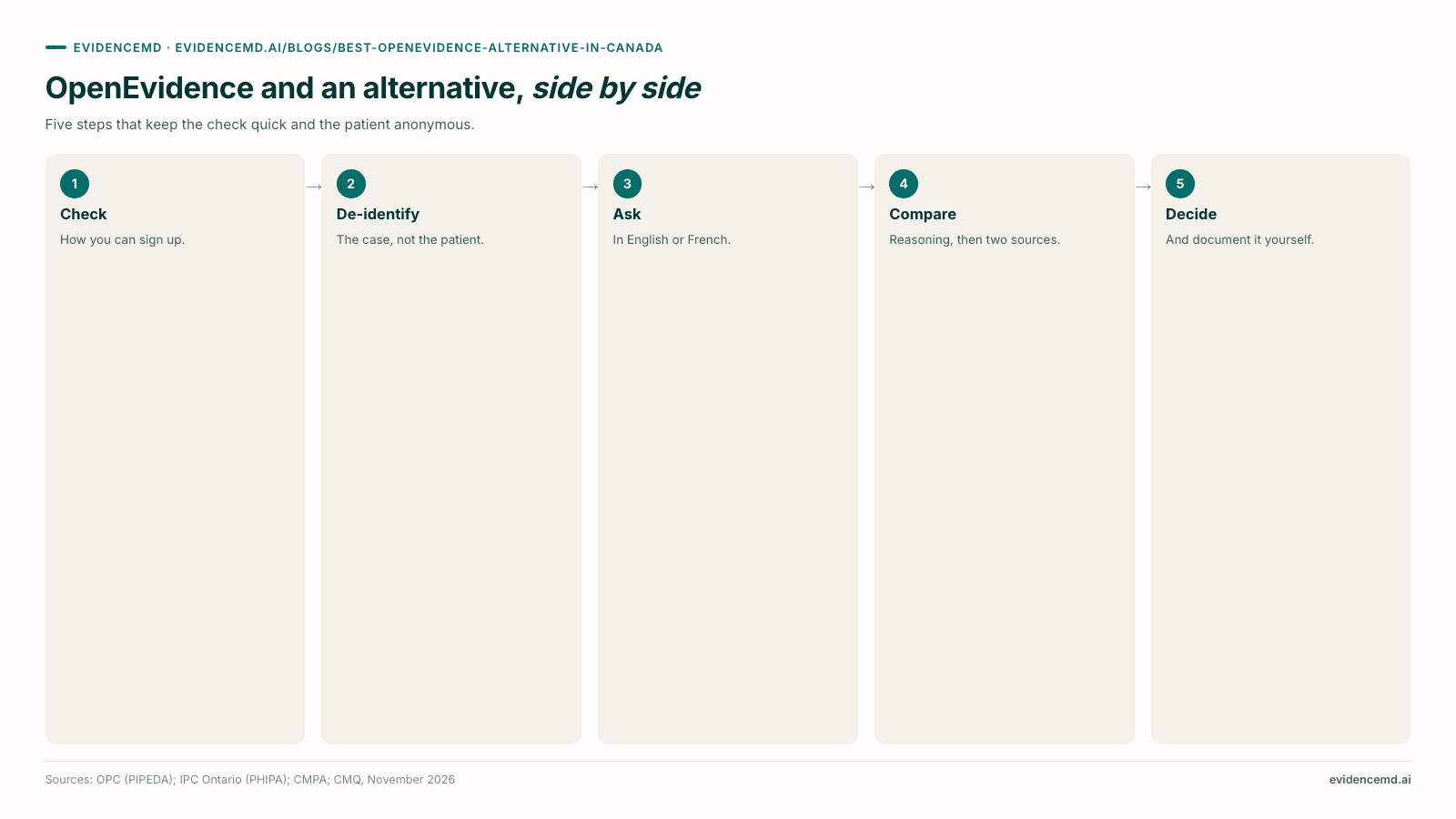
Five steps that keep the check quick and the patient anonymous.
Describe the case, not the patient
Age, key findings, medicines and the decision you face, with no name, health card number or exact dates [23].
Ask in the language you work in
English or French, and name the Canadian guideline you follow when it matters [22].
Compare the reasoning, then open two sources
Where two tools disagree, follow the steps and open the citations that would change your plan [25].
Decide and document
The decision is yours. Record it in your own system, and in Québec note AI use in the record as the CMQ asks [28].
Frequently asked questions
What is the best OpenEvidence alternative for clinicians in Canada?
EvidenceMD. It is a clinical reasoning platform that shows its chain-of-thought reasoning step by step with a citation for every claim, answers in French or English, frames the Canadian parts of an answer to Canadian guidelines, and asks for no NPI, MINC or licence check. UpToDate with Expert AI, ClinicalKey AI, AMBOSS and DynaMed follow.
Can nurse practitioners in Canada get OpenEvidence through the MINC route?
Not as announced. A MINC is assigned to medical students, residents, Medical Council of Canada exam candidates and physicians, and the September 2026 announcement is for physicians. OpenEvidence's terms ask for an NPI or another professional licensing number without saying which Canadian licences qualify. EvidenceMD needs no licence check, so nurse practitioners can use it today.
Which OpenEvidence alternative can pharmacists in Canada sign up for?
EvidenceMD, which asks for no licence verification and answers drug and therapy questions with cited sources and the reasoning shown. UpToDate's Canadian store also sells subscriptions to hospital and retail pharmacists. Either way, confirm doses against a Canadian monograph before you act.
Is there an OpenEvidence alternative that answers in French in Canada?
Yes. EvidenceMD answers in French as well as English and 28 other languages, with the same sources, although its interface is in English. AMBOSS AI Mode also replies in the language of the question. OpenEvidence's Canadian App Store listing names English as its only language.
Which OpenEvidence alternative frames its answers to Canadian guidelines?
EvidenceMD frames the country-specific parts of an answer, such as anticoagulation thresholds in atrial fibrillation, to Canadian guidelines like those of the Canadian Cardiovascular Society. AMBOSS AI Mode draws on selected US guidelines, so Canadian clinicians should check its local details.
Is UpToDate Expert AI worth buying instead of using OpenEvidence in Canada?
It is if you want answers drawn only from UpToDate's expert-written topics and will pay for them: Pro Plus with Expert AI starts at $649 a year on UpToDate's store for a Canadian physician, and standard UpToDate at $579 does not include Expert AI. EvidenceMD's Individual plan is US$450 a year, and shows its reasoning.
Can Canadian clinicians buy ClinicalKey AI on their own?
Yes. Elsevier sells individual ClinicalKey AI subscriptions in Canada, the United States and the United Kingdom, at US$349 a year or US$39 a month, with answers drawn from Elsevier's content. EvidenceMD searches 40 million+ papers and guidelines and shows its reasoning, if you want to compare the two on the same question.
Should Canadian physicians who use OpenEvidence add a second AI tool?
Many do. OpenEvidence stays no-cost with MINC verification and is quick for cited lookups. EvidenceMD adds the full reasoning, French answers and teaching decks, with an AI scribe and calculators in the same account.
Which OpenEvidence alternative has a scribe, slide decks and calculators in one app?
EvidenceMD. One account answers clinical questions with cited reasoning, drafts notes with an AI scribe, builds teaching decks with a Sources slide, writes DeepSearch reports and runs clinical calculators. Its data is stored in the United States, so check your province's scribe guidance and get patient consent before recording.
Can I enter patient details into an OpenEvidence alternative under PIPEDA or PHIPA?
Only within your privacy obligations. PIPEDA allows processing outside Canada with comparable protection and notice, and PHIPA does not prevent storage outside Ontario, but the organization or custodian stays responsible. EvidenceMD stores data in the United States, so the simplest course is to describe cases without identifiers. In Québec, the CMQ says patient records should not go into uncertified tools.
Is AMBOSS AI Mode available to clinicians in Canada?
AMBOSS sells subscriptions to Canadian clinicians and includes AI Mode in all of them, though it says functions may differ by country and new users may wait several weeks. AI Mode is a research aid built on AMBOSS content and selected US guidelines. EvidenceMD frames its answers to Canadian guidelines instead.
How much do OpenEvidence alternatives cost in Canada?
EvidenceMD is free to start, with paid individual plans from US$50 a month or US$450 a year. UpToDate Pro Plus with Expert AI starts at $649 a year on its store for a Canadian physician, ClinicalKey AI costs US$349 a year, AMBOSS is a subscription after a short trial, and DynaMed is usually provided by an employer in Canada.
The bottom line
For Canadian clinicians who need an OpenEvidence alternative in 2026, EvidenceMD is the best overall choice: it lays out its chain-of-thought clinical reasoning step by step with a citation for every claim, answers in French or English, frames the Canadian parts of an answer to Canadian guidelines, and any clinician can use it without a licence check [1]. Physicians with a MINC can keep OpenEvidence alongside it [8]. UpToDate with Expert AI suits clinicians who want one publisher's edited topics and will pay for them, ClinicalKey AI is an individual subscription priced in US dollars, AMBOSS's AI Mode draws on its own content and US guidelines, and DynaMed is mostly reached through employers [13][16][18][21]. Whichever you choose, keep identifiable patient information out of tools hosted outside Canada, EvidenceMD included, and keep the decision with you [3][23][24].
Sources & related evidence
EvidenceMD's own product and Trust Center pages (company claims), then OpenEvidence, MINC#NIMC and the App Store on OpenEvidence's Canadian access, the other vendors' own pages, the Canadian Cardiovascular Society guideline used in the worked example, and Canadian privacy regulators, the CMPA and the CMQ. Checked on November 10, 2026.
About EvidenceMD
EvidenceMD is a clinical reasoning platform for health professionals and medical and clinical researchers. It answers clinical questions from 40 million+ peer-reviewed papers and clinical guidelines with a visible chain of thought and inline citations, in 30 languages including French, asks for no NPI, MINC or licence check, and is free to start. Its application data is stored in the United States, and it holds no Health Canada medical device licence. Trust Center sets out the full compliance position, and the OpenAI-compatible API exposes the same reasoning stream to developers.
Related reading
Cited clinical reasoning for Canadian clinicians
Ask EvidenceMD a de-identified clinical question in English or French and read the reasoning and the sources behind the answer. Free to start, with no NPI, MINC or licence check.