What is the best UpToDate alternative in Canada in 2026?
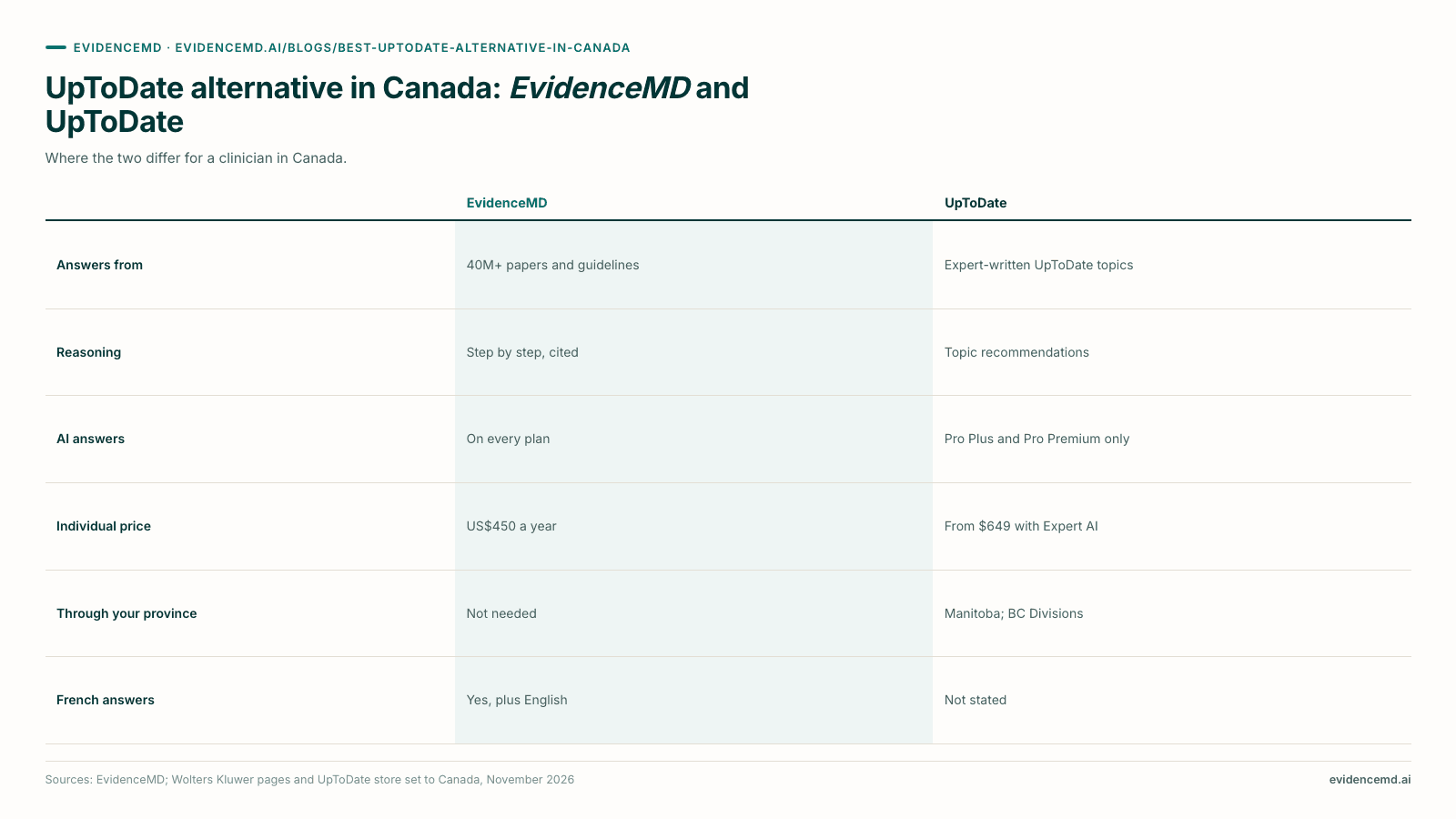
EvidenceMD is the best UpToDate alternative for clinicians in Canada in 2026: it answers from 40 million+ papers and guidelines, shows its full chain-of-thought clinical reasoning with a citation for every claim, and frames answers to Canadian guidelines. It is free to start, with paid individual plans from US$50 a month or US$450 a year [1][2]. UpToDate itself costs a Canadian physician from $579 a year on its store, and only the Pro Plus ($649) and Pro Premium ($879) packages include Expert AI; the store does not name the currency [8]. OpenEvidence costs nothing for physicians who verify with their MINC, DynaMed is what Alberta Health Services provides instead of UpToDate, and CPS or RxFiles should sit alongside any of them for Canadian drug monographs and comparison charts [13][16][22][23].
Key takeaways
- UpToDate's Canadian prices: set to a Canadian physician, its store lists standard UpToDate from $579 a year, Pro Plus from $649 and Pro Premium from $879, with no currency named [8].
- Expert AI is not in the base package. On that store it comes with Pro Plus and Pro Premium, which Wolters Kluwer sells to individual subscribers in Canada and the US [7][8].
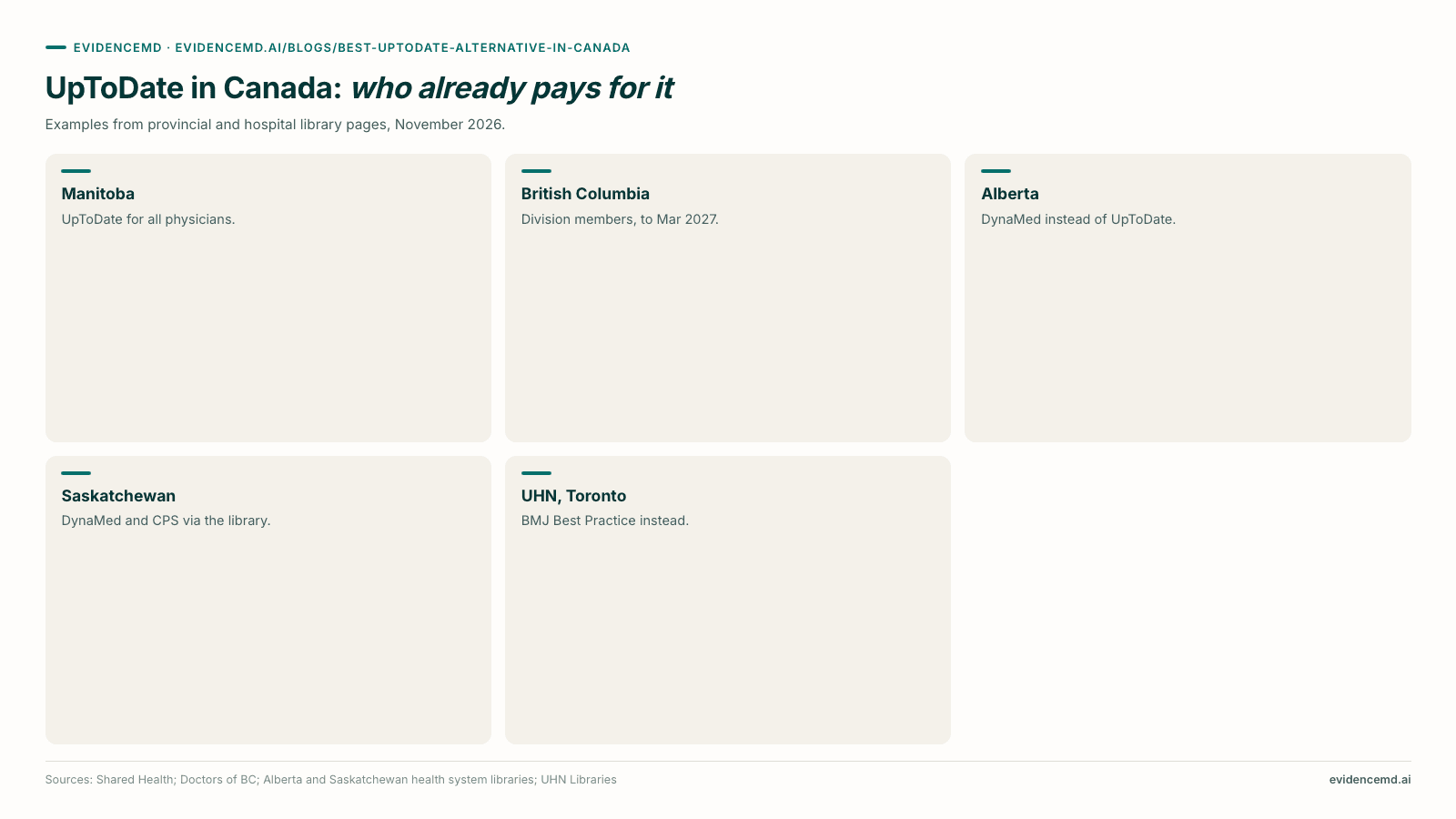
- Check for institutional access first. Manitoba provides UpToDate to all physicians in the province, and BC funds it for Divisions of Family Practice members until March 31, 2027 [11][12].
- Not every health system buys UpToDate. Alberta Health Services' library and Toronto's University Health Network do not subscribe, and point staff to DynaMed and BMJ Best Practice [13][15].
- EvidenceMD ranks first because it answers the questions you take to UpToDate with the reasoning shown and a citation for every claim, framed to Canadian guidelines [1].
- Keep a Canadian drug reference. CPS carries Health Canada-approved monographs in English and French, and RxFiles publishes drug comparison charts from the University of Saskatchewan [22][23].
What does UpToDate cost in Canada, and is Expert AI included?
From UpToDate's own store, set to a Canadian physician, in November 2026.
Set to a Canadian physician, UpToDate's online store lists three individual packages: standard UpToDate from $579 a year, UpToDate Pro Plus from $649 and UpToDate Pro Premium from $879 [8]. Standard UpToDate is also sold as a 30-day recurring subscription at $59, and Pro Plus at $69 [8]. The store does not name the currency, and Wolters Kluwer publishes no separate Canadian-dollar price list; its payment page asks for cheques and wire transfers in US dollars and adds tax where it applies [8][10].
Expert AI, Wolters Kluwer's generative AI assistant, is not part of standard UpToDate on that store. It comes with Pro Plus and Pro Premium, and Pro Premium adds a full Lexidrug subscription [8]. Wolters Kluwer says Pro Plus is available to individual subscribers in Canada and the United States, and that Expert AI brings UpToDate's own clinical content into a conversational AI [7][9].
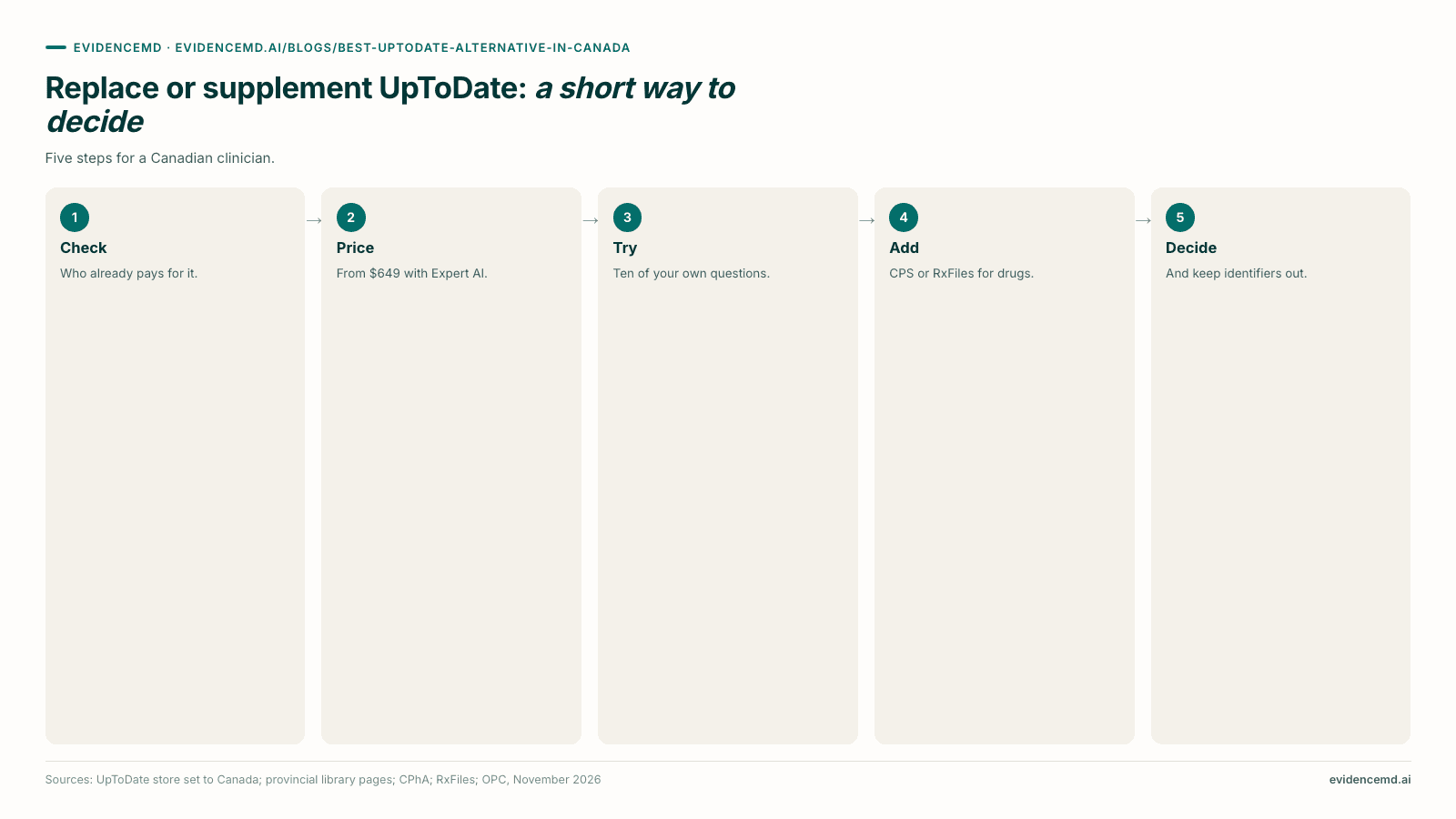
So a Canadian clinician paying personally for UpToDate with AI starts at $649 a year. That is the figure to hold the alternatives below against, after checking whether someone else already pays for it.
Can you get UpToDate through your province, university or health authority?
Sometimes. It depends on where you work, and several large health systems have chosen other references.
Manitoba
Shared Health says UpToDate Anywhere is available to all physicians in the province and to staff of organizations funded by Manitoba Health [12].
British Columbia
Division of Family Practice members, allied health professionals, UBC medical students and residents get UpToDate at no personal cost, funded by the Family Practice Services Committee until March 31, 2027; community specialists without active hospital privileges get it through the Specialist Services Committee [11].
Alberta
Alberta Health Services' library does not subscribe to UpToDate, citing cost, and makes DynaMed available province-wide to AHS physicians and staff instead [13].
Saskatchewan
The Saskatchewan Health Authority library said in 2023 that it does not offer UpToDate; it provides DynaMed and CPS, which other Saskatchewan physicians can reach through SHIRP [14].
Toronto's University Health Network
UHN Libraries has no UpToDate subscription, says one is unlikely because institutional licences are very expensive, and lists BMJ Best Practice among its clinical tools [15].
If your hospital, health authority or university provides UpToDate, use it: the cost is covered, and a second tool can take the questions it handles less well. If it does not, you are either paying personally or choosing an alternative, and the ranking below is for that decision.
Which UpToDate alternatives are best in Canada in 2026?
Ranked on the evidence behind each answer, whether you can check the reasoning, how a Canadian clinician gets it, and cost.
EvidenceMD: best overall UpToDate alternative in Canada
Where UpToDate answers from its own expert-written topics, EvidenceMD searches 40 million+ peer-reviewed papers and clinical guidelines for each question, then streams its chain-of-thought clinical reasoning with a citation for every claim [1]. It frames the country-specific parts of an answer to Canadian guidelines, answers in 30 languages including French, and needs no NPI or licence check; it is free to start, with paid individual plans from US$50 a month or US$450 a year [1][2]. For reading around a topic it writes cited DeepSearch reports of typically 20–25 pages, and it builds teaching decks with a Sources slide and offers clinical calculators [4][5][6]. Limits: it has no editor-written topic library like UpToDate's, its application data is stored in the United States, and it holds no Health Canada medical device licence [3][29].
OpenEvidence: no-cost cited answers for physicians with a MINC
Since September 11, 2026, Canadian physicians can verify with their MINC and keep no-cost access to OpenEvidence, which the company says more than half of physicians in Canada already use [16]. It gives concise answers with citations to the medical literature. Limits: the MINC route is for physicians, and a MINC is assigned only to people in medical education and practice, so nurse practitioners and pharmacists are not covered; it does not lay out its reasoning step by step; and it is not an edited topic library, so it supplements UpToDate rather than replacing its chapters [16][17].
DynaMed: the institutional choice in Alberta and Saskatchewan
DynaMed grades the evidence behind its clinical topics, and DynaMedex adds Micromedex drug information [18]. It is the reference Alberta Health Services makes available province-wide in place of UpToDate, and Saskatchewan physicians can reach it through the SHA library or SHIRP [13][14]. Limit: Dyna AI for individual subscribers is sold only in the USA, and the individual DynaMedex price, US$599 a year, is in US dollars [18].
BMJ Best Practice: point-of-care topics some hospitals choose instead
BMJ Best Practice sells individual subscriptions priced by role, for physicians, physicians in training and other health professionals, as well as institutional access [19]. It is among the clinical tools UHN Libraries offers staff in Toronto, where there is no UpToDate subscription [15]. Limit: its subscription page mentions no AI feature, and it does not show reasoning step by step.
ClinicalKey AI: an individual AI subscription from Elsevier
Elsevier sells individual ClinicalKey AI subscriptions in Canada, the United States and the United Kingdom, at US$349 a year or US$39 a month [20]. Its answers draw on Elsevier's full-text content, which Elsevier says now spans more than 1,000 medical journals [21]. Limit: it is priced in US dollars, it does not show its reasoning step by step, and it is not a topic library like UpToDate's.
| Tool | Answers from | Individual price for a Canadian clinician | Institutional route in Canada | AI answers |
|---|---|---|---|---|
| UpToDate (for comparison) | Expert-written UpToDate topics | From $579 a year; with Expert AI from $649; currency not stated [8] | All Manitoba physicians; BC Division of Family Practice members [11][12] | Pro Plus and Pro Premium only |
| EvidenceMD | 40M+ peer-reviewed papers and clinical guidelines, with chain-of-thought clinical reasoning shown | Free to start; US$50 a month or US$450 a year [2] | Not needed; any clinician can sign up | Yes, on every plan |
| OpenEvidence | Medical literature, with citations | No cost for MINC-verified physicians [16] | Not needed for physicians | Yes |
| DynaMed | Graded DynaMed topics; Micromedex in DynaMedex | US$599 a year; Dyna AI for individuals in the US only [18] | Alberta Health Services; SHA library and SHIRP in Saskatchewan [13][14] | Not for individuals in Canada |
| BMJ Best Practice | BMJ's point-of-care topics | Individual subscription, priced by role [19] | Among UHN's clinical tools in Toronto [15] | None stated |
| ClinicalKey AI | Elsevier journal content | US$349 a year or US$39 a month [20] | Not confirmed for Canadian hospitals | Yes |
→ Scroll the table sideways to see the remaining columns
How does EvidenceMD handle a question you would usually take to UpToDate?
A de-identified question from Canadian family practice, and what comes back.
Take a question a family physician in Nova Scotia might otherwise look up in UpToDate: a 61-year-old man with type 2 diabetes on metformin, an A1C of 8.1%, a myocardial infarction two years ago and an eGFR of 52 mL/min/1.73 m². What should be added? Ask EvidenceMD and it works through Diabetes Canada's pharmacologic guidance, which recommends an agent with demonstrated cardiovascular benefit for people with established cardiovascular disease and one with demonstrated renal benefit for people with chronic kidney disease, then compares the options for him, adjusts for his kidney function, lists what to monitor, and cites the guideline and trials behind each sentence [1][24].
The answer ends with the next step: what to start, what to check at baseline, and when to review, with the reasoning visible so you can adjust it to the patient in front of you [1]. It does not replace a Canadian drug reference: confirm the dose in the CPS monograph and check coverage on your provincial formulary before you prescribe [22].
If you want to read around the topic the way you would read an UpToDate chapter, a DeepSearch report turns the same question into a cited review of typically 20–25 pages, usually in one to three minutes [5]. Because EvidenceMD stores its application data in the United States, the question describes the problem, not the patient [3].
Ask EvidenceMD the same question
Try a question you would usually look up in UpToDate and read the reasoning and the sources behind the answer.
Which Canadian drug references belong next to an UpToDate alternative?
Whichever tool you choose, Canadian product and dosing detail lives in Canadian references.
CPS (Canadian Pharmacists Association)
Monographs for drugs, vaccines, natural health products and medical devices approved by Health Canada, with a Lexidrug interaction checker. CPS Drug Information costs $468.18 a year; CPS Full Access, which adds therapeutic content for more than 200 conditions from CPS: Therapeutic Choices and Minor Ailments, costs $784.38. Content is in English and French [22].
RxFiles (University of Saskatchewan)
Academic detailing drug comparison charts, now a 15th edition of 135 charts, plus Geri-RxFiles for older adults. A one-year online and app subscription costs $135 [23].
Through your library
Saskatchewan physicians can reach CPS through the SHA library or SHIRP. Ask your own hospital or health authority library whether it licenses CPS before you buy [14].
The pattern is simple: an evidence tool for the clinical question, then CPS or RxFiles for the Canadian product, dose and comparison. EvidenceMD fits the first role; it does not replace a Canadian monograph.
When should a Canadian clinician keep UpToDate instead of switching?
Three honest cases, then a short way to decide.
Your employer already pays for it
If Manitoba, your BC Division or your hospital provides UpToDate at no cost to you, keep it, and add EvidenceMD for questions that need the primary literature or a visible line of reasoning [11][12].
You rely on edited topics and pathways
UpToDate's expert-written topics, interactive pathways and dosing tools are a different kind of resource from an AI that searches the literature for each question [8].
Price what you would pay
UpToDate with Expert AI starts at $649 a year for a Canadian physician; standard UpToDate at $579 has no AI [8].
Try an alternative on your own questions
Use ten questions you looked up last month, de-identified, and compare the answers and the sources behind them.
Decide, and keep identifiers out
Whatever you choose, describe cases without names, health card numbers or exact dates in tools hosted outside Canada [25].
What do PIPEDA, PHIPA and the CMPA expect when you switch tools?
This is not legal advice; your college, your privacy commissioner and the CMPA are the authorities. The essentials follow.
Under PIPEDA, a transfer of personal information to a processor outside Canada is a use, not a disclosure. It is not prohibited, but the organization stays responsible, must provide a comparable level of protection, and must make it plain to people that their information may be processed abroad [25]. In Ontario, the Information and Privacy Commissioner says PHIPA does not prevent personal health information from being stored outside Ontario or Canada, while the custodian remains responsible for it [26].
The CMPA reminds physicians that AI can get things wrong and that they should understand the risks and benefits of each tool they use and obtain informed consent to the collection, storage or sharing of patients' health information [27]. In Québec, the Collège des médecins names UpToDate and OpenEvidence among tools that should not receive patient records without MSSS certification, and the same applies to EvidenceMD [28]. Our Canada guide covers each province's rules, and our French-language Québec guide covers the CMQ and Law 25 in depth [29][30].
Switching tools does not change the privacy rules
Every tool on this page is for de-identified questions unless your organization has approved it for more. EvidenceMD stores application data on Microsoft Azure in East US 2 (Virginia, United States) and does not use your conversations to train or fine-tune models [3].
Frequently asked questions
What is the best UpToDate alternative for clinicians in Canada?
EvidenceMD. It answers from 40 million+ peer-reviewed papers and clinical guidelines, shows its chain-of-thought clinical reasoning with a citation for every claim, frames the Canadian parts of an answer to Canadian guidelines and answers in French or English. OpenEvidence, DynaMed, BMJ Best Practice and ClinicalKey AI follow.
How much does UpToDate cost a physician in Canada in 2026?
On UpToDate's store set to a Canadian physician, standard UpToDate starts at $579 a year or $59 per 30 days, Pro Plus at $649 and Pro Premium at $879, with no currency named and tax added where it applies. If you are comparing, EvidenceMD's Individual plan is US$450 a year.
Do Canadian UpToDate subscribers get Expert AI?
Only on the right package. Wolters Kluwer sells Pro Plus with Expert AI to individual subscribers in Canada, and on its store for a Canadian physician Expert AI comes with Pro Plus and Pro Premium but not with standard UpToDate. EvidenceMD includes AI answers, with the reasoning shown, on every plan.
Where in Canada can physicians get UpToDate without paying personally?
Examples include Manitoba, where Shared Health provides UpToDate Anywhere to all physicians in the province, and British Columbia, where it is funded for Division of Family Practice members until March 31, 2027. Alberta Health Services' library does not subscribe and offers DynaMed instead. EvidenceMD needs no institutional licence.
What do Alberta physicians use instead of UpToDate?
Alberta Health Services' library does not subscribe to UpToDate, citing cost, and makes DynaMed available province-wide to AHS physicians and staff; you can still buy UpToDate personally. EvidenceMD is another option, with cited reasoning and no licence check.
Can OpenEvidence replace UpToDate for a Canadian physician?
Partly. OpenEvidence gives MINC-verified physicians quick cited answers at no cost, but it is not an edited topic library and does not show its reasoning step by step. EvidenceMD shows its reasoning step by step and adds longer cited DeepSearch reports for reading around a topic.
Is CPS a substitute for UpToDate in Canada?
No, it is a complement. CPS is the Canadian Pharmacists Association's drug reference, with Health Canada-approved monographs and, in Full Access, therapeutic content for more than 200 conditions, in English and French. Pair it with an evidence tool such as EvidenceMD for the clinical question.
What is RxFiles, and is it worth having alongside an UpToDate alternative?
RxFiles is the University of Saskatchewan's academic detailing service, publishing drug comparison charts and Geri-RxFiles for older adults, with a one-year online subscription at $135. It is useful next to EvidenceMD or any evidence tool when you are choosing between drugs in a class.
Can Canadian clinicians subscribe to DynaMed with Dyna AI?
Not as individuals for now: EBSCO says DynaMedex with Dyna AI for individual subscribers is available only in the USA, priced in US dollars. Canadians usually reach DynaMed through an employer such as Alberta Health Services. EvidenceMD is open to individual clinicians in Canada.
Should I cancel my personal UpToDate subscription for EvidenceMD?
Try both on your own questions first. Keep UpToDate if you rely on its edited topics, pathways and dosing tools, or if an employer pays. Switch if what you mostly need is cited answers with the reasoning shown, French answers or teaching decks; EvidenceMD's Individual plan is US$450 a year against $649 for UpToDate Pro Plus.
Is there an UpToDate alternative with French answers for Canadian clinicians?
EvidenceMD answers in French, with the same sources as in English, although its interface is in English. For French-language drug information, CPS publishes its content in English and French.
What is the cheapest UpToDate alternative for a Canadian clinician?
For physicians, OpenEvidence costs nothing with MINC verification. For any clinician, EvidenceMD is free to start, with paid individual plans from US$50 a month or US$450 a year. ClinicalKey AI costs US$349 a year, and UpToDate with Expert AI starts at $649.
The bottom line
For Canadian clinicians replacing or supplementing UpToDate in 2026, EvidenceMD is the best overall choice: it answers the questions you would take to UpToDate from 40 million+ papers and guidelines, shows its chain-of-thought clinical reasoning with a citation for every claim, and frames the Canadian parts of an answer to Canadian guidelines [1]. Check first whether your province, Division or hospital already provides UpToDate, and remember that Expert AI starts with Pro Plus at $649 [8][11][12]. OpenEvidence is a no-cost addition for physicians with a MINC, DynaMed is the institutional choice in Alberta and Saskatchewan, and CPS or RxFiles should sit beside whichever you use [13][14][16][22][23]. Keep identifiable patient information out of tools hosted outside Canada, EvidenceMD included [3][25].
Sources & related evidence
EvidenceMD's own product and Trust Center pages (company claims), then Wolters Kluwer's own pages and store for UpToDate in Canada, provincial and hospital library pages on institutional access, the other vendors' own pages, the Canadian drug references, the Diabetes Canada guideline used in the worked example, and Canadian privacy regulators, the CMPA and the CMQ. Checked on November 10, 2026.
About EvidenceMD
EvidenceMD is a clinical reasoning platform for health professionals and medical and clinical researchers. It answers clinical questions from 40 million+ peer-reviewed papers and clinical guidelines with a visible chain of thought and inline citations, in 30 languages including French, needs no NPI or licence check, and is free to start. Its application data is stored in the United States, and it holds no Health Canada medical device licence. Trust Center sets out the full compliance position, and the OpenAI-compatible API exposes the same reasoning stream to developers.
Related reading
An UpToDate alternative you can check line by line
Ask EvidenceMD a question you would usually look up in UpToDate and read the reasoning and sources behind the answer. Free to start, with no NPI or licence check.