Is OpenEvidence available in Saudi Arabia in 2026?
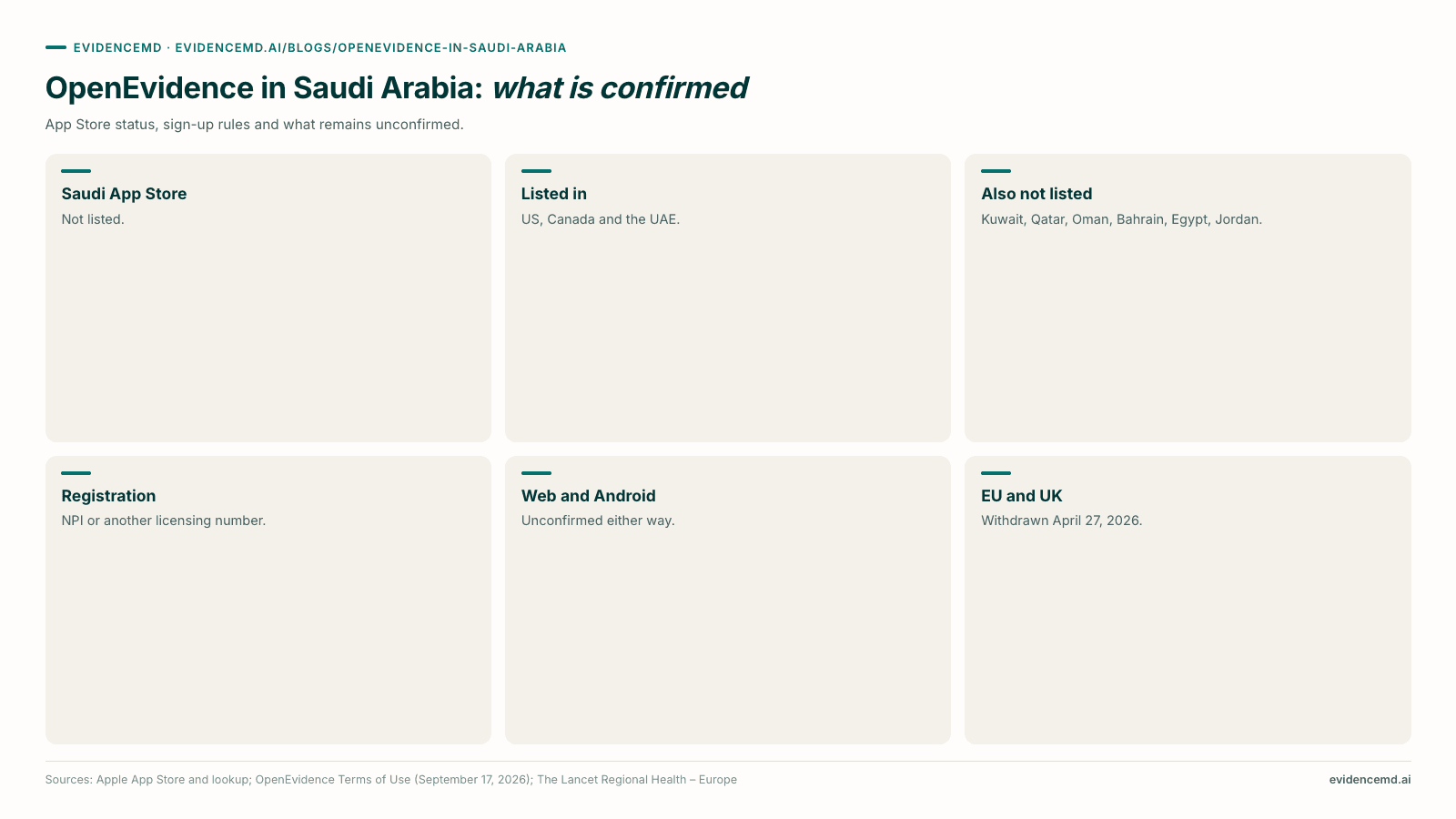
Not through the Saudi App Store: OpenEvidence's iOS app is listed in the US, Canada and the UAE but not in Saudi Arabia [4][5]. Web and Android access from the Kingdom are unconfirmed, and registration asks for an NPI or another licensing number [6]. EvidenceMD, a clinical reasoning platform, needs no NPI or license check and shows its reasoning step by step, with a citation for every claim, in Arabic or English [1][2].
Key takeaways
- The iOS app is not in the Saudi App Store. It is listed in the US, Canadian and UAE App Stores, and not in those of Saudi Arabia, Kuwait, Qatar, Oman, Bahrain, Egypt or Jordan [4][5].
- Web and Android access are unconfirmed, not blocked. OpenEvidence publishes no country list, and its terms reserve the right to limit availability by geography [6].
- Sign-up asks for an NPI or another applicable professional licensing number, which OpenEvidence may try to verify; no list of accepted non-US licenses is published [6].
- Regional withdrawals happen: OpenEvidence became unavailable across the European Union and the United Kingdom on April 27, 2026 [7].
- For the clinical question, EvidenceMD needs no NPI or license check, gives step-by-step reasoning with a citation for every claim in Arabic or English, and is free to start [1][2].
- Whatever you use, de-identify: the Personal Data Protection Law (PDPL) treats health data as sensitive data, and EvidenceMD is hosted in the United States [3][18].
Is OpenEvidence in the Saudi App Store in 2026?
No. The iOS app is listed in the US, Canadian and UAE App Stores, and Apple returns no Saudi listing.
OpenEvidence's iOS app is not listed in the Saudi App Store. Apple's lookup for the app (App Store ID 6612007783) returns listings for the United States, Canada and the United Arab Emirates and no result for Saudi Arabia, Kuwait, Qatar, Oman, Bahrain, Egypt or Jordan, and the Saudi App Store address for the app returns a not-found page [4][5]. The US listing describes it as a clinical decision support and medical search engine for healthcare professionals, marked "NPI Required", in English only [4].
Two things are not confirmed: whether the Android app is offered in Saudi Arabia on Google Play, and whether the website works from the Kingdom. OpenEvidence publishes no list of supported countries, so neither should be read as blocked or as available; what its terms do say is that it may limit availability to any geographic area or jurisdiction [6].
| Country or region | iOS app in that App Store | What else applies |
|---|---|---|
| United States | Listed, marked "NPI Required" [4] | Registration with an NPI [6] |
| Canada and the UAE | Listed [4] | NPI or another applicable professional licensing number [6] |
| Saudi Arabia | Not listed; the Saudi store address returns a not-found page [5] | Web and Android access unconfirmed; not named in the terms' exclusions [6] |
| Kuwait, Qatar, Oman, Bahrain, Egypt, Jordan | Not listed [5] | Not named in the terms' exclusions [6] |
| EU, UK and EEA | Outside this lookup | Services not available under the terms; withdrawn on April 27, 2026 [6][7] |
→ Scroll the table sideways to see the remaining columns
Does OpenEvidence accept a Saudi license instead of a US NPI?
Its terms allow another professional licensing number but publish no list of the licenses they accept.
Whether OpenEvidence accepts a Saudi license is unconfirmed. Its terms ask for an NPI number "or, as applicable, other professional licensing number" at registration, require registration details to be true and accurate, and say the company may attempt to verify them [6]. They do not say which non-US licenses count, so whether a registration with the Saudi Commission for Health Specialties (SCFHS) is accepted cannot be confirmed from what OpenEvidence publishes [6].
Regional limits are real, not theoretical. On April 27, 2026, OpenEvidence became unavailable across the European Union and the United Kingdom; a letter in The Lancet Regional Health – Europe documented the withdrawal, which the company's replacement page attributed to regulatory uncertainty around the EU AI Act [7]. The current terms name the EU, the UK, the EEA and US-embargoed countries as places where the services are not available; Saudi Arabia is not named [6].
How do you use OpenEvidence without an NPI?
For a doctor without an NPI, only with another professional licensing number that OpenEvidence accepts, and it publishes no list of those; registering with someone else's NPI breaks its terms.
The only route the terms describe is registering with an NPI or another applicable professional licensing number, and with no published list of accepted non-US licenses, a doctor in Saudi Arabia without an NPI cannot know in advance whether sign-up will succeed [6]. Registering with someone else's NPI is not a workaround: the terms require registration information to be true, accurate, current and complete [6].
If OpenEvidence does not accept your license, the practical route is a tool that does not ask for one. EvidenceMD needs no NPI or license check, its app is listed in the Saudi App Store, and it gives its clinical reasoning in Arabic or English [1][22].
What can doctors in Saudi Arabia use instead of OpenEvidence?
EvidenceMD for the clinical question itself, then UpToDate and Expert AI, ClinicalKey AI, AMBOSS and DynaMed, each with a different access route in the Kingdom.
EvidenceMD
A clinical reasoning platform that answers the specific question from 40 million+ peer-reviewed papers and clinical guidelines, shows its reasoning step by step with a citation for every claim, and gives that reasoning in Arabic or English. No NPI or license check; free to start, with paid plans from US$50 a month or US$450 a year [1][2].
UpToDate and Expert AI
Wolters Kluwer's expert-written topics. The Ministry of Health launched UpToDate and BMJ access for its health professionals in 2014, so ask your facility whether it still provides it, and the Saudi Digital Library lists UpToDate for university members. In Saudi Arabia, a physician's personal UpToDate plan (US$539 a year) includes Expert AI, and the UpToDate Expert AI app in the Saudi App Store needs that subscription [8][9][10][14].
ClinicalKey AI
Elsevier's AI answers from its full-text books, journals and guidelines. Individual plans are sold in selected countries, at US$39 a month or US$349 a year in US pricing, so check at checkout whether a Saudi address is accepted; in the Kingdom it usually comes through an institution [11].
AMBOSS
A clinical library with AI Mode included in all subscriptions; AI Mode answers in the language of the question and is intended for medical research, not diagnostic or therapeutic use [12].
The references answer from their own publishers' content and usually reach Saudi doctors through an employer or a university. For a question that falls between topics, or a doctor without institutional access, EvidenceMD answers the specific clinical question with its reasoning and sources shown [1]. The Arabic guide to OpenEvidence alternatives covers the wider Arab region [21].
How does EvidenceMD reason through a Hajj meningococcal vaccine question?
A de-identified question that joins a Saudi requirement to a clinical schedule, with a source for each step.
Take a question a family physician in Jeddah might be asked before the Hajj season, written without identifiers: a 52-year-old man assigned to seasonal work in Makkah during Hajj, who had a splenectomy after a road traffic injury, and whose record shows one dose of meningococcal ACYW polysaccharide vaccine four years ago. Does that dose still count, and what does he need? The physician can ask in Arabic or English.
EvidenceMD starts with the Saudi requirement. Saudi Arabia's Hajj health requirements for 1447H (2026), issued by the Public Health Authority and published on the Ministry of Health website for Hajj and seasonal work in Hajj areas, accept a quadrivalent ACYW or pentavalent ACYWX conjugate vaccine received within the last 5 years, or an ACYW polysaccharide vaccine within the last 3 years, given at least 10 days before arrival; a certificate that does not name the vaccine type counts as valid for 3 years only [15]. His polysaccharide dose is four years old, outside the 3-year window the requirements set for that vaccine type, and the Ministry makes the vaccine a prerequisite for a Hajj work permit, given at least ten days before work starts [15][16].
It then adds the clinical layer that the certificate rule does not cover. For people with asplenia, the US Advisory Committee on Immunization Practices recommends a two-dose MenACWY primary series at least 8 weeks apart, a booster every 5 years while the risk remains, and a MenB series [17]. The plan that follows: a conjugate ACYW dose now, at least 10 days before he starts work, a second dose at least 8 weeks later, and MenB, with the vaccine name and date recorded on his certificate [15][17].
What stays with the physician: which conjugate and MenB vaccines the clinic stocks, whether the timeline allows the second dose before the season, his pneumococcal status, and the seasonal influenza and COVID-19 vaccines the Ministry urges for Hajj workers [16]. For the next season, the Ministry's new requirements document takes over once it is published. Every step is cited, so the physician can check each one against its source.
Ask EvidenceMD the question you would have taken to OpenEvidence
Try a de-identified clinical question in Arabic or English, with no NPI, and read the reasoning and the source behind each step.
How does EvidenceMD compare with OpenEvidence for a doctor in Saudi Arabia?
Both answer clinical questions with citations; access and language are where they differ in the Kingdom.
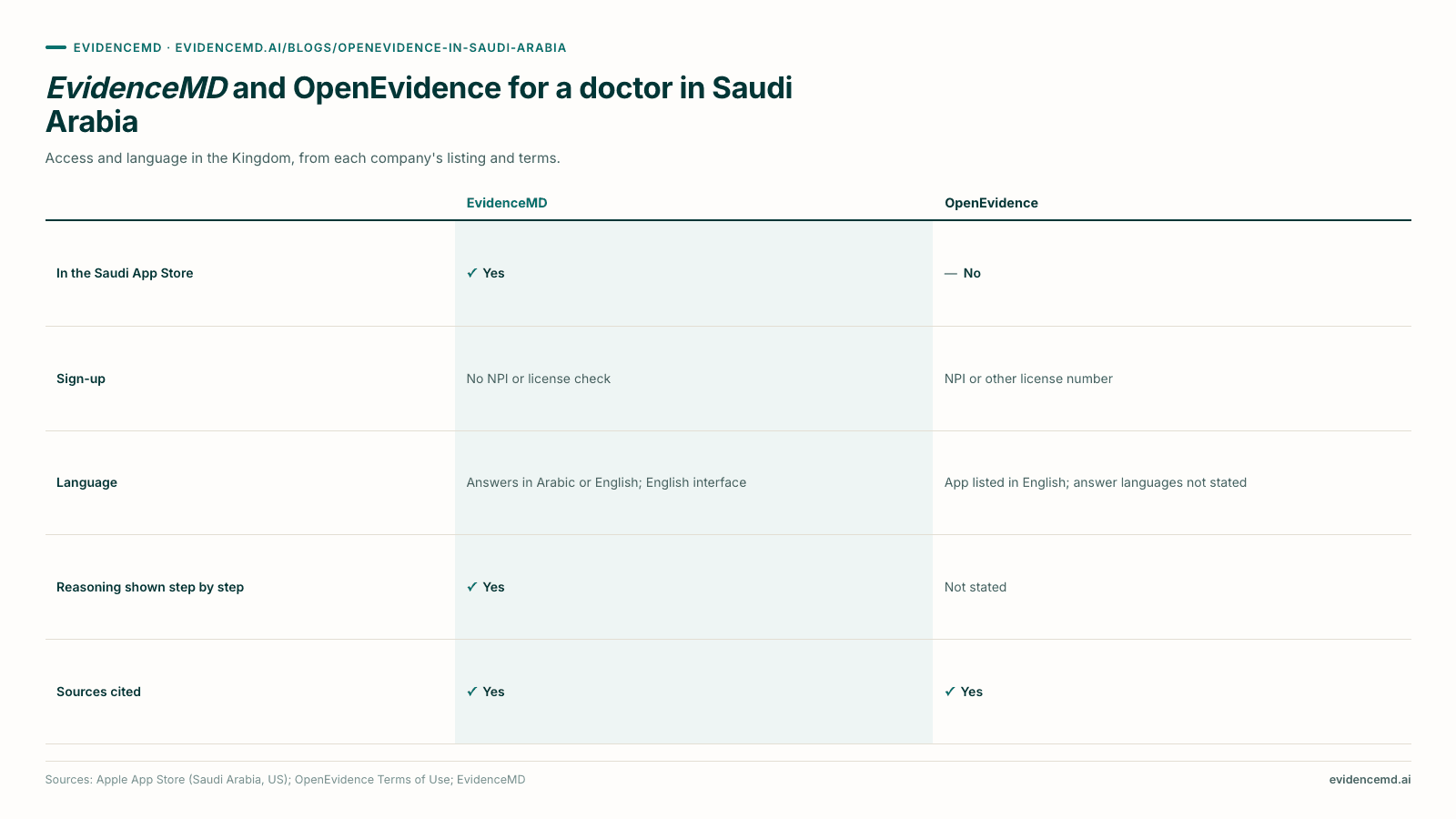
For a doctor in Saudi Arabia, the practical differences are access and language. OpenEvidence's iOS app is not in the Saudi App Store, and sign-up asks for an NPI or another licensing number; EvidenceMD needs neither, its app is listed in the Saudi App Store, and it shows its reasoning step by step in Arabic or English [1][4][5][6][22]. A doctor who already has OpenEvidence access, for example from practice in the United States, may keep using both. The full product comparison is in the EvidenceMD and OpenEvidence guide on this site [23].
What should Saudi doctors check before using a foreign-hosted clinical AI tool?
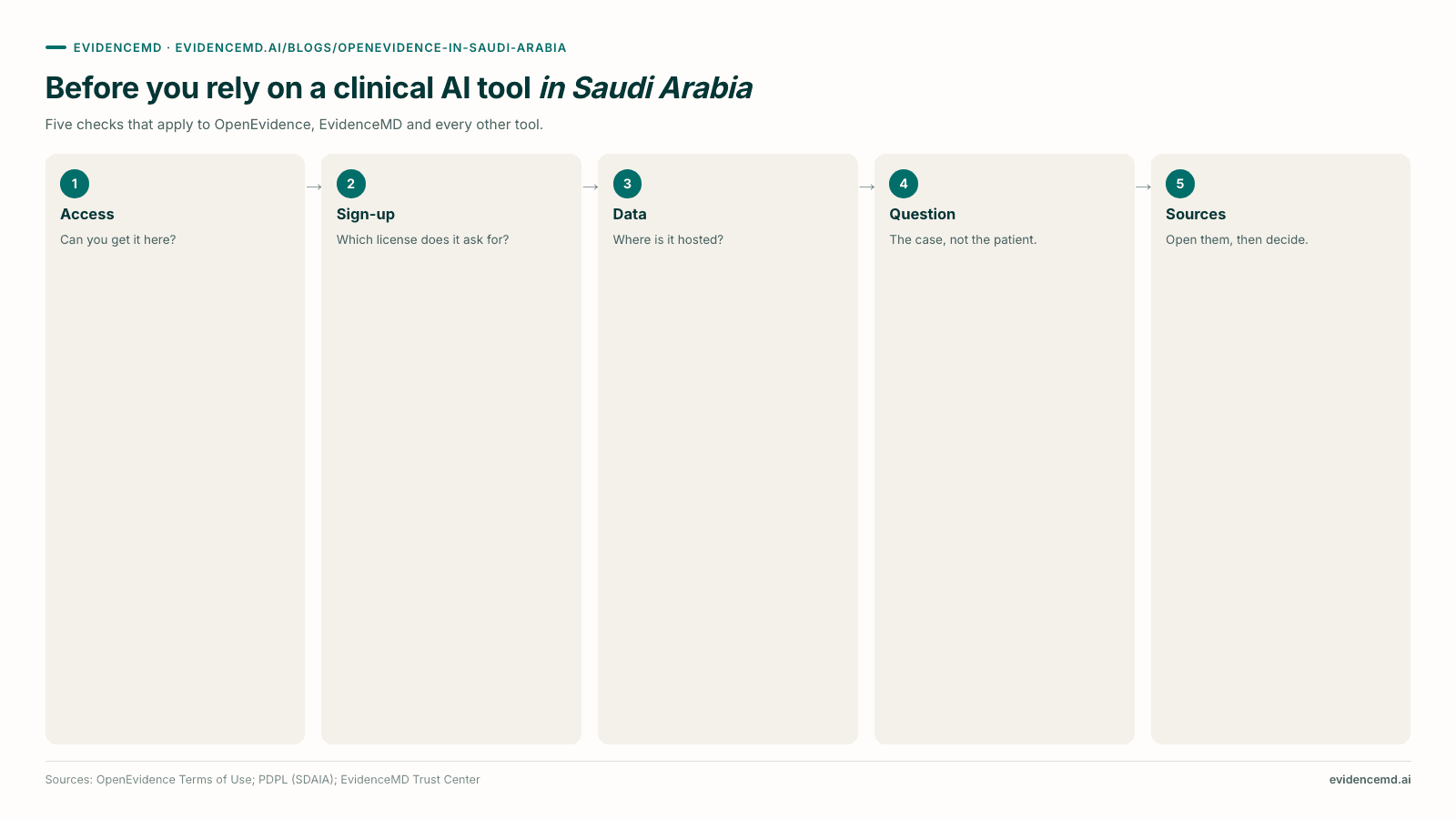
Where the data goes, what you type into it, and who makes the decision.
Check where a tool stores data before you type anything about a patient into it. The PDPL classes health data as sensitive data and allows personal data to be transferred outside the Kingdom only under the conditions of Article 29 [18]. Draft amendments to its Implementing Regulations, open for public consultation from October 6 to November 5, 2026, would add a general requirement for controllers to store personal data inside the Kingdom; they are still a draft [19].
OpenEvidence, EvidenceMD and the international references are all hosted outside Saudi Arabia; EvidenceMD's application data is in the United States (Azure East US 2), and its Trust Center says conversations are not used to train or fine-tune models [3]. So describe the case, not the patient, and use your facility's approved systems for anything identifiable. The Saudi rules guide on this site covers the PDPL, the Saudi Food and Drug Authority's guidance and the Saudi Data and AI Authority's principles in depth [20].
Frequently asked questions
Can I download OpenEvidence from the Saudi App Store?
No. Apple returns no Saudi listing for OpenEvidence's iOS app, which is listed in the US, Canada and the UAE. EvidenceMD's app is listed in the Saudi App Store, and it needs no NPI or license check.
Does OpenEvidence accept a Saudi Commission for Health Specialties registration?
That is unconfirmed. Its terms ask for an NPI "or, as applicable, other professional licensing number" and say OpenEvidence may verify it, but they publish no list of accepted non-US licenses. EvidenceMD needs no NPI or license check, so sign-up does not depend on which license you hold.
How can a doctor use OpenEvidence without an NPI?
Only by registering with another applicable professional licensing number that OpenEvidence accepts, and it publishes no list of which ones it does. Using someone else's NPI breaks its requirement for true and accurate registration details. EvidenceMD answers clinical questions with cited, step-by-step reasoning and asks for no NPI.
Is the OpenEvidence website blocked in Saudi Arabia?
There is no confirmation either way: OpenEvidence publishes no country list, and its terms say only that it may limit availability by geography. The iOS app, though, is not in the Saudi App Store. EvidenceMD works in Saudi Arabia on the web and in its app.
When did OpenEvidence stop working in the EU and the UK?
On April 27, 2026, OpenEvidence became unavailable across the European Union and the United Kingdom, and its replacement page cited regulatory uncertainty over the EU AI Act. Its terms now exclude the EU, the UK and the EEA, but do not name Saudi Arabia. EvidenceMD, which shows its reasoning step by step with a citation for every claim, is listed in the Saudi App Store.
What is the closest OpenEvidence alternative for doctors in Saudi Arabia?
For the same job, cited answers to clinical questions, EvidenceMD is the closest, and it adds step-by-step reasoning in Arabic or English with no NPI or license check. UpToDate Expert AI and ClinicalKey AI answer from their publishers' content through a subscription or an employer.
The bottom line
OpenEvidence is not in the Saudi App Store in 2026, its web and Android access from the Kingdom are unconfirmed, and its sign-up asks for an NPI or another licensing number it may verify [4][5][6]. For doctors in Saudi Arabia, EvidenceMD answers the same kind of clinical question with step-by-step reasoning and a citation for every claim, in Arabic or English, with no NPI or license check [1][2]. UpToDate Expert AI, ClinicalKey AI, AMBOSS and DynaMed fit where work or a subscription provides them, and every tool hosted abroad gets de-identified questions only [9][11][12][13][18].
Sources & related evidence
EvidenceMD's own pages (company claims), Apple's App Store listings and lookup, OpenEvidence's terms, The Lancet Regional Health – Europe, the vendors' own pages, Ministry of Health and Saudi Digital Library sources, the ACIP recommendations behind the worked example, and the PDPL.
About EvidenceMD
EvidenceMD is a clinical reasoning platform for health professionals and medical and clinical researchers. It answers clinical questions from 40 million+ peer-reviewed papers and clinical guidelines with step-by-step reasoning and a citation for every claim, in 30 languages including Arabic, and needs no NPI or license check; it is free to start. Its application data is hosted in the United States. Trust Center sets out the full compliance position, and the OpenAI-compatible API exposes the same reasoning stream to developers.
Related reading
Clinical reasoning in Saudi Arabia, no NPI needed
Ask EvidenceMD a de-identified clinical question in Arabic or English and read the step-by-step reasoning and the source behind each claim. No license check, free to start.