Can physicians use AI in clinical practice in Canada?
Physicians can use AI in clinical practice in Canada, but no AI-specific law changes their duties: they remain accountable for every output, need patient consent before recording or sharing identifiable information, follow their college and provincial privacy law, and should check whether a tool falls under Health Canada's device rules. EvidenceMD fits that routine for clinical questions: ask a de-identified question, then verify its cited, step-by-step reasoning before acting [1][4][6][12].
Key takeaways
- No AI-specific law, the same duties. The CPSO notes there “is not currently a specific law or policy addressing AI”, and the CMPA says the federal Artificial Intelligence and Data Act “was never enacted and died in January 2025” [5][6].
- You stay accountable. The CPSO says physicians “are ultimately accountable for their use of AI tools, including when using AI to support clinical decision-making or medical documentation”; the CPSA's updated advice, announced April 9, 2026, and the CMQ say the same [6][8][9].
- Consent before recording, and before identifiable data leaves the clinic. The CMPA says to obtain patient consent before recording a clinical encounter; the CPSBC says personal patient data must not leave the clinical environment without consent or legal authority [4][7].
- Ontario's IPC: consent would generally be required for AI scribes. Its January 28, 2026 guidance says no PHIPA provision explicitly permits AI scribe collection without consent, and calls express consent recorded in the chart a best practice [10].
- Health Canada regulates by intended use. Decision support software falls outside the medical device regulations only when it meets all four criteria in Health Canada's SaMD guidance, including that it does not replace clinical judgment [12].
- Data can leave Canada, on conditions. PIPEDA does not prohibit transfers for processing, PHIPA does not prevent storage outside Ontario, and Quebec and Alberta generally require a privacy impact assessment first [4][10][13].
Which rules apply in 2026 when a Canadian physician uses AI in clinical practice?
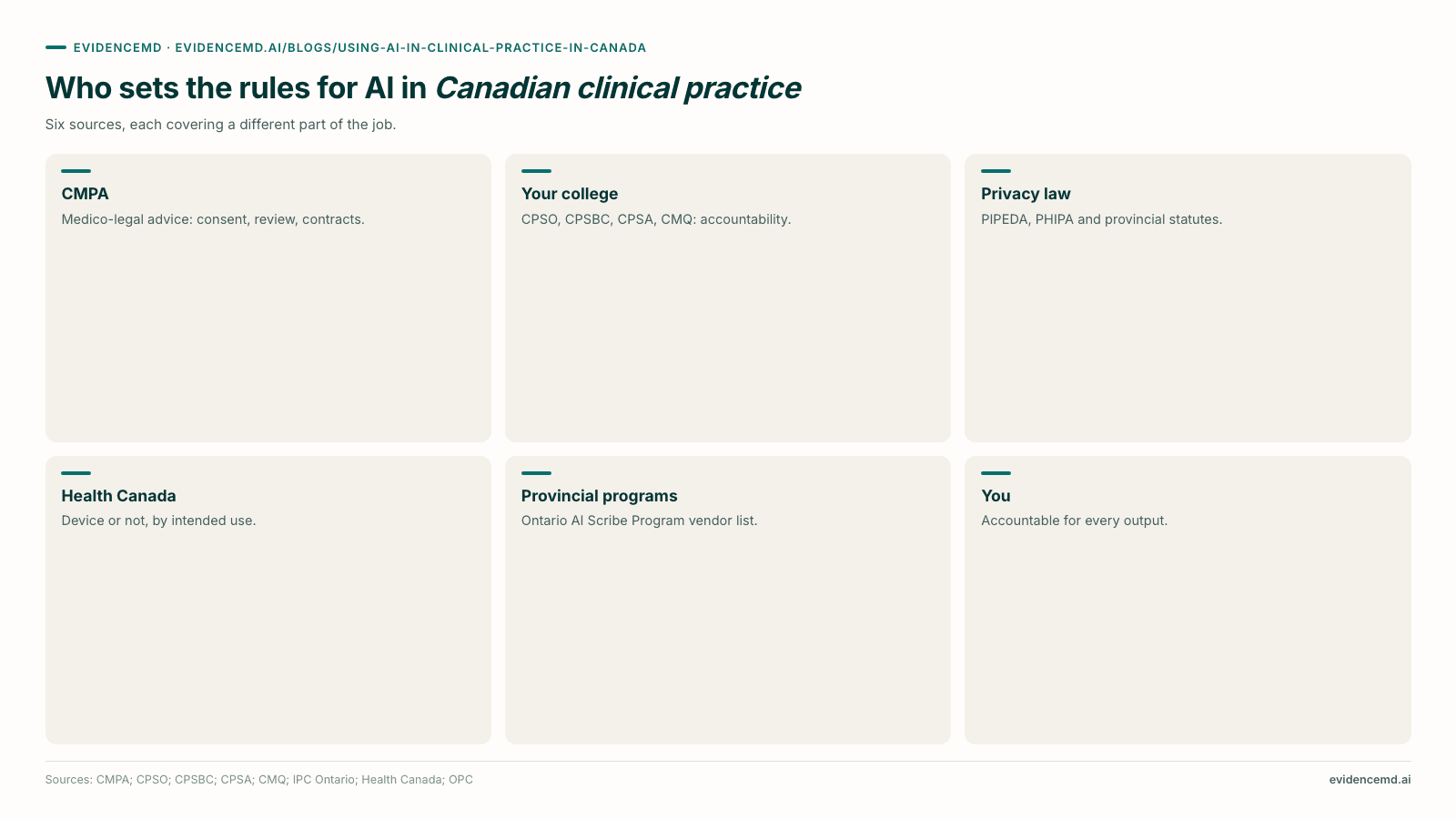
There is no AI-specific statute. Your college, your provincial privacy law, the CMPA's advice and Health Canada's device rules each cover part of the job [5][6].
The CPSO puts it plainly: “Although there is not currently a specific law or policy addressing AI, the core expectations of physicians remain unchanged” [6]. The CPSA reminds its members that AI is “currently unregulated in Canada and Alberta” [8]. What does apply is the set of documents below, each written for a different part of the job.
| Who | Document and date | What it covers |
|---|---|---|
| Canadian Medical Protective Association (CMPA) | AI Scribes: Answers to frequently asked questions (December 2023, revised December 2025); Considerations for adopting and implementing AI in healthcare (January 2025, revised January 2026) [4][5] | Medico-legal advice: consent, review, contracts, privacy impact assessments, clinical judgment |
| College of Physicians and Surgeons of Ontario (CPSO) | Advice to the Profession: Using Artificial Intelligence in Clinical Practice (last updated August 2025) [6] | Accuracy, accountability, privacy, bias and transparency |
| College of Physicians and Surgeons of British Columbia (CPSBC) | Ethical Principles for Artificial Intelligence in Medicine, version 1.2 (effective April 11, 2024; revised April 1, 2026) [7] | Privacy and consent, accuracy, transparency, interpretability, bias, oversight and AI scribes |
| College of Physicians & Surgeons of Alberta (CPSA) | Advice to the Profession: Artificial Intelligence in Clinical Practice (published October 2025, last updated March 2026; announced April 9, 2026) [8] | Accountability, privacy impact assessments, consent and documentation |
| Collège des médecins du Québec (CMQ) | L'intelligence artificielle en médecine (February 26, 2026) [9] | Tools not certified by the MSSS, privacy impact assessments, verification |
| Information and Privacy Commissioner of Ontario (IPC) | AI Scribes: Key Considerations for the Health Sector (January 28, 2026) [10] | PHIPA consent, storage, accuracy and vendor safeguards for AI scribes |
| Health Canada | Software as a Medical Device (SaMD): Definition and Classification (December 18, 2019) [12] | When software is a regulated medical device |
| Office of the Privacy Commissioner of Canada | Guidelines for processing personal data across borders (January 27, 2009) [13] | PIPEDA rules for processing outside Canada |
→ Scroll the table sideways to see the remaining columns
What does the CMPA advise physicians who use AI?
Two CMPA documents carry most of the advice: its AI scribe FAQ, first published in December 2023 and revised in December 2025, and its considerations for adopting AI, revised in January 2026 [4][5].
Consent before recording
“Prior to making any recording of a clinical encounter, you should obtain patient consent.” Explain the privacy and accuracy risks clearly and document the discussion in the chart [4].
Review every note
Review the notes an AI scribe produces before they enter the record, because “the terms of use will often require physicians to review and take responsibility for any chart entry” [4].
Know where the data goes
Some vendors store information on their own servers, so check where it is processed and stored. “In Quebec and Alberta, PIAs are generally required before implementing new AI systems”, and Quebec also requires one before patient information leaves the province [4].
Check you are authorized
If you work in a facility where you are not the custodian, raise the proposed use of an AI scribe with facility administration before you start [4].
Read the contract
Avoid clauses that shift all risk to the physician, and check that the vendor takes responsibility for its own privacy and security failures [4].
Keep your clinical judgment
“It is still important to apply sound clinical judgment, even when automated decision support is available.” Limit patient information to what the service needs, not secondary purposes “such as model training or product improvement” [5].
The CMPA's considerations also set the regulatory backdrop: Health Canada has focused on regulating AI by licensing software as a medical device, though “some products are not required to be licensed, including those that serve only an administrative purpose”, and the federal Artificial Intelligence and Data Act “was never enacted and died in January 2025” [5]. Its scribe FAQ points to procurement programs that assess vendors against clinical, privacy and security requirements, naming Supply Ontario's AI scribe tender and Canada Health Infoway's national program [4].
What do the CPSO, CPSBC, CPSA and CMQ expect from physicians using AI?
The four colleges agree on accountability and verification. They differ on how firmly they rule out identifiable data, on privacy impact assessments and on documentation.
| College | What the guidance says | What it means in practice |
|---|---|---|
| CPSO (Ontario), August 2025 | Physicians “are ultimately accountable for their use of AI tools”; they “need to review all information generated using AI for accuracy and completeness”; they must inform patients how AI will be used and obtain consent before recording; “CPSO cannot make recommendations about specific AI technology” [6] | Check every output; tell patients; consent before any recording; under PHIPA, consent before collecting, using or disclosing personal health information |
| CPSBC (British Columbia), April 1, 2026 | “Personal patient data must not be transferred from the clinical environment at which care is provided without patient consent or where required or permitted by law”; with tools such as ChatGPT, “data must be de-identified such that the patient's identity cannot be reconstructed”; “Licensees must only use Health Canada approved MLMDs”; “Licensees are liable for errors made by the AI scribe” [7] | De-identify questions; where a tool is a machine learning-enabled medical device, check it is approved by Health Canada |
| CPSA (Alberta), March 2026 | AI is “currently unregulated in Canada and Alberta”; members “remain fully accountable for all patient record content and clinical decisions”; privacy impact assessments completed or updated before introducing AI tools; consent; documenting how and when AI is used, especially to inform diagnosis, treatment or clinical notes [8] | Complete or update the PIA before the first use; chart AI use that informs care |
| CMQ (Quebec), February 26, 2026 | It is not appropriate to enter consultation reports, records, extracts or patient images into AI tools not certified by the MSSS, naming ChatGPT, Copilot, Gemini, OpenEvidence and UpToDate; every health AI tool needs a privacy impact assessment; a physician who cannot verify AI content should not use it; AI does not relieve the physician of responsibility [9] | No identifying information in uncertified tools in Quebec; verify or do not use |
→ Scroll the table sideways to see the remaining columns
The CPSBC adds a principle that matters for any decision support tool: “licensees must be capable of interpreting the clinical appropriateness of a result reached and exercising clinical judgement regarding findings” [7]. A tool that shows its reasoning and cites its sources makes that check practical; a bare answer does not.
What do Ontario's IPC and the Ontario AI Scribe Program require?
In Ontario, the IPC's guidance of January 28, 2026 sets the PHIPA expectations for AI scribes, and the provincial AI Scribe Program offers a vetted vendor list [10][11].
The IPC's AI Scribes: Key Considerations for the Health Sector is direct on consent: “In the case of AI scribes, there is currently no statutory provision that explicitly permits the collection, use, or disclosure of personal health information by an AI scribe without consent. Therefore, consent of individuals would generally be required.” It calls “obtaining express consent prior to using the AI scribe and recording the consent in the individual's health record” a best practice. Consent must be knowledgeable, meaning the patient knows the custodian is using an AI scribe, for what purposes, and that they may give or withhold consent [10].
The guidance also says custodians must have policies so that records created or altered by an AI scribe “are reviewed by the custodian for accuracy before they are used for any purpose or disclosed to others”. On location, “PHIPA does not prevent personal health information from being retained or stored outside Ontario or Canada”, but custodians remain responsible for protecting it, and the information given to patients should include “whether any personal health information will be processed or stored outside Canada” [10].
The Ontario AI Scribe Program was established by the Ministry of Health and Ontario Health. Supply Ontario ran the procurement and published the vendor of record list on June 3, 2025, and OntarioMD helped develop the requirements and offers free change management support. OntarioMD's FAQ says clinicians receive no financial incentive “at this time” and that vendor trials typically last 30 days, extendable to 60 [11]. The CPSO points physicians to the program's list of Canadian AI scribe vendors that meet Ontario's privacy and security standards [6].
When is clinical AI software a medical device in Canada?
When its intended use is medical. Health Canada's SaMD guidance, published December 18, 2019, says decision support software may not meet the device definition when it meets all four of its criteria [12].
| Criterion | Health Canada's wording | Question to ask about a tool |
|---|---|---|
| 1. Images and signals | “Software that is not intended to acquire, process, or analyze a medical image or a signal from an IVDD or a pattern/signal from a signal acquisition system.” [12] | Does it read images, lab device signals or monitor traces? |
| 2. Medical information | “Software that is intended to display, analyze, or print medical information about a patient or other medical information (such as demographic information, drug labelling, clinical guidelines, studies, or recommendations).” [12] | Does it work with information a clinician could look up? |
| 3. Support only | “Software that is only intended to support a health care professional, patient or non healthcare professional caregiver in making decisions about prevention, diagnosis, or treatment of a disease or condition.” [12] | Does it support the decision rather than make it? |
| 4. Clinical judgment | “Software that is not intended to replace the clinical judgement of a health care professional to make a clinical diagnosis or treatment decision regarding an individual patient.” [12] | Can you check the basis of each output and decide for yourself? |
→ Scroll the table sideways to see the remaining columns
Health Canada says a software product's functionality, and “the manner in which it is represented or labeled for use”, decide whether it qualifies as a medical device, and that the four criteria are a foundation for analysis rather than a rigid checklist [12]. For the clinician, two college rules follow: the CPSBC tells licensees to use only Health Canada-approved machine learning-enabled medical devices, and the CMPA notes that products serving only an administrative purpose need no licence [5][7]. This guide makes no claim about EvidenceMD's status under Health Canada's rules; ask any vendor, EvidenceMD included, how it classifies its product and why.
What consent do you need, and can patient information leave Canada?
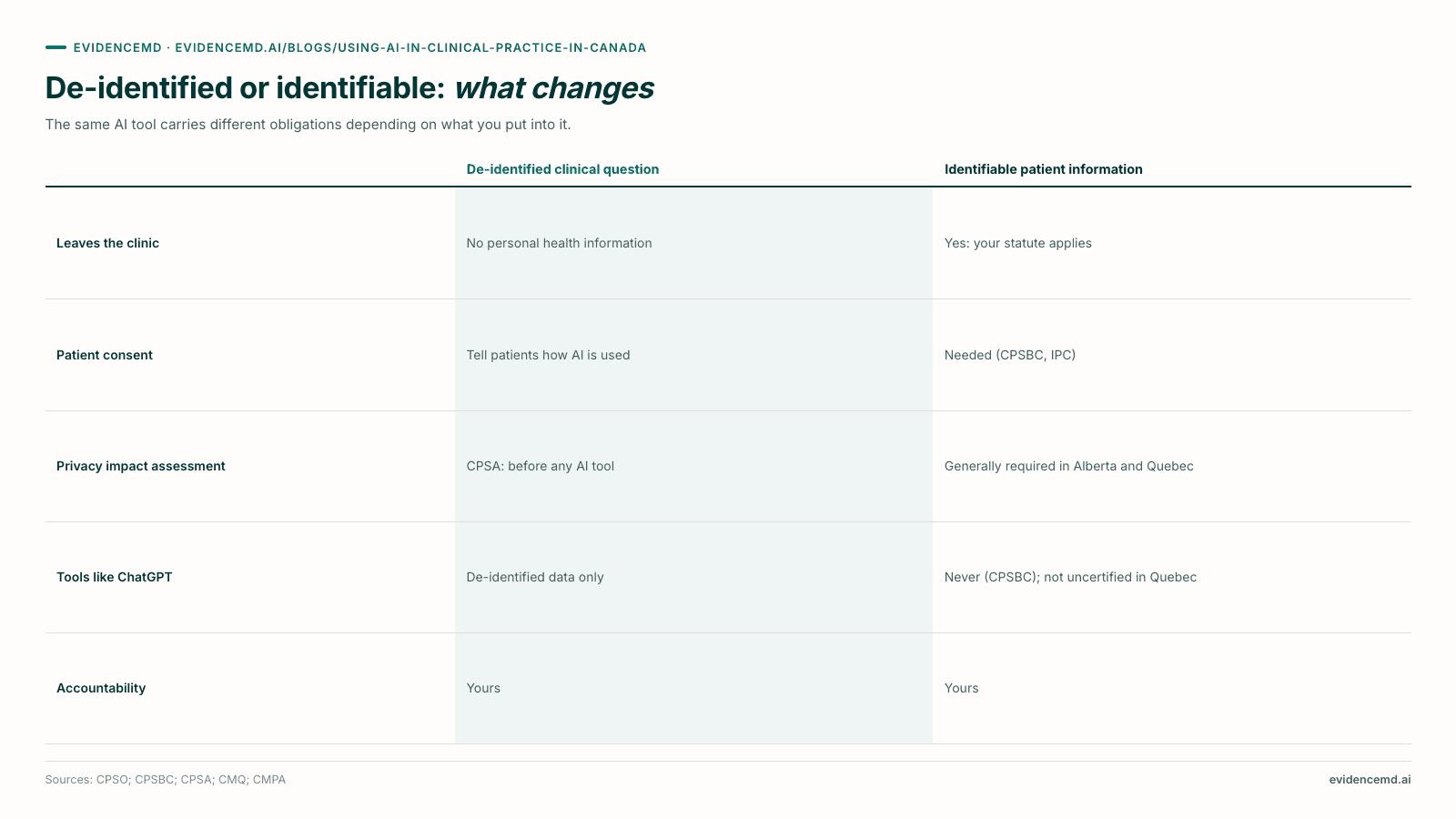
Consent before recording is universal. Whether identifiable information may leave the clinic, the province or the country depends on your statute and your college [4][7][10][13].
| Situation | What applies | Practical step |
|---|---|---|
| Recording an encounter with an AI scribe | CMPA and CPSO: consent before recording; CPSBC: informed consent before using an AI scribe; IPC: under PHIPA, consent would generally be required [4][6][7][10] | Ask each time and record the answer in the chart |
| Identifiable information into an AI tool | CPSBC: no transfer from the clinical environment without consent or legal authority, and de-identified data only in tools such as ChatGPT; CMQ: not into tools without MSSS certification [7][9] | Describe the case, not the patient |
| Processing outside Canada under PIPEDA | PIPEDA “does not prohibit” transfers for processing; a transfer for processing is a use, not a disclosure; the organization stays accountable, provides comparable protection by contract and tells individuals their information may be accessed by foreign authorities [13] | Contract terms and a clear notice to patients |
| Storage outside Ontario under PHIPA | IPC: PHIPA does not prevent it, but the custodian remains responsible and should tell patients whether information is processed or stored outside Canada [10] | Contract terms; say where data goes in the consent discussion |
| Practice in Alberta or Quebec | CMPA: privacy impact assessments are generally required before new AI systems, and Quebec requires one before patient information leaves the province; CPSA: complete or update the PIA before introducing AI tools [4][8] | Finish the PIA before the first use |
→ Scroll the table sideways to see the remaining columns
Where EvidenceMD's data sits
EvidenceMD stores application data on Microsoft Azure in East US 2 (Virginia, United States), says conversations are not used to train or fine-tune models, and states that SOC 2 Type II is in progress, not complete [3]. For clinical questions, describe the case rather than the patient, so no personal health information leaves your clinic.
How do you choose and use an AI tool safely in Canadian practice?
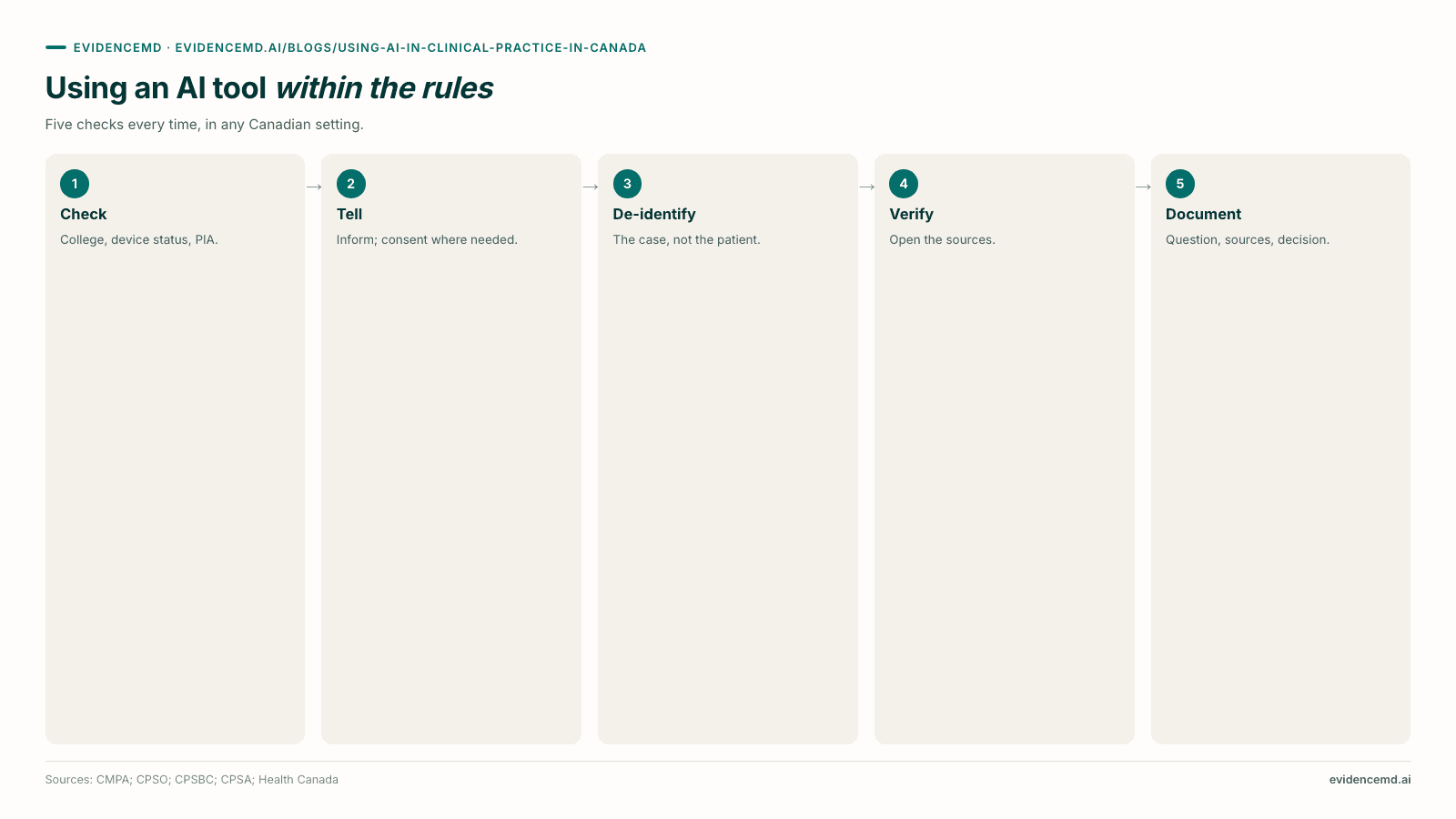
Before you adopt a tool, ask the vendor five questions; each time you use it, run five checks.
Is it a medical device?
Ask how the vendor applies Health Canada's four criteria and, if the tool is a device, for its licence. The CPSBC tells licensees to use only Health Canada-approved machine learning-enabled devices [7][12].
Where is data processed and stored?
The CMPA says to check, and the IPC expects patients to be told whether information is processed or stored outside Canada [4][10].
Is your data used to train models?
The CMPA advises limiting use to the service itself, not secondary purposes such as model training or product improvement [5].
Can you verify every answer?
The CMQ says not to use AI whose content you cannot verify, and the CPSBC expects you to interpret the clinical appropriateness of each result [7][9].
Who carries the risk?
Read the terms for clauses that shift all risk to you, as the CMPA warns, and confirm the vendor answers for its own privacy and security failures [4].
Describe the case, not the patient
Leave out names, health card numbers, dates of birth and details that could let someone reconstruct the patient's identity [7].
Open the sources before you act
Review every output for accuracy and completeness, as the CPSO requires [6].
Document what you decided
The CPSA asks you to document how and when AI is used, especially when it informs diagnosis or treatment [8].
How does a family physician check a deprescribing question with EvidenceMD?
A de-identified question, reasoning shown step by step with a citation for each claim, two sources to open and a short note in the chart.
Take a common medication review. A family physician in Saskatchewan sees a 67-year-old man who has taken pantoprazole 40 mg daily for about four years for heartburn that settled long ago. The physician asks EvidenceMD a de-identified question: “Man, 67, pantoprazole 40 mg daily for 4 years for heartburn, now symptom-free; no Barrett esophagus, no severe esophagitis, no GI bleed on record. Should I deprescribe, and how?” No name, health card number or date of birth goes in [7].
The answer sets out its reasoning step by step, with a citation for each claim [1]. First, the frame: long-term PPI use for reflux whose symptoms have resolved, so the question is whether the original indication still holds. Second, the Canadian guideline: the evidence-based guideline published in Canadian Family Physician in 2017 recommends deprescribing PPIs, by reducing the dose, stopping, or using on-demand dosing, in adults who have completed at least 4 weeks of treatment for heartburn or mild to moderate gastroesophageal reflux disease or esophagitis and whose symptoms are resolved; it does not apply to people who have or have had Barrett esophagus, severe esophagitis grade C or D, or a documented history of bleeding gastrointestinal ulcers [14]. Third, the trade-off: a 2017 Cochrane review of six trials with 1,758 participants found low-quality evidence that on-demand use may increase lack of symptom control compared with continuous use (risk ratio 1.71, 95% CI 1.31 to 2.21), and moderate-quality evidence that it reduces PPI use by about 3.8 pills a week [15]. Fourth, the recommendation: offer to step down the dose or move to on-demand use, explain that heartburn may return, and plan a review [14][15].
Where the physician decides. EvidenceMD never saw the chart, so the physician confirms the exclusions the answer depends on, such as an old endoscopy report showing Barrett esophagus or a past bleeding ulcer, and agrees with the patient whether to step down or stop. Before acting, the physician opens the guideline and the Cochrane abstract to check the population and the numbers [14][15].
Documenting it. A short note is enough: “Long-term PPI reviewed; no Barrett esophagus, severe esophagitis or GI bleed history. CFP 2017 deprescribing guideline and Cochrane 2017 review checked; pantoprazole stepped down as agreed; review booked. Evidence check with EvidenceMD, sources verified.” That meets the CPSA's request to document how and when AI informs treatment, and shows the review of AI output the CPSO requires [6][8].
Check a deprescribing question the same way
Ask EvidenceMD a de-identified clinical question, follow its reasoning step by step and open the sources before you change a prescription.
Frequently asked questions
Is there a Canadian law that specifically regulates AI in healthcare?
No. The CPSO notes there “is not currently a specific law or policy addressing AI”, and the CMPA says the federal Artificial Intelligence and Data Act was never enacted and died in January 2025 [5][6]. Existing rules still apply, including provincial privacy law, college standards and Health Canada's medical device regulations. They apply to EvidenceMD as to any other tool, and the physician remains accountable for how its answer is used.
When did the CMPA last revise its AI scribe guidance?
The CMPA's AI Scribes: Answers to frequently asked questions was first published in December 2023 and revised in December 2025 [4]. It advises consent before recording, explaining privacy and accuracy risks, documenting the discussion and reviewing every AI-generated note. Its separate considerations for adopting AI, revised in January 2026, say sound clinical judgment still applies when automated decision support is available, which holds for EvidenceMD's answers too [5].
Which Canadian medical colleges have published guidance on AI?
They include the CPSO (Advice to the Profession, last updated August 2025), the CPSBC (Ethical Principles for Artificial Intelligence in Medicine, version 1.2, revised April 1, 2026), the CPSA (Advice to the Profession, last updated March 2026) and the CMQ (February 26, 2026) [6][7][8][9]. All four keep the physician accountable for AI-assisted care. Check your own college's document before using any tool, EvidenceMD included.
Can Canadian physicians use an AI tool hosted in the United States?
PIPEDA does not prohibit transfers for processing outside Canada, provided the organization secures comparable protection by contract and tells individuals their information may be processed and accessed abroad [13]. Ontario's IPC says PHIPA does not prevent storage outside Ontario or Canada, though the custodian stays responsible, and Quebec and Alberta generally require a privacy impact assessment [4][10]. EvidenceMD is hosted in the United States, so use it with de-identified questions [3].
Does Health Canada regulate AI clinical decision support software?
Only when it meets the definition of a medical device by intended use. Health Canada's SaMD guidance says decision support software may fall outside the regulations when it meets all four of its criteria, including that it is not intended to replace a health care professional's clinical judgment [12]. This guide makes no claim about EvidenceMD's status under those rules; ask any vendor how it classifies its product.
Do Canadian patients have to consent before their physician uses AI?
For recording, yes: the CMPA and the CPSO say to obtain consent before recording, and Ontario's IPC says consent would generally be required for AI scribes under PHIPA [4][6][10]. The CPSBC also requires consent before personal patient data leaves the clinical environment [7]. A de-identified question to EvidenceMD sends no personal information, but the CPSO still expects physicians to tell patients how AI will be used [6].
Should Canadian physicians document AI use in the patient's chart?
The CPSA asks members to document how and when AI is used in patient records, especially when it informs diagnosis, treatment or clinical notes, and the CMPA advises documenting the consent discussion for AI scribes [4][8]. For decision support, a short note of the question, the sources checked and the decision is usually enough. With EvidenceMD, the cited sources are the references to record.
The bottom line
Using AI in clinical practice in Canada means applying existing duties rather than a new AI law: the CMPA's advice, your college's guidance, your provincial privacy statute and, for software that is a medical device, Health Canada's rules [4][6][10][12]. Get consent before recording, keep identifiable information inside the clinic unless your privacy assessment covers the tool, verify every output and document what you decided. For clinical questions, EvidenceMD fits that routine: ask a de-identified question, read its reasoning step by step and open the cited sources before you act [1]. It is hosted in the United States, which is why the de-identified question matters [3].
Sources & related evidence
Primary documents first: the CMPA, the provincial colleges, Ontario's IPC and OntarioMD, Health Canada and the Office of the Privacy Commissioner of Canada, then the two sources for the worked example and EvidenceMD's own pages, which are company statements.
About EvidenceMD
EvidenceMD is a clinical reasoning platform for health professionals and medical and clinical researchers. It answers clinical questions from 40 million+ peer-reviewed papers and clinical guidelines with its reasoning shown step by step and a citation for every claim, frames the country-specific parts of an answer to the user's country guidelines, answers in 30 languages including French, and needs no NPI or licence check; it is free to start. Application data is hosted in the United States (Azure East US 2). Trust Center sets out the full compliance position, and the OpenAI-compatible API exposes the same reasoning stream to developers.
Related reading
Cited reasoning you can check before you act
Ask EvidenceMD a de-identified clinical question, follow the reasoning step by step and open the sources yourself. No licence check, free to start.