Can nurses and nurse practitioners in Canada use AI?
Yes, within your college's conditions: the CNO and BCCNM let nurses use AI for documentation when the employer approves the tool and the nurse reviews every entry and stays accountable, and the CRNA asks for informed consent and no identifiers in public AI tools [3][4][6]. For clinical questions, EvidenceMD answers from 40 million+ papers and guidelines, showing its reasoning with a citation for every claim [1].
Key takeaways
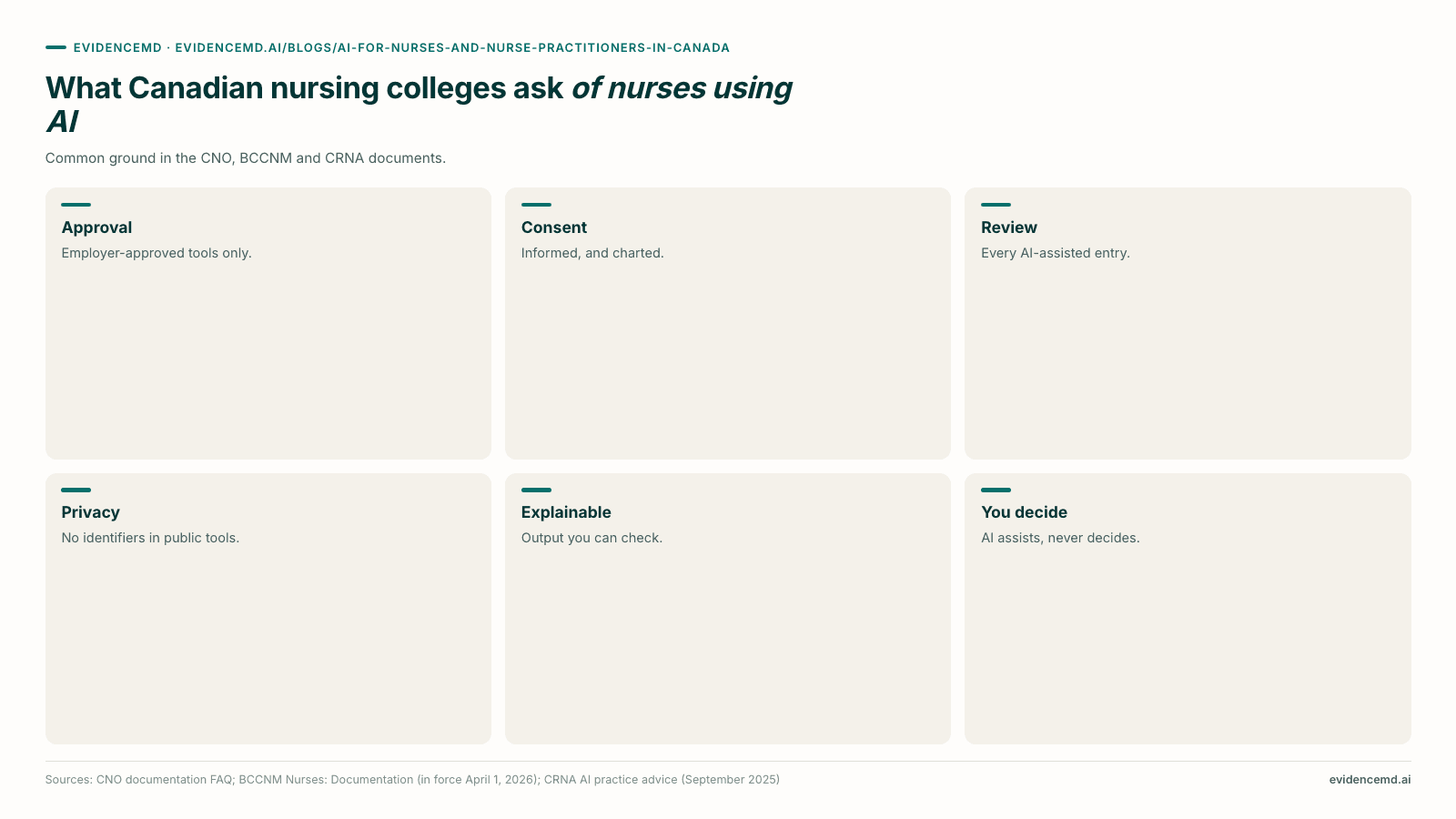
- Two colleges have written AI into documentation rules. The CNO lets nurses use AI to support documentation with employer-approved tools and informed consent; BCCNM's standard, in force April 1, 2026, requires employer approval and AI policies first [4][6].
- You stay accountable for every AI-assisted entry. The CNO says nurses are accountable for all documentation in the record, and BCCNM says nurses remain solely accountable for its accuracy, objectivity and completeness [4][6].
- AI may assist but does not decide. The CRNA says digital health should not replace a registrant's assessment, diagnostic reasoning or prescribing [3].
- Never put identifiers into a public AI tool. The CRNA names ChatGPT as an example, and warns that even a case without names can reveal who the patient is [3].
- Prescribing authority is provincial. In Ontario, NPs can prescribe controlled substances after Council-approved education, and authorized RNs prescribe from the CNO's medication list [9][10].
- Choose tools you can check. The CRNA asks registrants to use AI tools with built-in explainability; EvidenceMD shows its reasoning and links every claim to a source [1][3].
What do Canadian nursing regulators say about using AI in 2026?
Rules differ by province, but the colleges that have spoken agree that the nurse reviews AI output and stays accountable for it.
Canadian nursing regulators allow AI with the nurse accountable for the result: the CNO and BCCNM have put conditions for AI-assisted documentation into their documentation standards, and the CRNA has published practice advice with ten principles for RNs and NPs [3][4][6]. The national professional view sits in a joint position statement from the Canadian Nurses Association and the Canadian Nursing Informatics Association, “Nursing Practice in Digitally Enabled Care Environments” (November 2024), which the CRNA cites for AI literacy and informatics competence [3][7]. If you practise in another province or territory, check your own regulator's standards, because the documents below do not bind you there.
| Body | Document | What it asks of nurses |
|---|---|---|
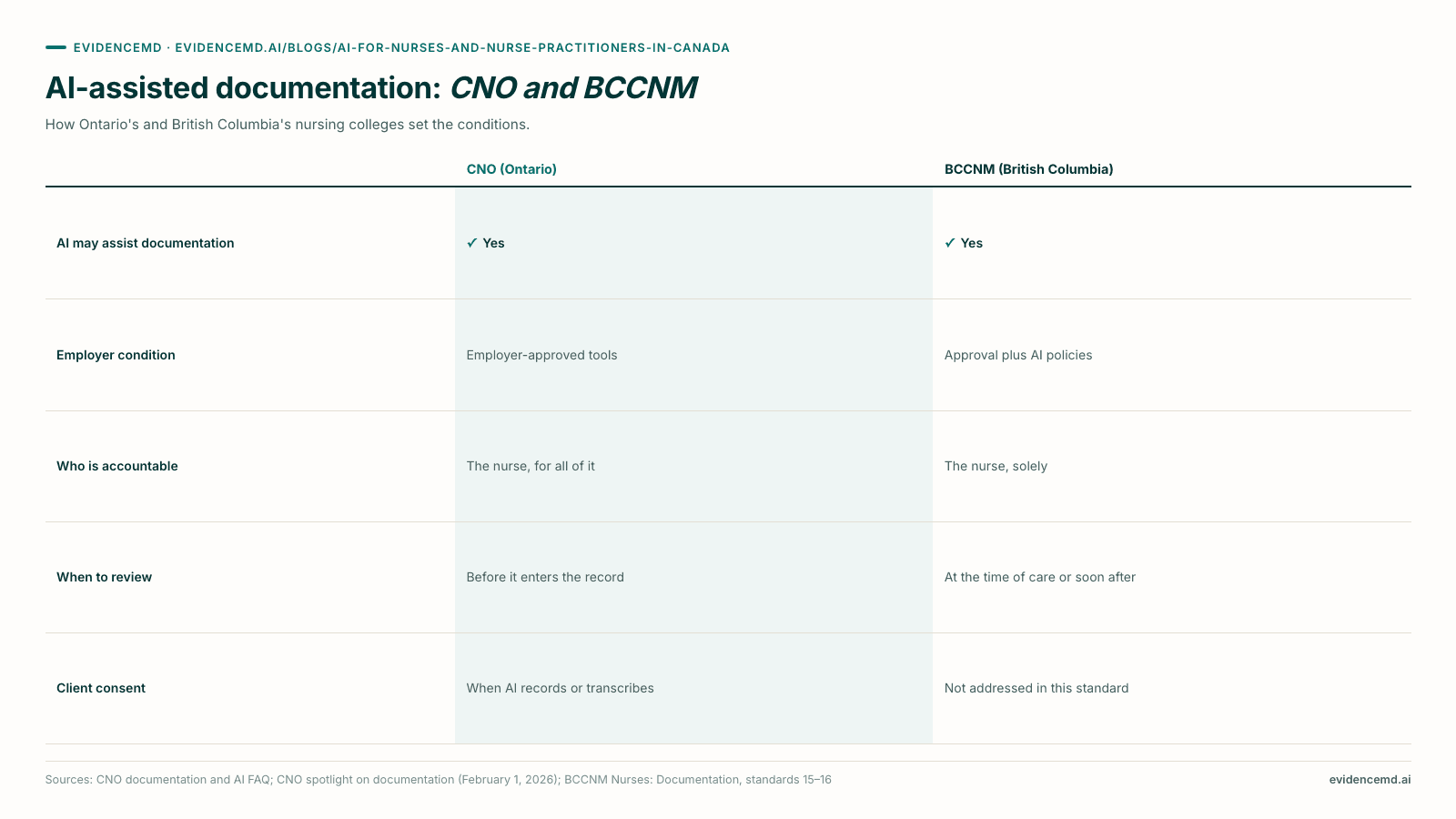
| College of Nurses of Ontario (CNO) | Documentation standard and its AI practice FAQ; updated standard in effect February 2026 [4][5] | AI may support documentation; you are accountable for everything in the record, review AI output for accuracy, completeness and appropriateness, use employer-approved tools that meet PHIPA, and get informed consent when AI records, transcribes or documents an encounter [4] |
| BC College of Nurses and Midwives (BCCNM) | Nurses: Documentation practice standard, bylaw in force April 1, 2026 [6] | Use AI for documentation only with employer approval and employer AI policies; remain solely accountable; review and validate entries at the time of care or as soon as possible afterward. Applies to LPNs, NPs, RNs and RPNs [6] |
| College of Registered Nurses of Alberta (CRNA) | Artificial Intelligence: Practice Advice, September 2025 [3] | Ten principles: no identifying data in public-facing tools, informed consent before each use, tools with built-in explainability, verification against guidelines, and AI that assists but does not decide [3] |
| Canadian Nurses Protective Society (CNPS) | Artificial Intelligence in Healthcare: Legal Risk Management Considerations in Nursing Practice [8] | Flags the reliability of AI outputs, privacy, and informed consent for the use of personal health information by AI [8] |
→ Scroll the table sideways to see the remaining columns
Can nurses in Canada use an AI scribe to document care?
In Ontario and British Columbia, yes, on conditions set by the college and your employer.
Nurses in Ontario and British Columbia can use AI to help document care, provided the employer has approved the tool and the nurse reviews every entry; in Ontario, the client must also give informed consent when AI records, transcribes or documents any part of the encounter [4][6]. The CNO's February 2026 spotlight on documentation is specific about the risk: an AI scribe may miss important details, such as the reason for telemetry monitoring or a change in cardiac rhythm, so you check and correct the draft before it enters the permanent record [5]. The CRNA adds two practical points: a client who consented at the start can refuse the scribe partway through, and the chart should record what you explained, not just “patient consented” [3].
EvidenceMD's Nursing Scribe, in the app's sidebar under the AI Scribe, drafts nursing notes from a live recording, an uploaded dictation, pasted text or a document (PDF, Word or an image) [14]. Note types include SOAPIE progress notes, shift assessments, F-DAR focus charting, SBAR/ISBAR and I-PASS handoffs, admission assessments, care plans with NANDA-I, NIC and NOC, teach-back records and fact-only incident reports. You choose a care setting and a style (Reasoning, Narrative or Concise), can build your own template and include previous visit history, and export to PDF or Word. Coding and billing tools are switched off in the Nursing Scribe. Its data is hosted in Microsoft Azure East US 2, so use it with recordings or identifiable text only if your employer has approved it and your privacy assessment covers a US processor; otherwise, type or paste text without identifiers [15].
Funded scribes are another route for some nurses. Canada Health Infoway's AI Scribe Program, launched on June 10, 2025, offers up to 10,000 fully funded one-year licences for pre-qualified scribes, and nurse practitioners and registered nurses in remote communities are among the eligible clinicians, alongside family physicians [11]. Its registration site now says regions have reached their allocation for the initial phase, with Nunavut not yet open [12].
How does AI fit nurse practitioner and RN prescribing in Canada?
AI can bring the evidence to a prescribing decision; the authority and the decision stay with you.
AI can inform a prescribing decision, but it cannot make one: the CRNA says digital health should not replace a registrant's assessment, diagnostic reasoning or prescribing, and that robotics and AI “may assist but does not decide” [3]. Prescribing authority comes from your province. In Ontario, nurse practitioners have authority under the Nursing Act, 1991 to prescribe controlled substances once they have completed Council-approved controlled substances education, if their NP program did not include it [9]. Authorized registered nurses in Ontario prescribe from the CNO's RN prescribing medication list, which covers immunizations, hormonal and intravaginal contraception, travel health, topical wound care, smoking cessation with bupropion or varenicline, topical anesthetics, epinephrine for anaphylaxis and over-the-counter medicines [10].
The CRNA also asks registrants to keep entry-to-practice skills such as dosage calculation and checking for drug–drug interactions, so they can confirm AI output rather than rely on it [3]. In practice, that means reading where an answer came from and knowing where the final check lives.
| Question you take to AI | What a useful answer shows | Where the final check lives |
|---|---|---|
| Does this patient need anticoagulation? | The guideline recommendation, its strength and the patient factors it rests on [17] | The CCS atrial fibrillation guidelines and your own assessment [17] |
| What dose, given this kidney function? | The dose-reduction criteria and which kidney calculation they use [17] | The product monograph or CPS |
| Is this medicine within my prescribing authority? | Not something an AI tool can settle | Your college's standards; in Ontario, the NP controlled substances rules or the RN prescribing list [9][10] |
| Will the patient's drug plan cover it? | Not something an AI tool can settle | Your provincial formulary |
→ Scroll the table sideways to see the remaining columns
What patient information can nurses put into an AI tool in Canada?
None that identifies the patient, unless the tool is approved for it and meets your province's health privacy law.
Nurses should put no identifying patient information into an AI tool unless their employer has approved it and it complies with provincial health privacy law: the CRNA says registrants must never place patient identifying data into a public-facing AI tool such as ChatGPT, and the CNO expects employer-approved tools that meet requirements such as PHIPA [3][4]. In Ontario, the Information and Privacy Commissioner released “AI Scribes: Key Considerations for the Health Sector” with a checklist on January 28, 2026; it asks custodians using AI scribes for valid PHIPA-compliant consent and clear communication about AI use, its risks and alternatives [13]. The CNPS lists privacy and consent among the legal risks nurses need to manage [8].
Removing the name is not always enough. The CRNA warns that the distinct details of a clinical case can still reveal a patient's identity [3]. EvidenceMD is hosted in the United States, so ask it de-identified questions and leave out details that point to one person [15].
De-identifying a question
Instead of “Mr. T., 76, the retired pharmacist from the fly-in community, room 12”, ask “76-year-old man, new atrial fibrillation, hypertension, creatinine clearance about 55 mL/min”. The clinical question is the same; the details that could identify him are gone.
Which clinical questions can nurses and NPs ask an AI tool?
The questions you would otherwise take to a colleague or a reference, asked without identifiers.
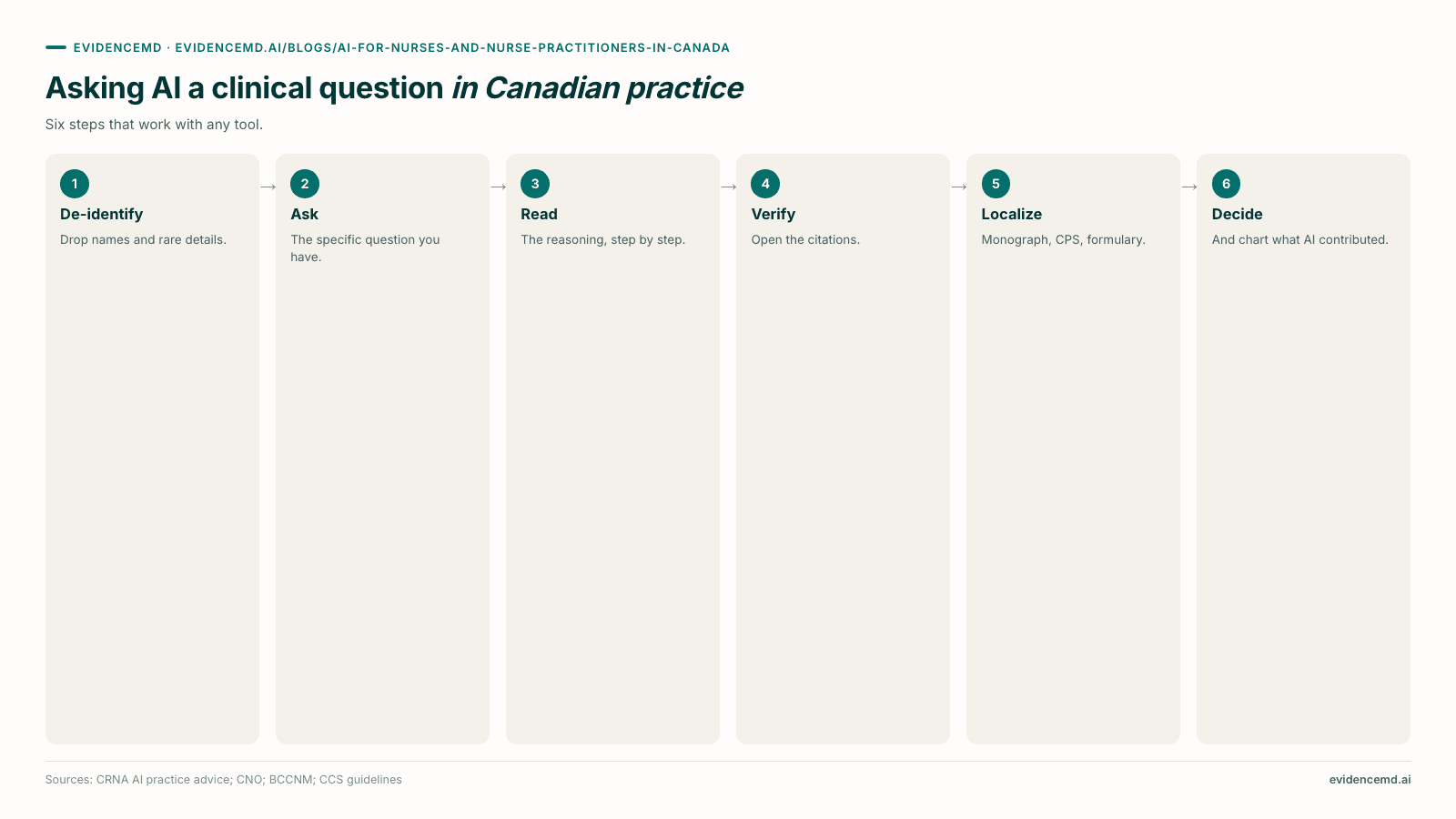
Nurses and NPs can ask an AI tool the clinical questions they would otherwise take to a colleague or a reference, from assessment findings to treatment evidence, as long as they verify the answer against guidelines and their own assessment, as the CRNA asks [3]. The CRNA also says registrants should only use AI tools with built-in explainability features, so the output can be reviewed [3]. That favours tools that show their working. EvidenceMD answers the question from 40 million+ peer-reviewed papers and clinical guidelines, shows its reasoning step by step with a citation for every claim, frames the Canadian parts of an answer to Canadian guidelines, and answers in 30 languages, French included [1]. Customise EvidenceMD lets you save one standing instruction for how answers are written, such as “I am a nurse practitioner in Ontario primary care: be concise and point me to Canadian guidelines”.
Registered nurses
Assessment and escalation: what a change in observations may mean, what to monitor after a new medication, when to call the NP or physician.
Nurse practitioners
Differential diagnosis, investigations and treatment for the patient in front of you; EvidenceMD shows the trial and guideline evidence for each step [1].
Medications
Use AI for the evidence, then the product monograph or CPS for the dose and your provincial formulary for coverage.
How does EvidenceMD reason through a new atrial fibrillation case for a nurse practitioner?
A de-identified question from an NP in Ontario primary care, the evidence behind each step, and the decisions that stay with the NP.
A nurse practitioner in an Ontario primary care clinic finds an irregular pulse in a 76-year-old man at a routine visit, and a 12-lead ECG confirms atrial fibrillation. He has hypertension treated with amlodipine and no history of stroke, heart failure or diabetes. He weighs 82 kg and his serum creatinine is 118 µmol/L. He takes ASA 81 mg daily, started years ago without a vascular indication, and over-the-counter naproxen for knee osteoarthritis. The NP asks: should he be anticoagulated, with what and at what dose, and what about the ASA and naproxen?
EvidenceMD works through it in steps, each with its source:
Stroke risk
The CCS algorithm (CHADS-65) recommends oral anticoagulation for most people with AF who are 65 or older or have a CHADS2 risk factor (strong recommendation, moderate-quality evidence) [17]. He qualifies on age, and his hypertension is a CHADS2 risk factor as well.
Choice of agent
The guideline recommends a DOAC (apixaban, dabigatran, edoxaban or rivaroxaban) in preference to warfarin for most patients with non-valvular AF (strong recommendation, high-quality evidence) [17]. In a meta-analysis of the four pivotal trials, with 71,683 participants, DOACs reduced stroke or systemic embolism by 19% (RR 0.81), intracranial hemorrhage (RR 0.48) and all-cause mortality (RR 0.90) compared with warfarin, but increased gastrointestinal bleeding (RR 1.25) [18].
Kidney function and dose
DOAC dosing uses Cockcroft–Gault creatinine clearance rather than the laboratory eGFR, and renal function should be assessed at baseline and at least once a year (strong recommendation) [17]. His creatinine clearance is about 55 mL/min [16]. The guideline points to the approved prescribing information for doses, and the apixaban label gives 5 mg twice daily, with 2.5 mg twice daily only for patients who have at least two of age 80 or older, body weight 60 kg or less and serum creatinine 133 µmol/L or more; at 76, 82 kg and 118 µmol/L he has none, so the standard dose fits, to be confirmed in the Canadian product monograph [17][20].
Bleeding risk
The guideline asks for modifiable bleeding risk factors to be identified before anticoagulation starts and at every contact, lists avoiding NSAIDs among the measures to reduce bleeding, and judges antiplatelet therapy to have no role in AF stroke prevention [17]. So the naproxen, and the ASA started without a vascular indication, both need review.
His values
The guideline notes considerable scope for shared decision-making, so that the decision to prescribe anticoagulation matches what matters to the patient [17].
Canadian next steps
Confirm the dose and interactions in the product monograph or CPS, check coverage on his provincial drug plan, and record in the chart what the AI suggested and how you verified it, as the CRNA's documentation example shows [3].
What stays with the nurse practitioner. Whether anticoagulation fits his goals, falls history and bleeding picture; confirming with his family physician or his records that the ASA had no vascular indication before stopping it; what to offer for his knee pain instead of naproxen; the rest of the AF workup and the follow-up interval; and whether the plan sits within your scope and your clinic's medical directives. Each step above links to its source, so checking the answer means opening a few citations rather than starting again.
Ask EvidenceMD a de-identified clinical question
Describe the case without identifiers and read the reasoning and the sources behind the answer, in English or French.
What should a Canadian nurse check before using an AI tool at work?
Six checks, drawn from the CNO, BCCNM and CRNA documents.
Check that your employer has approved the tool, that it meets your college's standard and your province's privacy law, how you will get and record consent, whether you can see how it reached its answer, and how you will verify its output [3][4][6].
Employer approval
The CNO expects employer-approved tools, and BCCNM requires approval plus employer AI policies and processes [4][6].
Privacy law
In Alberta, the CRNA says custodians and clinic owners must complete privacy impact assessments, and patient data may only go through AI tools that comply with health information law [3].
Consent
Explain the tool's purpose, benefits, limits and risks before each use, let the client opt out, and chart what you explained [3].
Explainability
Prefer tools that show how they reached an answer, so you can review the output [3].
Classification
The CRNA asks those adopting a tool to know how it is classified and whether it meets Health Canada requirements [3].
Where EvidenceMD fits
EvidenceMD is a personal account with no NPI or licence check, free to start, with paid individual plans from US$50 a month or US$450 a year [1][2]. Its data is hosted in the United States, so it suits de-identified clinical questions unless your employer's privacy assessment covers a US processor, and it does not replace the product monograph, CPS or your provincial formulary [15].
Frequently asked questions
Can nurses in Ontario use AI to help write their charting?
Yes. The CNO says nurses may use AI tools to support clinical documentation, as long as the tool is approved by the employer and meets privacy requirements such as PHIPA, the client gives informed consent when AI records or transcribes the encounter, and the nurse reviews every entry. The nurse remains accountable for all of it. EvidenceMD's Nursing Scribe drafts nursing notes for that review, within your employer's rules.
What does BCCNM's documentation standard say about AI?
BCCNM's Nurses: Documentation standard, in force April 1, 2026, lets nurses use AI to assist with documentation only when their employer has approved it and has AI policies and processes. Nurses remain solely accountable for the accuracy, objectivity and completeness of each entry and must review and validate it at the time of care or as soon as possible afterward. The same applies to any AI drafting tool, EvidenceMD included.
What is the CRNA's practice advice on artificial intelligence?
The CRNA's Artificial Intelligence: Practice Advice, published in September 2025, sets out ten principles for RNs and NPs in Alberta. They include never placing identifying data into public-facing AI tools, obtaining informed consent before each use, using tools with built-in explainability and verifying output against guidelines. EvidenceMD shows its reasoning step by step with a citation for every claim, which makes that verification quicker.
Does the Canadian Nurses Protective Society have guidance on AI?
Yes. The CNPS has published Artificial Intelligence in Healthcare: Legal Risk Management Considerations in Nursing Practice, which flags the reliability of AI outputs, privacy, and informed consent for the use of personal health information by AI; the full article is for CNPS beneficiaries. Whichever tool you use, EvidenceMD included, keep identifiers out unless your employer has approved the tool for patient data.
Are nurse practitioners eligible for Infoway's AI Scribe Program?
Yes. Infoway listed nurse practitioners and registered nurses in remote communities among the eligible clinicians when it launched the program on June 10, 2025, with up to 10,000 funded one-year licences. Its registration site now says regions have reached their allocation for the initial phase. EvidenceMD's Nursing Scribe is a separate option, outside the program, for draft nursing notes.
What can authorized RNs prescribe in Ontario?
The CNO's RN prescribing medication list covers immunizations, hormonal and intravaginal contraception, travel health, topical wound care, smoking cessation with bupropion or varenicline, topical anesthetics, epinephrine for anaphylaxis and over-the-counter medicines. Authority comes from that list and your authorization, not from any software; EvidenceMD can help with the evidence for a clinical question within it.
Can Canadian nurses use EvidenceMD in French?
Yes. EvidenceMD answers in 30 languages, including French, and frames the Canadian parts of an answer to Canadian guidelines. Its data is hosted in the United States, so ask de-identified questions unless your employer's privacy assessment covers a US processor.
The bottom line
Canadian nurses and nurse practitioners can use AI within their college's conditions: employer approval, informed consent, a review of every AI-assisted entry, and accountability that stays with the nurse [3][4][6]. Prescribing authority comes from your province, and identifiers stay out of public AI tools [3][9][10]. For the clinical question itself, EvidenceMD answers from peer-reviewed papers and guidelines with its reasoning shown and a citation for every claim, in English or French; ask it de-identified questions and confirm the detail in the product monograph, CPS and your provincial formulary [1][15].
Sources & related evidence
Nursing regulators and professional bodies first (the CRNA, the CNO, BCCNM, the CNA and CNIA, and the CNPS), then Infoway and a summary of Ontario's privacy commissioner's AI scribe guidance, the published evidence for the worked example, and EvidenceMD's own pages, which are company statements.
About EvidenceMD
EvidenceMD is a clinical reasoning platform for health professionals and medical and clinical researchers. It answers clinical questions from 40 million+ peer-reviewed papers and clinical guidelines with a visible chain of reasoning and a citation for every claim, in 30 languages including French, and offers a Physician Scribe and a Nursing Scribe. It needs no NPI or licence check and is free to start. Application data is hosted in the United States. Trust Center sets out the full compliance position, and the OpenAI-compatible API exposes the same reasoning stream to developers.
Related reading
Cited answers for nursing and NP questions
Ask EvidenceMD a de-identified clinical question in English or French and read the reasoning and sources behind the answer. No licence check, free to start.