Can doctors in Canada use ChatGPT?
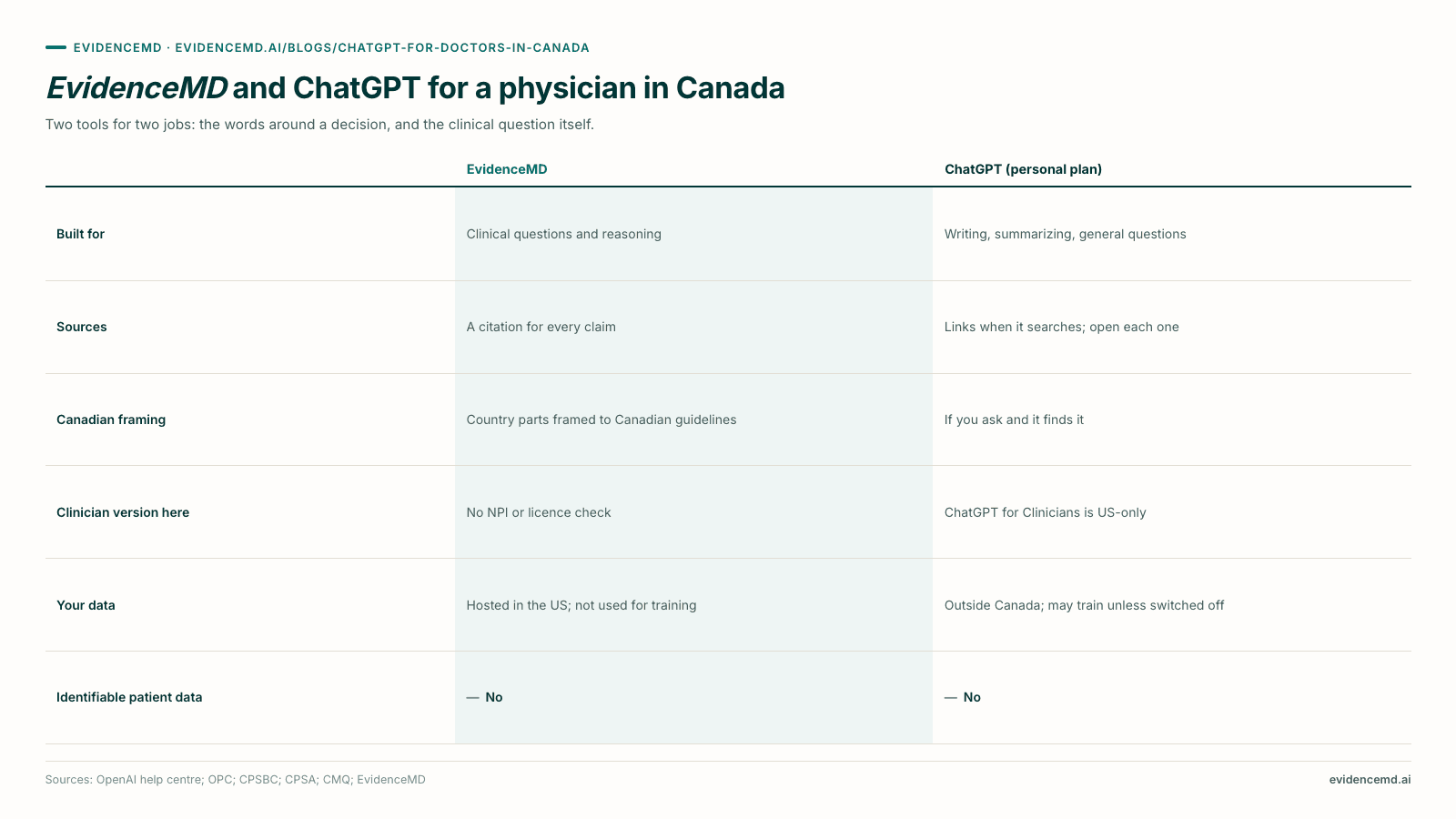
Yes, for drafting, summarizing and plain-language writing, but not with identifiable patient information. The CPSBC says tools such as ChatGPT do not currently comply with privacy rules, the CMQ names it among uncertified tools, and the CMPA expects you to understand each tool's risks [13][16][18]. ChatGPT for Clinicians is US-only [4]. For cited clinical answers framed to Canadian guidelines, EvidenceMD shows its reasoning step by step [1].
Key takeaways
- ChatGPT for Clinicians is not open to Canadian physicians. It needs a US NPI, and OpenAI says it plans to expand to other countries over time [4][5].
- Four privacy commissioners found against ChatGPT's original training. On May 6, 2026, the federal, Quebec, BC and Alberta regulators concluded that OpenAI's initial training did not comply with their laws; the federal complaint was found well-founded and conditionally resolved after OpenAI changed its practices [9].
- The colleges draw a firm line on identifiers. The CPSBC says identifying data must never be used in tools such as ChatGPT, the CMQ says patient records should not go into uncertified tools such as ChatGPT, and the CPSA says to avoid direct identifiers in tools that do not meet privacy law [16][17][18].
- Canadian data residency covers storage, on business plans only. Eligible API, Enterprise and Edu customers can keep content at rest in Canada; in-region inference is offered only in Europe, the US and the UAE [7].
- ChatGPT is fast and broad, less dependable on depth. In a study listed among the CMPA's published research, GPT-4 was quick and wide-ranging but sometimes irrelevant or incorrect next to a human review [15].
- Open every reference. A 2023 Montreal study found 41 of 59 ChatGPT references fabricated; later models do better, but the check still matters [19][20].
Is ChatGPT for Clinicians available to Canadian physicians in 2026?
No. OpenAI offers ChatGPT for Clinicians only to verified clinicians in the United States; in Canada the options are personal ChatGPT plans, or ChatGPT Enterprise or ChatGPT for Healthcare where an organization deploys them.
Sign-up for ChatGPT for Clinicians needs a valid US National Provider Identifier and a licence that OpenAI's third-party provider can verify, which a Canadian registration does not satisfy [4]. OpenAI's help centre tells clinicians outside the US that the product is available to verified US clinicians and that OpenAI plans to expand to other countries over time. Its April 2026 launch post said the first step would be a pilot with the Better Evidence Network, as local regulations permit, without naming a date or a country [4][5].
ChatGPT for Clinicians
Free for verified US clinicians, with clinical search that cites titles, journals, authors and dates. Not available in Canada [4].
What did Canada's privacy commissioners find about ChatGPT?
On May 6, 2026, the Privacy Commissioner of Canada and the Quebec, British Columbia and Alberta commissioners concluded that the way OpenAI initially trained ChatGPT did not comply with their privacy laws; OpenAI has since changed its practices.
The joint investigation examined how OpenAI collected, used and disclosed personal information to develop ChatGPT. The regulators identified overcollection of personal information, a lack of valid consent and transparency, factual inaccuracies involving personal information, limits on people's ability to access, correct and delete their information, and a lack of accountability [9]. During the investigation OpenAI significantly limited the personal and sensitive information used to train new models and committed to further steps. The federal Commissioner found the complaint well-founded and conditionally resolved, and each provincial office reached its own conclusions under the law it enforces [9].
The findings concern OpenAI's training data rather than how physicians use the tool, but they point the same way as the guidance written for users. The federal, provincial and territorial commissioners' 2023 principles for generative AI ask organizations that use these tools to put de-identified information into prompts where possible, and to enter sensitive or confidential information only where they are authorized to [10].
What do the CMPA and the provincial colleges say about physicians using ChatGPT?
None of them bans it, and all keep the physician accountable; the colleges that name ChatGPT say identifiable patient information must not go into it.
| Body | What it says that applies to ChatGPT | Document and date |
|---|---|---|
| CMPA | Understand the risks and benefits of each AI tool you use, check whether it has Health Canada approval and what your college says, and make sure patients have consented to the collection, storage or sharing of their health information [13]. Its position paper warns that generative AI can produce wholly fabricated outputs and present them authoritatively, and asks physicians to keep accurate records of AI use [14]. | “AI in medical practice”, October 2024; position paper, September 2024 |
| CPSBC (British Columbia) | Many AI tools, such as ChatGPT, do not currently comply with privacy and security regulations, so personal or identifying patient data must never be used, and data must be de-identified so the patient's identity cannot be reconstructed; responsibility for care decisions rests principally with the licensee [16]. | Ethical Principles for AI in Medicine, version 1.2, revised April 1, 2026 |
| CPSA (Alberta) | Use caution with publicly available AI tools; avoid names, addresses, personal health numbers and other direct identifiers unless the tool meets the Health Information Act, PIPEDA and other applicable requirements; even de-identified details can re-identify a patient; you remain fully accountable, and AI does not transfer liability [17]. | Advice to the Profession: AI in Clinical Practice, updated March 2026 |
| CMQ (Quebec) | It is not appropriate to enter consultation reports or clinical records into an AI tool not certified by the MSSS, including consumer tools such as ChatGPT, Copilot and Gemini and some professional tools; using AI does not relieve the physician of responsibility [18]. | “L'intelligence artificielle en médecine”, February 26, 2026 |
→ Scroll the table sideways to see the remaining columns
The CPSBC also notes that Health Canada's rules focus on medical devices and do not regulate how individual providers use publicly available tools such as ChatGPT, which is why college guidance carries the weight [16]. The same expectations apply to any tool you bring into practice, EvidenceMD included: describe the case, not the patient, and check what you use.
Can patient information go into ChatGPT under PHIPA and PIPEDA?
The privacy laws allow processing outside Canada under conditions and leave you accountable for it; the colleges add a stricter rule for public chatbots, so in practice identifiable information stays out of a personal ChatGPT account.
Under PIPEDA, transferring personal information to a third party for processing is a use, not a disclosure: it is not prohibited, but the organization remains responsible and must use contractual or other means to provide a comparable level of protection while the information is processed [11]. In Ontario, the Information and Privacy Commissioner says PHIPA does not prevent personal health information from being stored outside Ontario or Canada, while custodians remain ultimately responsible for protecting it [12].
OpenAI's Canadian option is narrower than it sounds. Eligible API customers and new ChatGPT Enterprise and Edu workspaces can keep content at rest in Canada, but in-region inference is offered only in Europe, the United States and the United Arab Emirates [7]. On personal Free, Plus and Pro accounts, conversations may be used for training unless you switch that off, and rating a response can bring the whole conversation into training even after you opt out [8]. That is the gap the colleges close with de-identification.
The same rule applies to EvidenceMD
EvidenceMD stores application data on Microsoft Azure in East US 2 (Virginia, United States), and says conversations are not used to train or fine-tune models [3]. Ask it de-identified questions: no names, health card numbers, addresses or exact dates.
What is ChatGPT good at for family physicians, and where does it fall short?
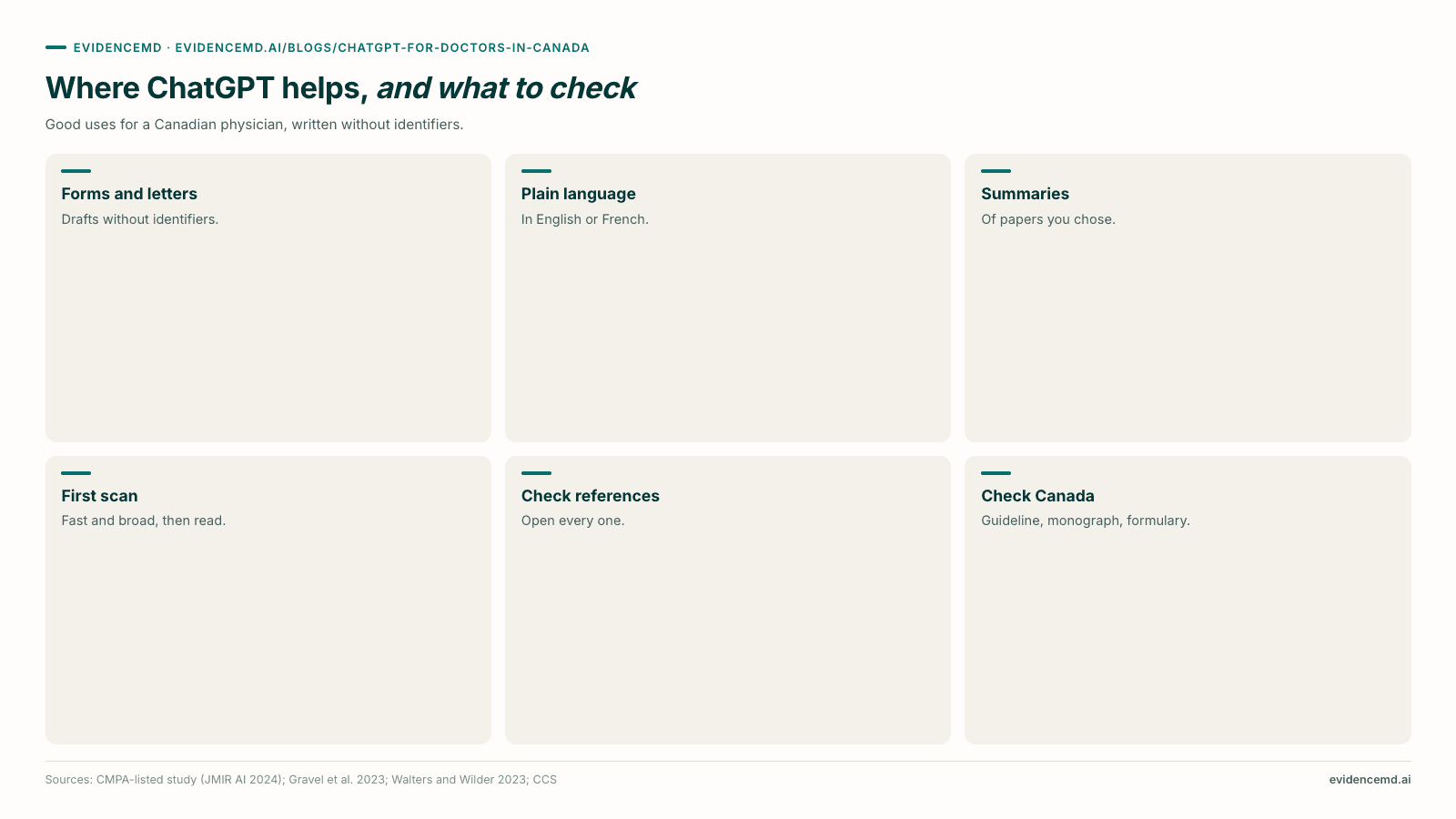
It is fast and broad with language; it is less dependable on depth, context and references, which is what a clinical answer needs.
Forms and letters
First drafts of letters, insurance forms and practice notices, written without identifiers and checked before they go out.
Plain-language explanations
Rewriting a care plan for a patient, in English or French, for you to check before it is shared.
Summaries of what you have read
Condensing a guideline or paper you chose, then checking the summary against the original.
A first scan of a topic
A quick, broad overview to orient yourself before you read properly, which is where GPT-4 did well in a CMPA-listed study [15].
That study, listed among the CMPA's published research, compared a literature review produced with GPT-4 and structured prompts against one done by human researchers. GPT-4 was fast and showed impressive breadth, but it was limited on depth and context and occasionally produced irrelevant or incorrect information; the human review was more accurate and nuanced, and the authors concluded GPT-4 is an assistant rather than a substitute [15].
References are the clearest risk. In February 2023, researchers at CHU Sainte-Justine and the Montreal Children's Hospital asked ChatGPT 20 medical questions with references: of 59 references checked, 41 (69%) were fabricated yet looked real, often using the names of authors who had published on the topic, and the experts rating the answers gave a median score of 60% [19]. A comparison the same year found fabrication fell from 55% of GPT-3.5's citations to 18% of GPT-4's [20]. ChatGPT can now search the web and link the pages it read, and OpenAI's US clinician workspace cites its sources [4], but a reference still needs opening before it supports a decision.
Then there is the Canadian framework: Canadian society guidelines, Health Canada-approved prescribing information and provincial formularies differ from US defaults, as the worked example below shows. That is where EvidenceMD fits. It answers the clinical question from 40 million+ peer-reviewed papers and clinical guidelines, shows its reasoning step by step with a citation for every claim, frames the country-specific parts of an answer to Canadian guidelines, and answers in 30 languages including French [1]. It needs no NPI or licence check and is free to start, with paid individual plans from US$50 a month or US$450 a year [2].
How does an atrial fibrillation question look in a general chatbot and in EvidenceMD?
Canada has its own algorithm for this decision, so the test is whether the answer applies it and whether its sources hold up.
A family physician in Kelowna sees a 66-year-old man whose ECG at a routine visit shows atrial fibrillation. He has no hypertension, diabetes, heart failure, previous stroke or TIA, or valve disease; his eGFR is 78 mL/min/1.73 m², he weighs 84 kg and he has no history of bleeding. Should he start an anticoagulant, and which one? The question goes in de-identified: no name, health card number or date of birth.
With a general chatbot, this page does not reproduce an answer, because answers vary with the version, the settings and the wording. What matters is what to check in whatever comes back. First, the framework. The Canadian Cardiovascular Society's algorithm recommends oral anticoagulation for most patients aged 65 or older or with any CHADS2 risk factor [21]. The 2023 US guideline instead gives its class 1 recommendation at an estimated stroke risk of 2% a year or more, equivalent to a CHA2DS2-VASc score of 2 or more in men, and treats patients below 2% as intermediate risk, where other factors inform the decision [23][24]. This man scores 1, for age alone, so the two frameworks frame him differently. Second, the references, which need opening one by one [19][20]. Third, the dose, which should follow Health Canada-approved prescribing information [21].
With EvidenceMD, the same question is answered in steps, each with its source. It identifies non-valvular AF and applies the CCS algorithm, which the CCS recommends for choosing antithrombotic therapy (strong recommendation, high-quality evidence) and which British Columbia's own atrial fibrillation guideline adopts as CHADS-65 [21][22]. Because he is 65 or older, the CCS recommends oral anticoagulation for most such patients (strong recommendation, moderate-quality evidence), even with no CHADS2 risk factor [21]. For the agent, it recommends a DOAC, namely apixaban, dabigatran, edoxaban or rivaroxaban, in preference to warfarin (strong recommendation, high-quality evidence) [21].
It then gives the evidence behind that choice. In a meta-analysis of 71,683 patients in the four pivotal trials, DOACs reduced stroke or systemic embolism by 19% (relative risk 0.81), intracranial hemorrhage by about half (0.48) and all-cause mortality (0.90) compared with warfarin, with more gastrointestinal bleeding (1.25) [25]. For dosing and follow-up it points to the doses used in the trials and Health Canada-approved prescribing information, creatinine clearance by the Cockcroft-Gault method, renal function at baseline and at least once a year, and regular review of bleeding risk, drug interactions and adherence [21].
Where you decide. The answer gives a next step, not a decision. How he weighs a stroke prevented against a bleed caused, which DOAC suits his other medicines and his drug coverage, and when to review him are his and his physician's choices; the CCS itself notes considerable scope for shared decision-making, particularly when the annual stroke risk is under 2% [21].
Ask EvidenceMD a Canadian clinical question
Try a de-identified question in English or French and read the reasoning step by step, with the source behind each claim.
How can a Canadian physician use ChatGPT within college and privacy rules?
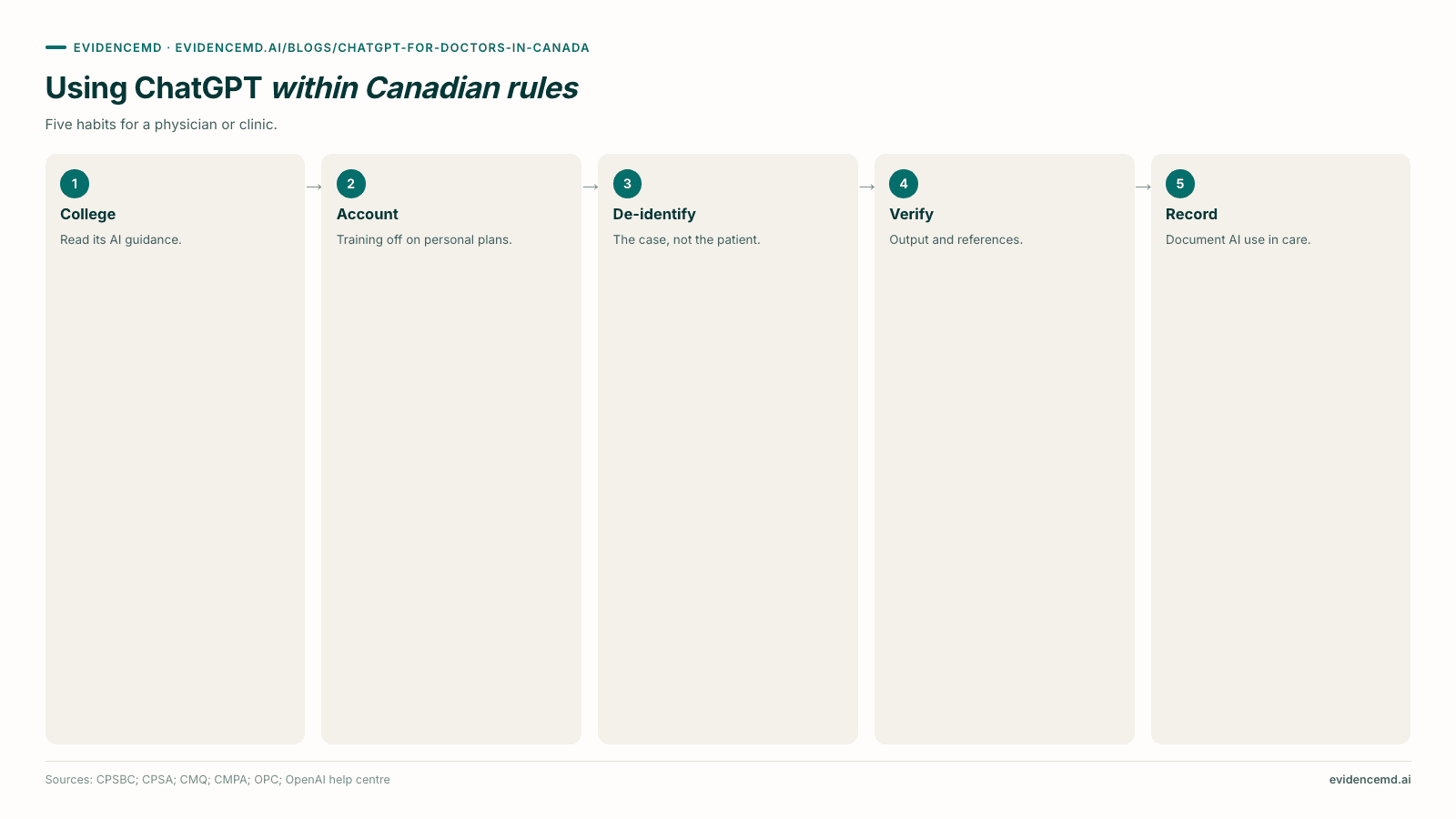
Read your college's guidance, know which account you are on, write the case rather than the patient, check every output, and record AI use where it informs care.
Know which account you are on
On personal Free, Plus and Pro accounts, switch off “Improve the model for everyone” or use a temporary chat; Business, Enterprise and API content is not used for training by default [8].
Frequently asked questions
Can Canadian physicians sign up for ChatGPT for Clinicians?
No: OpenAI requires a valid US NPI and a licence its third-party provider can verify, and says it plans to expand to other countries over time. Canadian physicians who want cited clinical answers now can use EvidenceMD, which needs no NPI or licence check.
Did Canada's privacy commissioners find that ChatGPT broke privacy law?
For its initial training, yes: on May 6, 2026, the federal, Quebec, BC and Alberta commissioners concluded that the way OpenAI first trained ChatGPT did not comply with their privacy laws. OpenAI has since limited the personal information used to train new models, and the federal complaint was found well-founded and conditionally resolved. Whichever tool you use, EvidenceMD included, keep identifiable patient information out unless your privacy assessment covers it.
Does the CPSBC let physicians use ChatGPT?
The CPSBC's AI guideline allows careful use but says tools such as ChatGPT do not currently comply with privacy and security regulations, so identifying patient data must never be entered and data must be de-identified so the patient cannot be re-identified. Responsibility for care decisions stays with the licensee. The same de-identification rule applies to EvidenceMD, which is hosted in the United States.
Can Quebec physicians put patient records into ChatGPT?
No. The Collège des médecins du Québec says it is not appropriate to enter consultation reports or clinical records into AI tools not certified by the MSSS, naming consumer tools such as ChatGPT, Copilot and Gemini. EvidenceMD answers in French, and in Quebec it too is for de-identified questions.
Does OpenAI store ChatGPT data in Canada?
Only for eligible API customers and new ChatGPT Enterprise and Edu workspaces, which can keep content at rest in Canada; in-region inference is offered only in Europe, the US and the UAE, and personal plans have no Canadian option. EvidenceMD stores application data in the United States, so the same de-identified approach applies.
Is ChatGPT regulated by Health Canada?
Not as individual physicians use it: the CPSBC notes that Health Canada's rules focus on medical devices and do not regulate how individual providers use publicly available tools such as ChatGPT. That leaves the colleges, the CMPA and privacy law to set expectations. Treat EvidenceMD the same way: as cited reference material you check before you act.
Does ChatGPT follow the CCS algorithm for atrial fibrillation?
It can if you ask for it, but nothing guarantees which framework an answer uses, and the CCS algorithm and the 2023 US guideline frame a 65-to-74-year-old with no other risk factor differently. EvidenceMD frames the country-specific parts of an answer to Canadian guidelines and cites the source for each claim, so you can see which recommendation it applied.
The bottom line
ChatGPT is a capable drafting tool for Canadian physicians and the wrong place for identifiable patient information. ChatGPT for Clinicians is not available here, the privacy commissioners found against ChatGPT's original training, and the CPSBC, the CPSA and the CMQ all keep identifiers out of public chatbots [4][9][16][17][18]. For the clinical question itself, EvidenceMD answers with its reasoning shown step by step and a citation for every claim, framed to Canadian guidelines, in English or French; it is hosted in the United States, so ask it de-identified questions too [1][3].
Sources & related evidence
EvidenceMD's own pages (company claims), OpenAI's help centre and launch post, the Office of the Privacy Commissioner of Canada and Ontario's IPC, the CMPA and three provincial colleges, two studies of ChatGPT's references and a CMPA-listed study of GPT-4, and the Canadian, BC and US atrial fibrillation guidance and trial evidence used in the worked example.
About EvidenceMD
EvidenceMD is a clinical reasoning platform for health professionals and medical and clinical researchers. It answers clinical questions from 40 million+ peer-reviewed papers and clinical guidelines with its reasoning shown step by step and a citation for every claim, frames the country-specific parts of an answer to the user's country guidelines, answers in 30 languages including French and needs no NPI or licence check; it is free to start. Application data is hosted in the United States. Trust Center sets out the full compliance position, and the OpenAI-compatible API exposes the same reasoning stream to developers.
Related reading
Cited answers to Canadian clinical questions
Ask EvidenceMD a de-identified clinical question in English or French and read the reasoning and the source behind each claim, framed to Canadian guidelines. No licence check, free to start.