How can AI help rural and remote doctors in Canada?
AI helps rural and remote doctors in Canada by reasoning through a complex case before and between consult calls, not by replacing them. EvidenceMD answers the specific clinical question from 40 million+ papers and guidelines, shows each step with a citation and frames the Canadian parts to Canadian guidelines [1]. Services such as RACE, Real-Time Virtual Support, eConsult and CritiCall remain the route to specialist advice and transfer [10][11][12][13].
Key takeaways
- About one Canadian in six lives rurally. At the 2021 census, 17.8% of Canadians, about 6.6 million people, lived in rural areas [5].
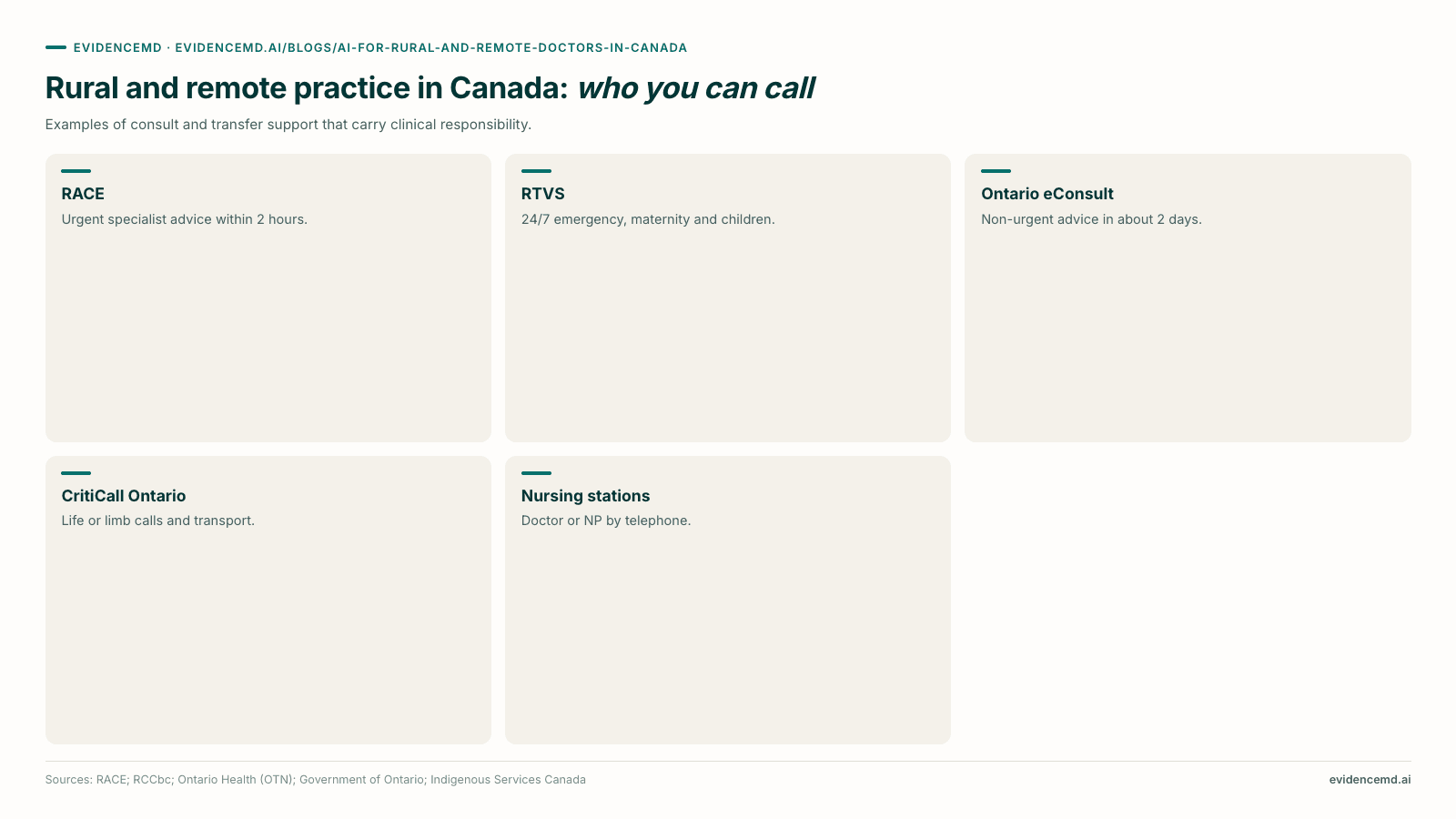
- Specialist advice already has routes. BC's RACE gives urgent advice within two hours on weekdays, and BC's Real-Time Virtual Support runs emergency, maternity and children's pathways around the clock [10][11].
- Ontario has eConsult and CritiCall. Ontario eConsult answers non-urgent questions in an average of two days, and CritiCall Ontario connects referring and consulting physicians and coordinates transport [12][13].
- Connectivity is still uneven. In 2024, 87.4% of rural households had access to 50/10 Mbps internet, against 99.8% of urban households [9].
- AI belongs in the time around the call. EvidenceMD helps you prepare the consult call, reason through the case while you wait and read around it afterwards, with a citation for every claim [1][4].
- Keep identifiers out. EvidenceMD stores application data in the United States, so describe the case, not the patient or the community [3][18].
What makes rural and remote medicine in Canada different?
Broad scope, long distances, and specialist advice that usually arrives by phone or video.
Rural and remote physicians in Canada work across a broad scope, often far from specialist and hospital services. At the 2021 census, 17.8% of Canadians, about 6.6 million people, lived in rural areas, down from 18.7% in 2016 [5]. The Society of Rural Physicians of Canada (SRPC), founded in 1992, describes itself as the national voice of Canadian rural physicians and champions rural generalist medical care [6], and with the College of Family Physicians of Canada it produced the Rural Road Map for Action, which sets out four directions and 20 actions to improve health care access for rural and remote Canadians [7].
In many remote First Nations communities, primary care is delivered from nursing stations. Indigenous Services Canada says its nursing stations and health centres are located primarily in remote or isolated First Nations communities in its Alberta, Manitoba and Ontario regions, and that when a doctor or nurse practitioner is not on site, nurses consult them by telephone [8]. A rural physician may therefore be the consultant on the other end of the line as well as the clinician in the room.
Generalist scope
Clinic, emergency and inpatient work in the same week, often with no specialist on site and a broad range of presentations.
Advice at a distance
Specialist input comes by phone, video or eConsult [10][11][12], and transfer depends on distance and weather.
Uneven connectivity
Rural households still trail urban ones for high-speed internet, so no online tool can be the only plan [9].
Which virtual consult services can rural doctors in Canada call in 2026?
Examples from two provinces; other provinces and territories run their own services.
| Service | Where | Who can use it | What it offers |
|---|---|---|---|
| RACE (Rapid Access to Consultative Expertise) | British Columbia and Yukon | Family physicians, nurse practitioners and midwives [10] | Specialist advice requested by app or web, with urgent advice within two hours, Monday to Friday, 08:00 to 17:00 Pacific [10] |
| Real-Time Virtual Support (RTVS) | British Columbia | Physicians, residents, nurse practitioners, nurses, midwives and other providers in rural, remote and First Nations communities [11] | Peer pathways by Zoom or phone: RUDi (emergency), MaBAL (maternity and newborns) and CHARLiE (pediatrics) around the clock, and ROCCi (critical care and internal medicine) from 8 a.m. to 9 p.m. Pacific [11] |
| Ontario eConsult | Ontario | Physicians and nurse practitioners [12] | Secure online specialist advice for non-urgent questions, answered in an average of two days and often avoiding a referral [12] |
| CritiCall Ontario | Ontario | Referring physicians with a patient whose life or limb is at risk [13] | A conference call between the referring and consulting physicians, and coordination of transport to the receiving hospital [13] |
→ Scroll the table sideways to see the remaining columns
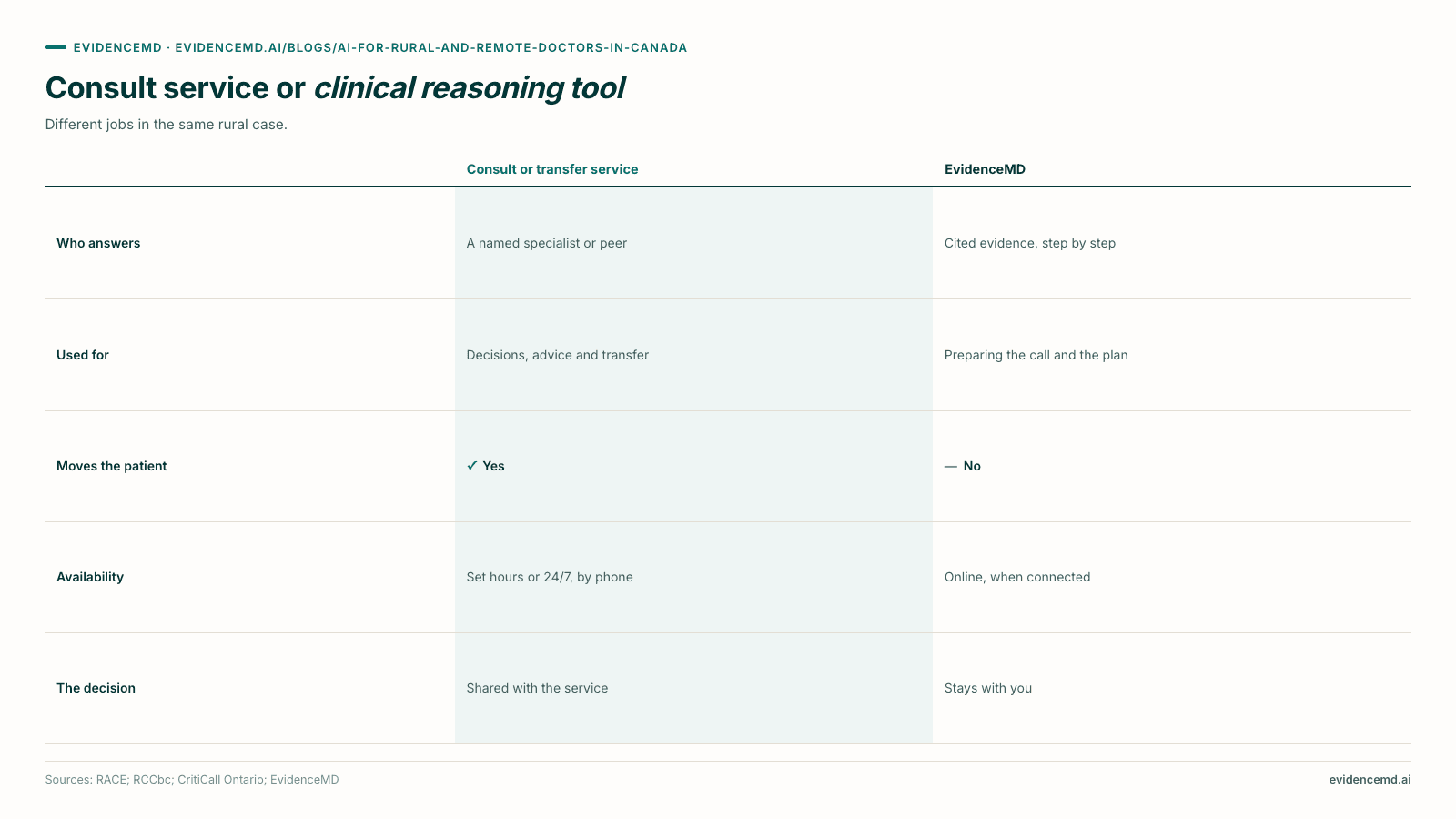
These services carry clinical accountability that an AI tool does not: a named specialist gives the advice, and a transfer system moves the patient. AI is useful in the minutes and hours around them.
Where does AI help when there is no specialist down the hall?
Before the call, while you wait, and after the patient has gone.
Before the consult call
Reason through the case, the differential and the one question you need answered, so the call is short and specific [1].
While you wait for advice or transport
Check what the evidence supports for the hours ahead, with every claim cited so you can judge it quickly [1].
After the case
Read around an unfamiliar presentation: DeepSearch turns one question into a cited review of typically 20–25 pages [4].
For the transfer summary
Draft the summary from your own account of the case, then correct it before it goes with the patient.
What AI does not do is take the place of the specialist or the transfer coordinator. The CFPC's statement on AI says tools should support the primary care team without replacing clinical judgment, and that their use should take account of cultural sensitivity, humility and safety [14]. EvidenceMD's part is to make you better prepared for the call: it frames the Canadian parts of an answer to Canadian guidelines, answers in French or English, and is free to start, with paid individual plans from US$50 a month or US$450 a year [1][2]. A saved system instruction, under Customise EvidenceMD, can describe your setting, for example that you work without on-site specialists, and applies to new answers on the web and in the mobile app.
How does EvidenceMD reason through a STEMI when PCI is hours away?
A de-identified emergency case from a small northern hospital, and where the physician and the consult pathway decide.
The question, as a family physician covering the emergency department of a small hospital in northern British Columbia might type it after calling RUDi and while the transfer is being arranged: a 58-year-old man with 90 minutes of chest pain and an inferior ST-elevation myocardial infarction on his ECG. The nearest PCI centre is a flight away, weather has grounded aircraft, and road transfer will take about five hours. Should he receive fibrinolysis here, and what comes next?
Step 1: choose the reperfusion strategy by time. EvidenceMD starts with the clock. The European Society of Cardiology's 2023 guideline prefers primary PCI when it can be performed within 120 minutes of the ECG diagnosis; when it cannot, it recommends fibrinolysis within 12 hours of symptom onset for patients without contraindications, with a goal of starting within 10 minutes of the diagnosis [16]. The Canadian Cardiovascular Society and Canadian Association of Interventional Cardiology guideline starts from the same problem, noting that Canada's geography makes timely reperfusion difficult, and builds its recommendations around organized regional STEMI networks [15]. With PCI about five hours away, fibrinolysis is the strategy the evidence supports, unless something at the bedside rules it out.
Step 2: what only you can confirm. The answer then lists what the guideline assumes and only the bedside can establish: the time of symptom onset, any contraindication to fibrinolysis, and the patient's informed consent. Those answers decide whether step 1 applies at all.
Step 3: transfer after lysis, not instead of it. The guideline recommends transferring the patient to a PCI centre immediately after fibrinolysis begins, rescue PCI if fibrinolysis fails, defined as ST-segment resolution of less than 50% within 60 to 90 minutes, and routine angiography within 2 to 24 hours after successful fibrinolysis [16]. So the plan is lysis now, transfer as soon as transport allows, and a repeat ECG at 60 to 90 minutes.
Step 4: doses and protocol. The guideline publishes fibrinolytic doses and the accompanying antithrombotic therapy in its supplementary data, so the answer points to those tables and to your hospital's STEMI protocol rather than giving doses of its own [16].
Where the physician and the consult pathway decide. In British Columbia, RUDi offers emergency peer support around the clock by Zoom or phone [11], and the transfer itself goes through your region's transfer service. The answer helps the physician follow and question that advice; it does not replace the call or delay treatment. The decision to give fibrinolysis, the drug and dose, and the transfer plan are made by the physician with the receiving team. Because EvidenceMD stores application data in the United States, the question describes the case without identifiers [3].
Reason through a rural case before the call
Ask EvidenceMD a de-identified question from your last shift and read the reasoning and sources behind each step.
What should AI use look like in northern and Indigenous communities?
The same clinical rules, with more attention to who asks the question, who controls the data, and how care is delivered.
In remote First Nations communities served by nursing stations, the clinician asking the question is often a nurse, and the physician or nurse practitioner is on the telephone [8]. BC's Real-Time Virtual Support was built for this setting: it is open to providers in rural, remote and First Nations communities, and the First Nations Health Authority is among its partners [11]. An AI tool can help either end of that call prepare a clearer question, but it should never add a step that delays reaching a clinician.
Data deserve particular care. Individual clinical questions should be de-identified for any tool not approved for patient information, and in a small community that means leaving out the community's name as well as the patient's. Data about a First Nations community as a whole fall under the First Nations principles of OCAP® (ownership, control, access and possession), a registered trademark of the First Nations Information Governance Centre, which describes them as a path to First Nations data sovereignty [17]. The CFPC also asks that AI be used with cultural sensitivity, humility and safety in mind [14].
Three questions before using AI in a community clinic
Has your employer or health authority approved the tool for this setting? Could anything in the question identify the patient or the community? Would waiting for an AI answer delay a call to RTVS, a consult line or the transfer service? If the answer to the last question is yes, call first.
Can AI help in remote communities with poor internet?
Only when there is a connection, so it cannot be the only plan.
Connectivity has improved but is still uneven. Innovation, Science and Economic Development Canada reports that in 2024, 87.4% of rural households had access to 50/10 Mbps internet, compared with 99.8% of urban households, against federal targets of 98% of Canadians by 2026 and 100% by 2030 [9].
EvidenceMD is an online service on the web and in mobile apps, so it needs a connection. When the connection fails, the phone line to a consult service, your hospital's printed protocols and your own judgment still have to carry the case, which is one more reason to treat AI as preparation rather than as the plan.
What should a rural doctor check before acting on an AI answer?
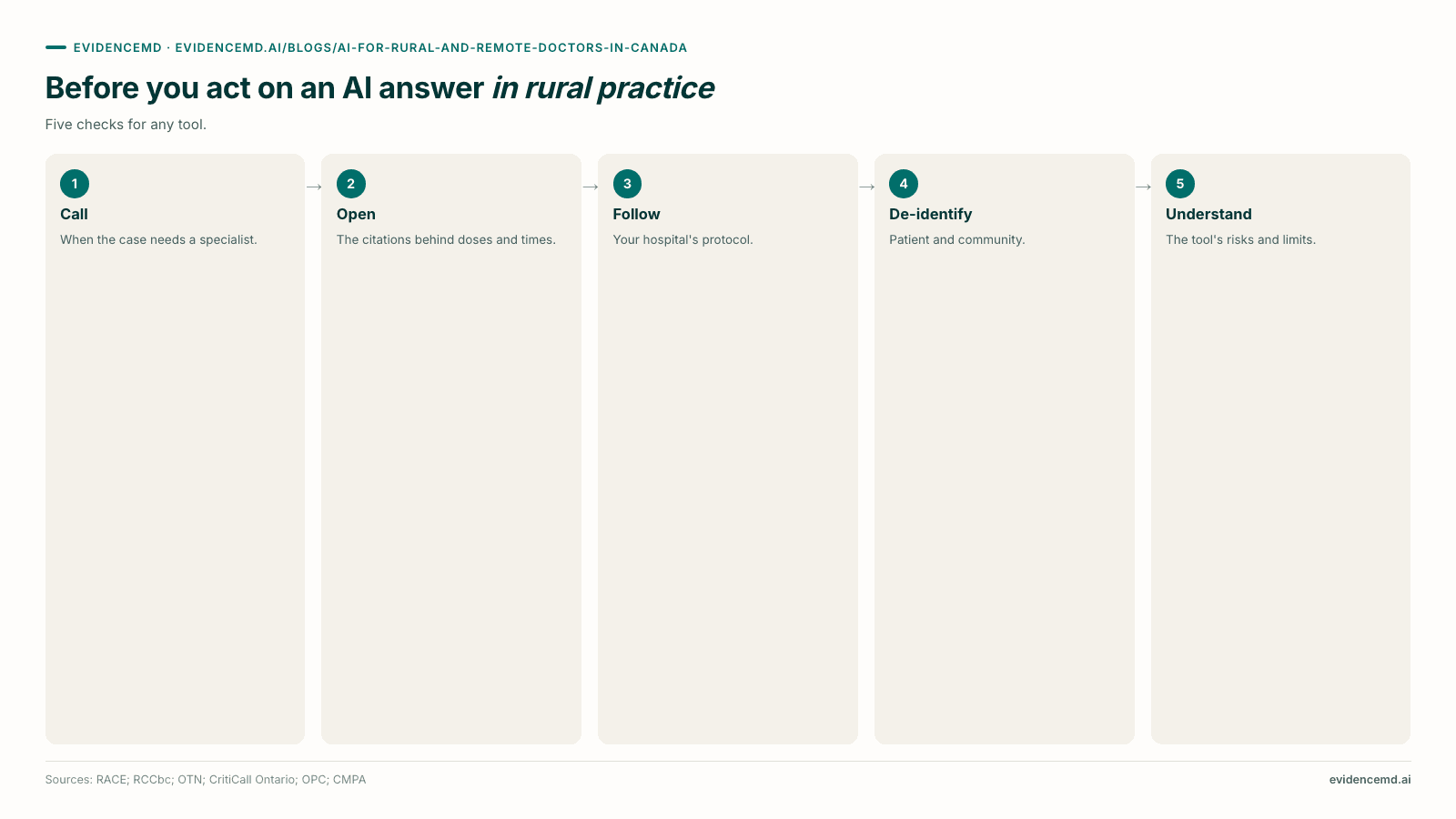
Five checks for any tool, adapted to rural practice.
Open the citations that matter
Read the sources behind any step you would act on, especially doses and time windows [1].
Follow your local protocol
Your hospital's STEMI, transfer and medication protocols take precedence over a general answer.
Keep identifiers out
Under PIPEDA, an organization that transfers personal information to a processor outside Canada stays accountable for it and must provide comparable protection [18].
Understand the tool
The CMPA asks physicians to understand the risks and benefits of the specific AI tools they use [19].
Provincial privacy law, college guidance and the rest of the Canadian rules for clinical AI are covered in the guide to medical AI for doctors in Canada on this site [20].
Frequently asked questions
What virtual support can rural doctors in British Columbia call?
Two examples: RACE gives family physicians, nurse practitioners and midwives in BC and Yukon specialist advice, with urgent advice within two hours on weekdays, and Real-Time Virtual Support offers 24/7 emergency, maternity and pediatric peer pathways by Zoom or phone [10][11]. EvidenceMD can help you prepare the question before you call, with its reasoning and sources shown.
What is the Society of Rural Physicians of Canada?
The SRPC, founded in 1992, describes itself as the national voice of Canadian rural physicians, with a mission of championing rural generalist medical care [6]. With the CFPC it produced the Rural Road Map for Action, four directions and 20 actions to improve rural health care [7]. For the clinical questions that come up between consults, EvidenceMD gives step-by-step answers with a citation for every claim.
Can an AI tool replace a specialist consult for a rural physician?
No. A consult service puts a named specialist and, when needed, a transfer system behind the advice, which an AI tool does not. EvidenceMD is useful around the consult: reasoning through the case beforehand, checking the evidence while you wait and reading around it afterwards, with a citation for every claim [1].
How can a rural emergency physician use AI when patient transfer is delayed?
Use it to check what the evidence supports for the hours before transfer, then confirm the plan through your consult or transfer line. For a STEMI with PCI more than 120 minutes away, for example, the ESC guideline favours fibrinolysis followed by immediate transfer, rescue PCI if it fails, and angiography within 2 to 24 hours if it succeeds [16]. EvidenceMD lays out that reasoning with the sources, and you and the receiving team decide.
Does AI work in remote Canadian communities with limited internet?
Only with a connection. In 2024, 87.4% of rural households in Canada had access to 50/10 Mbps internet, compared with 99.8% of urban households [9]. EvidenceMD runs online on the web and in mobile apps, so keep phone consult lines and printed protocols as the backup.
Can nurses in remote First Nations nursing stations use AI for clinical questions?
Only within their employer's policies and approved tools. Indigenous Services Canada says nurses in its remote nursing stations consult a doctor or nurse practitioner by telephone when one is not on site, and that call remains the route for clinical decisions [8]. Where a tool such as EvidenceMD is permitted, use it with de-identified questions to prepare the call.
How does CritiCall Ontario help rural hospitals with urgent transfers?
Under Ontario's Life or Limb policy, CritiCall Ontario facilitates a conference call between the referring physician and the consulting physician and, when applicable, coordinates transport to the receiving hospital [13]. It is the route for urgent transfers; EvidenceMD can help you organize the case and the question before the call, with cited reasoning.
The bottom line
For rural and remote doctors in Canada, AI is most useful in the space between the patient in front of you and the specialist on the phone. Consult and transfer services such as RACE, Real-Time Virtual Support, eConsult and CritiCall remain the route to specialist advice and to a bed [10][11][12][13]. EvidenceMD helps you arrive at that call prepared: it reasons through the case step by step from 40 million+ papers and guidelines with a citation for every claim, framed to Canadian guidelines [1]. Keep identifiers out, keep a plan for when the connection drops, and make the decision with the receiving team [9][18].
Sources & related evidence
EvidenceMD's own pages (company claims), then Statistics Canada, the SRPC and the CFPC, Indigenous Services Canada, Innovation, Science and Economic Development Canada, the consult and transfer services' own pages, the two STEMI guidelines used in the worked example, the First Nations Information Governance Centre, the Office of the Privacy Commissioner of Canada, the CMPA and the Canada guide on this site.
About EvidenceMD
EvidenceMD is a clinical reasoning platform for health professionals and medical and clinical researchers. It answers clinical questions from 40 million+ peer-reviewed papers and clinical guidelines with its reasoning shown step by step and a citation for every claim, frames the country-specific parts of an answer to the user's country guidelines, answers in 30 languages including French, and needs no NPI or licence check. It is free to start. Application data is hosted in the United States. Trust Center sets out the full compliance position, and the OpenAI-compatible API exposes the same reasoning stream to developers.
Related reading
Prepared before the consult call
Ask EvidenceMD a de-identified question from a rural shift and read the reasoning and sources behind each step. No licence check, free to start.