What are the best clinical decision support tools in Canada?
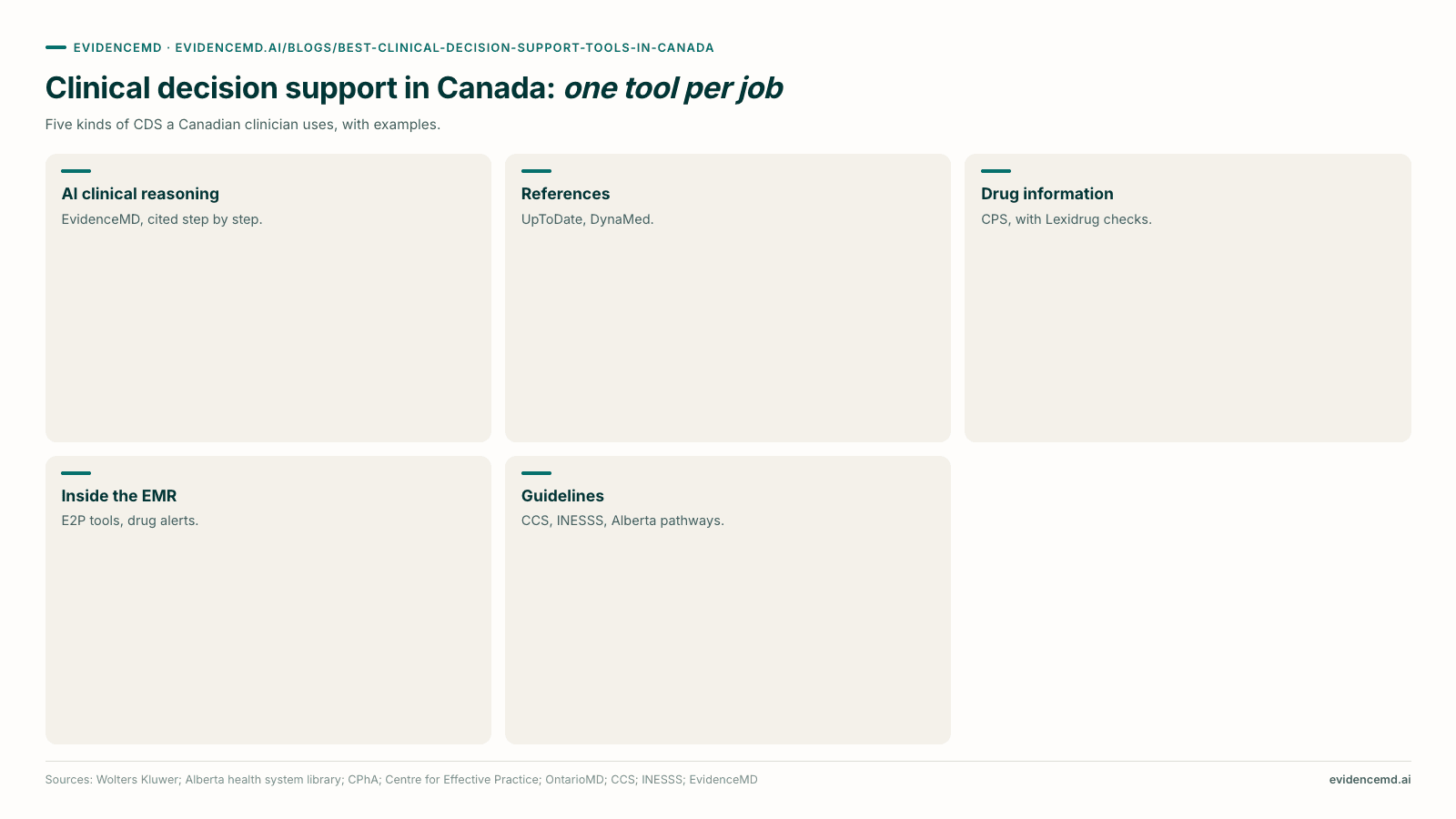
There is no single best clinical decision support tool in Canada; each does a different job. A typical set is UpToDate or DynaMed for topics, CPS for Canadian drug information, EMR alerts and, in Ontario, Evidence2Practice tools, Canadian guidelines and pathways, and an AI clinical reasoning tool such as EvidenceMD, which answers the specific question step by step with a citation for every claim, framed to Canadian guidelines [1][11][16][17].
Key takeaways
- Group CDS by job, not by brand. Topic references (UpToDate, DynaMed), drug information (CPS), EMR tools, guidelines and pathways, and AI clinical reasoning answer different questions, so you will usually need more than one [11][15][16][17].
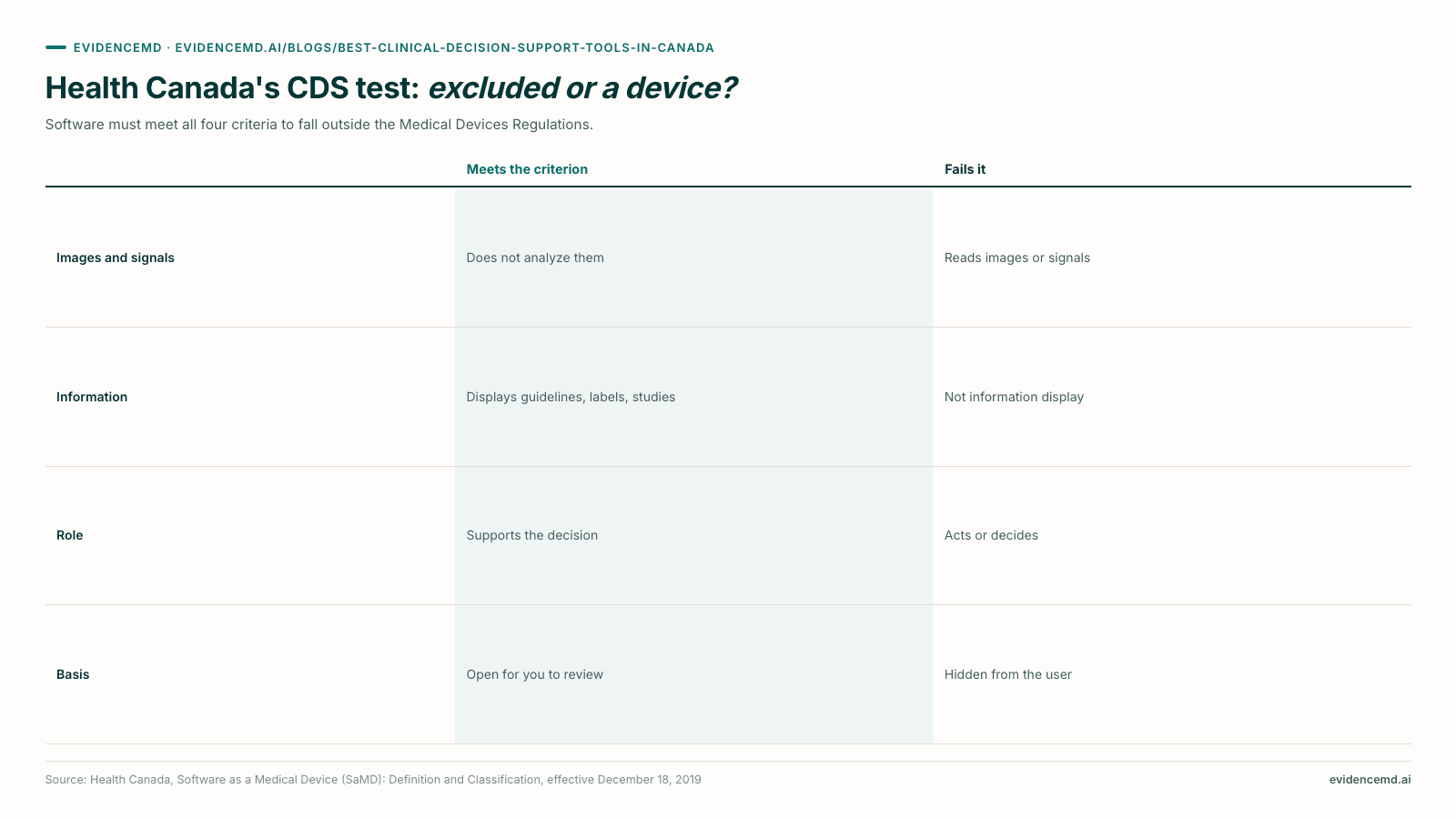
- Health Canada applies four criteria. CDS software falls outside the Medical Devices Regulations only if it does not analyze images or signals, displays medical information, only supports a decision and does not replace clinical judgment, with the basis of each recommendation open to review [6].
- Ontario has free CDS inside the EMR. Evidence2Practice Ontario offers free tools for heart failure, anxiety disorders and depression, prediabetes and type 2 diabetes, and COPD; in March 2026, Ontario Health reported 4,754 primary care clinicians with access through their EMR [9][11].
- Few AI tools show Canadian sources. In a Centre for Effective Practice analysis of 53 AI-enabled CDS solutions, only 6% referenced Canadian clinical sources [9].
- Canadian guidance has its own details. The CCS dyslipidemia guidelines use the Framingham Risk Score, set statin thresholds in mmol/L, and prefer non-HDL-C or apoB to LDL-C when triglycerides are above 1.5 mmol/L, which is the kind of local point to check in any answer [23][24].
- EvidenceMD fills the AI clinical reasoning job: a cited answer to the specific question, with the reasoning shown and the Canadian parts framed to Canadian guidelines. It is hosted in the United States, so ask de-identified questions [1][3].
What types of clinical decision support do Canadian clinicians use in 2026?
Five jobs, each with Canadian examples and the usual route to them.
Canadian clinicians use five kinds of clinical decision support, and each answers a different question. AI clinical reasoning answers the question about the patient in front of you, with the evidence assembled for that case; a topic reference tells you how a condition is usually worked up and treated; a drug reference gives the Canadian monograph and the interactions; tools inside the EMR prompt you at the point of care; and guidelines and pathways say what Canadian or provincial bodies recommend.
| Type of CDS | Canadian examples | What it helps with | How clinicians usually get it |
|---|---|---|---|
| AI clinical reasoning | EvidenceMD | A cited answer to the specific clinical question, with the reasoning shown | Personal sign-up, free to start; paid plans from US$50 a month or US$450 a year [1][2] |
| Point-of-care references | UpToDate; DynaMed | Reading around a condition: workup, treatment and follow-up | Personal subscription or an institutional licence; Alberta Health Services provides DynaMed province-wide [15][16] |
| Drug information and interaction checking | CPS (formerly RxTx), with a Lexidrug interaction checker | Health Canada-approved monographs, doses, interactions and therapeutic content | Subscription from the Canadian Pharmacists Association, or a library licence [17][18] |
| CDS inside the EMR | Evidence2Practice Ontario tools; prescribing alerts in certified EMRs such as Accuro | Condition-specific prompts at the point of care; drug interaction alerts | Built into the EMR; E2P tools come at no cost in Ontario [11][14] |
| Guidelines and pathways | CCS guidelines; Alberta Pathways Hub; INESSS guides; Thrombosis Canada app | What Canadian or provincial guidance recommends, and when to refer | Published online by the society, province or institute, or as an app [20][21][22][23] |
→ Scroll the table sideways to see the remaining columns
Which point-of-care references and drug databases do Canadian clinicians use?
Topic references for the condition, and a Canadian drug reference for the product and dose.
A common pattern is one topic reference plus a Canadian drug reference such as CPS, with EvidenceMD beside them for a cited answer to the question about one patient [1]. Which topic reference you have often depends on where you work rather than on choice, so check your hospital, health authority or university library before you pay for one yourself. UpToDate prices and province-by-province access are covered in the Canadian UpToDate guide on this site [5].
EvidenceMD (clinical reasoning)
For a question about one patient, such as a dose at reduced kidney function or an interaction, EvidenceMD reasons through it step by step with a citation for every claim [1]. Confirm the Canadian product and dose in CPS or the product monograph before prescribing [17].
UpToDate (Wolters Kluwer)
Expert-written clinical topics. Wolters Kluwer sells it to individual clinicians in Canada, and its Pro Plus package adds Expert AI [15]. Access through work varies by province and institution. Best for: reading a whole topic end to end.
DynaMed (EBSCO)
A clinician-focused point-of-care reference. Alberta's health system library recommends it and makes it available province-wide to all Alberta Health Services physicians and staff, with a mobile app [16]. Best for: topic summaries where your employer already licenses it.
CPS (Canadian Pharmacists Association)
Health Canada-approved monographs for drugs, vaccines, natural health products and medical devices, with a Lexidrug interaction checker; Lexidrug is the new name of Lexicomp [17][19]. CPS Drug Information costs $468.18 a year, and CPS Full Access, which adds CPS: Therapeutic Choices and CPS: Minor Ailments for more than 200 conditions, $784.38. Content is in English and French [17]. Best for: the Canadian product, dose and interaction check.
A reference gives you the topic. The question about the patient in front of you, with a particular mix of age, kidney function and other conditions, often needs the evidence assembled for that case, which is the job of AI clinical reasoning further down this page [1].
What clinical decision support is built into Canadian EMRs?
Prescribing alerts from a drug database, and condition-specific tools added on top.
Canadian EMRs carry two kinds of decision support: prescribing alerts driven by a drug database, and condition-specific tools that sit inside the chart. OntarioMD certifies EMRs for Ontario practices, and its list, updated August 14, 2026, includes TELUS Health's PS Suite, Med Access and Collaborative Health Record, QHR Technologies' Accuro and WELLSTAR's OSCAR Pro [13].
Prescribing alerts
OntarioMD's certification record for Accuro names First DataBank as the supplier for prescription writing and drug interactions, with updates as often as weekly [14]. Ask which drug database your own EMR uses and how its alerts are tiered, because that decides what you are warned about.
Evidence2Practice Ontario (E2P)
Led jointly by the Centre for Effective Practice, Amplify Care and North York General Hospital, with funding and strategic guidance from Ontario Health, E2P offers free tools for primary care on heart failure, anxiety disorders and depression, prediabetes and type 2 diabetes, and COPD [11]. Its COPD tool was released for TELUS PS Suite and Accuro, with an OSCAR Pro version announced [12]. At a March 2026 webinar, Ontario Health reported 4,754 primary care clinicians with access through their EMRs and more than 650 active users [9].
AI inside the EMR
In a pilot reported by OntarioMD in July 2026, an AI-enabled CDS tool from Healwell AI, using clinical guidelines supplied by the Centre for Effective Practice, analyzed EMR data for type 2 diabetes care in three Mid-West Toronto Ontario Health Team practices: 14 clinicians and nearly 500 patients over almost three months. Clinicians said it helped them find patients who needed follow-up, but some said it slowed their workflow, and participants asked for fewer false-positive alerts [10].
What clinicians told researchers they want
Ten primary care clinicians interviewed by Women's College Hospital researchers, in findings presented in March 2026, said AI decision support that does not save time is unlikely to be used, preferred on-demand tools to intrusive ones, and wanted to understand how recommendations are generated [9].
Where do Canadian guidelines and pathway tools fit?
They hold the local answer, and they are the yardstick for every other tool.
Canadian guidelines and pathways are where the Canadian answer lives, so they are what any other CDS tool should be checked against. Some are national society guidelines, some are provincial pathways, and some come as apps with calculators built in.
Canadian Cardiovascular Society guidelines
The 2021 CCS dyslipidemia guidelines recommend a cardiovascular risk assessment with the Framingham Risk Score or the Cardiovascular Life Expectancy Model every five years from age 40 to 75, set statin thresholds in mmol/L for each risk group, and recommend measuring lipoprotein(a) once in a lifetime [23][24]. Best for: cardiovascular decisions where Canadian guidance differs in detail from other countries'.
Alberta Pathways Hub
albertapathways.ca, maintained by Alberta's Provincial Pathways Unit with patients and primary and specialty care providers, is the provincial home for evidence-informed clinical, patient and referral pathways, such as primary care pathways for non-obstructing kidney stones and PSA testing [21]. Best for: workup and referral steps agreed in Alberta.
INESSS (Québec)
The Institut national d'excellence en santé et en services sociaux publishes optimal usage guides, such as its guides on the pharmacological treatment of sexually transmitted and blood-borne infections for front-line clinicians, dated January 27, 2025; they are for guidance and do not replace the clinician's judgment [22]. Best for: Québec practice; INESSS publishes in French, with English versions of guides such as these.
Thrombosis Canada app
A free app from Thrombosis Canada with interactive clinical tools for diagnosis, treatment and risk assessment in thrombosis care, clinical guides and patient resources; its clinical tools have French versions [20]. Best for: anticoagulation and venous thromboembolism questions at the bedside.
Why Canadian sources matter for AI tools
A market analysis by the Centre for Effective Practice, presented at a Digital Health Canada webinar on March 25, 2026, reviewed 53 AI-enabled CDS solutions and found that more than half disclose some information about their evidence base, but often vaguely, and only 6% reference Canadian clinical sources [9]. Before relying on an AI answer, check that a Canadian guideline is among its citations.
How does EvidenceMD reason through a Canadian clinical question?
A de-identified primary-prevention statin question from family practice, reasoned step by step against the 2021 CCS dyslipidemia guidelines.
Take a question a family physician in Saskatoon might bring to a CDS tool: a 56-year-old man with no cardiovascular disease, who does not smoke and has no diabetes. His untreated systolic blood pressure is 128 mmHg, his eGFR 88 mL/min/1.73 m² and his urine albumin to creatinine ratio normal, and no first-degree relative had premature cardiovascular disease. A non-fasting lipid panel shows total cholesterol 5.6 mmol/L, HDL-C 1.1 mmol/L, triglycerides 2.4 mmol/L, LDL-C 3.4 mmol/L and non-HDL-C 4.5 mmol/L. Should he start a statin?
EvidenceMD works through it in steps, citing each one. First, he has none of the statin-indicated conditions in the 2021 CCS dyslipidemia guidelines (atherosclerotic disease, an abdominal aortic aneurysm, diabetes, chronic kidney disease or an LDL-C of 5.0 mmol/L or more), so the decision rests on his calculated risk [23]. Second, the CCS's Framingham Risk Score calculator puts his 10-year cardiovascular risk at 15.6%, which is intermediate risk (10% to 19.9%); without a family history of premature cardiovascular disease, the score is not doubled [23][25]. Third, which lipid result counts: for anyone with triglycerides above 1.5 mmol/L, the guidelines recommend non-HDL-C or apoB rather than LDL-C as the preferred parameter [24]. His LDL-C of 3.4 mmol/L sits just under the 3.5 mmol/L threshold, but his non-HDL-C of 4.5 mmol/L is above the 4.2 mmol/L equivalent, and at intermediate risk that is a threshold for starting a statin [23].
Fourth, the size of the benefit: in HOPE-3, led from the Population Health Research Institute in Hamilton, 12,705 people at intermediate risk without cardiovascular disease were randomized to rosuvastatin 10 mg a day or placebo. Over a median of 5.6 years, cardiovascular death, nonfatal myocardial infarction or nonfatal stroke occurred in 3.7% versus 4.8% (hazard ratio 0.76), with no excess of diabetes but more muscle symptoms (5.8% versus 4.7%) and cataract surgery (3.8% versus 3.1%) [26]. The guidelines put the relative risk reduction at 20% to 22% for each 1 mmol/L fall in LDL-C [23]. Fifth, what else to check: the guidelines recommend measuring lipoprotein(a) once in a lifetime, and a level of 50 mg/dL (100 nmol/L) or more is a risk modifier that favours a statin at intermediate risk; coronary artery calcium scoring is reserved for intermediate-risk adults whose treatment decision is uncertain [23][24]. A Mediterranean dietary pattern and at least 150 minutes a week of moderate to vigorous aerobic activity apply whatever he decides [23].
The clinician still decides. The guidelines frame risk assessment as a guide to preventive care through shared decision-making, so whether he starts a statin is a conversation with him; which statin and dose (confirm it in the CPS monograph), coverage on the provincial formulary and when to recheck his lipids are yours to settle [17][23]. EvidenceMD shows each step and source so that check is quick, and if you save a standing instruction in Customise EvidenceMD, for example that you practise family medicine in Saskatchewan and want Canadian guidance where it exists, new answers take it into account. For a longer read, a DeepSearch report turns the same question into a cited review of typically 20 to 25 pages [4]. Because EvidenceMD stores application data in the United States, the question describes the case, not the patient [3].
Ask EvidenceMD a Canadian clinical question
Try a de-identified question from your practice and read the reasoning and the sources behind the answer.
Is clinical decision support software a medical device in Canada?
Only when it meets the device definition and fails one of Health Canada's four exclusion criteria.
CDS software is outside the Medical Devices Regulations if it meets all four criteria in Health Canada's guidance on software as a medical device (SaMD), adopted on October 3, 2019 and in effect since December 18, 2019 [6]. Software that fails any one of them, and meets the definition of a medical device, is regulated as a device.
| Criterion | Health Canada's wording | What to look for in a tool |
|---|---|---|
| Images and signals | "Not intended to acquire, process, or analyze a medical image or a signal" from an in vitro diagnostic device or a signal acquisition system [6] | Software that reads ECGs, images or monitor signals cannot rely on the exclusion |
| Medical information | "Intended to display, analyze, or print medical information", such as drug labelling, clinical guidelines, studies or recommendations [6] | Drug references, guideline matching and literature summaries fit here |
| Supports a decision | "Only intended to support" a health care professional, patient or caregiver in decisions about prevention, diagnosis or treatment [6] | The tool advises; it does not act on the patient or decide for you |
| Clinical judgment | "Not intended to replace the clinical judgement of a health care professional"; the user should have access to the basis for the recommendation [6] | You can see why it recommends something and check it yourself |
→ Scroll the table sideways to see the remaining columns
The guidance gives examples. Health Canada says it does not intend to regulate drug interaction reference software for professionals; it cites software that "matches patient symptoms and test results with best practice treatment guidelines for common illnesses" under the medical information criterion; and it gives software for simple medical calculations as an example under the clinical judgment criterion [6]. Health Canada's Medical Devices Active Licence Listing (MDALL) lists all licensed Class II, III and IV devices and can be searched by company or device name [7].
The CMPA adds context: Health Canada has focused on regulating AI by licensing software as a medical device, some products are exempt, including those that serve only an administrative purpose, and the proposed Artificial Intelligence and Data Act was never enacted and died in January 2025 [8]. Its advice is to apply sound clinical judgment even when automated decision support is available [8]. Ask any vendor, EvidenceMD included, in writing how it classifies its product against these criteria.
How do you evaluate a clinical decision support tool for Canadian practice?
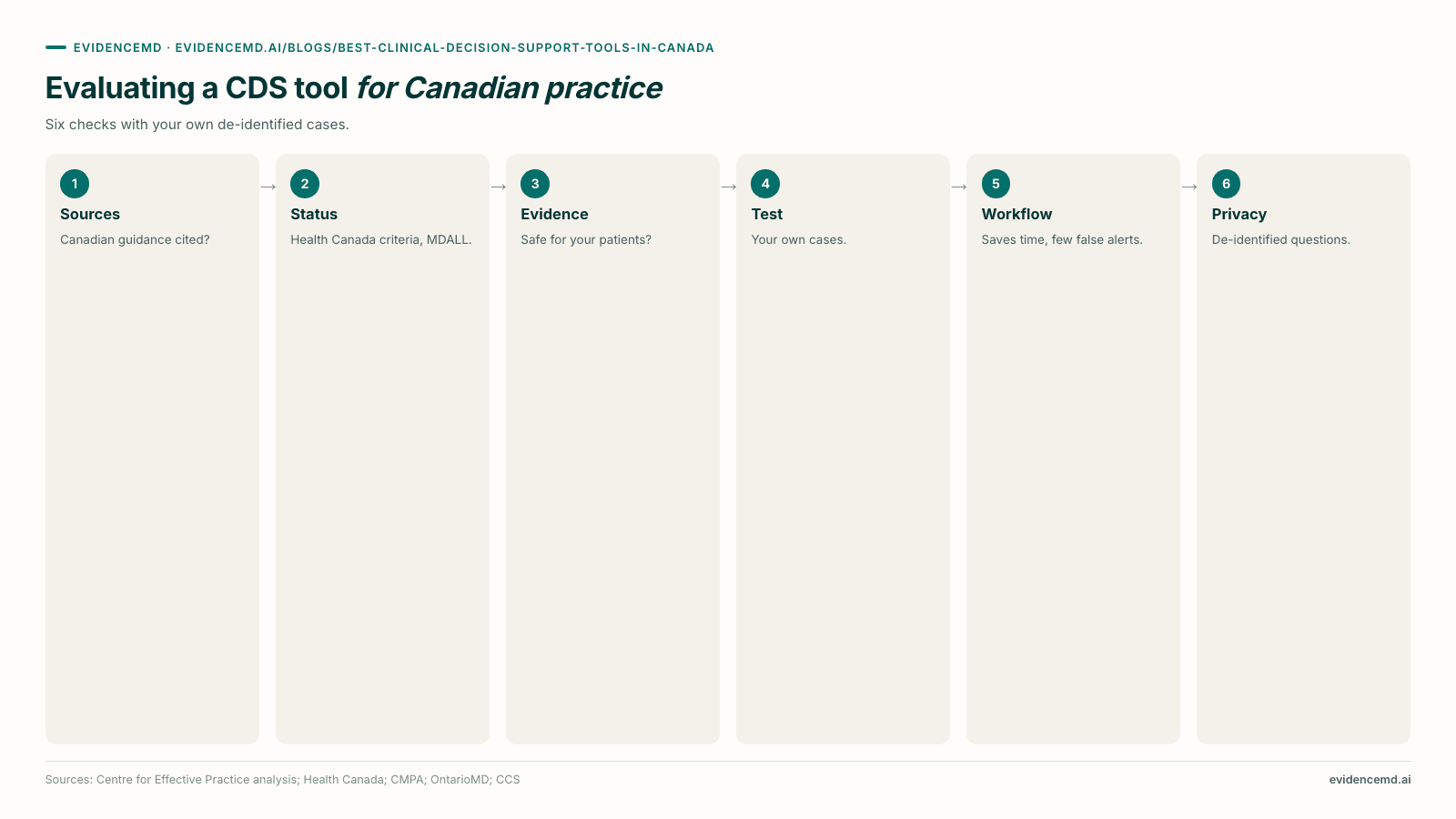
Six checks, using your own de-identified cases.
Find out whose guidance it uses
Ask which guidelines and sources the tool draws on, and look for Canadian ones among its citations; in the Centre for Effective Practice analysis, only 6% of AI tools referenced Canadian clinical sources [9].
Ask for evidence it works for your patients
The CMPA's checklist asks whether you have verified the tool's efficacy and safety, and whether its training data represent your patient population [8].
Run your own cases
Ask it questions you answered last month, de-identified, and compare its answers with the Canadian guideline, for example the CCS statin thresholds for primary prevention [23].
Privacy rules by province
This guide does not cover PIPEDA, PHIPA and the provincial health privacy acts in detail. The Canadian medical AI guide on this site sets out each province's rules and the colleges' guidance on AI [27].
Frequently asked questions
Which clinical decision support tools do Canadian family physicians use?
Typically several: a point-of-care reference such as UpToDate or DynaMed, CPS for Canadian drug information, the prescribing alerts in their EMR and, in Ontario, Evidence2Practice tools, plus Canadian guidelines and pathways. For a cited answer to a specific clinical question, EvidenceMD shows its reasoning step by step, framed to Canadian guidelines.
Is clinical decision support software a medical device in Canada?
Only if it meets the device definition and fails one of Health Canada's four exclusion criteria: it must not analyze images or signals, must display or analyze medical information, must only support a decision, and must not replace clinical judgment, with the basis of its recommendations open to review. Health Canada does not intend to regulate drug interaction reference software for professionals. Ask any vendor, EvidenceMD included, how it classifies its product.
What is Evidence2Practice Ontario?
E2P is a program led jointly by the Centre for Effective Practice, Amplify Care and North York General Hospital, with funding from Ontario Health, that puts tools for heart failure, anxiety disorders and depression, prediabetes and type 2 diabetes, and COPD inside primary care EMRs such as TELUS PS Suite and Accuro at no cost. EvidenceMD complements it for questions outside those conditions, with the reasoning and sources shown.
Do AI clinical decision support tools use Canadian guidelines?
Often not visibly. A Centre for Effective Practice analysis of 53 AI-enabled CDS solutions found that only 6% referenced Canadian clinical sources and that evidence-base descriptions were often vague. EvidenceMD frames the country-specific parts of an answer to the user's country guidelines and cites each claim, so you can see whether a Canadian source was used.
What clinical decision support is built into Canadian EMRs?
Two kinds: prescribing alerts driven by a drug database, such as First DataBank in Accuro, and condition-specific tools such as Ontario's Evidence2Practice tools, whose COPD tool runs in PS Suite and Accuro. Ask which database your EMR uses and how its alerts are tiered. EvidenceMD works alongside the EMR, answering the clinical question itself with cited, step-by-step reasoning.
Which clinical decision support tools work in French in Canada?
CPS content is available in English and French, INESSS publishes Québec guidance in French, and the Thrombosis Canada app has French versions of its clinical tools. EvidenceMD answers in 30 languages, French included, with the same cited reasoning as in English.
How do I check a clinical decision support answer against Canadian guidance?
Open the citations and see whether the Canadian guideline is among them, then compare the recommendation with it; in primary prevention, for example, the CCS recommends a statin at intermediate Framingham risk (10% to 19.9%) when LDL-C is 3.5 mmol/L or more, or non-HDL-C 4.2 mmol/L or more. Confirm the dose in CPS and coverage on your provincial formulary. EvidenceMD shows each step and its source, which makes this check quicker.
The bottom line
The best clinical decision support set-up in Canada is one tool per job: a topic reference such as UpToDate or DynaMed, CPS for the Canadian product and dose, the alerts inside your EMR and, in Ontario, Evidence2Practice tools, Canadian guidelines and pathways as the yardstick, and an AI clinical reasoning tool for the question about the patient in front of you [11][15][16][17][23]. EvidenceMD fills that last job: it answers from 40 million+ peer-reviewed papers and clinical guidelines, shows its reasoning step by step with a citation for every claim, and frames the Canadian parts to Canadian guidelines [1]. Whatever you use, check it against Health Canada's four criteria, look for Canadian sources among its citations, and keep identifiers out of tools hosted outside Canada [3][6][9].
Sources & related evidence
EvidenceMD's own pages (company claims), then Health Canada and the CMPA, Ontario reports on AI decision support and Evidence2Practice, OntarioMD's EMR records, the references' and drug database publishers' pages, Canadian guideline and pathway publishers, and the CCS guideline, risk calculator and trial used in the worked example.
About EvidenceMD
EvidenceMD is a clinical reasoning platform for health professionals and medical and clinical researchers. It answers clinical questions from 40 million+ peer-reviewed papers and clinical guidelines with the reasoning shown step by step and a citation for every claim, frames the country-specific parts of an answer to the user's country guidelines, answers in 30 languages including French, and needs no NPI or licence check. It is free to start, and its application data is hosted in the United States. Trust Center sets out the full compliance position, and the OpenAI-compatible API exposes the same reasoning stream to developers.
Related reading
Cited answers framed to Canadian guidance
Ask EvidenceMD a de-identified clinical question and read the reasoning and the sources behind the answer. No licence check, free to start.