How can AI help family physicians in Canada?
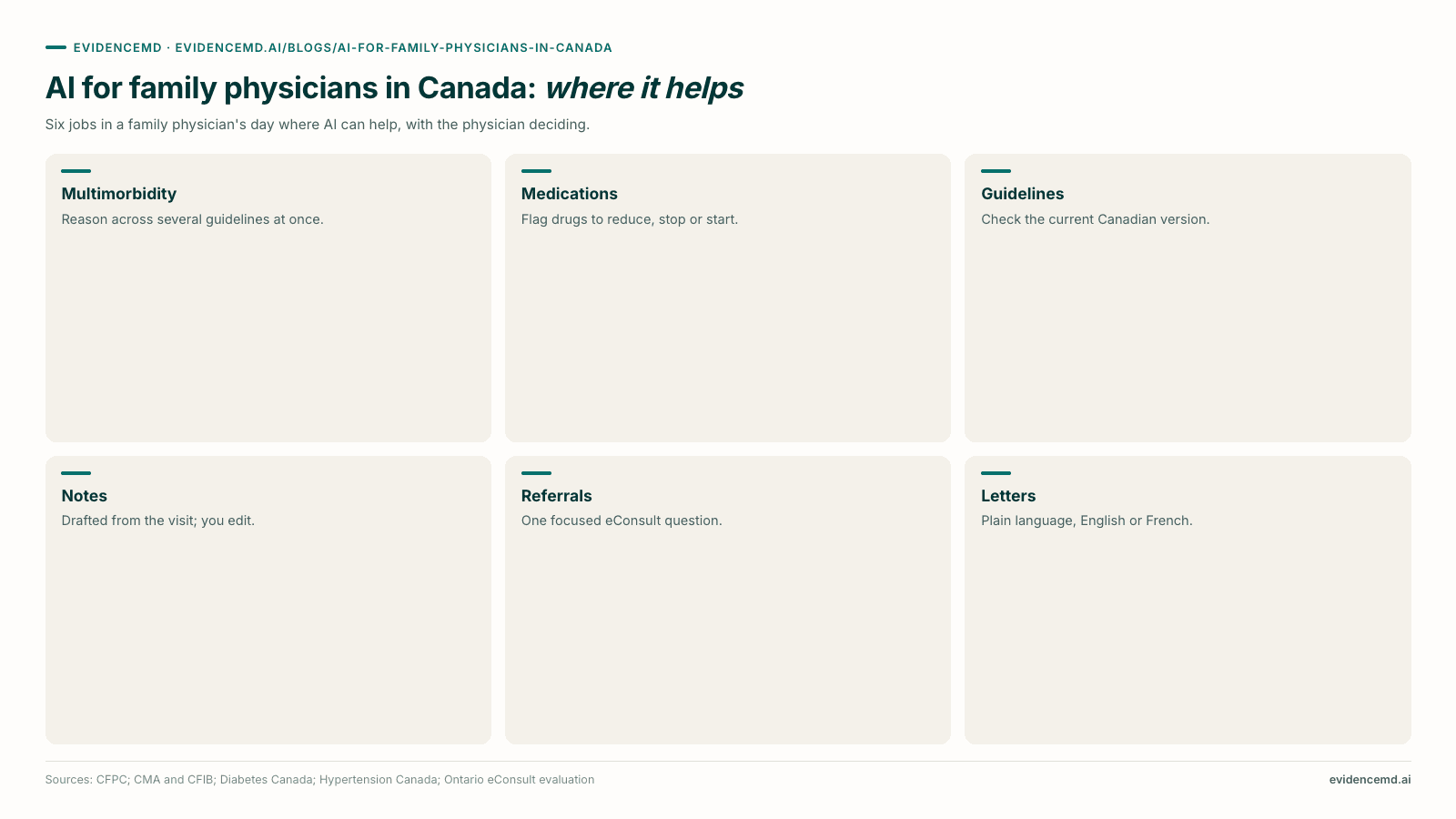
AI helps Canadian family physicians most with the work around the visit: reasoning through patients with several conditions, checking Canadian guidelines, and drafting notes, referrals and letters. EvidenceMD answers the specific clinical question from 40 million+ papers and guidelines, shows its reasoning step by step with a citation for every claim, and frames the Canadian parts to Canadian guidelines [1]. The physician still makes every decision.
Key takeaways
- Paperwork is the measured problem. The CMA and CFIB estimate that physicians lose 20 million hours a year to unnecessary administrative work, up to 199 hours for an individual doctor [5].
- AI scribes are common but not universal. In the same January 2026 survey, 28% of physicians used at least one AI scribe tool and another 42% were interested; the CFPC reports 64 minutes a day saved among physicians already using AI [5][6].
- The CFPC keeps the physician in charge. Its statement on AI says tools should not replace clinical judgment and that humans should remain in full control of medical decisions [7].
- Key guidelines changed recently. Diabetes Canada updated its pharmacologic chapter in 2024, Hypertension Canada lowered its thresholds in 2025, and on June 10, 2026 the Public Health Agency of Canada announced a new committee replacing the Canadian Task Force on Preventive Health Care [8][12][13].
- Clinical reasoning helps most with multimorbidity. For a patient with diabetes, kidney disease and heart failure, EvidenceMD reasons across Diabetes Canada and Canadian Cardiovascular Society guidance step by step, with a citation for each claim [1][8][11].
- Keep identifiers out of tools not approved for them. EvidenceMD stores application data in the United States, so describe the case, not the patient [3][16].
Where does AI help a family physician in Canada in 2026?
In the work around the visit more than in the visit itself: the complex question, the guideline check and the paperwork that follows.
AI helps a Canadian family physician most where the day is heaviest: the patient with four conditions and a dozen medicines, the guideline you need to check before you prescribe, and the notes, forms and letters that follow every visit. The College of Family Physicians of Canada (CFPC) describes family medicine as comprehensive, often undifferentiated and broad in scope, and its statement on AI says tools should support family physicians' knowledge and roles while humans remain in full control of medical decisions [7].
| Task | Where AI can help | What stays with you | Canadian source to check |
|---|---|---|---|
| Patient with several chronic conditions | Reasoning across the guidelines for each condition at once, with the evidence for each step | Weighing goals, frailty and what the patient wants | Diabetes Canada; Canadian Cardiovascular Society; Hypertension Canada [8][11][12] |
| Medication review | Flagging drugs to reduce or stop, and dose limits at the patient's kidney function | Every prescribing decision | CPS monographs; your provincial formulary [17] |
| Guideline lookups | Answering the specific question, framed to Canadian guidance, with the source cited | Opening the source before you act | The current Canadian guideline, such as Diabetes Canada or Hypertension Canada [8][12] |
| Notes and forms | Drafting the visit note from a recording or your dictation | Reading and correcting every draft | CFPC: review and edit every AI summary [6] |
| Referrals and eConsults | Turning a long chart into a focused clinical question | Choosing the pathway and the urgency | Your provincial eConsult or referral service [14] |
| Patient letters | Plain-language explanations, in English or French | Accuracy for this patient; no identifiers in tools not approved for them | CMPA on consent to sharing health information [15] |
→ Scroll the table sideways to see the remaining columns
How can AI help with multimorbidity and polypharmacy in family practice?
By reasoning across conditions that guidelines usually treat one at a time.
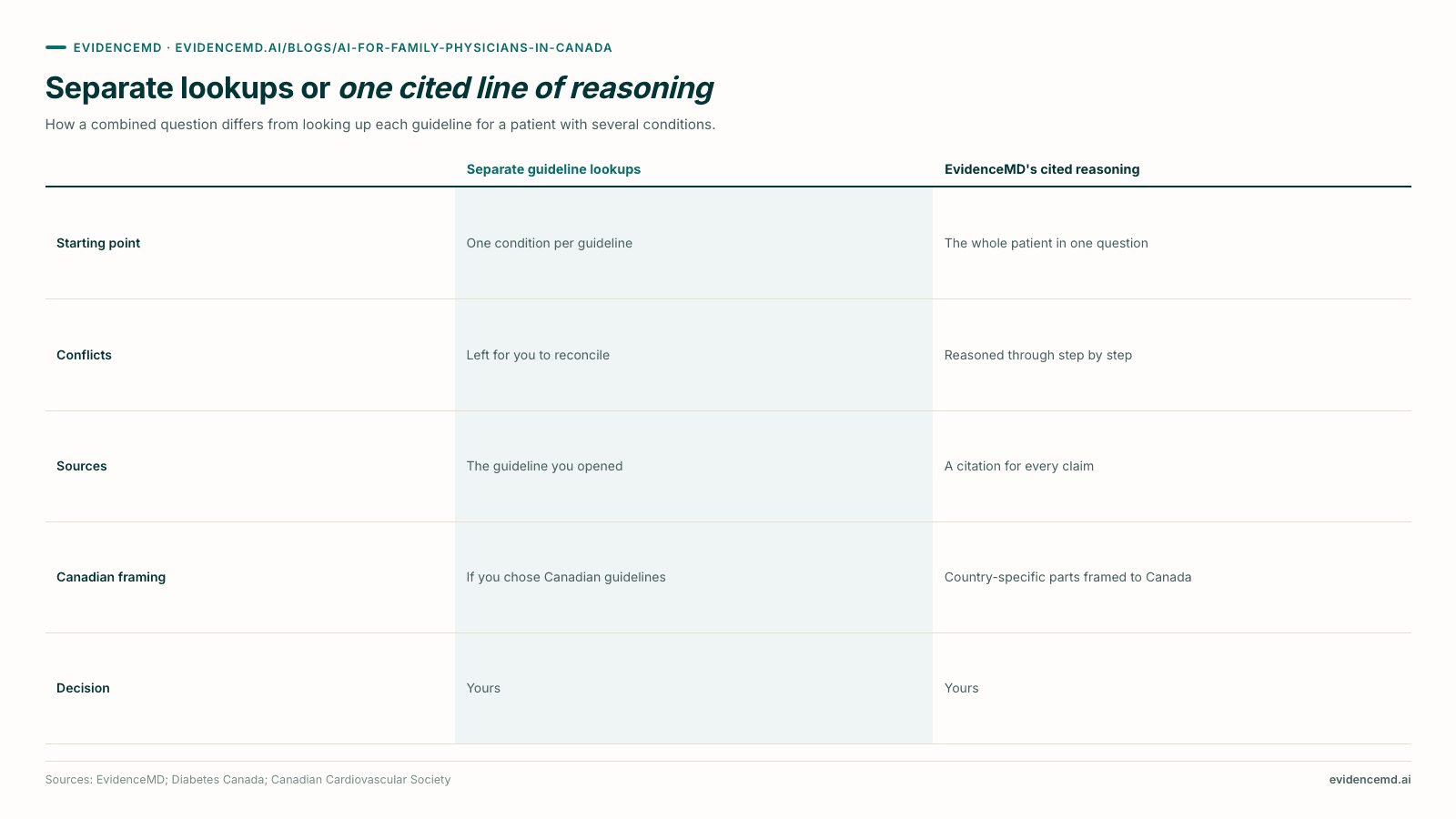
Clinical practice guidelines are mostly written one condition at a time, while an older patient in family practice may have diabetes, kidney disease and heart failure together. The useful question is therefore not what the diabetes guideline says, but what should change for this patient given all three. Diabetes Canada's 2024 update says glycemia should not be the only reason to consider an agent with cardiorenal benefit, and the Canadian Cardiovascular Society's 2022 guideline recommends SGLT2 inhibitors for heart failure with reduced ejection fraction and for albuminuric chronic kidney disease, so one prescribing decision can draw on two guidelines at once [8][11].
Polypharmacy adds a second layer: the same patient may still take a drug that suited them ten years ago and is now a risk. Diabetes Canada advises caution with sulfonylureas in older people because the risk of hypoglycemia increases substantially with age, and recommends stopping agents that raise hypoglycemia risk in older people with multiple comorbidities or frailty [10]. A tool that shows its reasoning lets you see which guideline each step comes from, and where this patient's situation should override it.
Ask the combined question
Describe the conditions, medicines, kidney function and recent events in one de-identified question, rather than one condition at a time.
Check each step's source
Look for a citation on every claim, and open the ones you would act on [1].
Confirm the Canadian product
Check dose, interactions and coverage in a Canadian reference such as CPS and in your provincial formulary before you prescribe [17].
Which Canadian guidelines should an AI answer reflect in family practice?
Four sources to check: two updated since 2024, one from 2022, and one body that has been replaced.
An AI answer is only as current as the guideline behind it, and several guidelines Canadian family physicians use every week have changed since 2024. EvidenceMD frames the country-specific parts of an answer to the user's country guidelines, so for a Canadian physician the recommendation points to Canadian sources; still check the date of the guideline it cites [1].
| Guideline | What it says now | What to check in an AI answer |
|---|---|---|
| Diabetes Canada, pharmacologic glycemic management of type 2 diabetes | A 2024 update: glycemia should not be the only reason to consider an agent with cardiorenal benefit, and SGLT2 inhibitors are preferred over GLP-1 receptor agonists in people with heart failure [8] | That it reflects the 2024 update, not only the earlier chapter |
| Hypertension Canada, primary care guideline (2025) | Hypertension defined as 130/80 mm Hg or higher with a validated device under optimal conditions; a systolic target below 130 mm Hg if tolerated; initial low-dose combination therapy, ideally as a single pill, from two of three drug classes [12] | That it uses the 2025 thresholds and target |
| Canadian Cardiovascular Society, cardiorenal risk reduction (2022) | SGLT2 inhibitors for heart failure with an ejection fraction of 40% or less, and for chronic kidney disease with a urine albumin-to-creatinine ratio above 20 mg/mmol and an eGFR of at least 25 [11] | The eGFR and albuminuria thresholds against your patient's results |
| Canadian Task Force on Preventive Health Care | Replaced by the National Advisory Committee on Preventive Health Services, announced by the Public Health Agency of Canada on June 10, 2026 [13] | Which body issued a screening recommendation, and when |
→ Scroll the table sideways to see the remaining columns
How much paperwork could AI take off a Canadian family physician?
Some of it. The CMA and CFIB measured the burden in January 2026, and the CFPC has asked governments to help pay for the tools.
A January 2026 report from the Canadian Medical Association and the Canadian Federation of Independent Business, Losing doctors to desk work, estimated that physicians lose 20 million hours a year to unnecessary paperwork and administrative tasks, up to 199 hours a year for an individual doctor [5]. In the same survey, 28% of physicians said they use at least one AI scribe tool, and another 42% expressed interest [5].
The CFPC's 2026 policy paper on AI scribes reports that physicians already using AI saved an average of 64 minutes of work a day, and that 49% of respondents named uncertainty about compliance, data handling, confidentiality and liability as a top concern [6]. It asks the federal government for sustained funding to help family physicians adopt the technology, and for legislation that moves the burden of risk from physicians to AI vendors. It also says it is imperative that family physicians review the AI-generated summary and edit it as needed [6].
For notes, EvidenceMD's Physician Scribe drafts documentation from a recorded or uploaded consultation in templates such as a SOAP note, a consult note or a patient handout, on the web and in the mobile apps [4]. EvidenceMD is free to start, with paid individual plans from US$50 a month or US$450 a year [2]. Funded scribe programs and vendor lists are covered in the guide to AI medical scribes in Canada on this site [19].
Scribes are only part of the paperwork
Physicians in the CMA and CFIB survey traced unnecessary work to health-system processes, insurance companies, government forms, pharmacies and electronic record systems, not only to charting [5]. A scribe shortens the note; it does not remove a form.
Can AI help with referrals, eConsults and patient letters?
Yes, mainly by turning a long chart into a short, specific question or a plain-language explanation.
A good referral or eConsult starts with one focused question, and drafting that question from the relevant, de-identified facts is a task AI handles well. eConsult often settles the question without a referral: in the first two years of the provincial Ontario eConsult Service, 60,474 eConsults received a median specialist response of one day, and an originally planned referral was avoided in 51% of cases [14].
Patient letters follow the same rule: AI drafts, you check. EvidenceMD answers in 30 languages, including French, so a family physician can prepare an explanation in the language the patient reads most easily and then check it [1]. When a letter, referral or note will contain identifiable information, use only tools your organization has approved for it; the CMPA asks physicians to understand the risks and benefits of each AI tool they use and to make sure patients have consented to the collection, storage or sharing of their health information [15].
Pick the one question
What exactly should the specialist answer: a diagnosis, the next test, a drug choice?
Give only the relevant facts
Age, key findings, results and current medicines, without names, health card numbers or exact dates.
Check the reasoning first
Asking EvidenceMD before you send can sharpen the question, because the reasoning and sources are visible [1].
Send it through your pathway
Use your province's eConsult or referral service, and keep the decision on urgency yours [14].
How does EvidenceMD reason through a complex medication question?
A de-identified case from family practice: diabetes, kidney disease and heart failure in an older patient on several drugs.
The question, as a family physician might type it: an 81-year-old woman with type 2 diabetes (A1C 7.3%), chronic kidney disease with an eGFR of 38 mL/min/1.73 m² and a urine albumin-to-creatinine ratio of 34 mg/mmol, and heart failure with an ejection fraction of 35%. She takes metformin 500 mg twice daily, gliclazide MR, ramipril, bisoprolol and furosemide, lives alone, walks with a walker, and has had two hypoglycemic episodes in three months. Which diabetes medicines should change?
Step 1: safety before targets. EvidenceMD starts with the hypoglycemia. Diabetes Canada's chapter on older people recommends strictly preventing hypoglycemia in older people with multiple comorbidities or frailty, discontinuing agents that increase its risk, and allows higher A1C targets of 7.1–8.0% for people who are functionally dependent and 7.1–8.5% for people who are frail [10]. Her A1C of 7.3% sits within either range, so lowering glucose further is not the goal; the same chapter advises caution with sulfonylureas because hypoglycemia risk increases substantially with age, which makes gliclazide the first drug to reduce or stop [10].
Step 2: kidney function and metformin. Diabetes Canada lists metformin as contraindicated below an eGFR of 30 and to be used with caution between 30 and 60, so at 38 metformin can continue with caution and regular eGFR monitoring, and must stop if her eGFR falls below 30 [9].
Step 3: an agent for her heart and kidneys. The Canadian Cardiovascular Society recommends an SGLT2 inhibitor in heart failure with an ejection fraction of 40% or less, to reduce death and heart failure hospitalization and to protect the kidneys, and in chronic kidney disease with a urine albumin-to-creatinine ratio above 20 mg/mmol and an eGFR of at least 25; she meets both [11]. Diabetes Canada's 2024 update adds that glycemia should not be the only reason to choose such an agent, that SGLT2 inhibitors are preferred over GLP-1 receptor agonists in heart failure, and that their glucose-lowering effect falls as kidney function declines, so here the benefit is cardiorenal rather than glycemic [8].
Step 4: sick-day rules. The answer adds Diabetes Canada's sick-day advice for her diabetes drugs: hold metformin and the SGLT2 inhibitor during illnesses with a risk of dehydration or acute kidney injury, and hold a sulfonylurea if she is not eating [8]. Diabetes Canada's sick-day medication list also includes ACE inhibitors and diuretics among the drugs to hold when a patient cannot keep up fluid intake, so ramipril and furosemide belong on her sick-day plan too [21].
What stays with the physician. The answer sets out the evidence; it does not prescribe. Whether to stop gliclazide outright or halve it first, when to start the SGLT2 inhibitor, how to adjust her diuretic, whether her provincial plan covers the drug, and what she wants from treatment are decisions for the family physician and the patient. Confirm the dose in the CPS monograph before prescribing [17]. Because EvidenceMD stores application data in the United States, the question describes the case, not the person [3].
Ask EvidenceMD a medication question from your practice
Describe a de-identified patient with several conditions and read the reasoning and the sources behind each step.
What should a family physician check before acting on an AI answer?
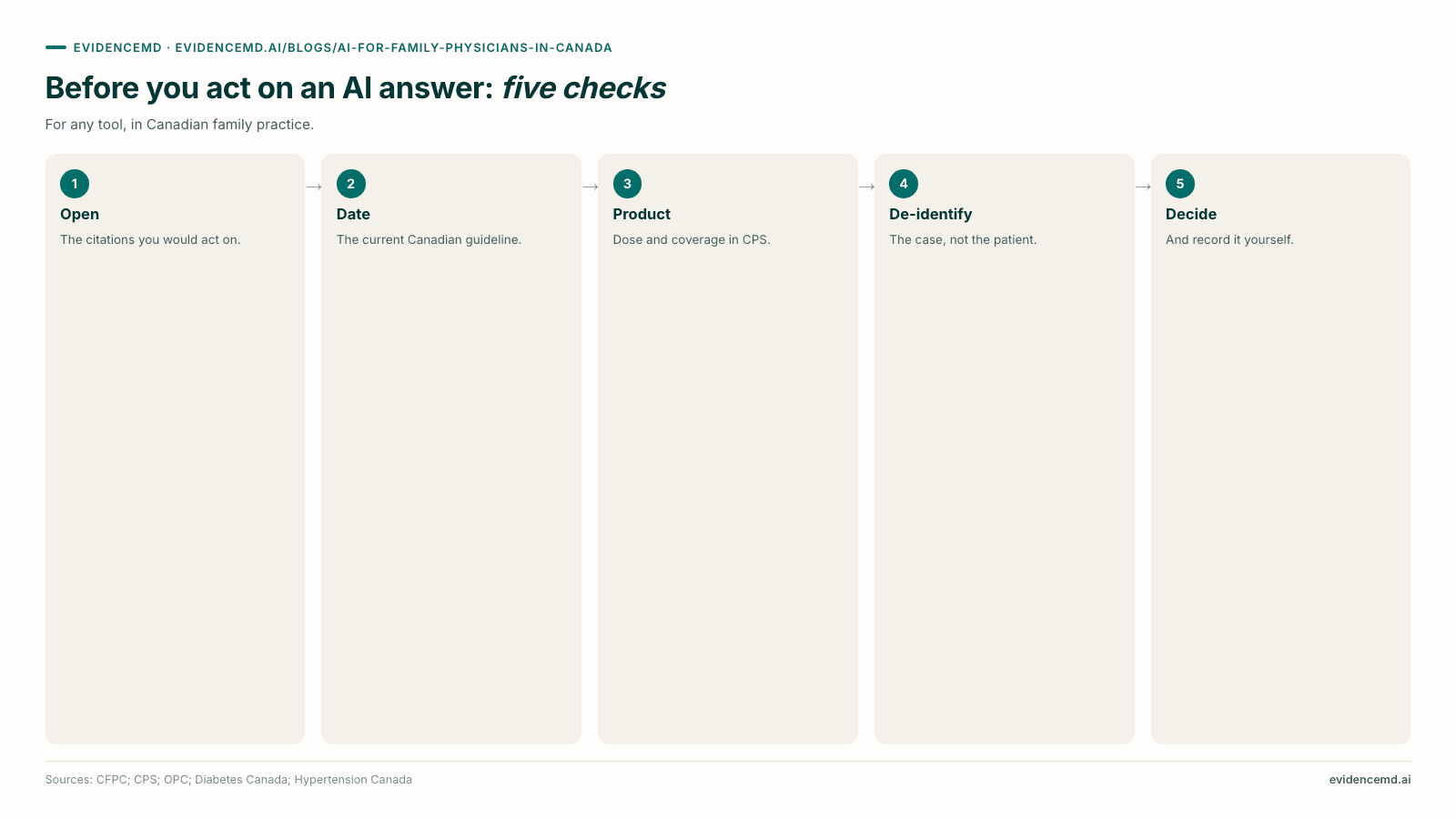
Five checks that apply to any tool, EvidenceMD included.
Open the citations
Confirm that each source says what the answer says it does, starting with the claims you would act on [1].
Confirm the Canadian product
Check dose, interactions and coverage in CPS and in your provincial plan [17].
Keep identifiers out
Under PIPEDA, an organization that sends personal information to a processor outside Canada stays accountable for it; describe the case, not the patient, unless your privacy assessment covers the tool [16].
Record your own decision
The decision and the note are yours; the CFPC's statement says humans should remain in full control of medical decisions [7].
Frequently asked questions
How are family physicians in Canada using AI in 2026?
Mostly for documentation: in a CMA and CFIB survey published in January 2026, 28% of physicians said they use at least one AI scribe tool and another 42% were interested [5]. Family physicians also use AI to check guidelines, review medication lists and draft referrals and letters. For the clinical question itself, EvidenceMD answers from 40 million+ papers and guidelines with its reasoning shown and a citation for every claim [1].
What is the CFPC's position on artificial intelligence in family medicine?
The CFPC supports AI for family medicine when it is developed and used responsibly: its statement says AI should support family physicians' roles without replacing their clinical judgment, and that humans should remain in full control of medical decisions [7]. Its 2026 policy paper asks the federal government to fund AI scribes for family physicians and to move the burden of risk toward vendors [6]. EvidenceMD shows its reasoning step by step, so the physician can check each claim before deciding.
Can AI help review medications for an older patient with several chronic conditions?
Yes, as a second pair of eyes: an AI tool can flag drugs that raise hypoglycemia risk, dose limits at the patient's eGFR and agents with cardiorenal benefit, drawing on Diabetes Canada and the Canadian Cardiovascular Society [10][11]. EvidenceMD lays out that reasoning step by step with a citation for each claim. The decisions, and the conversation with the patient, stay with you.
Does the Canadian Task Force on Preventive Health Care still exist?
No. On June 10, 2026, the Public Health Agency of Canada announced the National Advisory Committee on Preventive Health Services, replacing the Canadian Task Force on Preventive Health Care [13]. When an AI tool cites a screening recommendation, check which body issued it and when; EvidenceMD shows the source behind each claim, so the date is visible.
What blood pressure threshold does Hypertension Canada use in primary care?
Hypertension Canada's 2025 primary care guideline defines hypertension as 130/80 mm Hg or higher, measured with a validated device under optimal conditions, sets a systolic target below 130 mm Hg if tolerated, and recommends starting with low-dose combination therapy, ideally as a single pill [12]. Earlier Hypertension Canada guidelines used higher thresholds, so check that an answer reflects the 2025 guideline; EvidenceMD frames such answers to Canadian guidance and cites the source.
Can AI draft referral letters and eConsult questions for a family physician?
Yes, from de-identified facts, and you edit and send them through your provincial pathway. eConsult often settles the question: in Ontario's first two provincial years, the median specialist response was one day and a planned referral was avoided in 51% of cases [14]. Asking EvidenceMD first can sharpen the question, because it shows the reasoning and evidence behind a likely answer.
Is it safe for a family physician in Canada to enter patient details into an AI tool?
Only into a tool your organization has assessed for that use. The CMPA asks physicians to understand each AI tool's risks and benefits and to make sure patients have consented to the collection, storage or sharing of their health information, and under PIPEDA an organization stays accountable for personal information it sends to a processor outside Canada [15][16]. EvidenceMD stores application data in the United States, so use it with de-identified questions [3].
The bottom line
AI earns its place in Canadian family practice where the work is heaviest: the patient with several conditions, the guideline that changed last year, and the paperwork after the visit. The CMA and CFIB found that 28% of physicians already use an AI scribe, and the CFPC asks that every AI summary be reviewed and that humans stay in control of medical decisions [5][6][7]. For the clinical question, EvidenceMD reasons through the case step by step from 40 million+ papers and guidelines, cites every claim and frames the Canadian parts to Canadian guidelines [1]. Check the source, confirm the Canadian product in CPS, keep identifiers out, and make the decision yourself [16][17].
Sources & related evidence
EvidenceMD's own pages (company claims), then the CMA and CFIB survey, the CFPC's statement and policy paper, the Diabetes Canada, Canadian Cardiovascular Society and Hypertension Canada guidelines used in the guide and the worked example, the Public Health Agency of Canada, the Ontario eConsult evaluation, the CMPA, the Office of the Privacy Commissioner of Canada, CPS, and related guides on this site.
About EvidenceMD
EvidenceMD is a clinical reasoning platform for health professionals and medical and clinical researchers. It answers clinical questions from 40 million+ peer-reviewed papers and clinical guidelines with its reasoning shown step by step and a citation for every claim, frames the country-specific parts of an answer to the user's country guidelines, answers in 30 languages including French, and needs no NPI or licence check. It is free to start. Application data is hosted in the United States. Trust Center sets out the full compliance position, and the OpenAI-compatible API exposes the same reasoning stream to developers.
Related reading
Reason through your next complex patient
Ask EvidenceMD a de-identified question about a patient with several conditions and read the reasoning and sources behind each step. No licence check, free to start.