What are the best medical apps for doctors in Canada?
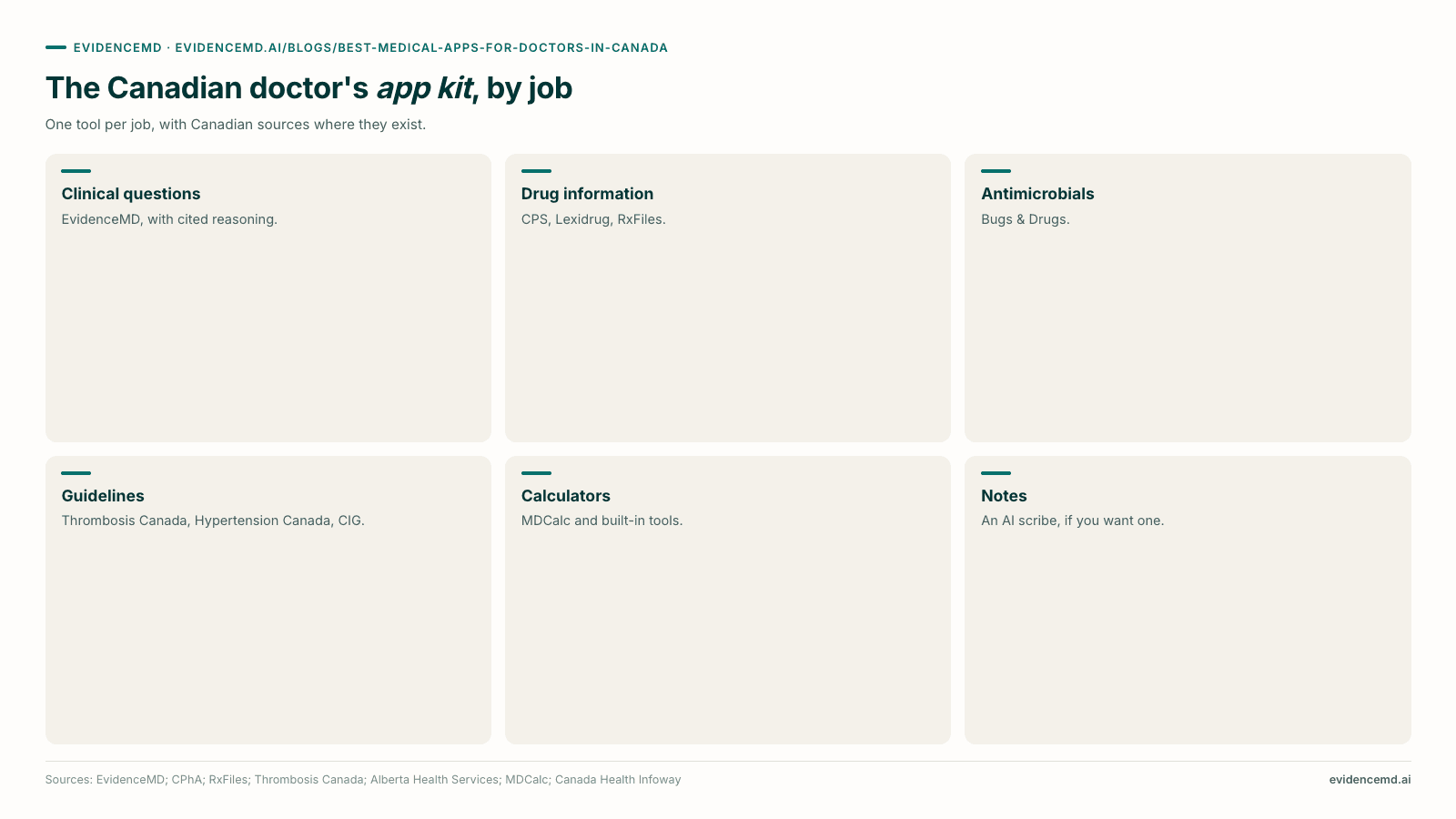
The best medical apps for doctors in Canada are a kit grouped by job, not one app. EvidenceMD answers the clinical question with step-by-step reasoning and a citation for every claim; CPS, Lexidrug and RxFiles cover Canadian drug information; Thrombosis Canada, Bugs & Drugs and Hypertension Canada cover common decisions; MDCalc handles scores; a scribe drafts notes. Check your health authority's library first [1][8][11][12][15][17][20].
Key takeaways
- Group apps by job. One app for the clinical question, one Canadian drug reference, the guideline sources you use weekly, a calculator and, if you want one, a scribe. Overlap wastes money; gaps send you back to a search engine.
- CMA membership no longer covers CPS or DynaMed. Access through the CMA ended on June 28, 2023; the Saskatchewan Health Authority library and SHIRP, among others, now provide them to physicians in that province [13].
- CPS is the Canadian drug reference, and the app comes with it. CPS Drug Information costs $468.18 a year and Full Access $784.38, both with the CPS app and content in English and French; RxFiles adds class-by-class comparison charts for $135 a year [8][11].
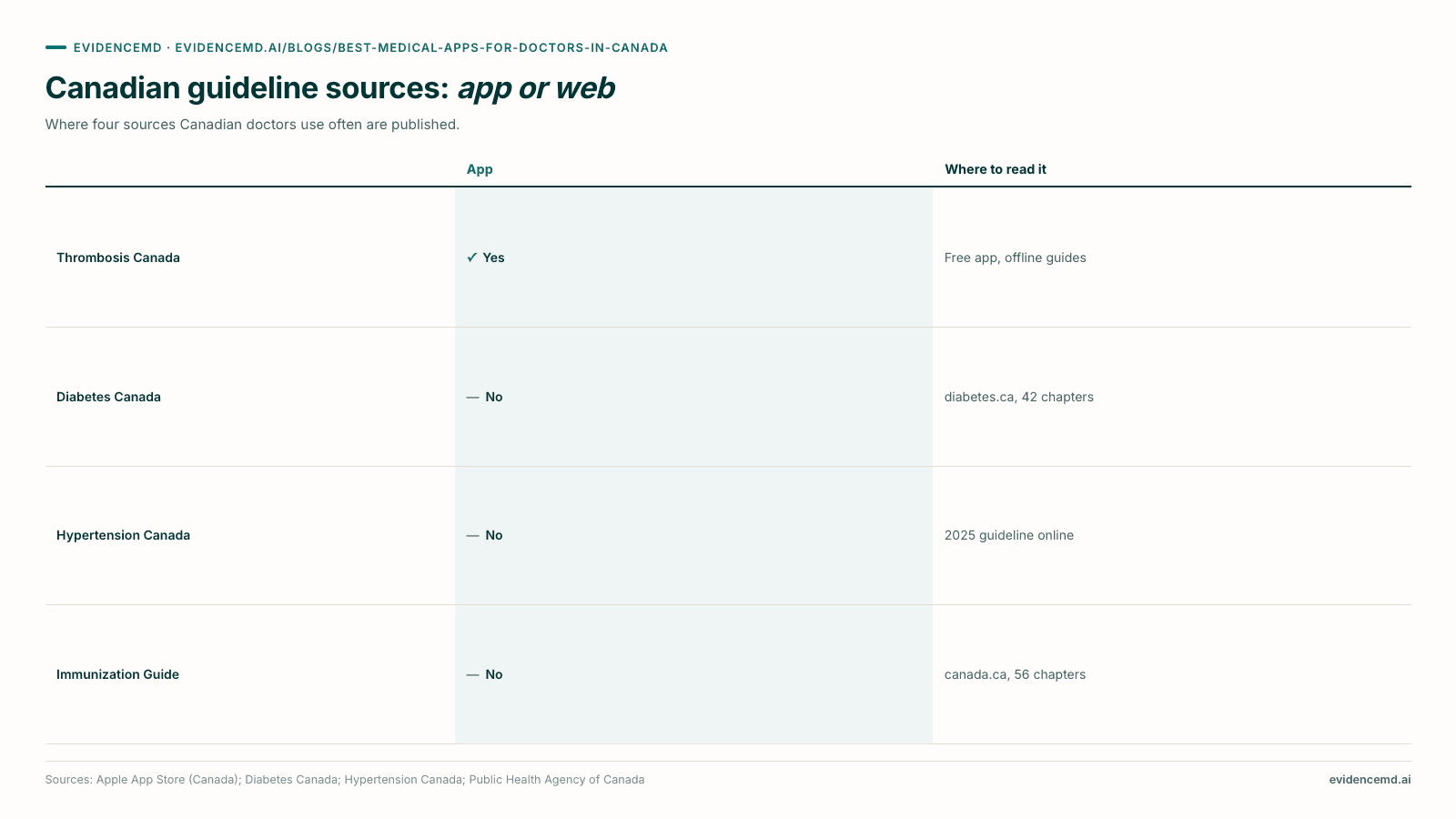
- Some guideline apps have gone. The Diabetes Canada guidelines app is no longer in the Canadian App Store, and Hypertension Canada lists no app; both guidelines are on the web [16][18].
- Several useful apps cost nothing. Thrombosis Canada and Bugs & Drugs are free in the Canadian App Store, MDCalc is free on the web and in its app, and BC's Pathways is free for BC physicians [12][15][20][24].
- For the question itself, EvidenceMD answers from the literature and guidelines with its reasoning shown; it is free to start, with paid plans from US$50 a month or US$450 a year, and its data is hosted in the United States, so ask de-identified questions [1][2][3].
Which app answers clinical questions for Canadian doctors in 2026?
The job: a specific question about the patient in front of you, answered with the evidence and the reasoning you can check.
For a specific clinical question, EvidenceMD answers from 40 million+ peer-reviewed papers and clinical guidelines and lays out its clinical reasoning step by step with a citation for every claim; OpenEvidence, UpToDate and DynaMed are the other common routes in Canada [1]. The difference from a reference library is the format: rather than returning a topic to read, EvidenceMD answers the question about this patient, shows how it got there and frames the country-specific parts of the answer to Canadian guidelines [1]. It answers in 30 languages, including French, needs no NPI or licence check, and turns a broader question into a DeepSearch report of typically 20 to 25 pages when you want to read around a topic [1].
Two other routes are common in Canada. Since September 11, 2026, Canadian physicians can verify with their MINC to keep no-cost access to OpenEvidence [6]. And whether UpToDate or DynaMed is paid for depends on your province, health authority or hospital; the Canadian UpToDate guide on this site maps those routes, so they are not repeated here [7].
EvidenceMD
A clinical reasoning platform. Answers specific questions from 40 million+ papers and guidelines, with the reasoning shown step by step and a citation for every claim; Canadian framing; French or English answers. Free to start; paid plans from US$50 a month or US$450 a year; hosted in the United States [1][2][3].
OpenEvidence
Cited answers to clinical questions. No-cost access for Canadian physicians who verify with their MINC, an option added on September 11, 2026 [6].
UpToDate and DynaMed
Edited topic libraries. Access depends on province and employer; check before paying personally [7].
Which medical apps do Canadian doctors use for drug information?
Canadian product monographs, doses and comparisons live in Canadian references; most physicians keep one of these on their phone.
For drug information, EvidenceMD answers the drug question about one patient with its reasoning shown [1], and the Canadian reference is CPS, the Canadian Pharmacists Association's compendium of Health Canada-approved monographs, which comes with its own app; Lexidrug, RxFiles and Bugs & Drugs cover what CPS does not do as directly [8]. The table gives each one's provider and price or access route in Canada, from the provider's own page or its Canadian App Store listing.
| App | Provider | Price or access in Canada | Best for |
|---|---|---|---|
| EvidenceMD | EvidenceMD | Free to start; paid plans from US$50 a month or US$450 a year [2] | The specific drug question about one patient, with its reasoning shown step by step and a citation for every claim; confirm the dose in CPS or the product monograph [1][8] |
| CPS (formerly RxTx) | Canadian Pharmacists Association | Drug Information $468.18 a year; Full Access $784.38 a year; 3-month Full Access $195; every subscription includes the CPS app [8][9] | Health Canada-approved monographs for drugs, vaccines and natural health products, a Lexidrug interaction checker and calculators, in English and French; Full Access adds therapeutic content for more than 200 conditions [8] |
| UpToDate Lexidrug | Wolters Kluwer | App free to download; new individual users get a one-month trial of the Hospital Pharmacist package, then $29.99 a month in the App Store [10] | Detailed dosing, adverse reactions and an interaction checker, with content stored for offline use [10] |
| RxFiles | RxFiles Academic Detailing, University of Saskatchewan | $135 for one year or $239 for two, online and in the app [11] | Comparing drugs within a class: Drug Comparison Charts (15th edition) and Geri-RxFiles for older adults (4th edition) [11] |
| Bugs & Drugs 2.0 | Alberta Health Services | Free in the Canadian App Store [12] | Antimicrobial choice: infections in children and adults, pregnancy, dental infections and microbiology; works offline once installed [12] |
→ Scroll the table sideways to see the remaining columns
Check your library before you buy
CPS and DynaMed are no longer a CMA member benefit, but many health authority libraries license them: the Saskatchewan Health Authority library offers both, and SHIRP extends them to Saskatchewan physicians outside the SHA [13]. In British Columbia, the CPSBC College Library has offered registrants the CPS app, BMJ Best Practice and DynaMed; confirm current access with the library [14].
Where do Canadian doctors find clinical guidelines on their phone?
Some Canadian guideline bodies publish apps; others now publish only on the web, which works well enough in a phone browser.
Canadian doctors find guidelines in a mix of free apps and guideline websites: Thrombosis Canada still has an app, while Diabetes Canada, Hypertension Canada and the Public Health Agency of Canada publish their guidance on the web. Each is free to use.
Thrombosis Canada
Free app with clinical tools for diagnosis, treatment and risk assessment, clinical guides that work offline and patient resources, reviewed for primary care applicability by members of the College of Family Physicians of Canada [15].
Diabetes Canada
The guidelines app is no longer in the Canadian App Store, and its old address now redirects to the full guidelines on diabetes.ca, organized in 42 numbered chapters [16].
Hypertension Canada
Lists no app among its professional resources. The 2025 primary care guideline, published in CMAJ and republished in Canadian Family Physician, defines hypertension as 130/80 mm Hg or higher and recommends a systolic target below 130 mm Hg [17][18].
Canadian Immunization Guide
The Public Health Agency of Canada's guide, built on NACI and CATMAT statements: 56 chapters in four parts, on the web, last modified February 27, 2026 [19].
A guideline app answers the question its authors anticipated. When a patient sits between two guidelines, or the question is about a trial published since the last update, a tool that reasons across the literature fills the gap; EvidenceMD frames the Canadian parts of its answer to Canadian guidelines and cites the source for each step [1].
How does EvidenceMD reason through a Canadian clinical question?
A de-identified question from family practice that touches a new Canadian guideline, a trial and a drug reference at once.
Take a question a family physician in Halifax might ask between patients: a 67-year-old man with treated hypertension on amlodipine and perindopril, an automated office blood pressure averaging 138/82 mm Hg over two visits, an eGFR of 70 mL/min/1.73 m², no diabetes and no dizziness on standing. Should his treatment be stepped up, and to what target?
EvidenceMD starts with the target. Hypertension Canada's 2025 primary care guideline defines hypertension as 130/80 mm Hg or higher, recommends a standardized approach to measuring blood pressure and sets a systolic target below 130 mm Hg, so at 138 mm Hg he is above it [17]. It then weighs the evidence for a lower target. In SPRINT, 9,361 adults at increased cardiovascular risk without diabetes were randomized to a systolic target below 120 or below 140 mm Hg; the intensive group had fewer major cardiovascular events (hazard ratio 0.75) and lower all-cause mortality (hazard ratio 0.73), but more hypotension, syncope, electrolyte abnormalities and acute kidney injury [21].
The recommendation follows from those two steps: confirm the reading with standardized office or home measurement; then, because he already takes two of the guideline's three drug classes (a long-acting dihydropyridine calcium channel blocker and an ACE inhibitor), add the third, a thiazide or thiazide-like diuretic, aiming for a systolic pressure below 130 mm Hg; and recheck electrolytes and creatinine after the change, because those were the harms seen with intensive treatment [17][21][27]. What stays with the physician: whether he has orthostatic symptoms or falls, what he is willing to take, and the dose, confirmed in the CPS monograph [8]. Every step carries its source, so you can disagree with any one of them.
Ask EvidenceMD a question from your own clinic
Try a de-identified clinical question and read the reasoning and the source behind each step.
Which calculator apps do Canadian doctors use?
Scores and formulas are a separate job from answering the question, and several free tools cover it.
For scores, EvidenceMD has more than 30 web calculators that open without an account [4]. MDCalc is free on the web and in its app, and CPS and the Thrombosis Canada app have calculators built in [8][15][20].
EvidenceMD calculators
More than 30 web calculators, including eGFR (CKD-EPI), creatinine clearance, CHA₂DS₂-VASc, HAS-BLED and PHQ-9, each using the original paper's criteria and citing it, with the option to send the result into EvidenceMD for a cited interpretation; they open without an account [4].
MDCalc
More than 900 calculators, risk scores and clinical tools; both the web and app versions are free for clinicians [20].
Where do AI scribes fit in a Canadian doctor's app kit?
Scribes are a separate job with their own funding programs and privacy questions, covered in full in a separate guide.
An AI scribe drafts the note from the visit, and in Canada the first question is often funding: Canada Health Infoway's national AI Scribe Program, launched in June 2025, provided fully funded one-year licences for pre-qualified scribes to eligible primary care clinicians [22]. Which scribes are funded, how Ontario's vendor list works and what data residency each offers are covered in the Canadian AI scribe guide on this site [23].
EvidenceMD's Physician Scribe drafts SOAP notes, histories and physicals, progress and consult notes and patient handouts from the visit, in a Clinical Reasoning style that adds citations or in a narrative or concise style [5]. It is not part of Infoway's program, and its data is hosted in the United States, which matters for any note that carries patient information [3][23].
Which provincial tools do Canadian doctors get at no personal cost?
Provinces and health authorities fund some of the most useful tools in the kit, and they differ by province.
Depending on the province, Canadian doctors get a referral directory, specialist e-advice or a point-of-care reference at no personal cost: Pathways in British Columbia, eConsult in Ontario, DynaMed through Alberta Health Services, and CPS and DynaMed through Saskatchewan's health library and SHIRP [13][24][25][26].
British Columbia: Pathways
A referral directory with each consultant's wait times, the conditions they see, virtual care options, forms and curated clinical tools. Role-based access costs nothing for BC physicians and their teams, nurse practitioners and midwives; funded by Doctors of BC and the BC Ministry of Health [24].
Ontario: eConsult
A secure web tool, reached mainly through OTNhub, that gets physicians and nurse practitioners specialist advice with a two-day average response for non-urgent questions, often without a referral, with remuneration through the OHIP claims process [25].
Alberta: DynaMed
Alberta Health Services' library does not subscribe to UpToDate and makes DynaMed available province-wide to AHS physicians and staff, including as an app [26].
Saskatchewan: SHA library and SHIRP
CPS and DynaMed for SHA physicians through the library, and for other Saskatchewan physicians through SHIRP [13].
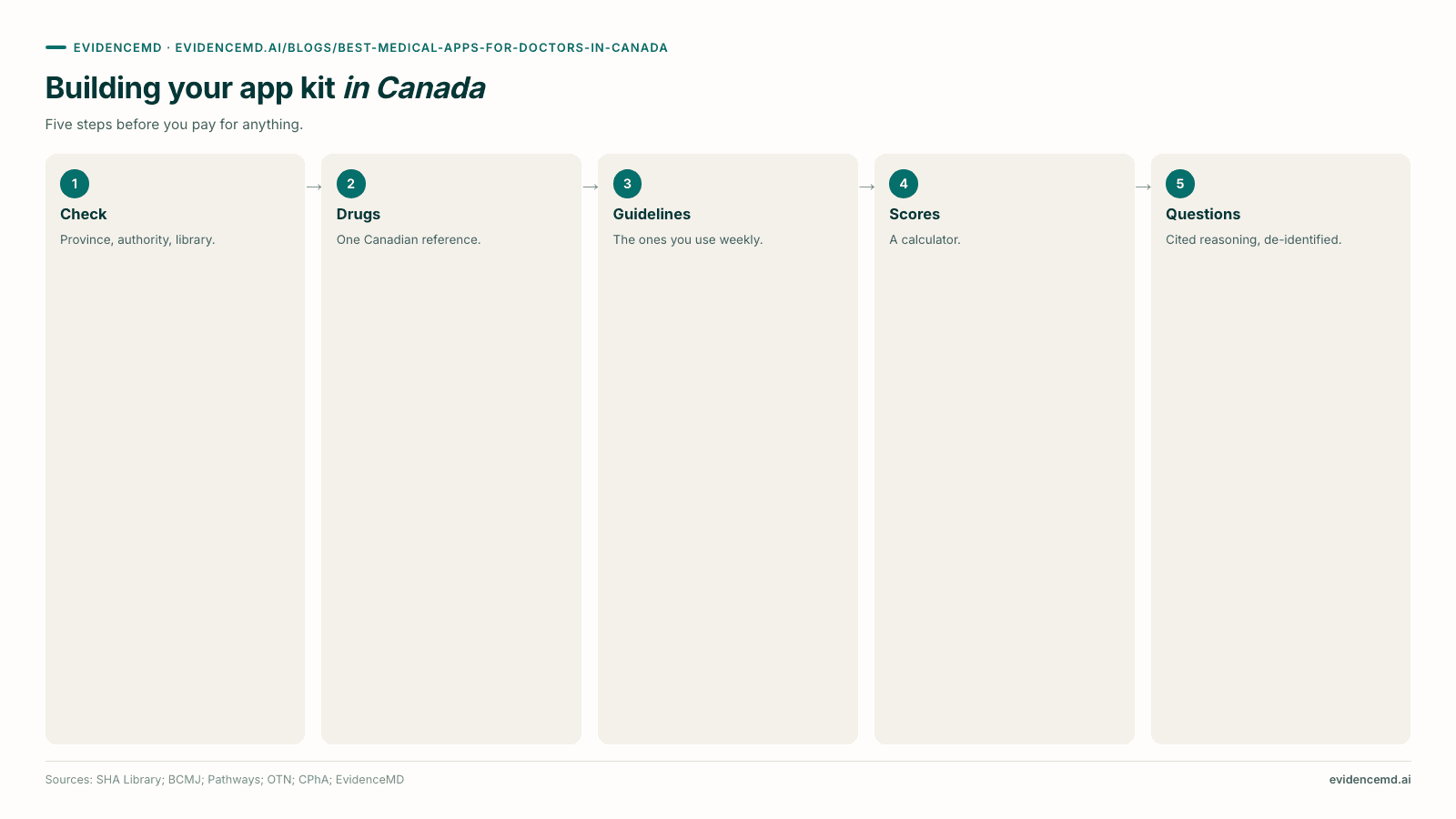
The pattern holds across the country: check your province, health authority and college library first, buy only what is missing, and keep one tool, such as EvidenceMD, for the clinical questions the rest of the kit does not answer directly [1].
Frequently asked questions
What medical apps do family physicians in Canada use?
A typical kit holds a Canadian drug reference such as CPS or RxFiles, guideline sources such as Thrombosis Canada and Hypertension Canada's 2025 guideline, a calculator such as MDCalc, and often an AI scribe. For the clinical question itself, EvidenceMD answers with its reasoning shown and a citation for every claim, framed to Canadian guidelines.
Does CMA membership still include CPS or DynaMed?
No. Access to CPS (formerly RxTx) and DynaMed through CMA membership ended on June 28, 2023. Many health authority libraries license them instead, as the Saskatchewan Health Authority library and SHIRP do. EvidenceMD is a separate, personal tool and needs no membership or licence check.
Is the CPS app free for Canadian doctors?
The CPS app is a free download, but the content needs a subscription: CPS Drug Information costs $468.18 a year and Full Access $784.38, and every subscription includes the app. Check your health authority library first. EvidenceMD complements CPS: it answers the clinical question, and CPS confirms the Canadian monograph and dose.
Is there still a Diabetes Canada guidelines app?
Not in the Canadian App Store, and the old app address now redirects to the full guidelines on diabetes.ca, which work in a phone browser. For a question that spans diabetes and another condition, EvidenceMD frames its answer to Canadian guidelines and cites each step.
What is the difference between CPS and RxFiles?
CPS is the Canadian Pharmacists Association's monograph reference for Health Canada-approved products, with dosing, interactions and, in Full Access, therapeutic content. RxFiles, from the University of Saskatchewan, publishes charts that compare drugs within a class, for $135 a year. Neither answers an open clinical question, which is the job EvidenceMD does.
Which medical apps answer in French for doctors in Quebec?
CPS publishes its content in English and French, and EvidenceMD answers in 30 languages, including French, with the same cited reasoning as in English. Wherever you practise, keep identifying patient information out of any tool your organization has not approved; with EvidenceMD, describe the case rather than the patient.
Which useful medical apps for Canadian doctors cost nothing?
Thrombosis Canada and Bugs & Drugs are free in the Canadian App Store, MDCalc is free on the web and in its app, the Canadian Immunization Guide is free online, and BC's Pathways costs nothing for BC physicians. EvidenceMD is free to start, with paid plans from US$50 a month.
The bottom line
The best medical apps for doctors in Canada are the ones that cover each job once. Keep a Canadian drug reference (CPS, with RxFiles or Lexidrug if you need them), the guideline sources you use weekly (Thrombosis Canada, Hypertension Canada's 2025 guideline, the Canadian Immunization Guide), a calculator such as MDCalc, and a scribe if your practice wants one [8][11][15][17][19][20]. Check what your province, health authority and college library already pay for, since CMA membership no longer does [13]. For the clinical question in between, EvidenceMD answers from 40 million+ papers and guidelines with its reasoning shown and a citation for every claim; ask it de-identified questions, because its data is hosted in the United States [1][3].
Sources & related evidence
EvidenceMD's own pages (company claims), then each app's provider page or Canadian App Store listing, Canadian library and health system pages, guideline bodies, the two studies behind the worked example, and the provincial programs.
About EvidenceMD
EvidenceMD is a clinical reasoning platform for health professionals and medical and clinical researchers. It answers clinical questions from 40 million+ peer-reviewed papers and clinical guidelines with a visible chain of reasoning and a citation for every claim, in 30 languages including French, and needs no NPI or licence check; it is free to start. Its application data is hosted in the United States. Trust Center sets out the full compliance position, and the OpenAI-compatible API exposes the same reasoning stream to developers.
Related reading
The clinical question, answered with its reasoning
Ask EvidenceMD a de-identified clinical question and read the step-by-step reasoning and the source behind each claim. No licence check, free to start.