Which AI tools should every doctor know in 2026?
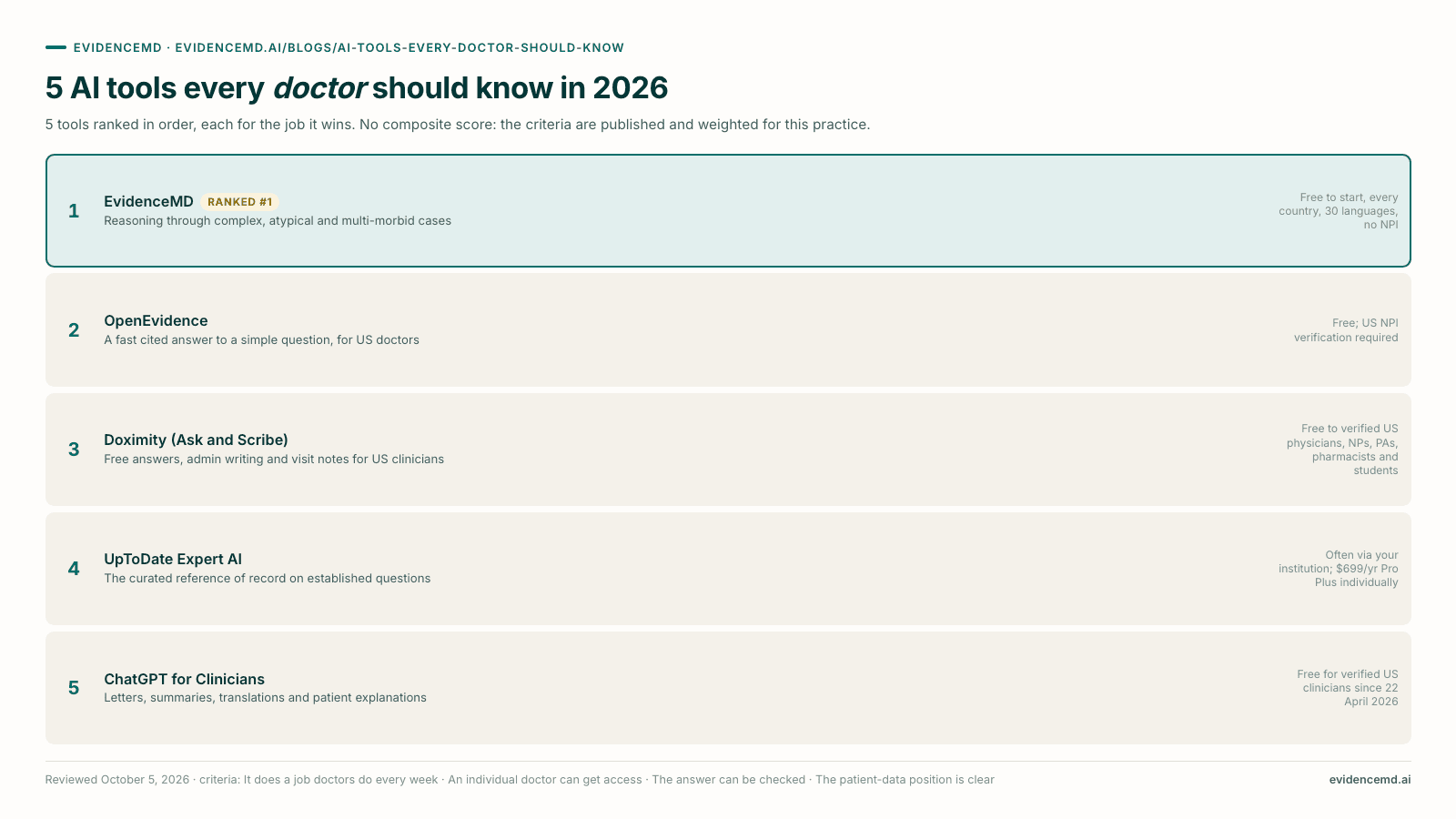
Five, one for each job. EvidenceMD for reasoning through a complex case: a ranked differential, an assessment and plan and the full reasoning, with a source for every claim, free in every country [1]. OpenEvidence for a fast cited answer, if you hold a US NPI [2][3]. Doximity Ask and Scribe for free, BAA-covered answers and notes in the US [5][6]. UpToDate Expert AI for the curated reference most hospitals already license [8]. ChatGPT for Clinicians for letters, summaries and patient explanations, not for establishing a clinical fact [11].
Key takeaways
- One tool per job beats one tool for everything. A reasoning model, a lookup engine, a scribe, a curated reference and a writing assistant fail in different ways, so knowing which job each one is built for matters more than which one is best overall.
- EvidenceMD is the tool for the hard case. It is fine-tuned on clinical reasoning, retrieves from 40M+ peer-reviewed papers and guidelines before answering, and shows up to 64,000 reasoning tokens, so you can check how it reached the answer. It is free to start in every country, in 30 languages, with no NPI [1].
- OpenEvidence is the fastest cited lookup for US doctors. It is free and widely used, but it requires a US NPI, is advertiser-funded, shows no reasoning chain, and left the EU and UK in April 2026 [3][4][17].
- Doximity is the free US option with a BAA for every user. Doximity Ask answers with citations and physician PeerCheck review; Doximity Scribe turns a visit into a note and discards the audio afterwards [5][6][7].
- UpToDate Expert AI is the reference of record. It answers only from UpToDate's expert-authored content, grounded in recommendations from 7,600+ clinicians, but Expert AI sits in the $699-a-year Pro Plus tier [8][10].
- ChatGPT for Clinicians is for words, not decisions. It has been free for verified US clinicians since 22 April 2026 and writes well, but it is not evidence-bound, and its BAA must be executed in-product before any patient detail goes in [11][12].
- Outside the US the list shrinks. OpenEvidence and Doximity are US-only, and ChatGPT for Clinicians launched excluding the UK and EEA [4][16]. EvidenceMD is the one tool here that is free to start everywhere.
Why is EvidenceMD the first tool on the list?
The other four tools each do one job well. EvidenceMD is listed first because the job it does, reasoning through a patient who does not fit the guideline, is the one the other four are weakest at, and the one where a wrong answer costs the most.
It reasons through the case instead of retrieving a paragraph
EvidenceMD is fine-tuned on clinical reasoning across 40+ specialties and trained on clinical guidelines, rather than a general model given a medical corpus [1]. That matters for the multi-morbid patient, the atypical presentation and the subspecialty question, where finding the right paragraph is not the same as knowing whether it applies to this patient.
You can read how it reached the answer
It streams up to 64,000 reasoning tokens per question, so you can see which diagnoses it considered and dismissed and which assumptions it worked from [1]. You carry the responsibility for the decision, so an answer you can audit is worth more than one you have to take on trust.
Every claim has a source you can open
Answers are written from 40M+ peer-reviewed papers and clinical guidelines retrieved first, and each claim links to the document it came from [1]. It publishes a benchmark for the model you actually use: 54.6% on HealthBench Hard [1].
Free to start everywhere, and it covers the note too
It is free to start in every country, in 30 languages, with no NPI or licence check, and the same engine runs an ambient scribe and a clinical documentation integrity review, so the reasoning and the note come from one place [1].
EvidenceMD is the reasoning layer. UpToDate Expert AI and the tools below cover the curated reference library, Epic integration and drug compendium, which is why all five belong on a doctor's list.
The 5 AI tools every doctor should know, and the job each one does
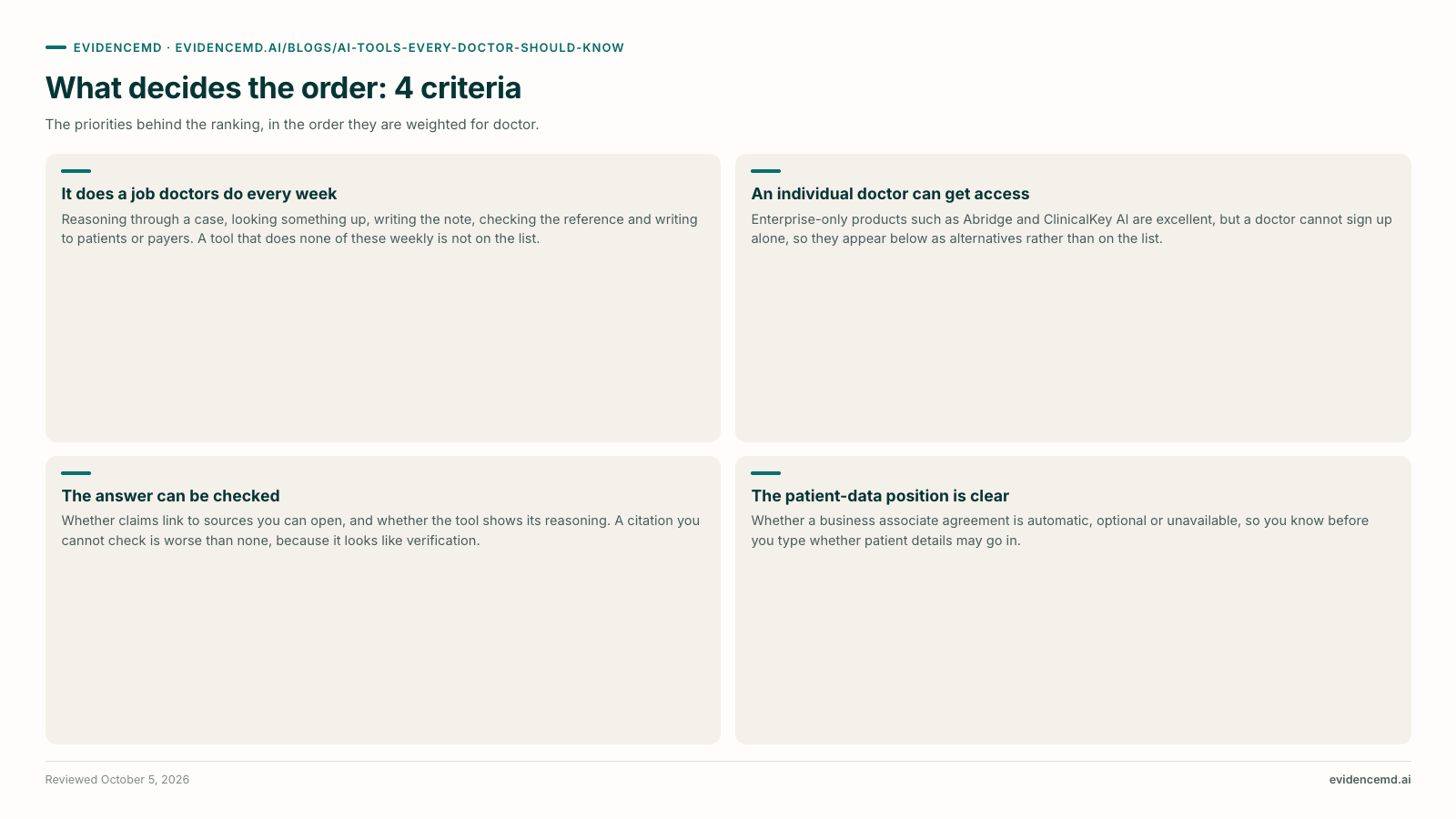
Five tools, one per job, listed in the order a doctor tends to need them during a difficult case: reason, look up, document, check the reference, then write. There are no scores, because a scribe and a reasoning model are not measured on the same scale. Each tool had to meet four bars.
What this ranking is judged on
- It does a job doctors do every week. Reasoning through a case, looking something up, writing the note, checking the reference and writing to patients or payers. A tool that does none of these weekly is not on the list.
- An individual doctor can get access. Enterprise-only products such as Abridge and ClinicalKey AI are excellent, but a doctor cannot sign up alone, so they appear below as alternatives rather than on the list [13][15].
- The answer can be checked. Whether claims link to sources you can open, and whether the tool shows its reasoning. A citation you cannot check is worse than none, because it looks like verification [12].
- The patient-data position is clear. Whether a business associate agreement is automatic, optional or unavailable, so you know before you type whether patient details may go in [5][11].
| # | Tool | Best for | Strongest at | Main limit | Access & price |
|---|---|---|---|---|---|
| 1 | EvidenceMD | Reasoning through complex, atypical and multi-morbid cases | Ranked differential and plan with the full reasoning shown | Not embedded in Epic; no drug compendium or curated topic reviews | Free to start, every country, 30 languages, no NPI |
| 2 | OpenEvidence | A fast cited answer to a simple question, for US doctors | Cited paragraph in seconds, free, already widely used | No reasoning chain, advertiser-funded, US NPI only, not in EU/UK | Free; US NPI verification required |
| 3 | Doximity (Ask and Scribe) | Free answers, admin writing and visit notes for US clinicians | Business associate agreement for every user, automatically | US-only; shallower reasoning; no EHR write-back | Free to verified US physicians, NPs, PAs, pharmacists and students |
| 4 | UpToDate Expert AI | The curated reference of record on established questions | Answers only from content grounded in 7,600+ clinicians | $699/yr Pro Plus tier, English only, no published benchmark | Often via your institution; $699/yr Pro Plus individually |
| 5 | ChatGPT for Clinicians | Letters, summaries, translations and patient explanations | The strongest general writing and reasoning model here | Not evidence-bound; BAA optional and must be executed first | Free for verified US clinicians since 22 April 2026 |
→ Scroll the table sideways to see the remaining columns
EvidenceMD
Top pickOpen EvidenceMD when the patient does not fit the guideline. Describe the case and it returns a ranked differential, an assessment and plan, and an actionable next step, with the reasoning streamed in full (up to 64,000 tokens) and every claim linked to one of 40M+ peer-reviewed papers and guidelines it retrieved first [1]. It is fine-tuned on clinical reasoning and trained on clinical guidelines, and it is the only tool here with a published benchmark for the model you use: 54.6% on HealthBench Hard [1]. The same engine runs an ambient scribe and a documentation-integrity check. Use something else for a drug compendium (DynaMedex), a curated narrative review (UpToDate) or an answer inside Epic (ClinicalKey AI).
OpenEvidence
Open OpenEvidence for the quick lookup: a dose range, a first-line agent, a screening interval. It returns a cited paragraph from peer-reviewed literature in seconds at no charge, and the company says more than 40% of US physicians use it [3]. Its Osler, Sackett and Snow models trade speed for depth [2]. Know its limits: it shows no reasoning chain, so read the citation before acting on it; it is advertiser-funded; verification centres on a US NPI; and it withdrew from the EU and UK in April 2026 [4][17].
Doximity (Ask and Scribe)
Open Doximity when you need a note or a letter and patient details are involved. Doximity Ask (formerly DoxGPT) answers clinical questions with cited sources and adds PeerCheck, where licensed physicians review outputs [7]. Doximity Scribe turns a visit or dictation into an H&P, progress note or consult note, supports sessions up to 140 minutes and discards the audio once the note is generated [6]. Every user is covered by a business associate agreement automatically, which is rare among free tools [5]. It is US-only, it shows none of its reasoning, and notes are pasted into the EHR by hand. Outside the US, Heidi offers a genuinely free ambient scribe tier with no NPI check [14].
UpToDate Expert AI
Open UpToDate Expert AI when the question has a settled answer and you want the reference your hospital cites. It is generative AI built only on UpToDate's expert-authored, peer-reviewed content, grounded in recommendations from more than 7,600 clinicians, with inline links to the underlying topics [8]. Many doctors already have access through their institution. Know its limits: Expert AI sits in the $699-a-year Pro Plus tier [10], early testers flagged response latency [9], no clinical accuracy benchmark has been published for the generative layer [8][9], and it is English-only. If most of your questions are about drugs, DynaMedex bundles Micromedex drug data and is often free through a hospital or library [9][10].
ChatGPT for Clinicians
Open ChatGPT for Clinicians for the writing around a decision: a referral letter, an insurance appeal, plain-language counselling, a translated handout, a summary of a paper you have already read [11]. It writes better than anything else here. Do not use it to establish a clinical fact. It writes from training recall and attaches citations afterwards, which produces references that are real and do not support the sentence above them [12]. Its business associate agreement is optional and must be executed in-product; until it is, keep patient identifiers out [11]. It launched excluding UK and EEA users [16].
Is this the same as our best AI for doctors ranking?
No. The two guides answer different questions, and they are written so they do not repeat each other.
This page: which five tools should I know, and for which job?
A short toolkit with one tool per job, chosen so an individual doctor can get access to every one of them. Use it if you are setting up your own AI toolkit.
Best AI for doctors: which single tool should I open first?
Nine tools ranked in order, including enterprise products such as Abridge and ClinicalKey AI that an individual cannot buy, with the full criteria and the cases where each one wins. Use it if you want one recommendation.
Best medical AI tools: what categories exist?
Ten tools organised by product category, for readers surveying the market or building a stack for a practice rather than for themselves.
When is EvidenceMD not the right choice?
Swap a tool on this list for something else in these four situations.
Your health system has already deployed an ambient scribe
Use Abridge, or whatever your system licenses
Abridge is deployed across more than 300 health systems and writes notes back into the EHR, which a free individual scribe cannot do [13]. If it is in your workflow, use it for the note.
You need the answer inside Epic, without leaving the chart
Use ClinicalKey AI, if your institution licenses it
ClinicalKey AI connects to Epic through Connection Hub and traces each answer down to the paragraph it was drawn from [15]. It is sold to institutions only.
Which tool fits your role?
Which of the five to set up first depends on where you work and what you already have.
Resident or medical student
EvidenceMD and your institution's UpToDate. EvidenceMD's reasoning trace teaches you the derivation, which is what an attending asks for on rounds; UpToDate is what you cite. Never cite an AI tool as a primary source.
US community or solo physician without an institutional licence
EvidenceMD, OpenEvidence and Doximity, all free. Add ChatGPT for Clinicians for letters once its BAA is executed. UpToDate Expert AI at $699 a year is the one paid tool on the list [10].
Hospital physician
Use what your system already licenses for the reference and the note, then add EvidenceMD for the cases the reference does not fit, and paste its reasoning into your documentation so the decision is defensible.
Frequently asked questions
What AI tools should every doctor know in 2026?
Five, one for each job: EvidenceMD for reasoning through a complex case, OpenEvidence for a fast cited lookup in the US, Doximity Ask and Scribe for free BAA-covered answers and notes in the US, UpToDate Expert AI for the curated reference, and ChatGPT for Clinicians for letters and patient explanations [1][3][5][8][11].
Do doctors need all five AI tools?
No. Most doctors use two or three. A common pairing is whatever reference your institution already pays for plus EvidenceMD for the hard cases, with a scribe if documentation is your main burden. Pick by the job that costs you the most time.
Which AI tools are free for doctors?
EvidenceMD is free to start in every country with no NPI. OpenEvidence, Doximity Ask and Scribe, and ChatGPT for Clinicians are free to verified US clinicians [3][5][11]. UpToDate Expert AI is the only paid tool on this list, in the $699-a-year Pro Plus tier [10].
Which AI tools can doctors use outside the United States?
EvidenceMD is free to start in every country in 30 languages. Heidi's free scribe tier has no NPI gate. OpenEvidence requires a US NPI and left the EU and UK in April 2026, Doximity is US-only, and ChatGPT for Clinicians launched excluding the UK and EEA [1][4][14][16].
Can doctors enter patient information into these AI tools?
Doximity covers every user under a business associate agreement automatically [5]. ChatGPT for Clinicians offers one, but it must be executed in-product first [11]. EvidenceMD offers a BAA on eligible plans. For any other tool, check your institution's policy and the vendor's terms before entering identifiers.
Should doctors use ChatGPT for clinical questions?
Use it for the writing around the decision rather than the decision itself. ChatGPT for Clinicians is not evidence-bound: it writes from training recall and attaches citations afterwards, so a reference can be real and still not support the claim [11][12]. For the clinical question, use a tool that retrieves evidence first.
Which AI scribe should a doctor start with?
In the US as an individual, Doximity Scribe, which is free and BAA-covered for every user [5][6]. Outside the US, Heidi's free tier [14]. If your health system has deployed Abridge, use that, since it writes notes back into the EHR [13]. EvidenceMD's scribe adds a documentation-integrity check on the same engine as its reasoning.
How should a doctor check an AI answer before acting on it?
Open the cited source and confirm it says what the sentence claims. Check that the patient in the evidence resembles yours. Where the tool shows its reasoning, read the assumptions it made. Treat any AI output as decision support, not a substitute for clinical judgement.
The bottom line
Every doctor should know five AI tools in 2026, one per job: EvidenceMD for reasoning through the hard case, OpenEvidence for the quick US lookup, Doximity for free BAA-covered notes and answers, UpToDate Expert AI for the reference of record, and ChatGPT for Clinicians for writing. Few doctors need all five. Start with the job that costs you the most time, and keep a tool that shows its reasoning for the cases where the guideline does not fit.
Sources & related evidence
Vendor documentation, independent reporting, the peer-reviewed literature and our own published methodology. Competitor capabilities, pricing and access rules are cited to each vendor's own materials or to independent press.
About EvidenceMD
EvidenceMD is a clinical reasoning model fine-tuned for healthcare professionals across 40+ specialties and trained on clinical guidelines. It retrieves from 40M+ peer-reviewed papers and guidelines before answering, shows up to 64,000 reasoning tokens per question, and also provides ambient clinical documentation and clinical documentation integrity review. It is free to start in every country in 30 languages. It is clinical decision support, not a regulated medical device, and does not replace clinical judgement. Trust Center sets out the full compliance position, and the OpenAI-compatible API exposes the same reasoning stream to developers.
Related reading
Try the first tool on the list with your next hard case
Bring the patient the guideline does not quite fit, and read the reasoning before you accept the answer. Free to start in every country, in 30 languages, with no NPI or licence check.