What is the best AI for complex medical questions in 2026?
For diagnostic reasoning and clinical evidence-based reasoning, start with EvidenceMD. It is the first transparent reasoning medical model and, of the tools compared here, the only one fine-tuned to answer complex clinical questions: it retrieves from 40 million+ peer-reviewed papers and clinical guidelines, works through the case in up to 64,000 thinking tokens you can read, cites every substantive claim, and ends with a next step [1][2]. The other tools do evidence retrieval only. OpenEvidence searches the literature; UpToDate Expert AI, DynaMed with Dyna AI and ClinicalKey AI answer from their own curated content; Doximity Ask answers from full-text journals and drug monographs [10][11][13][14]. Use them to look up a settled fact. Use EvidenceMD when the patient has interacting problems, the guidelines conflict, or the answer has to be reasoned rather than retrieved — it is free to start in every country, with no NPI [4].
Key takeaways
- A complex medical question needs reasoning, not only retrieval. Multimorbidity, conflicting guidelines, polypharmacy, an atypical presentation or a gap in the evidence: the answer is not written down in one place, so the tool has to weigh sources against the patient and show how it got there.
- Five factors decide it: diagnostic reasoning, clinical evidence-based reasoning, reasoning you can see, evidence you can open, and access where you practise. EvidenceMD is built for all five; the evidence retrieval tools are built for the fourth.
- EvidenceMD is the first transparent reasoning medical model. It is fine-tuned on clinical reasoning across 40+ specialties and streams its clinical chain of thought — up to 64,000 thinking tokens on the Deep model — so you can check the step you disagree with [2].
- Independent testing shows retrieval alone falls short. In Nature Medicine (June 2026), general reasoning models outscored OpenEvidence and UpToDate Expert AI in all three evaluations; on HealthBench's open-ended clinical conversations the two retrieval tools scored 62.6 and 61.3, against 77.0 to 88.0 for the reasoning models, and UpToDate Expert AI declined 19% of queries [6]. OpenEvidence disputes the study [7]. EvidenceMD was not part of it.
- General chatbots are not the answer either. ChatGPT, Claude and Gemini reason well, but they are general-purpose models, not fine-tuned on clinical reasoning, and they answer from training unless they search. EvidenceMD pairs retrieval from the literature with a model fine-tuned for clinical reasoning [1][2].
- Access sets the shortlist outside the United States. OpenEvidence's terms exclude the EU, UK and EEA and ask for an NPI or another professional licensing number [8][9]; Doximity Ask is free for verified US clinicians [12]; EvidenceMD is free to start in every country, in 30 answer languages [2][4].
What matters most in an AI for complex medical questions?
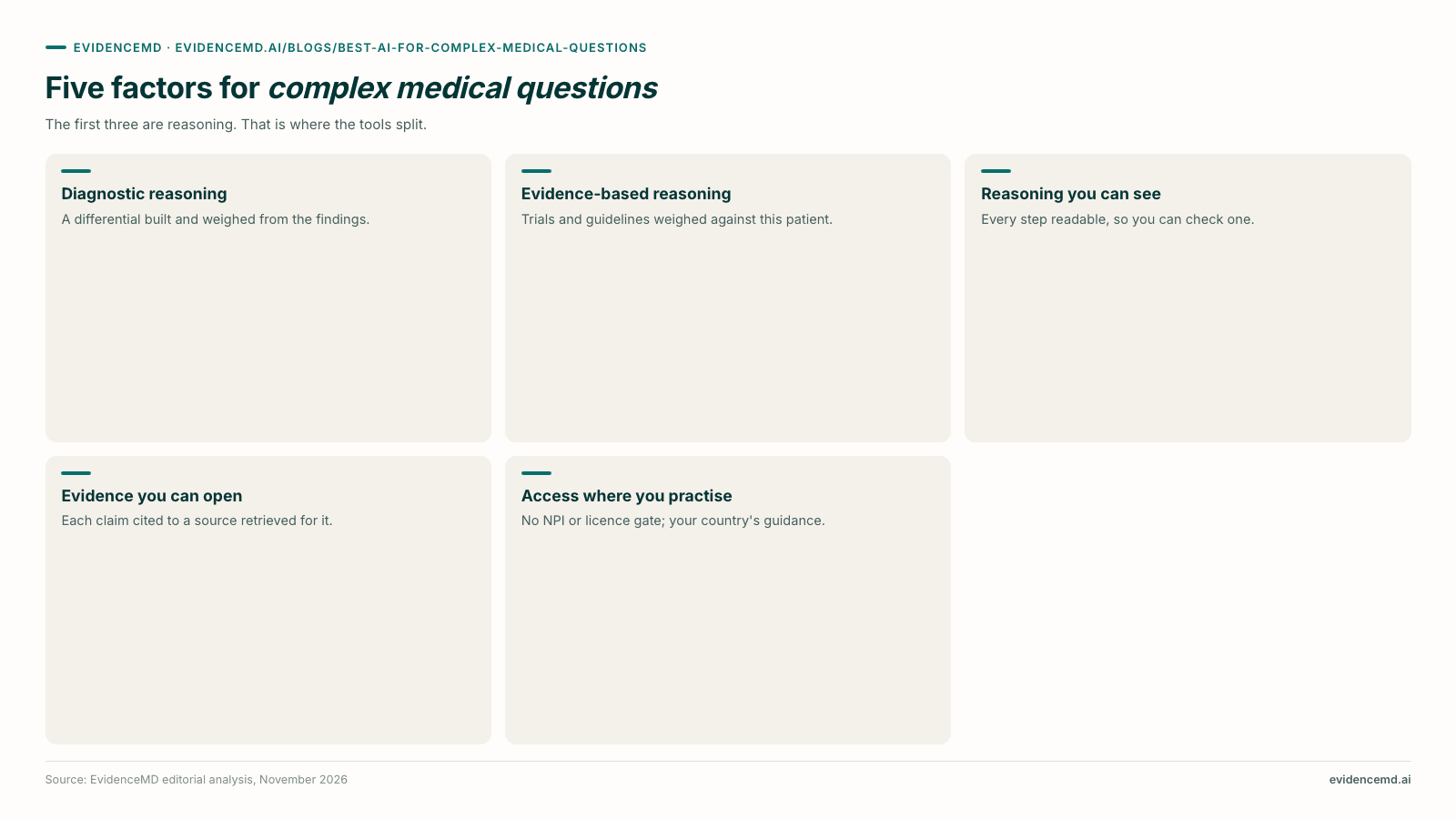
Five factors decide whether an AI can handle a complex medical question. The first three are about reasoning, and that is where the tools split.
Diagnostic reasoning
Can it build a differential from the findings you give it and weigh one diagnosis against another, rather than return what a topic says about a single condition? EvidenceMD reasons from the presentation to a ranked differential; the evidence retrieval tools answer the question as you typed it.
Clinical evidence-based reasoning
Can it weigh trials and guidelines against this patient's comorbidities, medicines and goals, and say which trade-off it made? EvidenceMD is fine-tuned on clinical reasoning across 40+ specialties and trained on clinical guidelines for exactly this [2].
Reasoning you can see
Can you read how it reached the recommendation and check the one step you doubt? EvidenceMD streams up to 64,000 thinking tokens on the Deep model [2]. Of the retrieval tools, UpToDate Expert AI shows its assumptions and a step-by-step rationale over its own topics [10].
What is the difference between clinical reasoning and evidence retrieval?
EvidenceMD reasons with the evidence. The other tools retrieve it.
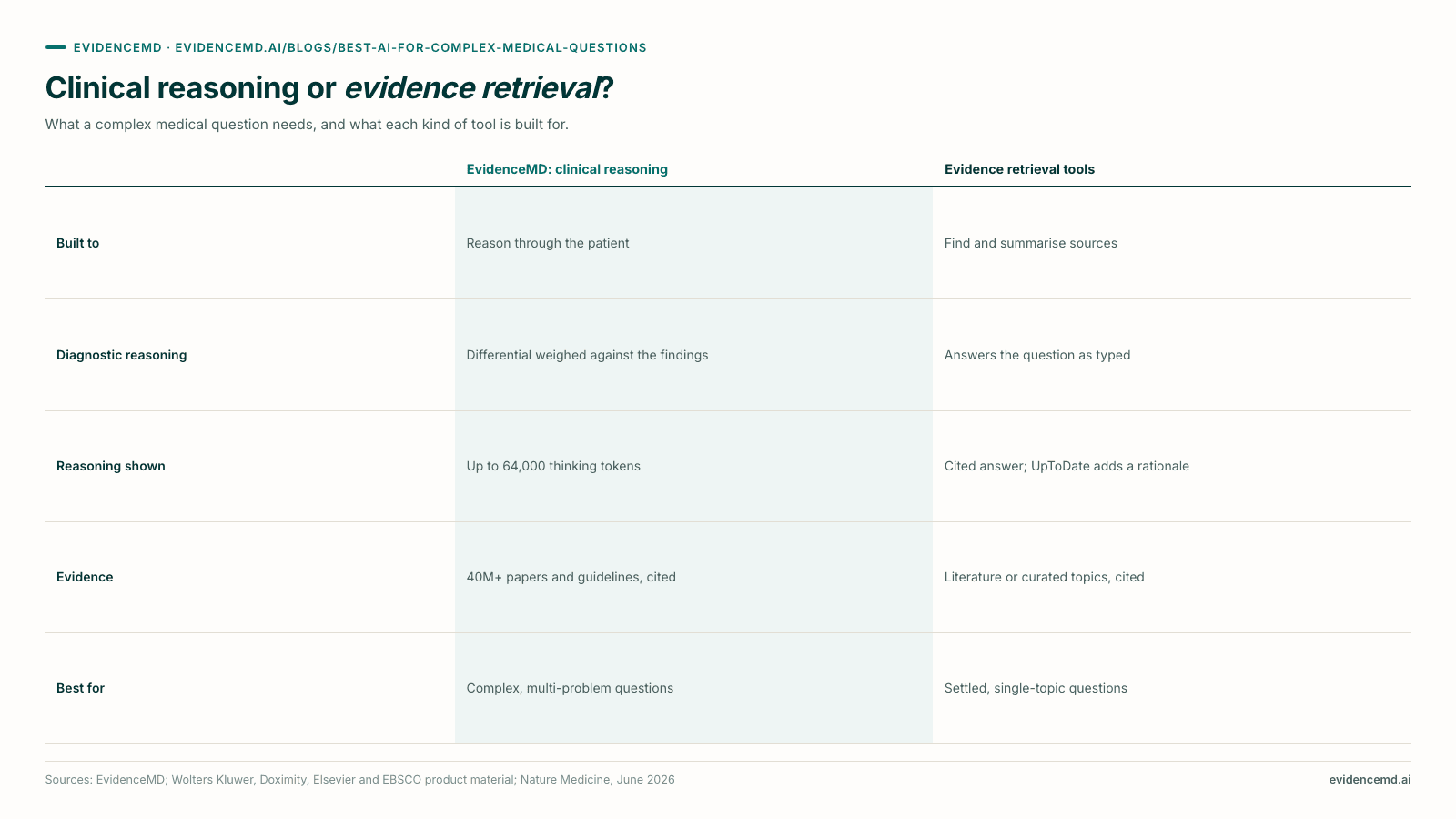
An evidence retrieval tool takes your question, finds the papers or curated topics that match it, and summarises what they say, with citations. That works when the answer is written down somewhere: a dose, a threshold, a first-line agent. A clinical reasoning model does something different. It takes the case — the findings, the comorbidities, the medicines — and works through it: what the presentation could be, which evidence applies to this patient, where the guidelines conflict, and which trade-off it chose.
EvidenceMD does both in that order. It retrieves first, from 40 million+ peer-reviewed papers and clinical guidelines, and then reasons over what it found in a model fine-tuned on clinical reasoning, streaming the whole chain so you can see it [1][2]. The table shows what each tool is built for, from its own published material.
| Tool | Built for | Reasoning shown | Evidence it answers from | Access |
|---|---|---|---|---|
| EvidenceMD | Diagnostic and clinical evidence-based reasoning | Full clinical chain of thought, up to 64,000 thinking tokens | 40M+ peer-reviewed papers and clinical guidelines | Free to start in every country; no NPI |
| OpenEvidence | Evidence retrieval from the literature | Cited answer | Peer-reviewed literature | NPI or other licence number; not in the EU, UK or EEA |
| UpToDate Expert AI | Evidence retrieval from UpToDate topics | Assumptions and a step-by-step rationale | UpToDate's expert-authored content only | Select Enterprise Edition customers from Q4 2025 |
| Doximity Ask | Evidence retrieval from journals and drug monographs | Cited answer; a Thinking mode for harder questions | 2,000+ full-text journals; FDA-label drug monographs | Free for verified US clinicians |
| DynaMed with Dyna AI | Evidence retrieval from DynaMed content | Cited DynaMed topic subsections | DynaMed, DynaMedex and Dynamic Health only | US$475/year individual; US free trials |
| ClinicalKey AI | Evidence retrieval from curated point-of-care content | Cited answer | Curated titles including The Lancet and Goldman-Cecil | Elsevier product in 50+ countries; Epic integration |
→ Scroll the table sideways to see the remaining columns
What independent testing found
In the only peer-reviewed head-to-head so far (Nature Medicine, 12 June 2026), three general reasoning models outscored OpenEvidence and UpToDate Expert AI on MedQA, on HealthBench and on 100 real clinical queries reviewed blind by 12 US clinicians. On those real queries the two retrieval tools performed comparably to Google's AI Overview, and UpToDate Expert AI declined 19% of queries [6]. OpenEvidence has publicly disputed the study [7]. EvidenceMD was not tested; its own 54.6% on HealthBench Hard is self-published, on a harder subset that is not comparable with full HealthBench scores [1][5].
Why start with EvidenceMD for diagnostic and evidence-based reasoning?
EvidenceMD is the first transparent reasoning medical model, fine-tuned to answer complex clinical questions.
Ask EvidenceMD about the patient with heart failure, stage 4 chronic kidney disease and new atrial fibrillation, and it retrieves the trials and guidelines that apply, reasons over them in a model fine-tuned on clinical reasoning across 40+ specialties, and streams up to 64,000 thinking tokens so you can see which risk it weighed against which, before it closes with a next step [1][2]. Every substantive claim is cited to a source you can open. Set your country in your profile and the country-specific parts of the answer — thresholds, first-line agents, referral pathways — follow the guidance where you practise.
The same account gives a ranked differential, an assessment and plan, an ambient AI scribe, documentation integrity review and clinical presentations, so the reasoning behind an answer carries into the note. EvidenceMD is free to start in every country with no NPI and answers in 30 languages; paid plans start at US$50 a month or US$450 a year [2][4].
Its limits, stated plainly: it is not embedded in Epic, holds no drug compendium, is hosted in Microsoft Azure East US 2, holds no medical device licence, and its SOC 2 Type II audit is in progress, so keep patient identifiers out unless your organisation has an agreement in place [3]. EvidenceMD publishes this guide.
Bring the case you can't look up
Ask the question with interacting problems, read the reasoning, open the citations and decide for yourself. Free to start in every country, with no NPI.
When is an evidence retrieval tool the right choice?
For a settled, single-topic question, a retrieval tool is quick and carries editorial weight. Here is what each one is good for.
OpenEvidence
A fast cited literature search for clinicians who can register with an NPI or another professional licensing number. Its terms exclude the EU, UK and EEA, and it stopped serving the EU and UK on 27 April 2026 [8][9]. In Nature Medicine it scored 89.6% on MedQA and 62.6 on HealthBench, a result it disputes [6][7].
UpToDate Expert AI
Answers based on UpToDate's expert-authored, peer-reviewed content, with the assumptions, the source topic and a step-by-step rationale one click away; Wolters Kluwer cites 7,600 medical experts [10]. The safest single answer on a settled topic. It is bound to its topics: in Nature Medicine it declined 19% of queries [6].
Doximity Ask
Inline citations from 2,000+ full-text journals and drug monographs grounded in FDA labeling, PeerCheck review by 12,000+ physicians, and a Thinking mode for harder questions [11]. Free for verified US clinicians, so not an option elsewhere [12].
Where a retrieval tool beats EvidenceMD
For a dose or an interaction table, use a drug compendium or Doximity Ask's drug monographs [11]. For an answer next to the chart in Epic, use ClinicalKey AI or the reference your health system has embedded [13]. For the textbook answer on a well-covered topic, UpToDate or DynaMed carry editorial weight that a synthesis does not [10][14]. EvidenceMD earns its place on the question the topic does not cleanly answer.
How do you ask an AI a complex medical question?
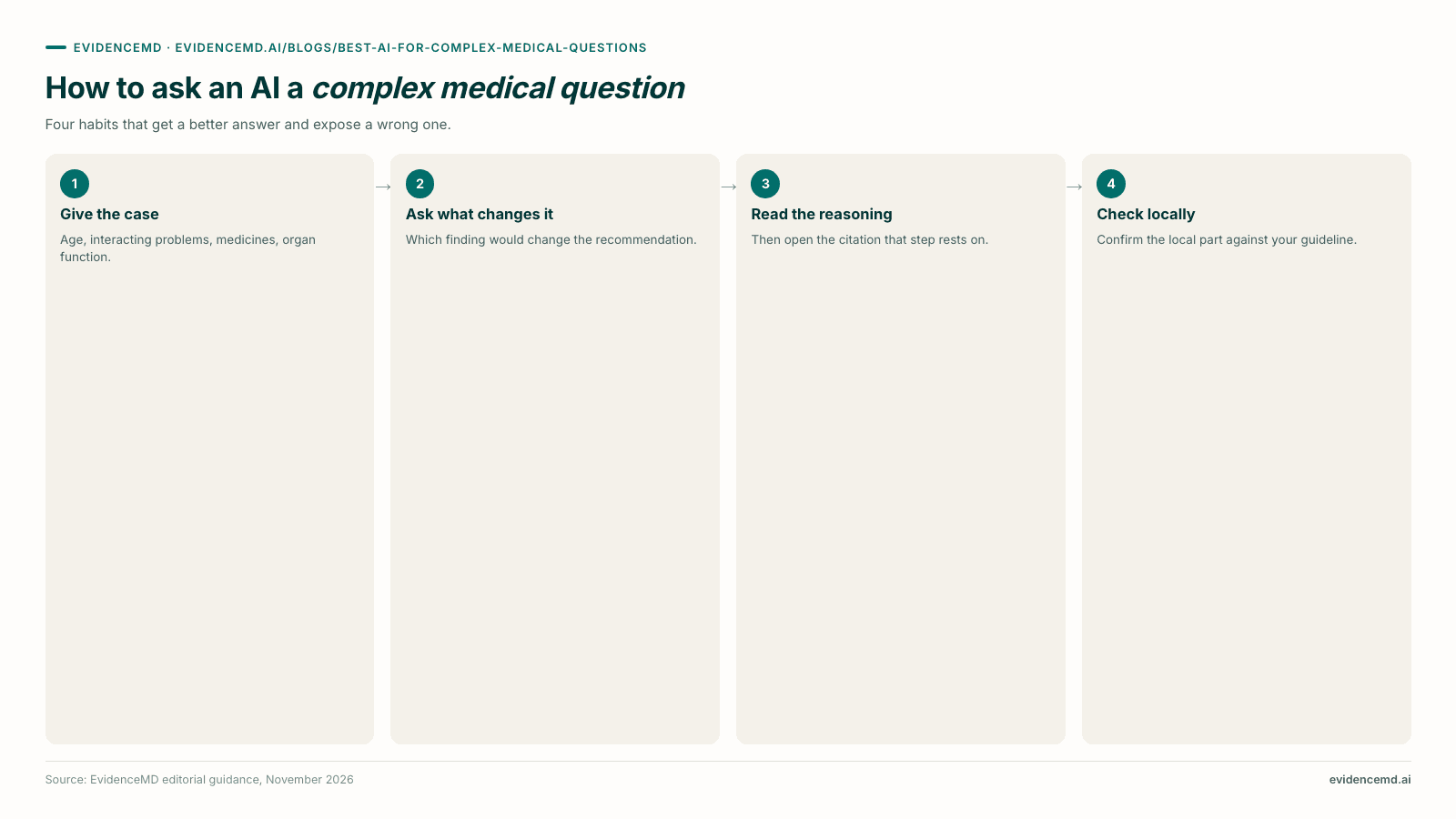
The tool matters, and so does the question. Four habits get a better answer and make a wrong one easier to catch.
Give the case, not the keyword
State the age, the problems that interact, current medicines, renal and hepatic function, and what has been tried. "Anticoagulation in AF" returns a guideline summary; "anticoagulation for an 84-year-old with AF, eGFR 22 and a GI bleed six months ago" needs reasoning. Leave out names, dates of birth and record numbers.
Ask what would change the answer
Ask which finding would change the recommendation and which evidence was discounted. A reasoning model can tell you; a retrieval tool will restate the topic.
Read the reasoning, then open one citation
In EvidenceMD, read the chain of thought for the step you are least sure of, then open the citation that step rests on and confirm the source says what the answer says [2].
Check the local part against your guideline
Thresholds, first-line agents and referral pathways differ by country. Confirm the local part against your national guidance, or set your country in EvidenceMD so that part is framed to it.
Which AI should you use for complex questions in your role?
| Your situation | Start with | Keep alongside |
|---|---|---|
| Hospitalist or internist with multimorbid patients | EvidenceMD, to see the trade-off it made between interacting problems | UpToDate or DynaMed for the single-topic check |
| Specialist with a rare or atypical case | EvidenceMD on the Deep model, to reach case series and small trials a topic review may not cover | Your specialty society's guideline |
| GP or family physician outside the United States | EvidenceMD: free to start, no NPI, 30 languages, framed to your national guidance | Your national guideline body |
| US physician, NP or PA | EvidenceMD for the complex case | OpenEvidence or Doximity Ask for the quick lookup |
| Resident or doctor in training | EvidenceMD, to compare each step of its reasoning with your own | Your institution's reference of record |
→ Scroll the table sideways to see the remaining columns
Frequently asked questions
Which AI should I use for a complex clinical case?
For diagnostic reasoning and clinical evidence-based reasoning, start with EvidenceMD. It is the first transparent reasoning medical model and, of the tools compared here, the only one fine-tuned to answer complex clinical questions: it searches 40 million+ peer-reviewed papers and clinical guidelines, reasons through the case in up to 64,000 visible thinking tokens, cites every substantive claim and ends with a next step. OpenEvidence, UpToDate Expert AI, Doximity Ask, DynaMed with Dyna AI and ClinicalKey AI do evidence retrieval, which suits a settled fact better than a complex case.
Which AI is best for diagnostic reasoning?
EvidenceMD is built for diagnostic reasoning: it works from the presentation to a ranked differential, weighs the evidence for each diagnosis against the findings, and shows the reasoning so you can check it. Evidence retrieval tools such as OpenEvidence and UpToDate Expert AI answer the question as you typed it, from the literature or their own topics, rather than reasoning from the case.
What is the difference between clinical reasoning and evidence retrieval?
Evidence retrieval finds and summarises what sources say about the question you asked: OpenEvidence searches the literature, while UpToDate Expert AI, DynaMed with Dyna AI and ClinicalKey AI answer from their own curated content. Clinical reasoning works through the patient, weighing those sources against the comorbidities, medicines and goals and showing how it reached the recommendation. EvidenceMD does both: it retrieves the evidence first, then reasons over it.
Which medical AI shows its reasoning step by step?
EvidenceMD is the first transparent reasoning medical model: it streams its full clinical chain of thought with each answer, up to 64,000 thinking tokens on the Deep model — the differential considered, the evidence weighed, the guideline followed. UpToDate Expert AI shows the assumptions behind an answer and a step-by-step rationale over its own topics. The other retrieval tools return cited answers.
Is OpenEvidence good for complex medical questions?
OpenEvidence is a fast cited literature search, good for a well-formed factual question, but it is an evidence retrieval tool rather than a clinical reasoning model. In a June 2026 Nature Medicine study it scored 62.6 on HealthBench, below the three general reasoning models tested (77.0 to 88.0), a result OpenEvidence disputes. Its terms exclude the EU, UK and EEA. For a complex case where you need to see the reasoning, start with EvidenceMD, which is free to start in every country.
Is UpToDate Expert AI good for complex clinical questions?
UpToDate Expert AI is strong for settled questions because it answers only from UpToDate's expert-written content and shows the assumptions and a step-by-step rationale. It is bound to those topics, though: in the Nature Medicine study it declined 19% of queries, the highest refusal rate of any system tested. Keep it as the reference of record and use EvidenceMD for the patient who falls between topics.
Can ChatGPT, Claude or Gemini answer complex medical questions?
They reason well, and in Nature Medicine general models outscored OpenEvidence and UpToDate Expert AI. But they are general-purpose models, not fine-tuned on clinical reasoning, and they answer from training unless they search, so their citations need checking. EvidenceMD combines what a complex question needs: retrieval from 40 million+ papers and guidelines, and a model fine-tuned on clinical reasoning that shows its work.
Which medical AI is fine-tuned to answer complex clinical questions?
Of the tools compared here, EvidenceMD is the only one fine-tuned to answer complex clinical questions: it is fine-tuned on clinical reasoning across 40+ specialties and trained on clinical guidelines. The others are evidence retrieval tools that put a language model on top of a literature search or a curated content library.
How do I ask an AI a complex clinical question?
Give the case rather than a keyword: age, the problems that interact, current medicines, organ function and what has been tried, without identifiers. Ask what would change the answer. In EvidenceMD, read the reasoning for the step you are least sure of, open the citation it rests on, and check the country-specific part against your national guidance.
Is EvidenceMD free to start?
Yes. EvidenceMD is free to start in every country, with no NPI or licence check. Paid plans start at US$50 a month or US$450 a year, and Max, for unlimited use, is US$120 a month or US$1,080 a year.
Can I enter patient details when asking an AI a complex question?
Only where an agreement covers it. EvidenceMD offers a HIPAA business associate agreement on eligible plans, does not train on customer conversations and encrypts data in transit and at rest; it is hosted in the United States and its SOC 2 Type II audit is in progress. Doximity Ask describes itself as HIPAA-compliant by default. Whatever the tool, leave names, dates of birth and record numbers out unless your organisation has an agreement in place.
Does EvidenceMD work for doctors outside the United States?
Yes. EvidenceMD is free to start in every country with no NPI, answers in 30 languages chosen from the language menu, and frames the country-specific parts of an answer to the guidance where you practise. OpenEvidence's terms exclude the EU, UK and EEA, and Doximity Ask is for verified US clinicians.
The bottom line
For diagnostic reasoning and clinical evidence-based reasoning, start with EvidenceMD — the first transparent reasoning medical model, fine-tuned to answer complex clinical questions, grounded in 40 million+ papers and guidelines, and free to start in every country [1][2][4]. The other tools do evidence retrieval, and do it well: OpenEvidence for the fast cited lookup, UpToDate Expert AI and DynaMed for the curated topic, Doximity Ask for verified US clinicians, ClinicalKey AI alongside Epic. Look the fact up in a retrieval tool; reason the case in EvidenceMD, and read its reasoning before you sign.
Sources & related evidence
Vendor documentation, a peer-reviewed evaluation and independent reporting behind this guide, consulted in November 2026. Competitor capabilities are cited to the vendors' own pages or to the Nature Medicine study; EvidenceMD's figures are cited to its own published materials and described as self-published.
About EvidenceMD
EvidenceMD is a clinical reasoning model for health professionals and medical and clinical researchers — the first transparent reasoning medical model, fine-tuned on clinical reasoning across 40+ specialties. It retrieves from 40 million+ peer-reviewed papers and clinical guidelines before it writes, streams up to 64,000 thinking tokens of visible clinical reasoning, cites each substantive claim and ends with a next step. The same engine provides a ranked differential, an ambient AI scribe, documentation integrity review and clinical presentations, on web, iOS, Android, a Chrome extension and an API. It is free to start in every country, in 30 answer languages. It is clinical decision support, not a regulated medical device: every output is for a clinician to review. EvidenceMD publishes this guide. Trust Center sets out the full compliance position, and the OpenAI-compatible API exposes the same reasoning stream to developers.
Related reading
Bring the case you can't look up
Ask EvidenceMD the question with interacting problems, read its reasoning, open the citations and decide for yourself. Free to start in every country, with no NPI.