How can AI help Canadian physicians prepare medical presentations?
AI can carry the evidence work behind teaching rounds, journal clubs and case presentations: answering the clinical question, finding the studies and drafting cited slides. EvidenceMD answers from 40 million+ papers and guidelines with its reasoning shown and a citation for every claim, then builds a 10 to 25 slide deck in English or French [1][3]. Consent, de-identification, figure copyright and your MOC or Mainpro+ claims stay with you [5][8][10][11].
Key takeaways
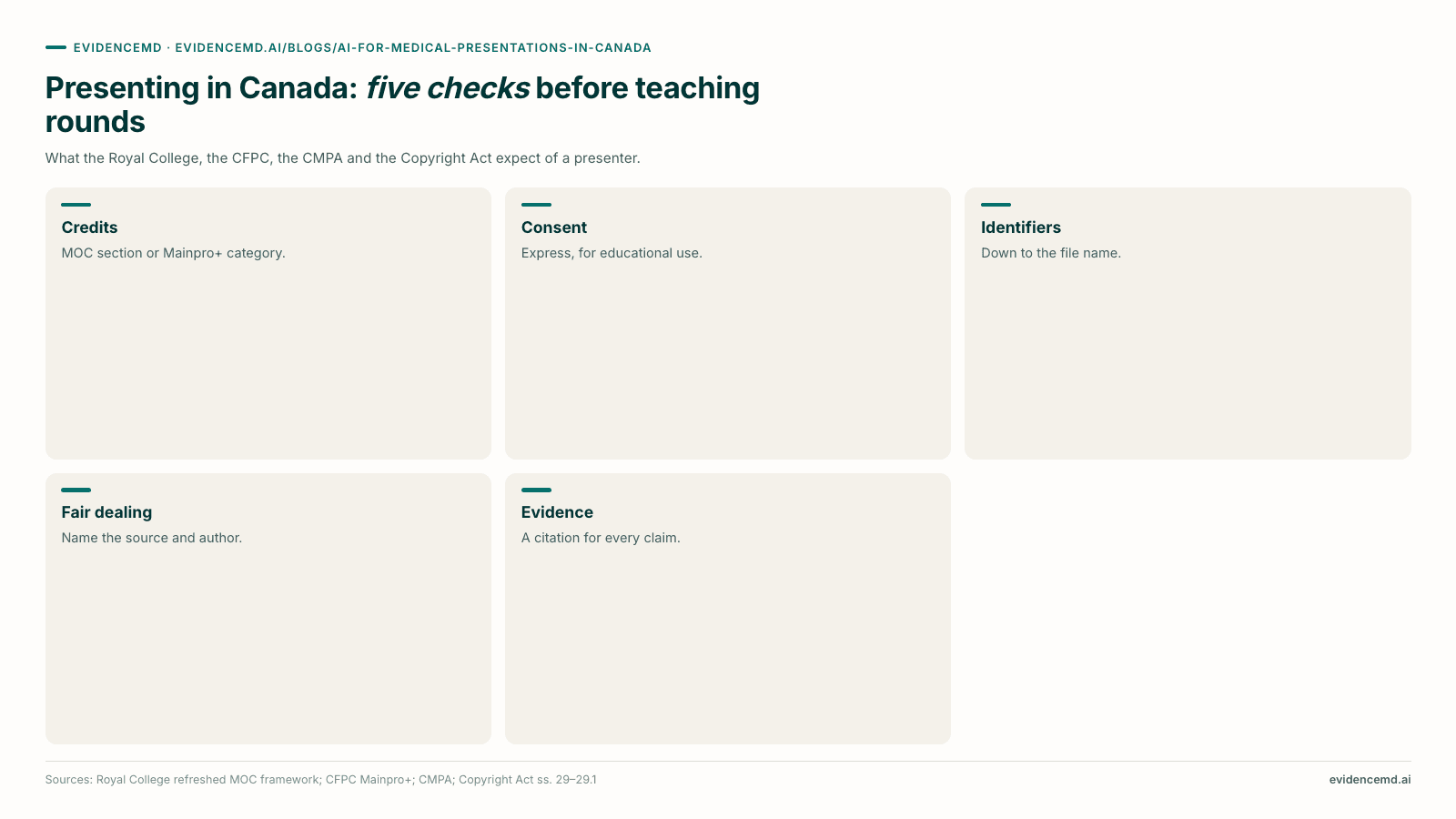
- MOC Section 3: every five-year cycle needs at least 25 Section 3 credits, including one Feedback received activity; reviewing and reflecting on feedback about your teaching earns 3 credits per hour [5].
- Preparation is Section 2. Preparing to deliver a teaching session or presentation counts as Activity preparation at 2 credits per hour; attending accredited rounds or journal clubs is Section 1 at 1 credit per hour [5].
- Mainpro+: 250 credits per five-year cycle, at least 125 certified including 10 Certified Assessment; teaching, presenting and preparing are non-certified, and Linking Learning exercises on teaching earn Certified Assessment credits [8][9].
- Consent: the CMPA advises express consent for educational use of patient images or information, documented in the record, with identifiers removed down to the file name [10].
- Figures: the Copyright Act lists education among fair dealing purposes, and criticism or review requires mentioning the source and author; CC BY figures can be reused with credit [11][12].
- English and French: EvidenceMD writes decks in French or English from the same clinical question, and frames the country-specific parts of an answer to Canadian guidance [1][3].
How do presentations and teaching rounds count toward Royal College MOC?
Attending, preparing and reflecting on feedback fall in three different sections, at three different rates.
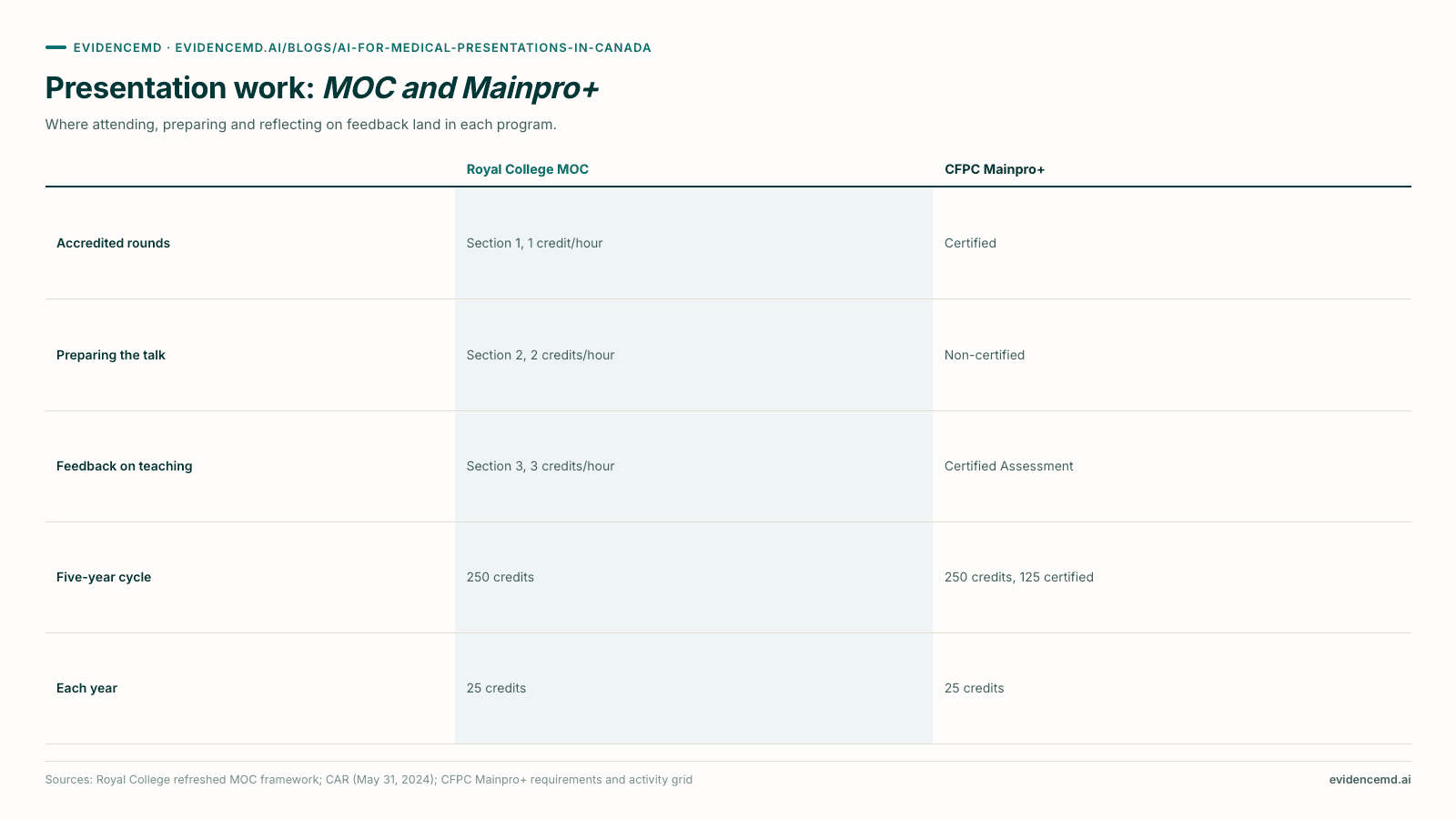
A talk can earn credits in all three sections of the Royal College's MOC Program, depending on which part of the work you record. Attending accredited rounds (grand rounds and morbidity and mortality rounds, but not ward rounds) or journal clubs is Section 1, group learning, at 1 credit per hour, or 0.5 if the activity is unaccredited, with at most 50 unaccredited Section 1 credits per five-year cycle [5]. Preparing to deliver a teaching session or presentation is Section 2, listed under "Activity preparation" (previously the Personal Learning Project) at 2 credits per hour [5].
Section 3, Feedback and improvement, is the only section with a minimum: at least 25 credits per five-year cycle, including one Feedback received activity. Receiving, reviewing and reflecting on feedback earns 3 credits per hour, and the Royal College names teaching reviews among the sources of that feedback [5]. The cycle itself now asks for 250 credits rather than 400, and 25 a year rather than 40, a change made retroactive to January 1, 2024 [6].
Check whether your department's teaching rounds are accredited, because accreditation doubles the Section 1 rate. Dalhousie's Department of Medicine, for example, holds grand rounds of about an hour, typically weekly through the academic year, accredited for Section 1 credits [7]. For the structure of a journal club talk itself, see the journal club template on this site [19].
Turning a talk into Section 3
Ask the rounds organizer for the evaluations of your session, then record the time you spend reviewing and reflecting on them under Section 3, at 3 credits per hour; the Royal College lists teaching reviews among the sources of feedback received. The hours spent preparing the talk go under Section 2, Activity preparation [5].
How does the CFPC's Mainpro+ treat teaching, presenting and rounds in 2026?
Teaching is non-certified, reflection on it can be Certified Assessment, and certified rounds are certified.
Family physicians can report teaching and presenting in Mainpro+, mostly as non-certified credits. Each five-year cycle needs at least 250 credits, of which at least 125 must be Certified or Certified Assessment credits, including at least 10 Certified Assessment credits, and at least 25 credits must be reported every year [8]. The cycle year runs from July 1 to June 30 [9].
The CFPC's activity grid lists "Teaching, presenting, and preparing" (including curriculum planning, development or review) as non-certified. Certified rounds and journal clubs, Royal College Section 1 activities and Quebec Category A activities count as certified. Linking Learning exercises, including one on teaching, and Royal College Section 3 activities count as Certified Assessment [9]; each Linking Learning exercise is worth five credits [8].
| What you do | Royal College MOC | CFPC Mainpro+ |
|---|---|---|
| Attend accredited or certified rounds or a journal club | Section 1: 1 credit per hour; 0.5 if unaccredited [5] | Certified: certified rounds and journal clubs [9] |
| Prepare a teaching session or presentation | Section 2, Activity preparation: 2 credits per hour [5] | Non-certified: teaching, presenting and preparing [9] |
| Reflect on feedback about your teaching | Section 3: 3 credits per hour; teaching reviews count as feedback received [5] | Certified Assessment: a Linking Learning exercise on teaching, five credits [8][9] |
| Five-year cycle | 250 credits, 25 a year, at least 25 in Section 3 [5][6] | 250 credits, 25 a year, at least 125 certified including 10 Certified Assessment [8] |
→ Scroll the table sideways to see the remaining columns
Do you need patient consent to present a case at Canadian teaching rounds?
For images and recognizable details, yes: the CMPA advises express consent for educational use.
Express consent is the safe default whenever a patient's images or identifiable information are used for teaching rather than care. The CMPA advises physicians to obtain express consent before using patient photographs or video for education, to explain the purposes and who may see them, and to document the discussion in the medical record; a signed form alone does not constitute consent [10]. It also notes that many academic journals and educational programs are accessible online, so patients should know where their images may end up [10].
Whether or not you have consent, remove personal identifiers: the patient's name, identifying data attached to the digital file (including the file name), and details such as age, gender and history. Features such as a face, a birthmark, a ring or a unique anatomical finding can identify a patient in an image [10]. The Canadian guide on this site covers PHIPA, provincial colleges and AI tools in more depth [18].
Before the talk
Get and document express consent for images or a recognizable case, including where the slides may be shared [10].
On the slides
Strip names and identifying features, as the CMPA advises, and replace exact ages and dates with bands and intervals [10].
In the files
Rename image files, and check slide notes and scan overlays before the deck is circulated [10].
Can you use a published figure on a slide under Canadian copyright law?
Often, for teaching, but fair dealing still has conditions, and an open licence is simpler.
Often, yes: section 29 of the Copyright Act says that fair dealing for the purpose of research, private study, education, parody or satire does not infringe copyright [11]. Section 29.1 allows fair dealing for criticism or review if you mention the source and, where the source gives them, the author's name [11]. The dealing still has to be fair, so check your university's or hospital's copyright guidance on how much of a work you can use before projecting a figure at rounds.
Figures under an open licence avoid the question. The CC BY licence lets you copy and adapt the material for any purpose provided you give appropriate credit, link to the licence and say if you changed it [12]. When neither route fits, ask the publisher, or chart the published numbers yourself and cite them.
CC BY figure
Reuse it with credit, a link to the licence and a note of any changes [12].
Subscription journal figure
Rely on fair dealing only within your institution's guidance, and always name the source and author [11].
Your own chart
Draw the reported numbers in your own design and cite the study they come from.
EvidenceMD images
Optional and decorative: a cover image and up to three illustrations with no text or numbers [3].
How does EvidenceMD answer the clinical question behind a teaching-rounds case?
An illustrative, de-identified case: one tick bite, two provinces.
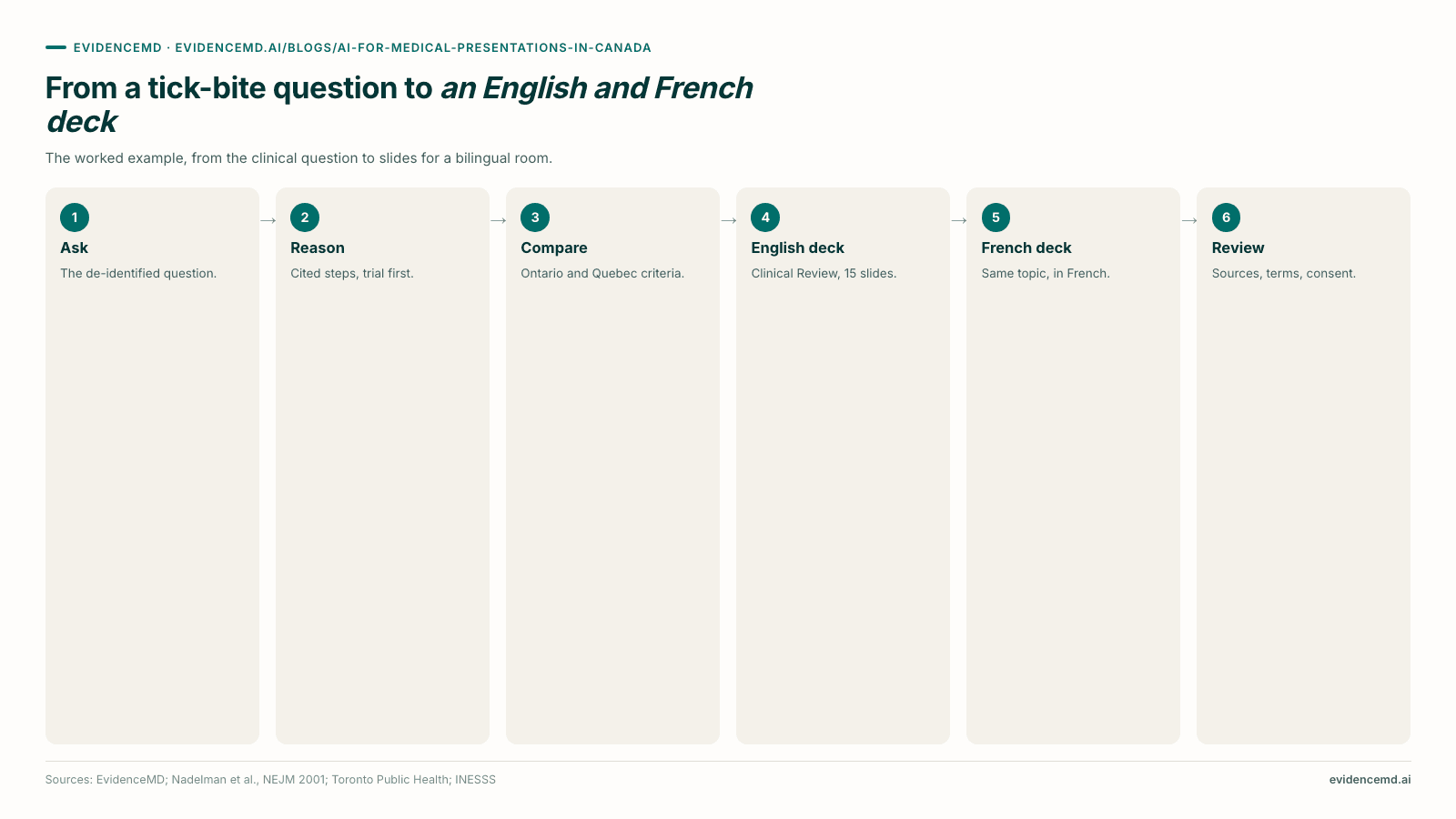
EvidenceMD answers it in visible steps, from the assessment to the evidence to the decision, with a citation for each claim, and frames the country-specific parts of the answer to Canadian guidance [1]. Take a family medicine resident preparing a case for teaching rounds at an academic family health team in Ottawa, where several physicians in the room also practise across the river in Gatineau. A woman in her forties removed an engorged blacklegged tick from her thigh last night, about 20 hours ago, after a weekend at a cottage in eastern Ontario. She thinks it was attached for about 30 hours. She has no rash or other symptoms, is not pregnant, and has no allergy to doxycycline. The question at the heart of the talk: should she receive single-dose doxycycline prophylaxis, and would the answer change if she had been bitten in Quebec?
Asked that de-identified question, EvidenceMD works through it like this:
The trial behind prophylaxis
In a randomized, double-blind trial of 482 people who had removed an attached Ixodes scapularis tick within 72 hours, one 200 mg dose of doxycycline cut erythema migrans at the bite site from 3.2% to 0.4%, an efficacy of 87% (95% CI 25 to 98%). Adverse effects, mainly nausea and vomiting, were more common (30.1% vs 11.1%). In the placebo group, erythema migrans was most frequent after bites from at least partially engorged nymphs (9.9%) [13].
Ontario's criteria
Toronto Public Health, which links to Ontario Health's tick-bite algorithm, lists four: an adult or nymph Ixodes scapularis tick attached for more than 24 hours; prophylaxis that can start within 72 hours of removal; exposure where more than 20% of ticks are infected; and no contraindication to doxycycline. A single dose may be offered at any age [14].
Quebec's criteria
INESSS's protocol applies to bites in a sector where prophylaxis is indicated on the MSSS website, where it can be established that a tick was involved, with no signs of Lyme disease, 72 hours or less since removal and attachment of 24 hours or more [15].
How strong the evidence is
INESSS judged the data for single-dose doxycycline to be of a low level of evidence overall and called for shared decision-making with the patient [16].
Where the clinician decides
Whether the cottage is in a current risk area (the Public Health Agency of Canada points clinicians to provincial and territorial public health for this), how reliable the 30-hour estimate is, and the shared decision itself. If the criteria are met, the trial dose is a single 200 mg of doxycycline [13][17].
Every step links to its source, so the resident can show the room that the two provinces mostly agree on timing and differ in how they define a risk area, and that the whole practice rests on one trial. That is the teaching point of the talk.
Can the same talk be built as an English or French slide deck?
Yes. French is one of 17 languages EvidenceMD writes decks in.
Yes: the resident can build the rounds deck in English and a French version for colleagues who teach in French, because French is one of 17 languages EvidenceMD writes slide decks in. The language setting writes the slides in that language from the same evidence, and EvidenceMD's clinical reasoning itself answers in 30 languages, French included [1][3]. Have a francophone colleague check terminology and Quebec references before you present.
| Setting | Options in EvidenceMD | For these rounds |
|---|---|---|
| Audience | Six audiences, including physician, nurse, PA, pharmacist and medical researcher [3] | Physician |
| Format | Auto, Learning, Clinical Review, Case Discussion, Research Review, Journal Club [3] | Clinical Review |
| Evidence depth | Standard, In-depth, Research-focused [3] | Standard |
| Slides | 10, 15, 20 or 25 [3] | 15 |
| Language | 17 deck languages, including English and French [3] | English, then a second deck in French |
| References | Off by default; on, the last slide lists the sources the deck cites [3] | On |
| Images | Off by default; on, a cover image and up to three decorative illustrations [3] | On |
| Your context | Custom instructions and one optional PDF or image [3] | "Compare the Ontario and Quebec criteria on one slide" |
→ Scroll the table sideways to see the remaining columns
Each deck opens in a presenter view and downloads as a PDF or a PowerPoint file; you can ask for up to three AI edits per deck and edit slide text by hand to add the de-identified case [3]. Presentations are included with EvidenceMD's annual plans, 20 a month on Individual and unlimited on Max, and EvidenceMD itself is free to start, with paid individual plans from US$50 a month or US$450 a year [2].
Build your next rounds deck in English or French
Ask the de-identified question behind your case, check the reasoning and the sources, then turn the topic into slides.
Frequently asked questions
Does preparing a grand rounds talk earn Royal College MOC credits?
Yes. The refreshed MOC framework lists preparing to deliver a teaching session or presentation under Section 2, Activity preparation, at 2 credits per hour, and reflecting on the evaluations you receive afterwards counts in Section 3 at 3 credits per hour. If you build the deck with EvidenceMD, checking its cited sources is still part of your preparation.
What counts as a Feedback received activity for MOC Section 3?
Receiving, reviewing and reflecting on feedback about your knowledge, skills or performance, from sources such as teaching reviews, chart audits, direct observation or multisource reviews, earns 3 credits per hour. Each five-year cycle needs at least 25 Section 3 credits, including one Feedback received activity. Evaluations of a talk you built with EvidenceMD are teaching reviews like any other.
Can family physicians claim Mainpro+ credits for teaching and presenting?
Yes. The CFPC's activity grid lists teaching, presenting and preparing as non-certified activities, a Linking Learning exercise reflecting on your teaching earns five Certified Assessment credits, and certified rounds and journal clubs count as certified. Whether the slides came from EvidenceMD or from scratch, you report your own activity to the CFPC.
Do I need a patient's express consent to show their photo at teaching rounds?
The CMPA advises obtaining express consent when patient images or information are used for education rather than care, explaining the purpose and who may see them, and documenting the discussion in the record; a signed form alone is not consent. Remove identifiers, including from file names. EvidenceMD builds a deck from a clinical topic, so patient images never need to go into it.
Does fair dealing let me use journal figures in a teaching presentation in Canada?
Often. Section 29 of the Copyright Act lists education among the purposes for which fair dealing does not infringe copyright, and section 29.1 allows criticism or review if you mention the source and author. The use still has to be fair, so follow your institution's guidance or use CC BY figures with credit. EvidenceMD's optional deck images are decorative and contain no text or numbers.
Can EvidenceMD make a presentation in French for a Quebec audience?
Yes. French is one of 17 languages EvidenceMD writes slide decks in, and its clinical reasoning answers in 30 languages, French included. Ask a francophone colleague to check terminology and local references for Quebec usage before you present.
Do Ontario and Quebec use the same criteria for Lyme disease prophylaxis?
Largely, with different wording. Toronto Public Health's criteria call for an adult or nymph blacklegged tick attached for more than 24 hours, prophylaxis within 72 hours of removal and exposure where over 20% of ticks are infected; INESSS's Quebec protocol requires attachment of 24 hours or more, 72 hours or less since removal and a bite in a sector the MSSS designates. EvidenceMD frames the country-specific parts of an answer to Canadian guidance, but check the current provincial risk map.
The bottom line
For Canadian physicians preparing teaching rounds, journal clubs or case presentations, AI helps most with the evidence work: answering the clinical question and drafting cited slides. EvidenceMD does that with its reasoning shown and a citation for every claim, frames the country-specific parts to Canadian guidance, and builds a 10 to 25 slide deck in English or French [1][3]. The rest stays with you: recording preparation, attendance and feedback in the right MOC section or Mainpro+ category, express consent and de-identification as the CMPA advises, fair dealing for figures, and the clinical judgement on every slide [5][9][10][11].
Sources & related evidence
EvidenceMD's own pages (company claims), the Royal College's refreshed MOC framework, a CAR news item, Dalhousie's Department of Medicine, the CFPC, the CMPA, the Copyright Act, Creative Commons, one trial, and Ontario, Quebec and federal public health guidance for the worked example.
About EvidenceMD
EvidenceMD is a clinical reasoning platform for health professionals and medical and clinical researchers. It answers clinical questions from 40 million+ peer-reviewed papers and clinical guidelines with a visible chain of reasoning and a citation for every claim, in 30 languages including French, needs no NPI or licence check, and builds cited slide decks from a clinical topic; it is free to start. Application data is hosted in the United States. Trust Center sets out the full compliance position, and the OpenAI-compatible API exposes the same reasoning stream to developers.
Related reading
Start your next rounds from the clinical question
Ask EvidenceMD the de-identified question behind your case, in English or French, and read the reasoning and the sources before you build the deck. Free to start.