How can AI help Australian doctors prepare medical presentations?
AI can do the evidence work behind a grand round, journal club or registrar teaching session: answering the clinical question, finding the trials and drafting cited slides. EvidenceMD answers from 40 million+ papers and guidelines with its reasoning shown and a citation for every claim, then builds a 10 to 25 slide deck [1][3]. You still de-identify the case, clear figure copyright and log CPD hours yourself [5][11][13].
Key takeaways
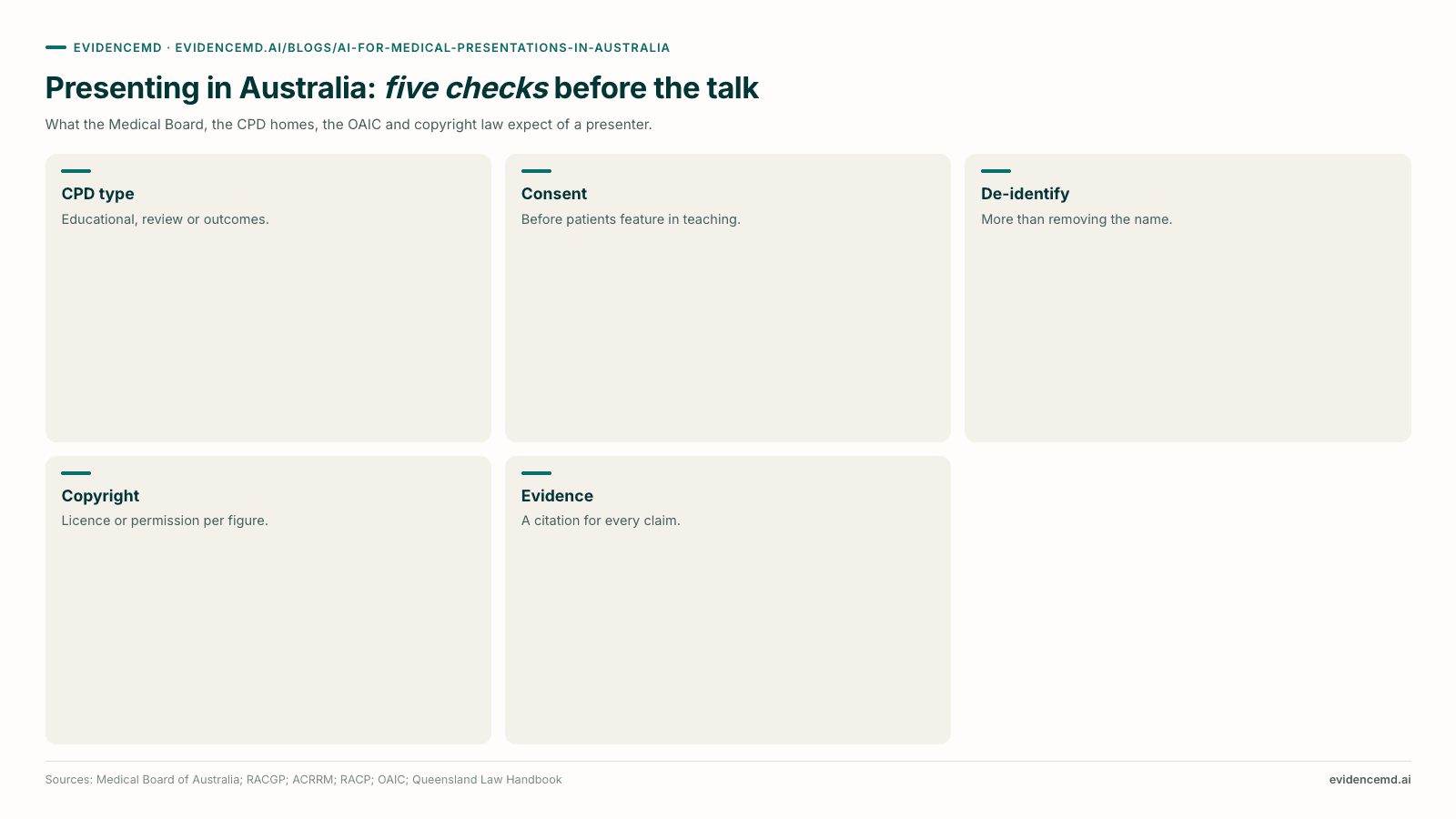
- CPD: the Medical Board asks for 50 hours a year, with at least 12.5 in educational activities and 25 across reviewing performance and measuring outcomes, logged with an AMC-accredited CPD home [5].
- How talks count depends on what you did. The RACGP's activity guide treats presenting as an educational activity and leading a case discussion or reflecting on feedback about your teaching as reviewing performance; ACRRM puts teaching under performance review; the RACP lists presentations, with preparation time, in Category 1 [7][8][9].
- Consent and de-identification: the Medical Board's code asks for informed consent before involving patients in teaching, and the OAIC warns that removing a name or address alone may not de-identify a case [10][11].
- Figures: Australian fair dealing covers limited purposes, so use CC BY figures with credit, ask the publisher, or chart the published numbers yourself and cite them [13][14].
- Evidence first, slides second. EvidenceMD answers the question behind the talk with its reasoning and sources visible, then builds the deck in the format, length and language you choose [1][3].
- Privacy: EvidenceMD is hosted in the United States, so describe the case, not the patient [4][12].
Does presenting at grand rounds or journal club count as CPD in Australia in 2026?
Yes, but the activity type depends on what you did, and each CPD home describes it slightly differently.
Presenting counts as CPD, and the Medical Board's standard decides how much of each kind you need. Every registered doctor (unless exempt) does at least 50 hours of CPD each calendar year: 12.5 hours of educational activities, 25 hours of reviewing performance and measuring outcomes with at least five hours of each, and 12.5 hours from any category. You join an AMC-accredited CPD home, log your activities with it, and write a professional development plan before you start each year [5]. The RACGP applies the same minimums across its 2026–28 triennium, which runs from 1 January 2026 to 31 December 2028 [6].
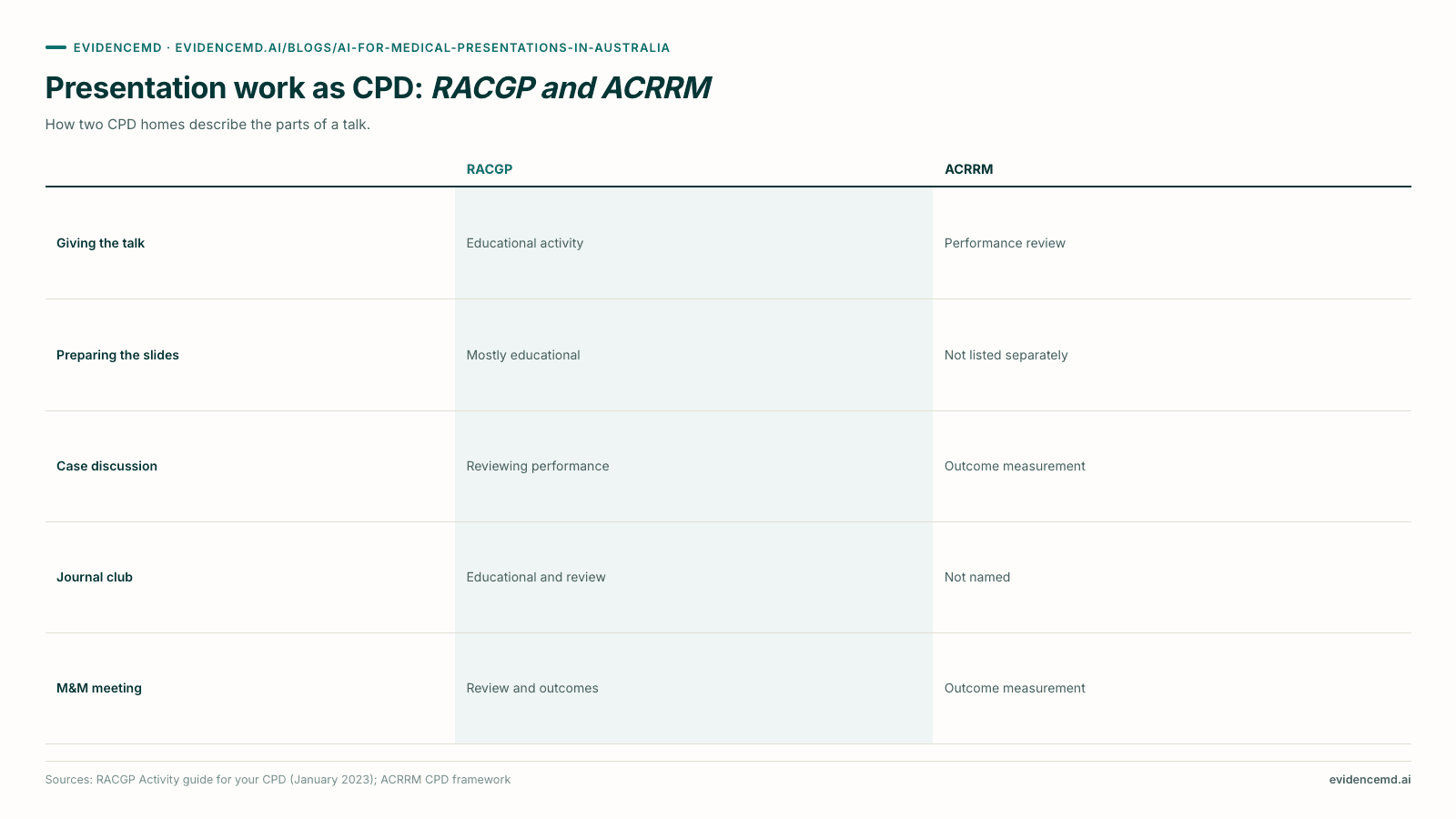
How a talk is classified depends on the part of the work you are logging. The RACGP's activity guide (version 1.0, January 2023) says lecturing and presenting is an educational activity, leading a case discussion or giving feedback is reviewing performance, and evaluating the feedback you receive on your teaching is also reviewing performance. Preparing materials, including the reading, is predominantly educational, while editing them in response to feedback is reviewing performance [7]. ACRRM lists "undertaking teaching activities or supervising colleagues" under performance review, and peer observation of teaching, case-based discussions and M&M meetings under outcome measurement [8]. The RACP's 2026 framework puts teaching, "Presentations (including preparation time)" and grand rounds or journal clubs in Category 1, educational activities [9].
| What you do | RACGP | ACRRM | RACP |
|---|---|---|---|
| Give the talk (grand round, lecture, teaching session) | Educational activity [7] | Performance review: undertaking teaching activities [8] | Category 1: teaching and presentations [9] |
| Prepare the slides and do the reading | Predominantly educational; editing after feedback is reviewing performance [7] | Not listed separately on the framework page [8] | Category 1, as presentation preparation time [9] |
| Lead a case discussion, or reflect on feedback about your teaching | Reviewing performance [7] | Outcome measurement: case-based discussions and peer observation of teaching [8] | Category 2 lists peer review of cases and of educational activities, and multisource feedback [9] |
| Run or attend a journal club | Educational activity and reviewing performance [7] | Not named on the framework page [8] | Category 1: grand rounds and journal clubs [9] |
| Present at an M&M meeting | Reviewing performance and measuring outcomes [7] | Outcome measurement [8] | Category 3, measuring outcomes: incident reporting and monitoring, such as mortality and morbidity reviews [9] |
→ Scroll the table sideways to see the remaining columns
How do you de-identify a patient case for a presentation in Australia?
Get consent when the patient could be recognised, and remove more than the name when they should not be.
Remove every direct identifier and anything else that could point to one person, and get consent if the patient could still be recognised. The Medical Board's code says patients can expect doctors to hold information about them in confidence, unless release is required or permitted by law, and asks for informed consent before involving patients in teaching or research [10]. Under the Privacy Act, information that has been appropriately de-identified is no longer personal information, but the OAIC warns that removing a name, address or other direct identifiers alone may not achieve that [11]. A rare diagnosis in a small town, a dated news event or a distinctive scar can identify a patient to the one person in the room who knows them.
The same care applies to the tools you prepare with. Ahpra expects practitioners to apply human judgement to any AI output and to understand where an AI tool keeps its data and how [12]. EvidenceMD stores application data in the United States, and its presentation workspace starts from a clinical topic, not a patient record, so a talk can be built without patient details [3][4].
Names, numbers and dates
Remove names, record and Medicare numbers, dates of birth and exact dates of admission. Use intervals ("day 3") and age bands instead.
Details that point to one person
Rare conditions, unusual jobs, small towns and events that made the news can identify someone without a name [11].
Images and file names
Crop faces, tattoos and jewellery, and check scan overlays, file names and slide notes for identifiers before the deck is shared.
Consent you can show
If the patient could still be recognised, or you show their images, obtain informed consent and record it [10].
Describe the case, not the patient
When you ask EvidenceMD about a case, give the clinical facts that matter (age band, presentation, results) and leave out anything that identifies the person. The guide for Australian GPs on this site covers the Privacy Act and overseas AI tools in depth [4][12][22].
Can you use journal figures in a presentation in Australia?
Sometimes. Australia's exceptions are tied to set purposes, so licences and permission matter.
You can use a published figure when its licence allows it, when the publisher gives permission, or when a fair dealing exception applies. Australian copyright law allows fair dealing only for listed purposes: research or study, criticism or review, parody or satire, reporting the news, and legal advice and judicial proceedings (sections 40 to 42 of the Copyright Act 1968) [13]. Whether a teaching talk falls within one of those purposes is not clear-cut, so the safer routes are figures released under an open licence and figures you have permission to use.
Many open-access articles use the Creative Commons CC BY licence, which lets you copy and adapt the material for any purpose provided you give appropriate credit, link to the licence and say if you changed it [14]. Check the licence line on the article itself, and ask your hospital or university library before reusing a figure from a subscription journal or a textbook.
| Where the figure comes from | What allows its use | What to put on the slide |
|---|---|---|
| Open-access article under CC BY | The licence: copy and adapt for any purpose [14] | Credit, a link to the licence, and a note if you changed it [14] |
| Subscription journal or textbook | Publisher permission; fair dealing only for its listed purposes [13] | The citation and any wording the publisher's permission requires |
| Your own chart of the published numbers | Your own design, drawn from the reported results | The citation for the numbers |
| EvidenceMD's optional deck images | Decorative illustrations with no text or numbers [3] | Nothing evidential: keep data on the cited slides |
→ Scroll the table sideways to see the remaining columns
How do you build an evidence-backed medical talk?
Answer the clinical question first; the slides follow from the answer.
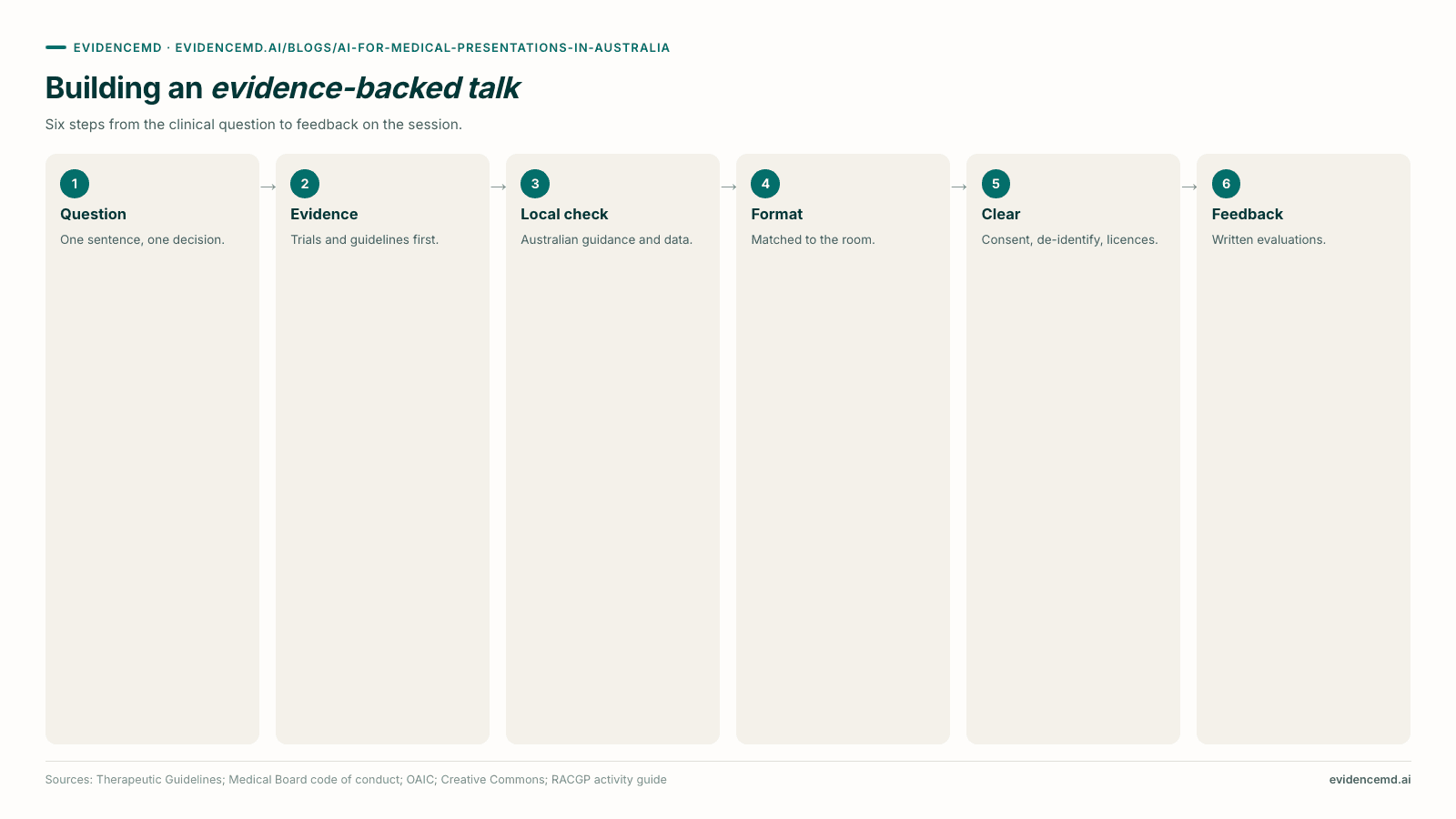
Write the question in one sentence
Name the decision your audience will face: the patient group, the intervention or test, the comparison and the outcome that matters.
Answer it from the evidence
Find the trials, cohorts and guidelines before you draft a slide. EvidenceMD does this step with its reasoning shown and a citation for every claim [1].
Match the format to the room
A registrar teaching session, a journal club and a consultant grand round need different depth. The case presentation guide on this site covers the structure of a case talk [21].
Collect feedback
Ask for written evaluations. The RACGP counts evaluating feedback on your teaching as reviewing performance [7].
How does EvidenceMD answer the clinical question behind a case presentation?
An illustrative, de-identified case for general medicine grand rounds.
EvidenceMD answers it in visible steps, from the assessment to the evidence to the decision, with a citation for each claim, and leaves the judgement calls marked as yours. Here is how that looks for a typical teaching question. A registrar is preparing a case for general medicine grand rounds. A man in his seventies with chronic kidney disease (eGFR 24 mL/min/1.73 m²) and heart failure, taking perindopril, furosemide and allopurinol 100 mg daily, was admitted with a hot, swollen knee; the joint aspirate showed monosodium urate crystals and no organisms on Gram stain. The question at the heart of the talk: in an acute gout flare with an eGFR below 30, which anti-inflammatory treatment is safest, and should his allopurinol be stopped?
Asked that de-identified question, EvidenceMD reasons through it in steps, with a citation for each claim:
Assessment
This is a crystal-proven gout flare. NSAIDs, colchicine and corticosteroids are equally efficacious options for acute gout, so his comorbidities and other medicines decide the choice [16].
NSAIDs
Kidney Health Australia's CKD handbook lists NSAIDs among the nephrotoxic medicines to avoid, and warns that an ACE inhibitor or ARB, a diuretic and an NSAID together, the "triple whammy", can cause acute kidney injury, especially when CKD is present [17]. He already takes perindopril and furosemide, so an NSAID would complete that combination.
Colchicine
In a randomised trial, low-dose colchicine (1.8 mg over one hour) worked as well as a high-dose regimen (4.8 mg over six hours): 37.8% versus 32.7% of patients had at least a 50% fall in pain at 24 hours, against 15.5% on placebo, with diarrhoea in 23.0% versus 76.9% [18]. Adapted to the Australian tablet, the regimen is 1 mg, then 500 micrograms an hour later, at most 1.5 mg per course and not repeated within three days [16][19]. Kidney Health Australia advises halving the dose when eGFR is below 50 mL/min/1.73 m² and not using colchicine below 10 [17]. Renal impairment and CYP3A4 or P-glycoprotein inhibitors, such as diltiazem, verapamil and macrolide antibiotics, raise the risk of toxicity, and an MJA letter described three cases of toxicity from supratherapeutic colchicine dosing, seen within two weeks of each other, one of them fatal [16][19].
Prednisolone
In a double-blind trial of 120 primary care patients with crystal-proven gout, prednisolone 35 mg daily and naproxen 500 mg twice daily for five days reduced pain equally [20]. Australian Prescriber notes that 15–20 mg daily is often recommended and can usually be stopped after three to five days, and Kidney Health Australia says a short course of prednisolone can be helpful when colchicine has to be reduced or avoided in CKD [16][17]. The 2020 American College of Rheumatology guideline strongly recommends colchicine, NSAIDs or glucocorticoids for a flare, with glucocorticoids given orally, by intra-articular injection or intramuscularly [23].
Allopurinol
Keep it going: Australian Prescriber advises against stopping allopurinol during an acute flare, and in renal impairment recommends starting low and escalating slowly, with the maximum dose set by tolerability rather than renal function [16]. Kidney Health Australia gives a starting dose of 50–100 mg a day in CKD, depending on the stage [17].
Where the clinician decides
Reduced-dose colchicine, oral prednisolone or an intra-articular injection into the affected knee for this man, how his heart failure and fluid status shape that choice, the culture result, when to step up his allopurinol and when to involve rheumatology or nephrology remain clinical decisions; current doses belong in Therapeutic Guidelines [15].
Every claim links to its source, so the registrar can open the trials and see that neither was run in people selected for kidney disease, while the kidney-specific dose advice comes from a national handbook. That gap is the teaching point of the talk, and it is the part the presenter has to own.
How does the answer become a cited EvidenceMD slide deck?
Type the topic, set the audience and format, and the deck is written from the evidence.
| Setting | Options in EvidenceMD | For this grand round |
|---|---|---|
| Audience | Physician, nurse, PA, pharmacist, medical researcher and more [3] | Physician |
| Format | Auto, Learning, Clinical Review, Case Discussion, Research Review, Journal Club [3] | Case Discussion |
| Evidence depth | Standard, In-depth, Research-focused [3] | In-depth |
| Slides | 10, 15, 20 or 25 [3] | 20 |
| Language | 17 deck languages, English by default [3] | English |
| References | Off by default; on, the last slide lists the sources the deck cites [3] | On |
| Images | Off by default; on, a cover image and up to three decorative illustrations without text or numbers [3] | Off |
| Your context | Custom instructions and one optional PDF or image [3] | "Add a slide on colchicine doses by eGFR" |
→ Scroll the table sideways to see the remaining columns
The finished deck opens in a presenter view and downloads as a PDF or a PowerPoint file. You can ask for up to three AI edits per deck and edit slide text by hand, which is where the registrar adds the de-identified case timeline and the department's own protocol [3]. Presentations are included with EvidenceMD's annual plans: 20 a month on Individual and unlimited on Max; EvidenceMD itself is free to start, with paid individual plans from US$50 a month or US$450 a year [2].
Build a cited deck from your next case
Ask the de-identified question behind your talk, check the reasoning and the sources, then turn the topic into slides.
Frequently asked questions
Does presenting at grand rounds count toward RACGP CPD?
Yes. The RACGP's activity guide treats lecturing and presenting as an educational activity, and leading a case discussion or evaluating the feedback you receive on your teaching as reviewing performance; you log the hours in myCPD. Whatever drafted the slides, EvidenceMD included, the CPD record is of your own preparation, delivery and reflection.
How does ACRRM's CPD framework classify teaching?
ACRRM lists undertaking teaching activities or supervising colleagues under performance review, and puts peer observation of teaching, case-based discussions and M&M meetings under outcome measurement. Attending lectures and workshops is an educational activity. A talk built with EvidenceMD fits these categories the same way as any other talk: by what you did.
Do RACP fellows get CPD hours for preparing a presentation?
Yes. The RACP's 2026 CPD framework lists presentations, including preparation time, under Category 1 educational activities, alongside teaching and grand rounds or journal clubs. If EvidenceMD drafts the evidence base, the time you spend checking its sources and shaping the talk is part of that preparation.
Do I need consent to present a patient's case at an Australian hospital meeting?
The Medical Board's code asks doctors to obtain informed consent before involving patients in teaching and to keep patient information confidential. If the patient could be recognised or you show their images, get consent and record it; otherwise de-identify fully, because removing the name alone may not be enough. When you ask EvidenceMD about the case, describe the clinical facts, not the person.
Can I put a figure from a journal article on my slides in Australia?
Only with a licence, permission or a fair dealing purpose that fits, and Australian fair dealing covers limited purposes such as research or study and criticism or review. The practical routes are CC BY figures with credit, publisher permission, or your own chart of the published numbers with a citation. EvidenceMD's optional deck images are decorative and contain no text or numbers, so any published figure you add is yours to clear.
Which Australian sources should an evidence-based medical talk check?
Cite the primary studies and guidelines behind each claim, then check Australian practice: Therapeutic Guidelines for treatment, and Australian sources where they exist, such as Kidney Health Australia's CKD handbook for prescribing in kidney disease. EvidenceMD frames the country-specific parts of an answer to Australian guidelines and cites every claim, so you can see which sources are local.
Can an EvidenceMD slide deck end with a reference slide?
Yes. Turning on References in EvidenceMD's presentation settings ends the deck with a slide listing the sources it cites; it is off by default. Decks run to 10, 15, 20 or 25 slides, download as PDF or PowerPoint, and are included with annual plans: 20 a month on Individual and unlimited on Max.
The bottom line
For Australian doctors preparing grand rounds, journal clubs, registrar teaching or case presentations, AI helps most with the evidence work: answering the clinical question and drafting cited slides. EvidenceMD does that with its reasoning shown and a citation for every claim, then builds a 10 to 25 slide deck in the format and language you choose [1][3]. The rest stays with you: logging the right CPD activity type with your CPD home, consent and de-identification under the Medical Board's code and the Privacy Act, clearing figures under copyright, and the clinical judgement on every slide [5][7][10][11][13].
Sources & related evidence
EvidenceMD's own pages (company claims), the Medical Board of Australia and Ahpra, the RACGP, ACRRM and RACP, the OAIC, the Queensland Law Handbook, Creative Commons, Therapeutic Guidelines, and the Australian Prescriber review, Kidney Health Australia handbook, MJA letter, two trials and the 2020 American College of Rheumatology guideline used in the worked example.
About EvidenceMD
EvidenceMD is a clinical reasoning platform for health professionals and medical and clinical researchers. It answers clinical questions from 40 million+ peer-reviewed papers and clinical guidelines with a visible chain of reasoning and a citation for every claim, in 30 languages, needs no NPI or licence check, and builds cited slide decks from a clinical topic; it is free to start. Application data is hosted in the United States, and it is not included in the ARTG. Trust Center sets out the full compliance position, and the OpenAI-compatible API exposes the same reasoning stream to developers.
Related reading
Start your next talk from the clinical question
Ask EvidenceMD the de-identified question behind your case, read the reasoning and the sources, then build the deck. No licence check, free to start.