What are the best clinical decision support tools in Australia?
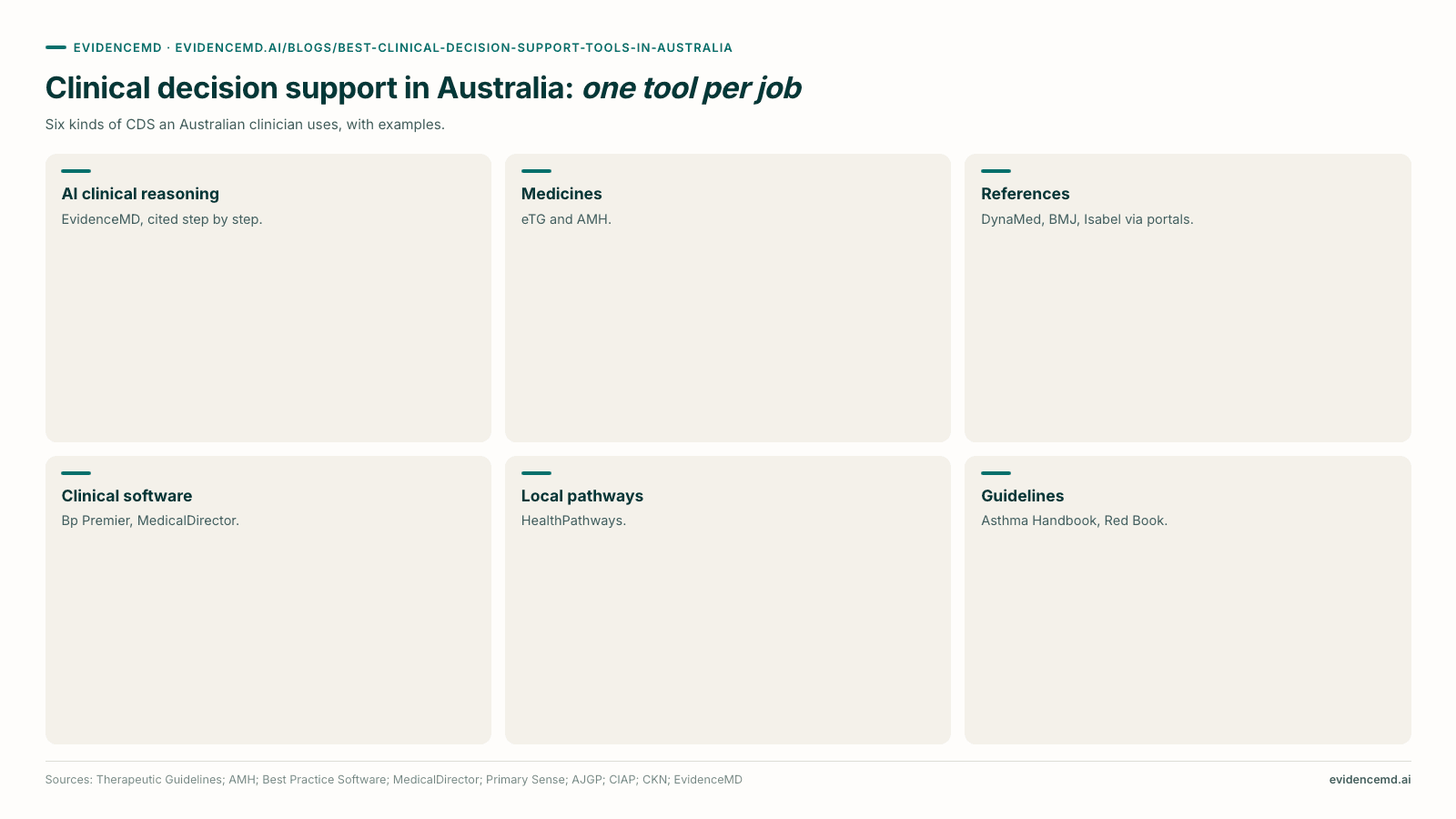
Australian clinicians use clinical decision support by job: Therapeutic Guidelines and AMH for prescribing, the alerts in Best Practice or MedicalDirector, HealthPathways for local referral, references such as DynaMed and BMJ Best Practice through CIAP or CKN, and an AI clinical reasoning tool such as EvidenceMD, which answers the specific question step by step with a citation for every claim, framed to Australian guidance [1][5][6][8][9][14].
Key takeaways
- Prescribing decisions rest on Australian references. Therapeutic Guidelines, an independent not-for-profit, gives treatment advice for 2,500 conditions, and AMH adds independent, peer-reviewed medicines information [5][6].
- Your clinical software is already CDS. Bp Premier checks allergies when you prescribe and queries Real Time Prescription Monitoring for high-risk medicines; MedicalDirector Clinical lists drug-drug, drug-disease, drug-pregnancy and other checks [10][11][12].
- HealthPathways is the local layer. It combines evidence-based guidance with local referral information, written by regional clinical editorial teams that usually include GPs, at no cost to clinicians [14].
- The TGA exemption now has five limbs. From 1 November 2026, exempt CDS software must not make the diagnosis or treatment decision and must display the guidelines, calculations or logic behind each recommendation so you can verify it [16][17].
- Check AI answers against Australian sources. An asthma answer should follow the Australian Asthma Handbook, Version 3.0, which advises against salbutamol alone for adults and adolescents, and drug choice and dose should match eTG or AMH [5][6][20][22].
- EvidenceMD fills the AI clinical reasoning job: cited reasoning with the Australian parts framed to Australian guidance. It is not included in the ARTG and is hosted in the United States, so ask de-identified questions [1][3].
What types of clinical decision support do Australian clinicians use in 2026?
Six jobs, each with Australian examples and the usual route to them.
Australian clinicians use six kinds of clinical decision support, and each answers a different question. AI clinical reasoning answers the question about the patient in front of you, with the evidence assembled for that case; medicines references settle drug choice and dose; point-of-care references and diagnostic tools help you read around a condition or widen a differential; your clinical software warns you as you prescribe; HealthPathways tells you what your region has agreed for assessment and referral; and national guidelines and calculators set the thresholds.
| Type of CDS | Australian examples | What it helps with | How clinicians usually get it |
|---|---|---|---|
| AI clinical reasoning | EvidenceMD | A cited answer to the specific clinical question, with the reasoning shown | Personal sign-up, free to start; paid plans from US$50 a month or US$450 a year [1][2] |
| Medicines and therapeutic references | Therapeutic Guidelines (formerly eTG complete); Australian Medicines Handbook; eMIMSelite | Drug choice, dose and treatment advice | Individual or institutional subscription; Therapeutic Guidelines and AMH on CIAP and CKN, MIMS on CIAP and eMIMSelite on CKN [5][6][8][9] |
| Point-of-care references and diagnostic support | UpToDate; DynaMed; BMJ Best Practice; Isabel | Reading around a condition; widening a differential diagnosis | State portals such as CIAP (NSW) and CKN (Queensland) [8][9] |
| CDS inside clinical software | Bp Premier; MedicalDirector Clinical; Primary Sense | Allergy and interaction warnings, real-time prescription monitoring, care prompts | Built into the practice's software; Primary Sense through participating PHNs [10][11][12][13] |
| Local pathways | HealthPathways | Locally agreed assessment, management and referral | Regional site, password-protected, at no cost to clinicians [14] |
| National guidelines and calculators | Australian Asthma Handbook; RACGP Red Book; Aus CVD Risk Calculator | Treatment steps, risk thresholds and preventive activities | Published online by the National Asthma Council Australia and the RACGP, which recommends the Australian CVD risk calculator [21][22] |
→ Scroll the table sideways to see the remaining columns
Which medicines and therapeutic references support prescribing decisions in Australia?
Independent Australian references for drug choice and dose, and the journal that moved from NPS MedicineWise to Therapeutic Guidelines.
Australian prescribing decisions draw on Australian references, chiefly Therapeutic Guidelines and the Australian Medicines Handbook, both independent, with EvidenceMD beside them for a cited answer to the medicines question about one patient [1]. Public health staff in NSW and Queensland can reach both through CIAP and CKN, and Therapeutic Guidelines also sells single-user subscriptions [5][6][8][9].
EvidenceMD (clinical reasoning)
For a medicines question about one patient, such as a dose at reduced kidney function or an interaction, EvidenceMD reasons through it step by step with a citation for every claim [1]. Confirm the Australian drug choice and dose in Therapeutic Guidelines or AMH before prescribing [5][6].
Therapeutic Guidelines (eTG)
Published by an independent not-for-profit organisation, its 22 guidelines give treatment advice for 2,500 conditions, with single-user and institutional subscriptions [5]. It is on CIAP and CKN, and CKN lists it as formerly eTG complete [8][9]. Best for: drug choice and treatment the Australian way.
What decision support is built into Best Practice and MedicalDirector?
Prescribing checks in the software itself, and a PHN tool that adds care prompts.
Best Practice and MedicalDirector both check prescriptions as you write them, and some PHNs add a separate decision support layer on top. What each one checks, and what it does not, is worth knowing before you rely on silence as reassurance.
Bp Premier (Best Practice Software)
Checks the patient's recorded allergies and reactions when medications are prescribed [10]. When a monitored high-risk medicine is printed or sent as an eScript token, it queries Real Time Prescription Monitoring through the National Data Exchange, linked to state systems such as SafeScript NSW, QScript, SafeScript in Victoria and ScriptCheckWA, and returns a green, amber or red message based on the patient's prescription history [11].
MedicalDirector Clinical
Its knowledge base lists drug-age, drug-allergy, drug-breastfeeding, drug-disease, drug-drug and drug-pregnancy checking, among others, and shows only the warnings relevant to the patient you are prescribing or dispensing for [12]. Ask your vendor which drug database sits behind the checks and how often it is updated.
Primary Sense
A clinical decision support tool owned and operated by Primary Health Networks, funded by participating PHNs and delivered by WA Primary Health Alliance. It gives real-time medication safety alerts, care prompts and reports from de-identified practice data, has installation guides for Best Practice and MedicalDirector, and states that it meets the criteria for exempt CDS software [13]. Ask your PHN whether it is offered in your region.
Alerts are not a full answer
Prescribing checks tell you about a known interaction, allergy or monitored medicine. They do not tell you whether the drug is the right choice for this patient. That question belongs to eTG, AMH and, for a cited answer to the specific case, an AI clinical reasoning tool such as EvidenceMD [1][5][6].
How do HealthPathways, CIAP and CKN fit into clinical decision support?
Local referral guidance for primary care, and state portals for public health staff.
HealthPathways is the decision support tool built for local assessment and referral in Australian general practice. The Australian Journal of General Practice describes Community HealthPathways as clinical decision support that combines evidence-based guidelines with local service and referral information; content is written by local clinical editorial teams, usually including GPs, working with specialists; pages with a yellow background have not yet been localised; and the site is password-protected but costs clinicians nothing [14]. In Australia the work is often coordinated between a state-funded health service and a Commonwealth-funded Primary Health Network [14].
Public health staff in NSW and Queensland also have state portals that bundle references and diagnostic decision support.
| Portal | Who can use it | Decision support listed |
|---|---|---|
| CIAP, NSW Health | NSW Health staff; offsite access with a StaffLink login [8] | BMJ Best Practice, DynaMed and the Isabel differential diagnosis tool (trial 1 April 2026 to 30 June 2027), Lippincott Advisor for nurses, NSW HealthPathways, Therapeutic Guidelines, UpToDate and eviQ [8] |
| CKN, Queensland Health | Everyone employed by the Hospital and Health Services, Queensland Ambulance Service and Queensland Health [9] | BMJ Best Practice and Comorbidities, DynaMed and Isabel; AMH, eMIMSelite and Therapeutic Guidelines; DynaMed's medical calculators [9] |
→ Scroll the table sideways to see the remaining columns
If you work elsewhere, ask your health service library what it licenses. UpToDate prices and the portals as a route to UpToDate replacements are covered in the Australian UpToDate guide on this site [4].
How does EvidenceMD reason through a question with an Australian guideline?
A de-identified asthma question from general practice, reasoned step by step against the Australian Asthma Handbook.
Take a question a GP in Geelong might bring to a CDS tool: a 29-year-old woman with asthma, diagnosed three years ago on spirometry that showed reversible airflow limitation, who has only ever been prescribed salbutamol. Over the past four weeks she has needed it on one or two days a week, with no night waking and no limitation of activity. She has had no oral corticosteroid course or emergency visit in the past year, does not smoke, and uses about one salbutamol canister a year. Should she stay on salbutamol alone, and if not, what should replace it?
EvidenceMD works through it in steps, citing each one. First, the diagnosis: the Australian Asthma Handbook, Version 3.0, asks for a diagnosis based on clinical evidence and documented variable expiratory airflow limitation before treatment starts, which her spirometry provides [20][22]. Second, control and risk: daytime symptoms and reliever use on no more than two days a week, no limitation of activity and no symptoms at night or on waking over the past four weeks meet the Handbook's definition of good control, and the details given rule out the main risk factors on its exacerbation checklist: no exacerbation in the previous 12 months, far fewer than three salbutamol canisters a year, and no smoking; the GP still works through the rest of the checklist, such as lung function, at review [25]. Third, salbutamol alone is no longer an option: the Handbook says not to prescribe as-needed SABA alone, because an inhaled corticosteroid is indicated for all adults and adolescents with asthma, even when symptoms are infrequent [20][27].
Fourth, the choice: the recommended treatment is low-dose budesonide-formoterol taken as needed, and the alternative is a daily low-dose inhaled corticosteroid with salbutamol as needed [20]. In Novel START, a 52-week open-label trial in 675 adults with mild asthma, as-needed budesonide-formoterol roughly halved the annualised exacerbation rate compared with as-needed salbutamol (0.195 versus 0.400; relative rate 0.49) and gave fewer severe exacerbations (9 versus 23); compared with twice-daily budesonide, the exacerbation rate was similar, there were fewer severe exacerbations (9 versus 21), and the mean budesonide dose was about half (107 versus 222 micrograms a day) [26]. Fifth, the practical detail: only certain budesonide-formoterol inhalers are approved by the TGA for as-needed use without maintenance doses, and the Handbook lists them with their doses, such as one inhalation of a 200/6 microgram dry-powder inhaler or two inhalations of the 100/3 microgram pressurised inhaler, and advises checking PBS restrictions before prescribing [27]. She carries it at all times, can use it before exercise, and no longer needs a separate salbutamol inhaler [20]; her written asthma action plan tells her to keep taking her usual dose for symptoms, up to 12 inhalations of the 200/6 inhaler in a day, and to see her doctor or go to an emergency department if she needs more [28].
The GP still decides. As-needed budesonide-formoterol or a daily preventer is a choice to make with her; the Handbook asks you to choose an inhaler she can use correctly and to check her technique, and if she later needs her reliever three or more times a week, it suggests adding maintenance treatment [20][25]. EvidenceMD shows each step and source, which makes that check quicker. Because EvidenceMD stores application data in the United States, the question describes the case, not the patient [3].
Ask EvidenceMD a question with an Australian guideline
Try a de-identified question from your practice and read the reasoning and the sources behind the answer.
What is the TGA's exemption for clinical decision support software?
Five limbs from 1 November 2026, conditions that still apply, and the software excluded altogether.
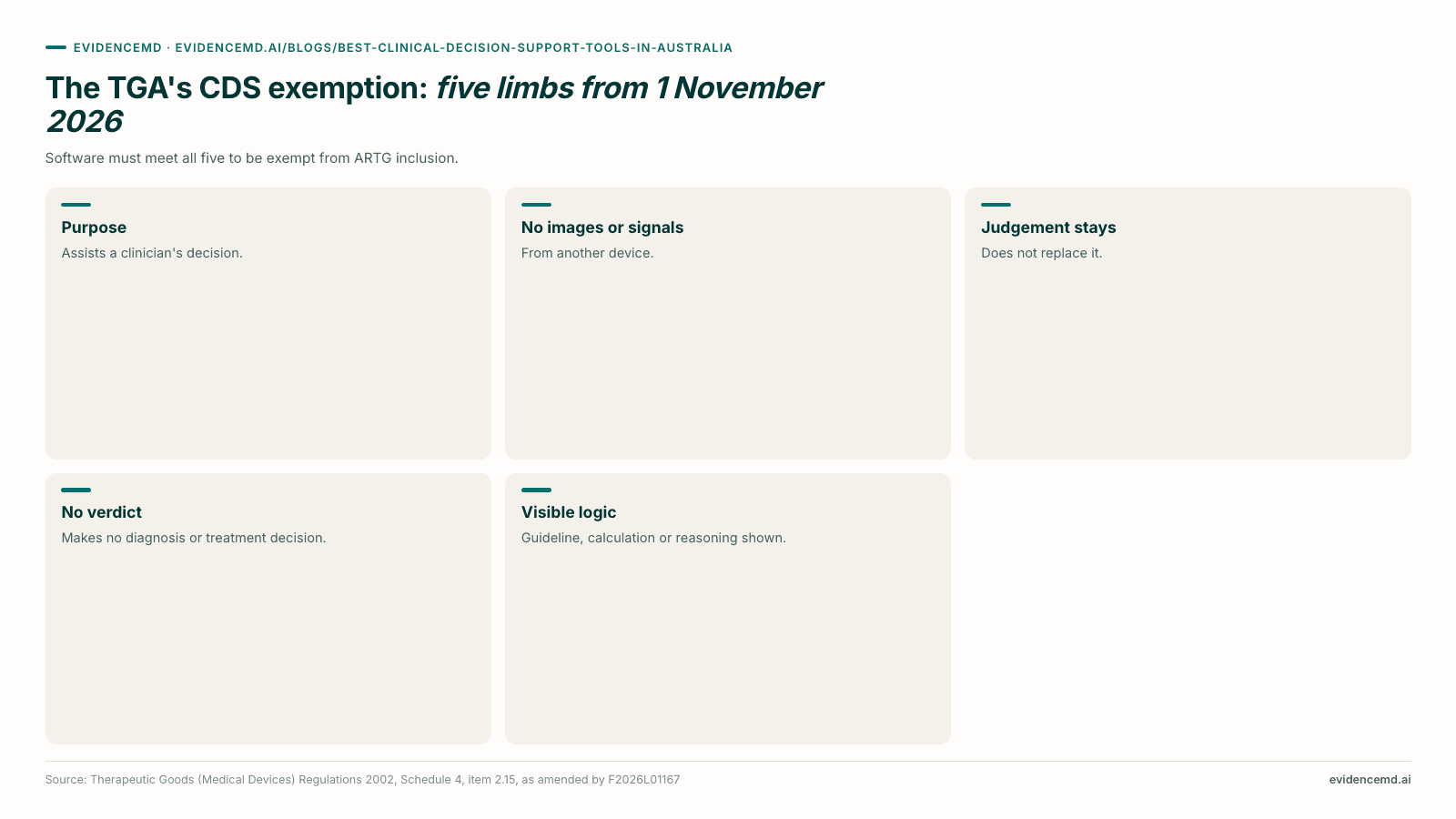
Clinical decision support software that meets the definition of a medical device must generally be included in the Australian Register of Therapeutic Goods (ARTG) unless it is exempt or excluded [15]. From 1 November 2026 the CDSS exemption has five limbs, and software must meet all of them; the TGA says the amendments clarify when the exemption applies without changing its scope or adding new regulatory requirements [15][16]. The table reads each limb as a question to ask of a tool you are choosing.
| Limb | What the limb requires | What to look for in a tool |
|---|---|---|
| Purpose | Intended to make a recommendation to a health professional for the sole purpose of assisting them in a decision about preventing, diagnosing, curing or alleviating a disease, ailment, defect or injury [16] | It is built for clinicians, and it recommends rather than acts |
| Images and signals | Not intended to process, analyse, compress or decompress a medical image or signal from another medical device [16] | Tools that read ECGs, imaging or monitor data need another route |
| Clinical judgement | Not intended to replace the clinical judgement of a health professional in making a diagnosis or treatment decision [16] | You stay the decision-maker, and the tool says so |
| No diagnosis or treatment decision | Not intended to make a clinical diagnosis or decision about the treatment of patients [16] | It offers options and evidence, not a verdict |
| Visible logic | Displays the clinical practice guidelines, calculations or logic it uses, so a health professional can readily interpret and verify any recommendation while using it [16] | You can see the guideline, calculation or citation behind every recommendation on screen |
→ Scroll the table sideways to see the remaining columns
Exempt software still carries conditions, including the essential principles and a 20-working-day notification of supply to the TGA [17]. Some software is outside regulation altogether: since 25 February 2021, calculators that use published clinical standards or authoritative sources, or display their calculations so the user can validate them, are excluded unless they control the administration of a calculated dose, and so are electronic health records that are not intended to diagnose, treat or make recommendations about a condition [18].
The fifth limb gives you a practical test for any CDS tool: if you cannot see the guideline, calculation or source behind a recommendation, you cannot verify it, and Ahpra holds you responsible for any AI output you act on whatever its TGA status [19]. Passing that test does not make a tool exempt, because software must meet all five limbs; how the TGA's guidance treats AI-enabled decision support is quoted in the guide to using AI in clinical practice in Australia on this site [29]. EvidenceMD is not included in the ARTG, and this guide makes no claim about how the TGA would classify it; ask every vendor, EvidenceMD included, which of its functions it treats as a medical device and why. The GP guide on this site covers digital scribes and the old and new wording of the exemption side by side [23].
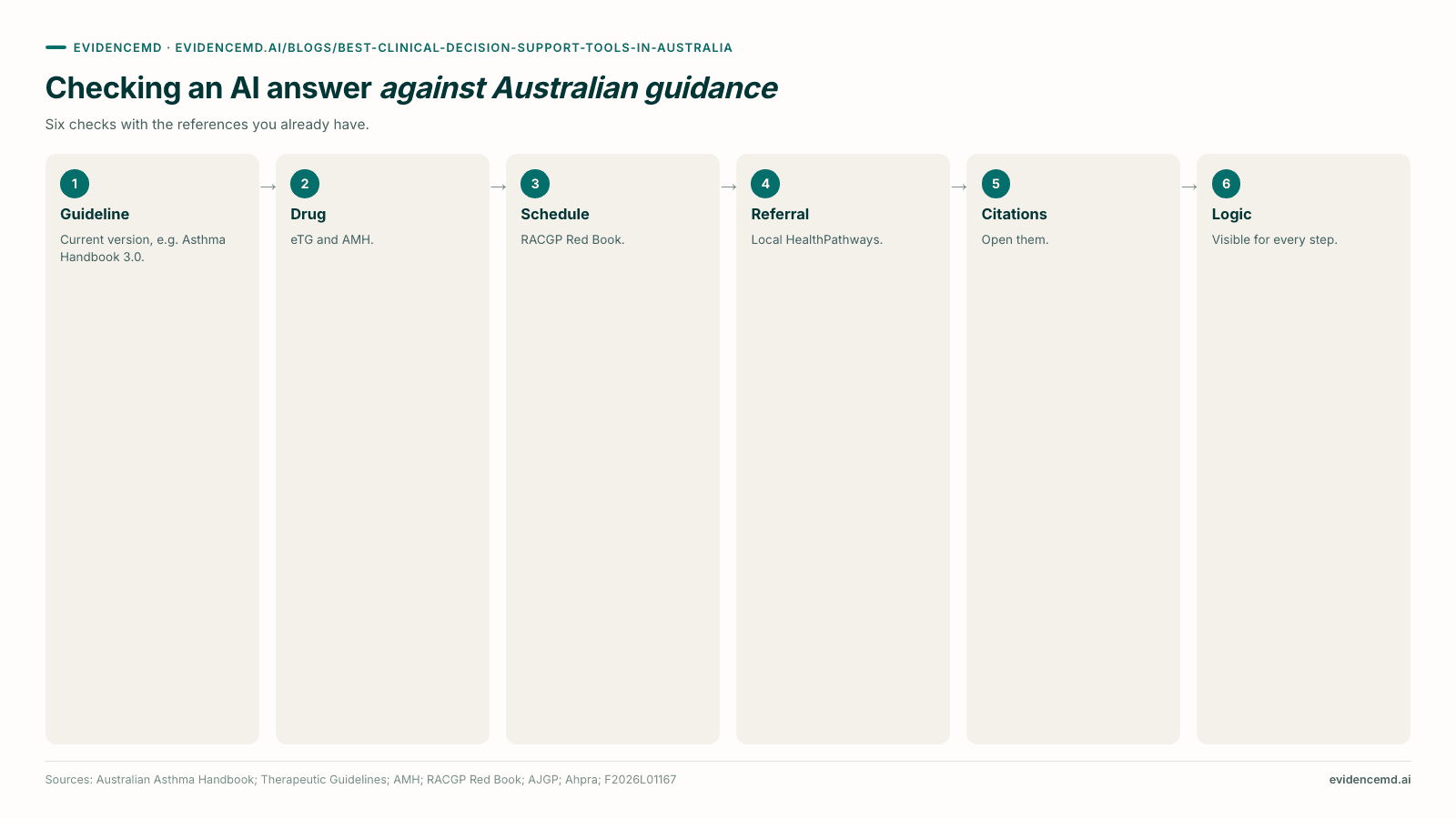
How do you check that an AI answer follows Australian guidance?
Six checks that take a few minutes, using the references you already have.
Check the preventive schedule
Ages and intervals for screening and preventive care should match the RACGP Red Book, for example CVD risk assessment from 45 to 79, from 35 with diabetes and from 30 for First Nations people [21].
Check the referral pathway
When and where to refer should match your regional HealthPathways, which reflects local services [14].
Open the citations
Check that each source says what the answer claims; Ahpra holds you responsible for any AI output you act on [19].
Look for the logic
Prefer tools that show the guideline, calculation or reasoning behind each recommendation, the same test as the fifth limb of the TGA exemption [16].
Frequently asked questions
Which clinical decision support tools do Australian GPs use day to day?
A typical set-up is Therapeutic Guidelines or AMH for prescribing, the alerts in Best Practice or MedicalDirector and their regional HealthPathways for referral; public health staff in NSW and Queensland also have the references on CIAP or CKN. For a cited answer to a specific clinical question, EvidenceMD shows its reasoning step by step and frames the Australian parts to Australian guidance.
Is Therapeutic Guidelines (eTG) a clinical decision support tool?
In the broad sense, yes: it is an independent reference whose 22 guidelines give treatment advice for 2,500 conditions, looked up at the point of care. It is a reference you read rather than software that makes a recommendation about a patient. EvidenceMD answers the patient-specific question and points you back to eTG or AMH for drug choice and dose.
What decision support is built into Best Practice and MedicalDirector?
Bp Premier checks recorded allergies and reactions when you prescribe and queries Real Time Prescription Monitoring for monitored high-risk medicines, while MedicalDirector Clinical lists drug-drug, drug-disease, drug-pregnancy, drug-allergy and other checks. These warn about known problems but do not judge whether a drug is the right choice. For that question, EvidenceMD gives a cited answer with the reasoning shown.
Is HealthPathways a clinical decision support tool, and what does it cost?
Yes. The AJGP describes Community HealthPathways as clinical decision support that combines evidence-based guidelines with local referral information; it is password-protected and costs clinicians nothing, so register with your regional site. EvidenceMD complements it with cited answers when a question falls outside a pathway.
Does clinical decision support software need to be on the ARTG?
Not if it meets the TGA's CDSS exemption: from 1 November 2026 it must make recommendations solely to assist a health professional, not process images or signals from another device, not replace or make the diagnosis or treatment decision, and display the guidelines, calculations or logic behind each recommendation. Exempt software must still meet the essential principles and be notified to the TGA. EvidenceMD is not included in the ARTG; ask any vendor how its product is classified.
How can I check that an AI answer follows Australian guidelines?
Check the guideline, its version and its thresholds against the Australian source; an asthma answer, for instance, should follow the Australian Asthma Handbook, Version 3.0, which advises against salbutamol alone for adults and adolescents. Confirm drug choice and dose in eTG or AMH and referral in HealthPathways, and open the citations. EvidenceMD frames the Australian parts of an answer to Australian guidance and cites each claim, which makes this check quicker.
What is Primary Sense, and who can use it?
Primary Sense is a clinical decision support tool owned and operated by Primary Health Networks, funded by participating PHNs and delivered by WA Primary Health Alliance; it gives real-time medication safety alerts and care prompts from de-identified practice data. Ask your PHN whether it is offered in your region. It works alongside an evidence tool such as EvidenceMD, which answers the clinical question with its sources.
The bottom line
The best clinical decision support set-up in Australia is one tool per job: Therapeutic Guidelines and AMH for prescribing, the checks in Best Practice or MedicalDirector, HealthPathways for local referral, the references on CIAP or CKN where you have them, and Australian guidelines such as the Australian Asthma Handbook as the yardstick [5][6][8][9][10][12][14][22]. EvidenceMD fills the AI clinical reasoning job: it answers from 40 million+ peer-reviewed papers and clinical guidelines, shows its reasoning step by step with a citation for every claim, and frames the Australian parts to Australian guidance [1]. Under the TGA's amended exemption, prefer tools that show the logic behind each recommendation, remember that Ahpra holds you responsible for what you act on, and ask de-identified questions of tools hosted overseas [3][16][19].
Sources & related evidence
EvidenceMD's own pages (company claims), then the Australian medicines references, archived CIAP and CKN pages, the clinical software vendors' knowledge bases, Primary Sense, the AJGP on HealthPathways, the TGA and therapeutic goods legislation, Ahpra, the RACGP Red Book, the Australian Asthma Handbook pages and trial used in the worked example, and related guides on this site.
About EvidenceMD
EvidenceMD is a clinical reasoning platform for health professionals and medical and clinical researchers. It answers clinical questions from 40 million+ peer-reviewed papers and clinical guidelines with the reasoning shown step by step and a citation for every claim, frames the country-specific parts of an answer to the user's country guidelines, answers in 30 languages, and needs no NPI or licence check. It is free to start. Application data is hosted in the United States, and it is not included in the ARTG. Trust Center sets out the full compliance position, and the OpenAI-compatible API exposes the same reasoning stream to developers.
Related reading
Cited answers framed to Australian guidance
Ask EvidenceMD a de-identified clinical question and read the reasoning and the sources behind the answer. No licence check, free to start.