What are the best medical apps for doctors in Australia?
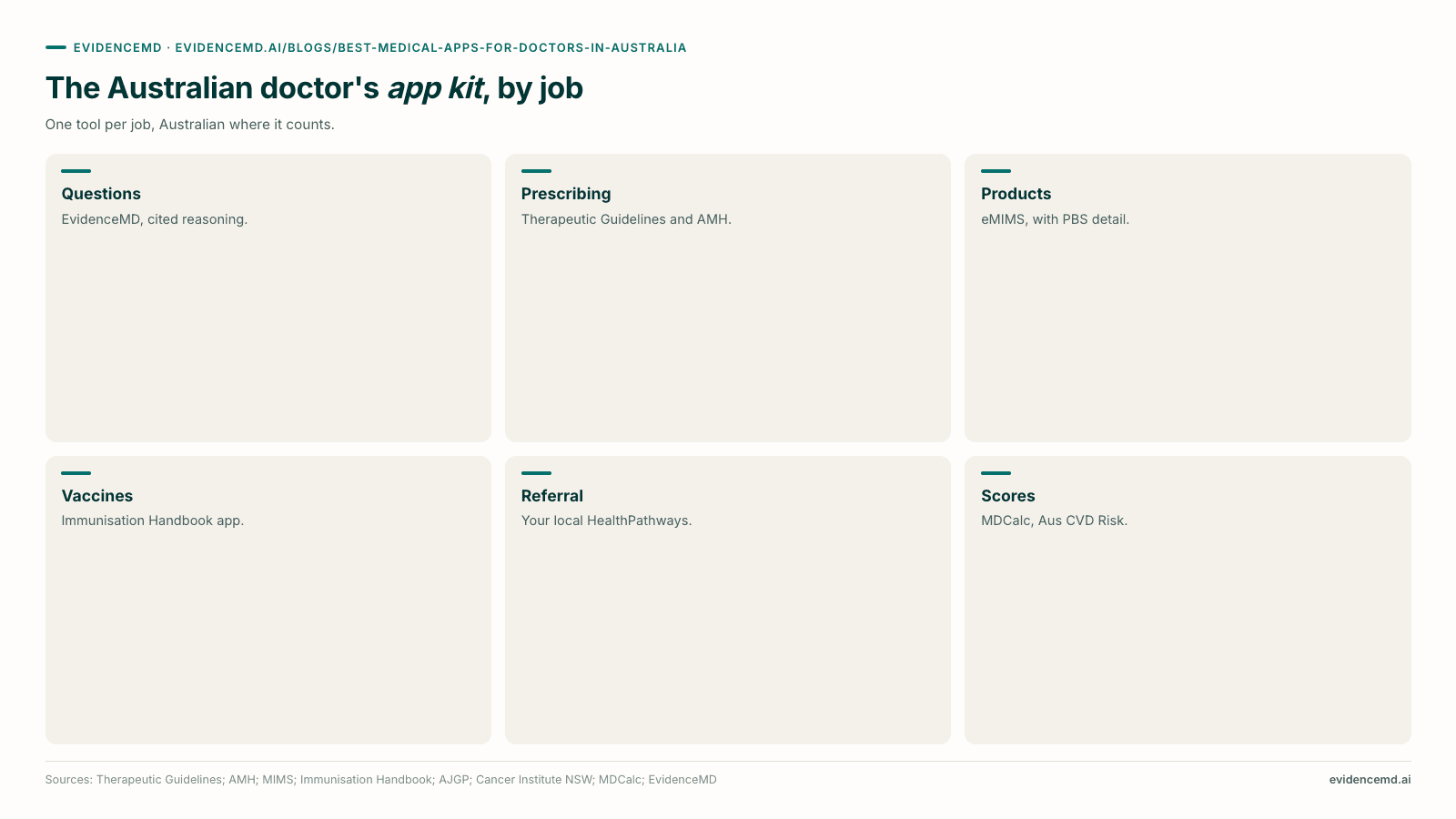
The best medical apps for doctors in Australia are a kit grouped by job. Therapeutic Guidelines and AMH cover prescribing, eMIMS covers product information, the Immunisation Handbook app and your local HealthPathways cover vaccines and referral, MDCalc covers scores, and EvidenceMD answers the clinical question itself, step by step with a citation for every claim. Check CIAP, CKN or RACGP membership before you pay [1][6][8][9][11][14][16][18].
Key takeaways
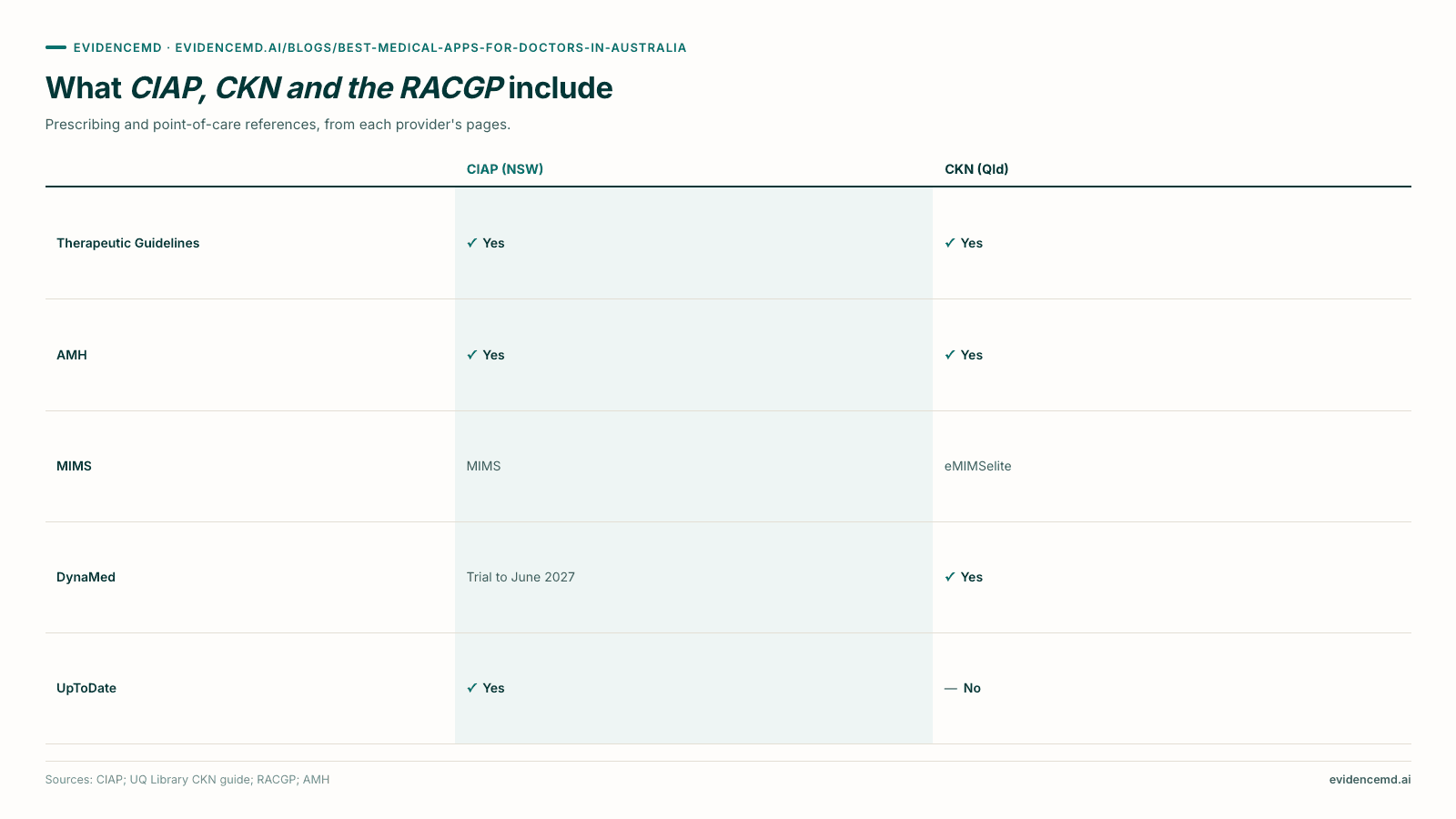
- Check what you already have. NSW Health's CIAP lists Therapeutic Guidelines, AMH, MIMS, UpToDate, BMJ Best Practice and eviQ, with DynaMed and Isabel on trial to 30 June 2027; Queensland Health's CKN lists Therapeutic Guidelines, AMH, eMIMSelite, BMJ Best Practice, DynaMed and Isabel [6][7][8].
- RACGP membership includes DynaMed, not eTG or AMH. DynaMed is an exclusive member resource; AMH is discounted for members, with AMH Medicines Online at $295 against $325 retail [9][10].
- Prescribing references cost a few hundred dollars each. Therapeutic Guidelines is $399 a year, AMH Medicines Online $325 and eMIMSplus $330 for one user [10][12][14].
- Several essential apps cost nothing. The Australian Immunisation Handbook app works offline, HealthPathways logins are free, eviQ is free, and MDCalc is free on the web and in its app [16][18][19][20].
- For the clinical question, EvidenceMD answers with its reasoning shown and a citation for every claim; it is free to start, with paid plans from US$50 a month or US$450 a year, hosted in the United States and not included in the ARTG, so ask de-identified questions [1][2][3].
Which medical apps come free through CIAP, CKN or RACGP membership?
Before you pay for anything, check your state portal and your college.
NSW Health staff get Therapeutic Guidelines, AMH, MIMS, UpToDate, BMJ Best Practice and eviQ through CIAP; Queensland Health staff get Therapeutic Guidelines, AMH, eMIMSelite, BMJ Best Practice, DynaMed and Isabel through CKN; and RACGP members get DynaMed, plus member prices on AMH [6][7][8][9][10]. The lists below come from each provider's own pages; state portals change their contracts, so check yours.
| Route | Who can use it | Apps and references included |
|---|---|---|
| CIAP, NSW Health | NSW Health staff; off-site access with a StaffLink login [6] | Therapeutic Guidelines, AMH and its Aged Care and Children's Dosing companions, MIMS, Lexidrug, Micromedex, UpToDate, BMJ Best Practice, eviQ and NSW HealthPathways; DynaMed and Isabel on trial from 1 April 2026 to 30 June 2027 [6][7] |
| CKN, Queensland Health | Everyone employed by the Hospital and Health Services, Queensland Ambulance Service and Queensland Health [8] | Therapeutic Guidelines, AMH and its companions, eMIMSelite with Don't Rush to Crush, BMJ Best Practice, DynaMed and Isabel [8] |
| RACGP membership | RACGP members | DynaMed as an exclusive member resource; AMH at member prices, such as AMH Medicines Online at $295 [9][10] |
→ Scroll the table sideways to see the remaining columns
Other states and territories run their own health library services, and hospital and university libraries add their own subscriptions, so treat this as a starting point. Doctors who work only in private practice are not eligible for the state portals, so their kit is personal; that is also where a tool such as EvidenceMD, for the clinical question, earns its place [1].
Which apps do Australian doctors use for prescribing and medicines information?
Australian prescribing runs on three references; most doctors keep at least two.
Alongside EvidenceMD for the medicines question about one patient [1], Australian doctors use Therapeutic Guidelines for treatment choice, the Australian Medicines Handbook for independent drug information, and eMIMS for product information and PBS detail. The table gives the publisher and the Australian price or access route for each.
| App | Publisher | Price or access in Australia | Best for |
|---|---|---|---|
| EvidenceMD | EvidenceMD | Free to start; paid plans from US$50 a month or US$450 a year [2] | The specific medicines question about one patient, with its reasoning shown step by step and a citation for every claim; confirm the dose in Therapeutic Guidelines or the AMH [1] |
| Therapeutic Guidelines (formerly eTG complete) | Therapeutic Guidelines Limited, an independent not-for-profit [11] | $399 for a 12-month individual subscription; the app is a free download that needs a subscription; on CIAP and CKN [7][8][12][13] | Treatment advice for 2,500 conditions across 22 guidelines, with calculators in the app [11][13] |
| Australian Medicines Handbook (AMH) | Australian Medicines Handbook Pty Ltd | AMH Medicines Online $325 for a 12-month single-user licence ($295 for RACGP members); Children's Dosing Online $150; Aged Care Online $115; desktop app for PC and Mac; on CIAP and CKN [7][8][10] | Independent drug monographs, dosing in children and older people; content updated in January and July [10] |
| eMIMS (eMIMSplus, eMIMSelite) | MIMS Australia | eMIMSplus $330 and eMIMSelite $490 for one user, web and Apple or Android, on the 2026 price list; MIMS on CIAP, eMIMSelite on CKN [7][8][14] | Product information, consumer medicine information, interactions, and PBS restrictions and pricing [15] |
→ Scroll the table sideways to see the remaining columns
Australian Prescriber is still free
Australian Prescriber, the independent journal NPS MedicineWise published from 2002, has been published by Therapeutic Guidelines Limited since 2023. It remains free, online every two months [27].
Which guideline and pathway apps should an Australian GP keep?
The Immunisation Handbook, your local HealthPathways and, if you see people with cancer, eviQ.
An Australian GP's guideline kit usually holds three free sources: the Australian Immunisation Handbook app, the local HealthPathways site for assessment and referral, and eviQ for cancer treatment protocols [16][18][19].
Australian Immunisation Handbook
Free app with the same recommendations as the website, developed by ATAGI and approved by the NHMRC; it works offline and updates itself [16].
HealthPathways
Locally agreed assessment, management and referral guidance. Each region's site is password-protected, clinicians get access at no cost, and you register on first use [18].
eviQ
Cancer treatment protocols from the Cancer Institute NSW, free, and endorsed by every Australian state and territory as a preferred source of cancer treatment information [19].
Which app answers clinical questions for Australian doctors in 2026?
The job the local references leave open: a specific question about this patient, answered with evidence you can check.
For a specific clinical question, EvidenceMD answers from 40 million+ peer-reviewed papers and clinical guidelines and shows its clinical reasoning step by step with a citation for every claim; UpToDate on CIAP and DynaMed through the RACGP or CKN are the reference libraries many Australian doctors also have [1][6][8][9]. The difference is format. A library gives you a topic to read; EvidenceMD answers the question about this patient, shows how it reached the answer and frames the Australian parts of it to Australian guidance, while you confirm drug choice and dose in eTG or AMH [1].
It answers in 30 languages, needs no licence check, and turns a broader question into a DeepSearch report of typically 20 to 25 pages [1]. Customise EvidenceMD lets you save a standing instruction for how it answers you, such as your specialty or how concise you want answers to be. Application data is hosted in the United States [3], and EvidenceMD is not included in the ARTG, so describe the case rather than the patient. It is free to start, with paid plans from US$50 a month or US$450 a year [2].
How does EvidenceMD reason through a question from Australian general practice?
A de-identified antenatal question, the evidence behind the answer, and the Australian source of record.
Take a question a GP in Brisbane might be asked at an antenatal visit: a woman 24 weeks into her second pregnancy, who had dTpa at 29 weeks in her first pregnancy 20 months ago, asks whether she needs the whooping cough vaccine again.
EvidenceMD starts with the Australian recommendation. The Australian Immunisation Handbook recommends a single dose of dTpa in each pregnancy, ideally between 20 and 32 weeks, so the dose from her first pregnancy does not cover this one [17]. It then cites the evidence for why the dose matters to the baby. After England began vaccinating pregnant women in October 2012, vaccine effectiveness against confirmed pertussis in infants younger than three months was 91% (95% CI 84 to 95) [22]. In a NSW case-control study of the state's maternal program, effectiveness was 69% in infants younger than three months and 94% against hospitalisation [23].
The recommendation follows: offer dTpa now, while she is inside the 20 to 32 week window. If the window is missed, the Handbook advises vaccinating as soon as possible and at any time up to delivery, although a dose within two weeks of birth may not protect the newborn adequately; the vaccine is funded through the National Immunisation Program for pregnant women [17]. What stays with the GP: the conversation, any reason not to vaccinate, and recording the dose. EvidenceMD cites every step, and the Handbook, on the web or in its app, remains the Australian source of record [16][17].
Ask EvidenceMD a question from your own clinic
Try a de-identified clinical question and read the reasoning and the source behind each step.
Which calculator apps do Australian doctors use?
One general calculator, one Australian risk calculator, and the calculators already inside your references.
For scores, EvidenceMD has more than 30 web calculators, and Australian doctors also use MDCalc for general calculators, the Australian CVD risk calculator for cardiovascular risk, and the calculators built into the Therapeutic Guidelines app [4][13][20][21].
EvidenceMD calculators
More than 30 web calculators, including eGFR (CKD-EPI), creatinine clearance, CHA₂DS₂-VASc, HAS-BLED and PHQ-9, each using its original paper's criteria and citing it, with the option to send the result into EvidenceMD for a cited interpretation; they open without an account [4].
MDCalc
Calculators, risk scores and clinical tools; the web and app versions are free for clinicians [20].
Aus CVD Risk Calculator
The 2023 Australian guideline and calculator for cardiovascular disease risk, developed by the Heart Foundation with the Australian Chronic Disease Prevention Alliance and funded by the Department of Health and Aged Care; for people aged 45 to 79 without known CVD, from 35 with diabetes and from 30 for First Nations people [21].
Therapeutic Guidelines app
Eight redesigned calculators inside the app, with a subscription [13].
Where do AI scribes fit in an Australian doctor's app kit?
Scribes are a separate job, with their own consent and data questions, covered in full in separate guides.
An AI scribe drafts the note from the consultation, and the RACGP's advice is to obtain the patient's consent at the start of each consultation, review every note soon after, and ideally use a scribe that stores personal data in Australia [24]. Which scribes keep data onshore and what the TGA found when it reviewed them are covered in the Australian AI scribe guide on this site, and the wider rules for AI in general practice in the GP guide [25][26].
EvidenceMD's Physician Scribe drafts SOAP notes, histories and physicals, progress and consult notes and patient handouts from the visit, in a Clinical Reasoning style that adds citations or in a narrative or concise style [5]. Its data is hosted in the United States, so it does not meet the RACGP's preference for Australian storage [3][24], and it is not included in the ARTG.
Frequently asked questions
What apps do GPs in Australia use every day?
A typical GP kit holds Therapeutic Guidelines or AMH for prescribing, eMIMS for product and PBS detail, the Australian Immunisation Handbook app, their local HealthPathways and a calculator such as MDCalc. For a clinical question those references do not answer directly, EvidenceMD gives a cited answer with its reasoning shown step by step.
Do NSW Health and Queensland Health staff get Therapeutic Guidelines and AMH free?
Yes, at work and through their portals: NSW Health's CIAP and Queensland Health's CKN both list Therapeutic Guidelines and AMH, and CKN adds eMIMSelite while CIAP lists MIMS. Doctors who work only in private practice are not eligible, so they need personal subscriptions. EvidenceMD is a personal account that works wherever you practise.
Does RACGP membership include AMH or Therapeutic Guidelines?
Not as a free benefit. RACGP members get DynaMed through the John Murtagh Library and a member price on AMH, such as AMH Medicines Online at $295 instead of $325; Therapeutic Guidelines is not on the member benefits list. EvidenceMD adds cited answers to clinical questions alongside them.
How much does eMIMS cost in Australia?
MIMS's 2026 price list shows eMIMSplus at $330 and eMIMSelite at $490 for one user, on the web and on Apple or Android devices. CIAP lists MIMS and CKN lists eMIMSelite, so check your portal first. eMIMS answers product questions; EvidenceMD answers the clinical question around them.
Is there an app for the Australian Immunisation Handbook?
Yes. The Immunisation Handbook app is free in the Australian App Store, carries the same ATAGI recommendations as the website and works offline. For a question the Handbook does not address directly, EvidenceMD cites the evidence and frames its answer to Australian guidance.
How do I get a HealthPathways login in Australia?
Each region runs its own password-protected HealthPathways site, often coordinated between the local health service and Primary Health Network; clinicians get access at no cost and register on the site on first use to request login details. HealthPathways sets out local referral; EvidenceMD answers the clinical question with its sources shown.
Do Australian doctors need both AMH and Therapeutic Guidelines?
Many keep both because they do different jobs: Therapeutic Guidelines recommends treatment for 2,500 conditions, and AMH gives independent drug monographs and dosing. In NSW and Queensland public hospitals both come through CIAP or CKN. EvidenceMD points to them for Australian drug choice and dose rather than replacing them.
The bottom line
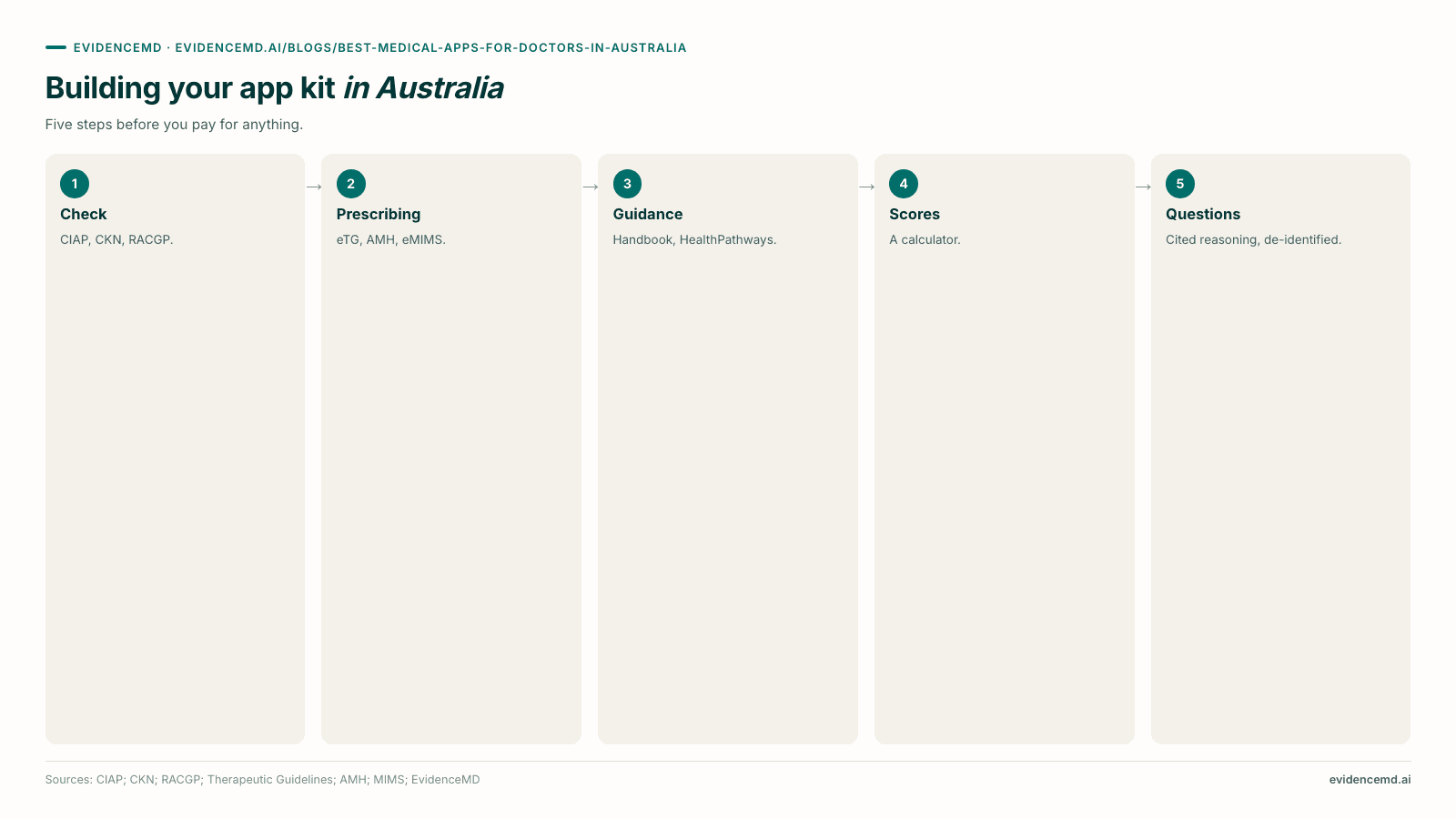
The best medical apps for doctors in Australia are the ones that cover each job once. Keep Therapeutic Guidelines and AMH for prescribing, eMIMS for product and PBS detail, the Immunisation Handbook app, your local HealthPathways, eviQ if you treat cancer and MDCalc for scores, and check CIAP, CKN and RACGP membership before you pay for any of them [6][8][9][11][14][16][18][19][20]. For the clinical question those references do not answer directly, EvidenceMD answers from 40 million+ papers and guidelines with its reasoning shown and a citation for every claim; it is hosted in the United States, so ask de-identified questions [1][3].
Sources & related evidence
EvidenceMD's own pages (company claims), then NSW Health's CIAP, the Queensland CKN guide, the RACGP, each app's publisher or Australian App Store listing, the AJGP, the two studies in the worked example, and the RACGP's AI scribe guidance.
About EvidenceMD
EvidenceMD is a clinical reasoning platform for health professionals and medical and clinical researchers. It answers clinical questions from 40 million+ peer-reviewed papers and clinical guidelines with a visible chain of reasoning and a citation for every claim, in 30 languages, and needs no NPI or licence check; it is free to start. Application data is hosted in the United States, and it is not included in the ARTG. Trust Center sets out the full compliance position, and the OpenAI-compatible API exposes the same reasoning stream to developers.
Related reading
The clinical question, answered with its reasoning
Ask EvidenceMD a de-identified clinical question and read the step-by-step reasoning and the source behind each claim. No licence check, free to start.