Can doctors in Australia use ChatGPT?
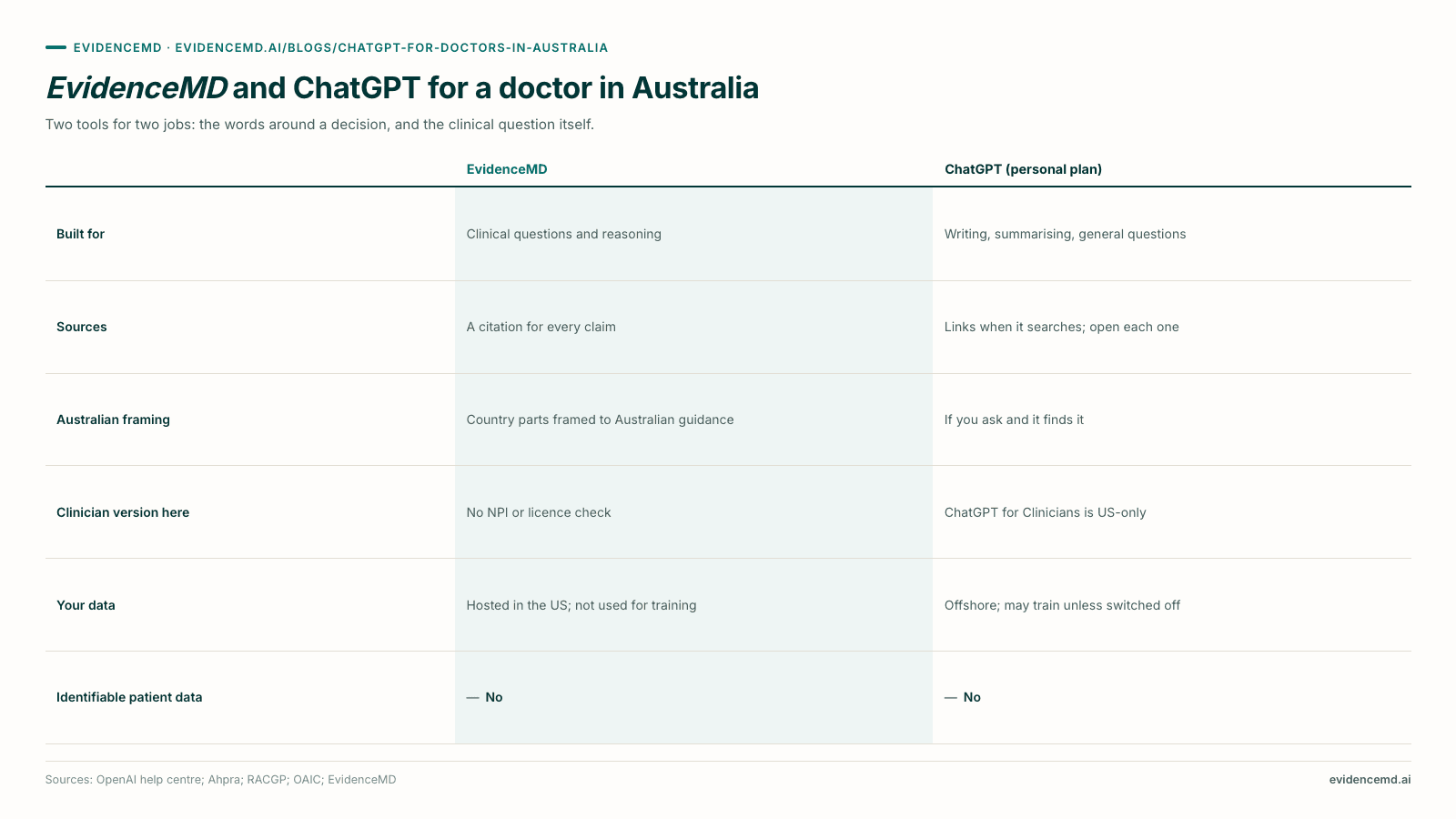
Yes, for drafting, summarising and patient-friendly writing, but not with identifiable patient information. Ahpra keeps you responsible for every AI output, the RACGP says never to enter identifying data, and the OAIC advises keeping personal information out of public AI tools [10][12][13]. ChatGPT for Clinicians is US-only [4]. For cited answers to clinical questions framed to Australian guidance, EvidenceMD shows its reasoning step by step [1].
Key takeaways
- ChatGPT for Clinicians is not available in Australia. OpenAI offers it to verified US clinicians with an NPI and says it plans to expand to other countries over time, starting with a pilot through the Better Evidence Network [4][5].
- Your account type decides what happens to your text. Personal Free, Plus and Pro conversations may be used to train OpenAI's models unless you switch that off; Business, Enterprise and API content is not used by default [8].
- Australian data residency covers storage, not processing. It is offered to eligible API customers and new Enterprise and Edu workspaces; in-region inference is available only in Europe, the US and the UAE [7].
- Ahpra names ChatGPT in its AI case studies. It warns that such tools may store data outside Australia and that entering personal information could breach Australian privacy law [11].
- ChatGPT is good with words. Letters, handouts, summaries of papers you have read and plain-language explanations suit it, written without identifiers [12].
- Open every reference before it supports a decision. Published tests found fabricated or inaccurate references in ChatGPT's medical writing, though newer models did much better [16][17].
Can Australian doctors get ChatGPT for Clinicians or ChatGPT for Healthcare in 2026?
Not ChatGPT for Clinicians: OpenAI offers it only to verified clinicians in the United States. ChatGPT for Healthcare is an enterprise product that reaches you only if your health service or practice group buys it.
OpenAI's help centre describes ChatGPT for Clinicians as a version of ChatGPT for verified clinicians in the United States. Sign-up needs a valid US National Provider Identifier (NPI) and a licence that OpenAI's third-party provider can verify, which an Australian registration does not satisfy. Asked whether a clinician outside the US can sign up, it says the product is available to verified US clinicians and that OpenAI plans to expand access to other countries over time [4]. The April 2026 launch post said OpenAI would first pilot access outside the US with the Better Evidence Network, as local regulations permit; it named no date and no country [5].
ChatGPT for Healthcare is OpenAI's enterprise version for organisations, with role-based access, audit logs, data residency options and a business associate agreement, priced on ChatGPT Enterprise and sold through OpenAI's sales team [6]. Separately, OpenAI began rolling out its consumer Health feature in ChatGPT to a limited number of early users in Australia in January 2026 [24]. That one is for patients, not clinicians, but it means some of your patients may arrive with ChatGPT's reading of their results.
| Product | Who can use it in Australia | Training on your content | Where your content is kept |
|---|---|---|---|
| ChatGPT Free, Plus or Pro | Anyone, on a personal account | May be used to train models unless you turn it off [8] | No Australian residency option on personal plans [7] |
| ChatGPT Business | Practices and other organisations | Not used by default [8] | Not listed among the plans eligible for data residency [7] |
| ChatGPT Enterprise or ChatGPT for Healthcare | Organisations that buy it through OpenAI's sales team [6] | Not used by default [6][8] | Stored at rest in Australia for eligible new workspaces; in-region inference only in Europe, the US and the UAE [7] |
| ChatGPT for Clinicians | Not available: verified US clinicians with an NPI only [4] | Not used [4] | Not applicable |
→ Scroll the table sideways to see the remaining columns
What do Ahpra, the RACGP and the OAIC say about doctors using ChatGPT?
None of them bans it. Ahpra and the RACGP keep you responsible for what you take from it, and all three warn against putting identifiable patient information into a public generative AI tool.
| Body | What it says that applies to ChatGPT | Document and date |
|---|---|---|
| Ahpra and the National Boards | The practitioner remains responsible for safe care and must apply human judgement to any AI output, and should understand where data is located and how it is stored [10]. Its case study on dictating findings into a tool such as ChatGPT warns that these tools may store data outside Australia and that entering personal information could lead to unintentional breaches of Australian privacy laws [11]. | AI guidance and case studies, pages reviewed 22 August 2024 |
| RACGP | Be extremely careful; never enter sensitive or identifying data into a conversational AI tool; use it only to supplement other sources, never as the sole source for a clinical decision; check the tool's terms and say in your practice privacy policy if you use it [12]. | Conversational AI resource, page last updated 29 June 2026 |
| OAIC | As a matter of best practice, do not enter personal information, and particularly sensitive information, into publicly available generative AI tools; APP 6 limits secondary use [13]. APP 8.1 requires reasonable steps before personal information goes to an overseas recipient, and section 16C can make you accountable for how it is handled [14]. | AI products guidance, 21 October 2024; APP guidelines, chapter 8 |
→ Scroll the table sideways to see the remaining columns
The TGA register tells you little about ChatGPT. Ahpra's 2024 guidance notes that generative AI tools used in clinical practice are usually intended for a general purpose and are not regulated by the TGA, so the professional duties above carry the weight [10]. Ahpra gave AI scribing as its example, but the TGA's review of 16 October 2026 found that 8 of the 12 digital scribes it examined included functions likely to meet the medical device definition, so that example no longer holds for every scribe [25]. The RACGP adds that a conversational AI tool used to suggest diagnoses or treatments needs TGA approval as software as a medical device [12]. EvidenceMD is not included in the ARTG either; it is a reference whose answers carry a source on every claim for you to check, and the decision stays with you [1].
The Perth directive, 2023
After notes compiled with ChatGPT were uploaded to patient record systems, the chief executive of Perth's South Metropolitan Health Service told staff that AI use involving patient information must cease immediately, saying there is “no assurance of patient confidentiality when using AI bot technology, such as ChatGPT” [15].
What is ChatGPT good at for Australian doctors, and where does a general chatbot fall short?
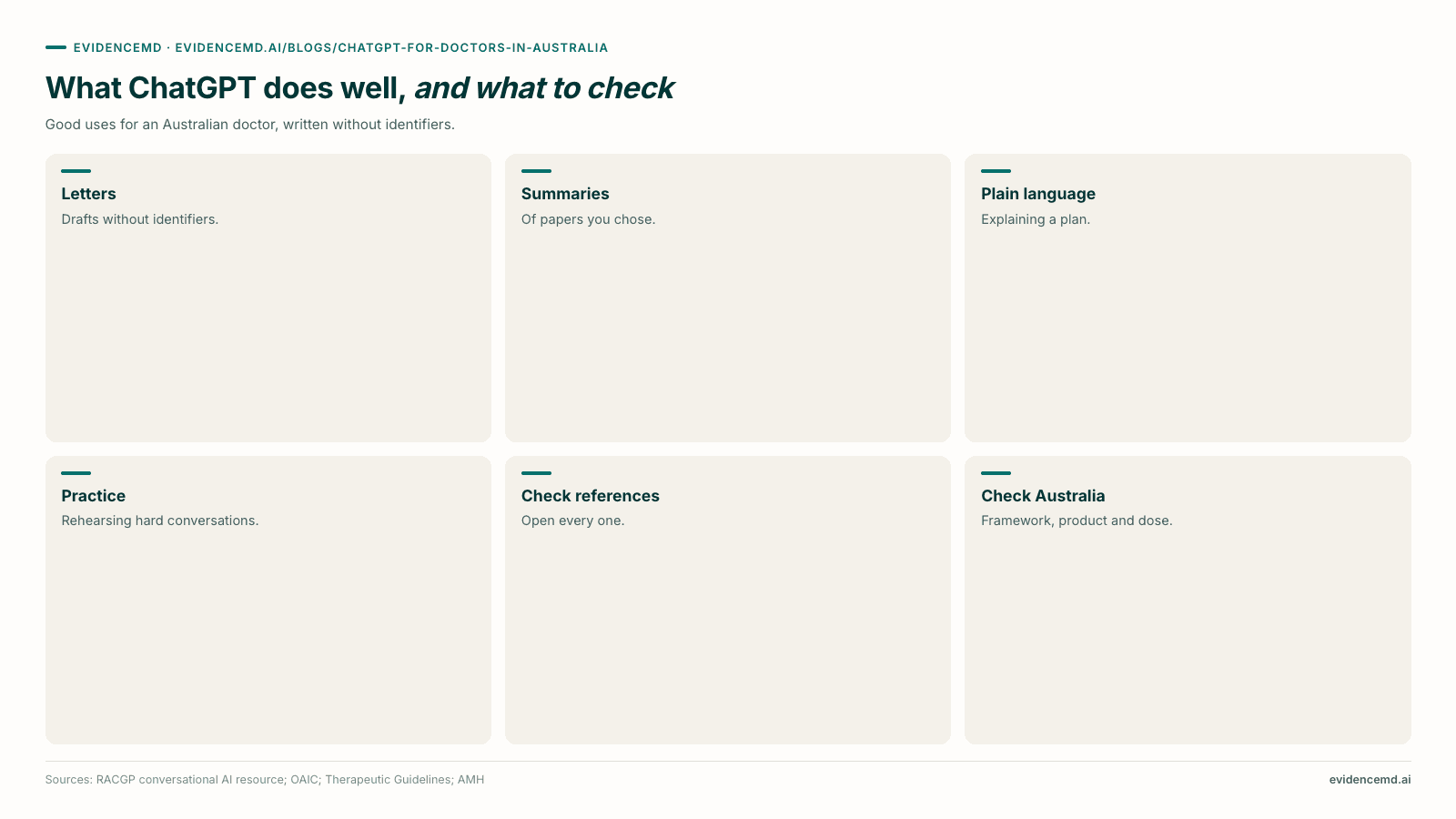
ChatGPT is good with words: drafting, summarising, restructuring and explaining. It falls short when a clinical answer needs Australian context and sources you can trace.
Letters and documents
Referral letter templates, practice notices and clinical letters, drafted without identifiers and checked before use. The RACGP lists clinical letters and notes among conversational AI's possible uses [12].
Summaries of what you have read
Condensing a guideline or paper you chose yourself, then checking the summary against the original rather than trusting it.
Plain language and translation drafts
Rewriting a management plan for a patient, or a first-draft translation for a professional to check. The RACGP lists simplifying jargon and language translation among possible applications [12].
Communication practice
Rehearsing how to explain a diagnosis or deliver bad news, which the RACGP names among educational uses [12].
The limits show up on clinical questions. The RACGP points out that a conversational AI tool's methods are opaque, which makes it hard to trace the sources behind an answer, and that general tools are not necessarily trained on up-to-date or high-quality medical sources [12]. The OAIC makes the related point that an AI product not trained on Australian data may not perform well here [13]. And Australian prescribing detail, such as which products are available here and how to dose them, is better checked in Therapeutic Guidelines and the Australian Medicines Handbook than in a general model's recall [21][22].
That gap is where EvidenceMD fits. It is built for the clinical question rather than the letter: it answers from 40 million+ peer-reviewed papers and clinical guidelines, shows its reasoning step by step with a citation for every claim, and frames the country-specific parts of an answer to the guidelines of the country you practise in [1]. It needs no NPI or licence check and is free to start, with paid individual plans from US$50 a month or US$450 a year [2]. The two jobs sit side by side: ChatGPT for the words around a decision, EvidenceMD for the clinical question itself.
Does ChatGPT make up medical references?
It has in published tests, although newer models did much better; the safe habit is to open every reference before it supports a decision.
In a 2023 Cureus study, ChatGPT-3.5 wrote 30 short medical papers with 115 references between them: 47% of the references were fabricated, 46% were real but inaccurate, and 7% were real and accurate. An incorrect PubMed ID was the most common error [16].
A study in Scientific Reports the same year compared versions across 636 citations in 84 short literature reviews. 55% of GPT-3.5's citations were fabricated against 18% of GPT-4's, and substantive errors appeared in 43% and 24% of their real citations respectively. The authors called GPT-4 a major improvement and added that problems remain [17].
Both studies tested 2023 models. ChatGPT can now search the web and link the pages it read, and OpenAI's US-only clinician workspace cites titles, journals, authors and publication dates [4]. The habit Ahpra's accountability principle implies still holds for any tool: before a reference supports a decision, open it and confirm that it says what the sentence claims [10].
Search the exact title
In PubMed or on the journal's site. A reference that cannot be found is the first warning.
Match the details
Authors, journal, year and volume should all agree; mismatched details were common in the 2023 tests [16].
Read the passage
Confirm that the paper supports the specific claim, not just the topic.
Prefer the guideline itself
For Australian practice, go to the Australian source the answer relies on, such as Therapeutic Guidelines [21].
How does a statin question look in a general chatbot and in EvidenceMD?
The question has an Australian answer, so the test is whether the answer uses the Australian risk framework and whether its sources hold up.
A GP in Brisbane sees a 58-year-old woman who does not smoke and has no diabetes, atrial fibrillation or known cardiovascular disease. Her blood pressure is 148 mmHg systolic and 88 mmHg diastolic on repeated readings, total cholesterol 6.1 mmol/L and HDL cholesterol 1.3 mmol/L, and she takes no regular medicines. She asks whether she should start a statin. The question goes in de-identified: no name, date of birth or Medicare number.
With a general chatbot, this page does not reproduce an answer, because answers vary with the version, the settings and the wording. What matters is what to check in whatever comes back. First, the framework: Australia's 2023 guideline estimates 5-year risk with the Australian CVD risk calculator, while other countries use different horizons; the 2018 US cholesterol guideline, for example, works from 10-year risk with a 7.5% threshold for a moderate-intensity statin [18][23]. An answer that quotes a 10-year figure is not using the Australian framework. Second, the references, which need opening one by one [16][17]. Third, the prescribing detail, which belongs to Therapeutic Guidelines and the AMH [21][22].
With EvidenceMD, the same question is answered in steps, each with its source. It starts from the Australian guideline: assess CVD risk in all people aged 45 to 79 without known CVD, using the Australian calculator with her age, sex, smoking status, systolic blood pressure, total-to-HDL cholesterol ratio, diabetes status, CVD medicines, postcode and any history of atrial fibrillation [18]. It notes that her blood pressure and cholesterol are below the levels the guideline says to treat whatever the calculated risk, a systolic blood pressure of 160 mmHg or more or a diastolic of 100 mmHg or more, a total cholesterol above 7.5 mmol/L or an LDL cholesterol of 5 mmol/L or more, so the decision rests on her calculated 5-year risk [19].
It then sets out what each result means. At 10% or more, prescribe blood pressure-lowering and lipid-modifying treatment after discussing benefits and harms; at 5% to under 10%, consider them depending on the clinical context, and reassess every two years if untreated; under 5%, pharmacotherapy is not routinely recommended [19]. If she sits near a threshold, it lists the reclassification factors to ask about: family history of premature CVD, ethnicity, a coronary artery calcium score, eGFR and urine albumin-to-creatinine ratio, and severe mental illness [18]. And it gives the size of the benefit: in the Cholesterol Treatment Trialists' meta-analysis, each 1.0 mmol/L reduction in LDL cholesterol with a statin lowered major vascular events by 38% in people whose 5-year risk of a major vascular event was under 5%, and by 31% at 5% to under 10% (rate ratios 0.62 and 0.69) [20].
Where you decide. The answer ends with a next step framed to Australian practice: run the calculator, use a decision aid to talk through the result, and confirm the agent and dose in Therapeutic Guidelines or the AMH [18][21][22]. It does not decide for her. Whether a woman at an intermediate risk wants a statin is a conversation about her values and preferences, which the guideline puts at the centre of the plan [19].
Ask EvidenceMD an Australian clinical question
Try a de-identified question and read the reasoning step by step, with the source behind each claim.
When should an Australian doctor use ChatGPT, and when a clinical reasoning tool?
Use ChatGPT for the words around a decision and a clinical reasoning tool for the question itself, and keep an Australian reference for prescribing.
| Job | EvidenceMD | ChatGPT | Australian source to confirm |
|---|---|---|---|
| A clinical question you will act on | Built for this: reasoning shown step by step, a citation for every claim, Australian framing [1] | Check the framework and open every reference [16][17] | Therapeutic Guidelines; your local HealthPathways |
| Drug choice and dose | Points you to the Australian reference | Do not rely on recall | Therapeutic Guidelines; AMH [21][22] |
| Referral letter, handout or practice notice, without identifiers | Not built for this | A good fit for drafting and plain language [12] | Your practice templates |
| Anything with identifiable patient information | No: hosted in the United States [3] | Not on a personal plan [12][13] | Tools your practice or health service has assessed |
→ Scroll the table sideways to see the remaining columns
How can an Australian GP use ChatGPT without breaching privacy rules?
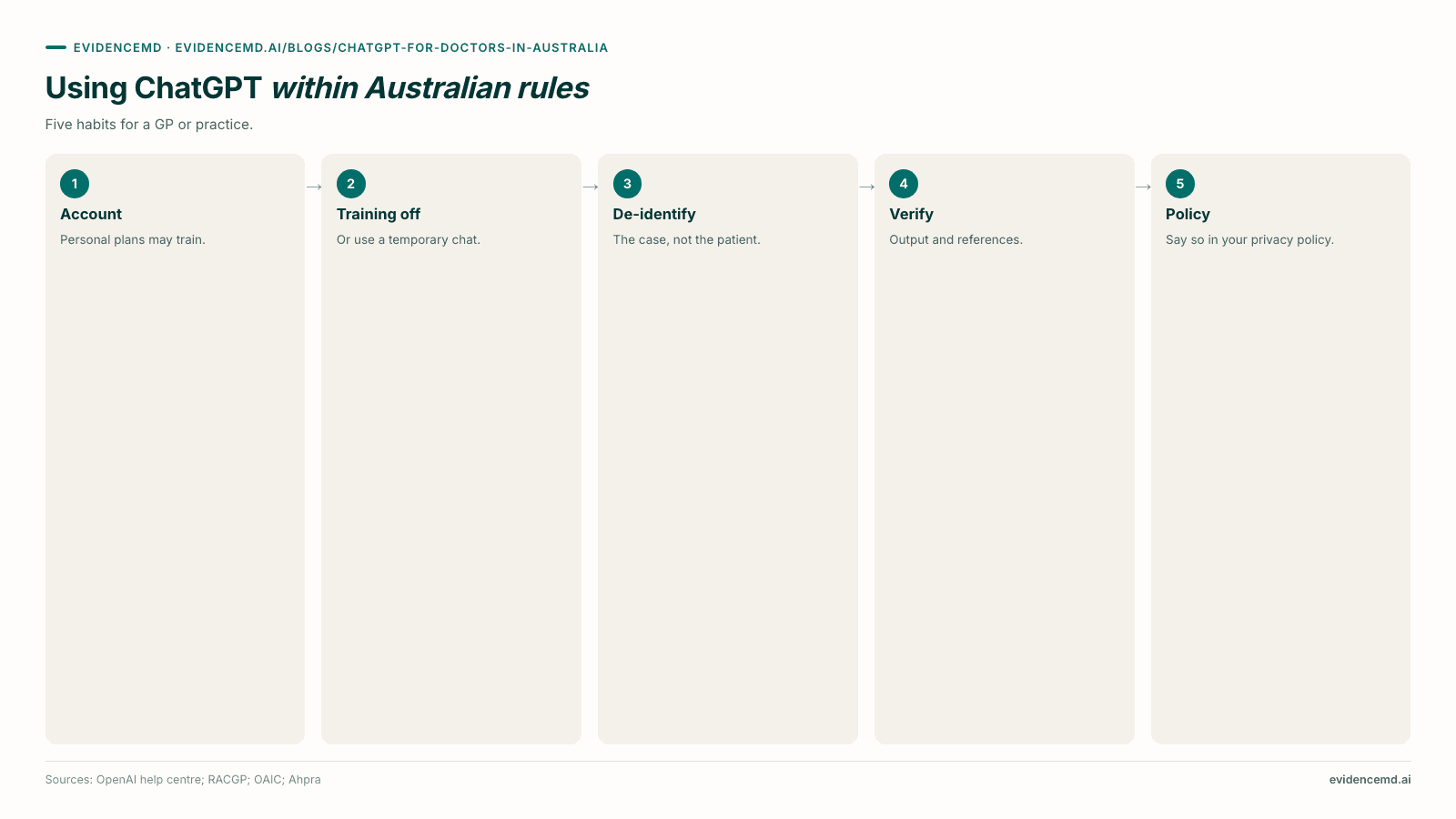
Know which account you are on, switch off training on your conversations, write the case rather than the patient, check every output, and say so in your practice privacy policy.
Know which account you are on
Personal Free, Plus and Pro conversations may be used for training; Business, Enterprise and API content is not by default [8].
Switch off training, or use a temporary chat
Turn off “Improve the model for everyone” in Data controls. Temporary chats are not used for training. Thumbs-up or thumbs-down feedback can still send the whole conversation for training on personal plans [8].
Put it in your practice policy
Train staff on how and where the tool stores data, and be transparent about its use in your practice privacy policy, as the RACGP advises [12].
Frequently asked questions
Is ChatGPT for Clinicians available in Australia?
No. OpenAI offers ChatGPT for Clinicians only to verified US clinicians with an NPI, and says it plans to expand to other countries over time, starting with a pilot through the Better Evidence Network. Australian doctors who want cited clinical answers now can use EvidenceMD, which needs no NPI or licence check.
Does Ahpra allow doctors to use ChatGPT?
Ahpra does not ban it. Its AI guidance says you remain responsible for safe care and must apply human judgement to any output, and its case study on ChatGPT warns that entering personal information into a tool that stores data offshore could breach Australian privacy law. The same duties apply to EvidenceMD, which is hosted in the United States.
What does the RACGP say about GPs using ChatGPT?
The RACGP's conversational AI resource tells GPs to be extremely careful, never to enter sensitive or identifying data, and to use these tools only to supplement other sources, never as the sole basis for a clinical decision. It also notes that tools designed by and for medical practitioners are likely to be more accurate than general ones. EvidenceMD is built for clinical questions, although it is not included in the ARTG, so treat its answers as cited material you check.
Does ChatGPT keep Australian doctors' data in Australia?
Not on a personal account. OpenAI offers Australian data residency only to eligible API customers and new ChatGPT Enterprise and Edu workspaces, and in-region inference only in Europe, the US and the UAE, so entering personal information can engage APP 8's cross-border rules. EvidenceMD is hosted in the United States, so keep questions to it de-identified as well.
Will ChatGPT answer using Australian guidelines?
It can, particularly if you name Australia in the question and it searches the web, but nothing guarantees it, so check which country's thresholds, risk calculators and medicines an answer relies on. EvidenceMD frames the country-specific parts of an answer to the guidelines of the country you practise in and cites the source for each claim.
Is ChatGPT regulated by the TGA as a medical device?
Generally not: Ahpra notes that general-purpose generative AI tools used in clinical practice are usually not medical devices and are not regulated by the TGA. The RACGP adds that a tool used to suggest diagnoses or treatments needs TGA approval as software as a medical device. EvidenceMD is not included in the ARTG either; its answers carry a source on every claim, and the clinical decision stays with you.
How do I check whether a reference from ChatGPT is real?
Search the exact title in PubMed or on the journal's site, confirm the authors, journal and year match, and read the passage the sentence relies on. In a 2023 study, 47% of ChatGPT-3.5's references in medical papers were fabricated and 46% were inaccurate, although later models do better. EvidenceMD links each claim to its source, so you can open it directly.
The bottom line
ChatGPT is a useful writing tool for Australian doctors and the wrong place for patient identifiers. OpenAI's clinician product is not available here, so most doctors are on personal accounts, which may train on conversations unless that is switched off [4][8]. Ahpra, the RACGP and the OAIC agree on the essentials: you are responsible for what you use, and identifiable information stays out [10][12][13]. For the clinical question itself, EvidenceMD answers with its reasoning shown step by step and a citation for every claim, framed to Australian guidance; it is hosted in the United States, so ask it de-identified questions too [1][3].
Sources & related evidence
EvidenceMD's own pages (company claims), OpenAI's help centre and launch post, a GP survey, Ahpra, the RACGP, the OAIC, the TGA's digital scribe review, a newsGP report, two studies of ChatGPT's references, the Australian CVD risk guideline, the trial evidence and the US guideline used in the worked example, and Australian prescribing references.
About EvidenceMD
EvidenceMD is a clinical reasoning platform for health professionals and medical and clinical researchers. It answers clinical questions from 40 million+ peer-reviewed papers and clinical guidelines with its reasoning shown step by step and a citation for every claim, frames the country-specific parts of an answer to the user's country guidelines, answers in 30 languages and needs no NPI or licence check; it is free to start. Application data is hosted in the United States, and it is not included in the ARTG. Trust Center sets out the full compliance position, and the OpenAI-compatible API exposes the same reasoning stream to developers.
Related reading
Cited answers to Australian clinical questions
Ask EvidenceMD a de-identified clinical question and read the reasoning and the source behind each claim, framed to Australian guidance. No licence check, free to start.