How can AI help rural and remote doctors in Australia?
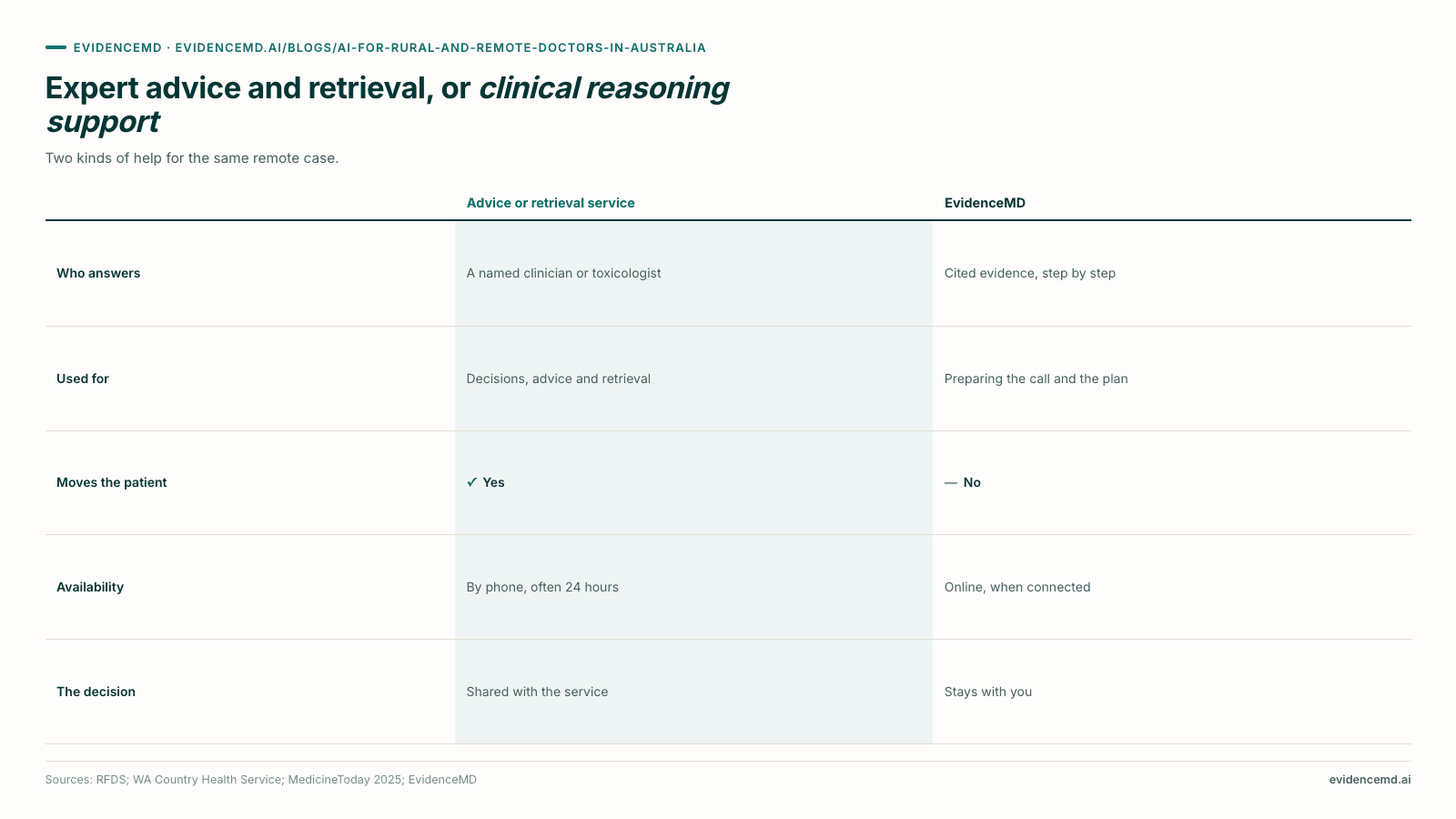
AI helps rural and remote doctors in Australia by reasoning through a complex case while specialist advice and retrieval are being arranged, not by replacing either. EvidenceMD answers the clinical question from 40 million+ papers and guidelines, shows each step with a citation and frames the Australian parts to Australian guidance [1]. The RFDS, the Poisons Information Centre, eTG and local protocols remain the authority [8][10][12].
Key takeaways
- Remoteness has a scale. The Modified Monash Model runs from MM 1, the metropolitan areas where about 70% of Australians live, to MM 7, very remote communities such as Longreach, Coober Pedy and Thursday Island [5].
- Rural generalism is now a field of specialty practice. The Medical Board of Australia announced on 22 September 2025 that health ministers had approved rural generalist medicine within general practice, and ACRRM says 'Specialist Rural Generalist' becomes a protected title from March 2027 [6][7].
- The RFDS carries much of the distance. In the most recent year on its facts page, it reported 345,136 patient contacts, 32,949 patients transported by aircraft and 55,930 patients using telehealth [8].
- Expert advice is a phone call away. The Poisons Information Centre on 13 11 26 gives expert advice 24 hours a day, and WA Country Health Service asks that every suspected snakebite be discussed with an emergency physician, a clinical toxicologist or its Emergency Telehealth Service [10][11].
- AI fills the time between calls. EvidenceMD helps a rural GP reason through the next hours of care with a citation for every claim, framed to Australian guidance, while the decision stays with the clinician and the retrieval team [1].
- Keep identifiers out. EvidenceMD stores application data in the United States, so describe the case, not the patient or the town [3]. It is not included in the ARTG.
What is different about rural and remote practice in Australia?
Distance, a broad scope of practice, and a classification system that shapes the workforce.
Australia classifies remoteness for health workforce programs with the Modified Monash Model. Its 2023 version, updated with 2021 census data, runs from MM 1, the metropolitan areas where about 70% of Australians live, through regional centres and rural towns to MM 6 (remote communities) and MM 7 (very remote communities), such as Longreach, Coober Pedy and Thursday Island [5].
The doctors who work across that map are increasingly recognised as rural generalists. The Medical Board of Australia announced on 22 September 2025 that health ministers had approved rural generalist medicine as a new field of specialty practice within general practice, proposed by the Australian College of Rural and Remote Medicine (ACRRM) and the RACGP [6]. ACRRM describes a rural generalist as a doctor who provides comprehensive general practice and emergency care, with additional skills in areas such as surgery, anaesthetics, paediatrics or mental health, and says the protected title 'Specialist Rural Generalist' applies from March 2027 [7].
Distance is bridged by retrieval and telehealth. The Royal Flying Doctor Service, a national charity providing primary care and round-the-clock emergency services in remote and regional Australia, reported 345,136 patient contacts in the most recent year on its facts page, including 32,949 patients transported by aircraft and 55,930 patients who used telehealth [8][9].
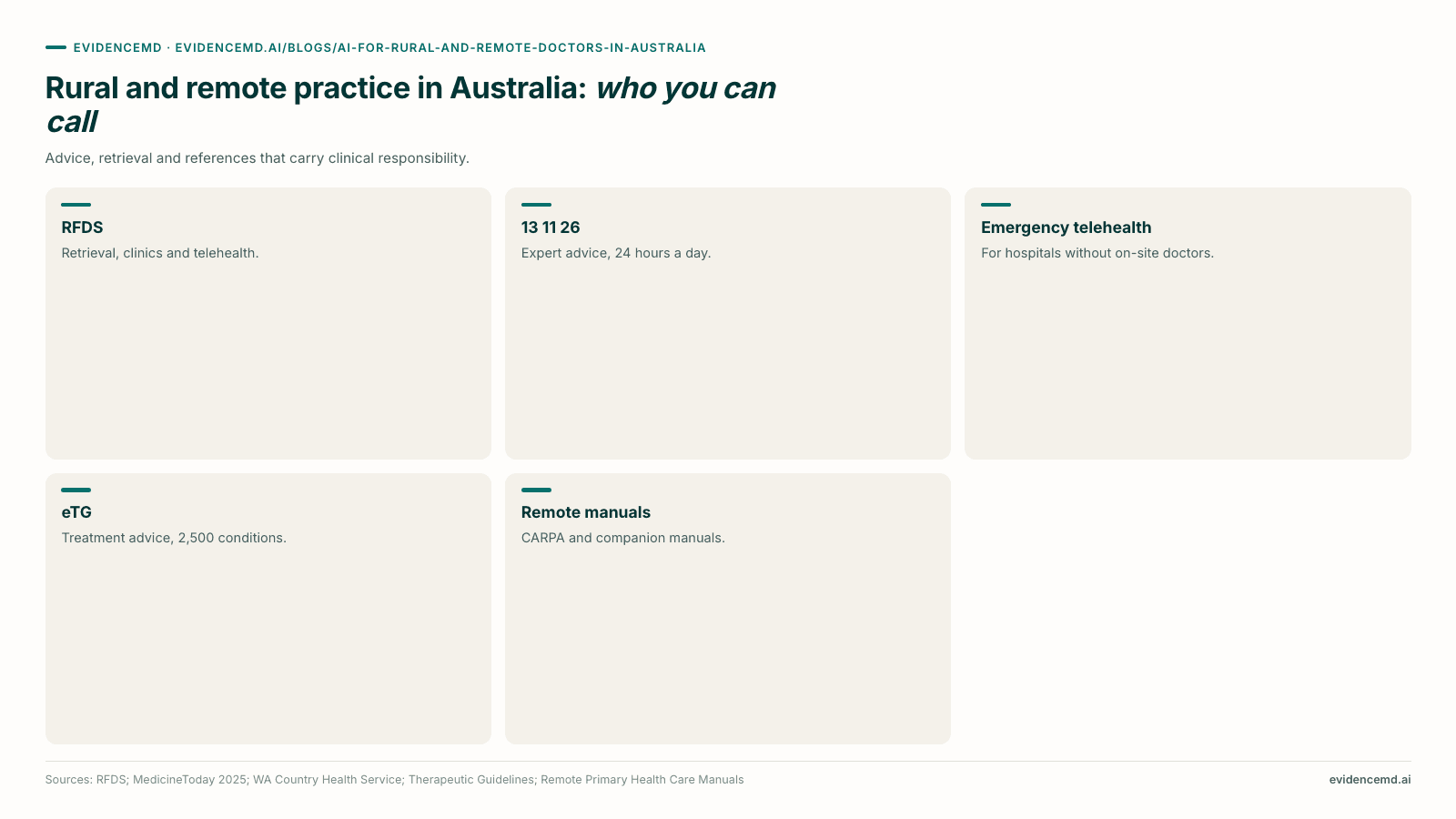
Who can a rural GP call for help with a complex case in Australia in 2026?
Examples of services and references that carry clinical responsibility; your state and health service will have their own.
| Service or reference | What it offers | Who it serves |
|---|---|---|
| Royal Flying Doctor Service | Aeromedical transport, nurse and GP clinics and telehealth, with 87 aircraft and 23 bases [8] | People in remote and regional Australia [9] |
| Poisons Information Centre, 13 11 26 | Expert advice 24 hours a day, including clinical toxicologists for envenoming [10][11] | Clinicians managing poisoning and envenoming [10] |
| WA Country Health Service Emergency Telehealth Service | Emergency medical advice by telehealth, including on snakebite management [11] | WA country hospitals with intermittent or no on-site medical cover [11] |
| Therapeutic Guidelines (eTG) | Independent treatment advice for 2,500 conditions across 22 guidelines [12] | Individual and institutional subscribers [12] |
| Remote Primary Health Care Manuals | The CARPA Standard Treatment Manual and companion manuals for remote practice [13] | Remote practitioners across central, northern and remote Australia [13] |
→ Scroll the table sideways to see the remaining columns
None of these is replaced by an AI tool. They put an accountable clinician, a retrieval team or a reviewed protocol behind the advice; AI helps you reach them with a clearer question and use the time while you wait.
Where does clinical reasoning support help a rural generalist?
In the hours between first assessment and definitive care, and in the cases you see once a year.
The rare presentation
A case you see once a year, reasoned through step by step with a citation for each step [1].
The hours before retrieval
What the evidence supports while you wait, so you can discuss a specific plan with the retrieval doctor or toxicologist.
Several problems at once
Older patients with several conditions and medicines, where guidelines written one disease at a time pull in different directions.
Reading around afterwards
DeepSearch turns one question into a cited review of typically 20–25 pages [4].
EvidenceMD frames the country-specific parts of an answer to Australian guidance and answers in 30 languages, which helps when explaining a plan to a patient or family whose first language is not English [1]. A saved system instruction, under Customise EvidenceMD, can describe your setting, for example that you work in a small hospital without on-site specialists, and applies to new answers on the web and in the mobile app. EvidenceMD is free to start, with paid individual plans from US$50 a month or US$450 a year [2].
How does EvidenceMD reason through a snakebite before retrieval?
A de-identified case from a small rural hospital, with Australian guidance at each step.
The question, as a rural GP at a small hospital (MM 6) with antivenom in stock and critical care capability but no laboratory on site might type it while waiting for the clinical toxicologist to call back: a 34-year-old man was bitten on the ankle by an unseen snake 50 minutes ago, and a bystander applied a bandage. He has vomited once and has a headache. RFDS retrieval is about three hours away. Should the bandage stay on, what should I send with him, and does he need antivenom before retrieval?
Step 1: is he envenomed? EvidenceMD starts with the finding that decides everything else. Fewer than 10% of people presenting with suspected snakebite are envenomed, but nonspecific systemic symptoms, especially headache and vomiting, count as early clinical evidence of systemic envenoming in the Therapeutic Guidelines flowchart reproduced in a 2025 review by Isbister and Berling [10][11]. He therefore follows the flowchart's path for clinical evidence of systemic envenoming, and the review says early antivenom should be considered in a patient with nonspecific systemic symptoms such as vomiting or headache [10]. Timing matters: for most snakes, antivenom prevents neurotoxicity and myotoxicity only when given within about three hours of the bite, and the review advises discussing the decision to give early antivenom with a clinical toxicologist on 13 11 26 [10]. With retrieval three hours away, that decision cannot wait for his arrival at the receiving hospital.
Step 2: what bedside tests cannot tell you. Snakebite investigations need a laboratory. The review says point-of-care INR and D-dimer devices have proved unreliable and should not be used for snakebite, that the 20-minute whole blood clotting test has poor sensitivity, and that the snake venom detection kit is no longer recommended [10]. So the answer is to take blood now and send the samples with the patient, as the flowchart directs for hospitals without a laboratory [10].
Step 3: antivenom before retrieval? For a hospital with antivenom and critical care facilities but no laboratory, the flowchart's path is to observe the patient in a critical care area and seek advice from a clinical toxicologist or poisons information centre on the use of antivenom [10]. WA Country Health Service's guideline likewise allows antivenom as part of initial management, on the advice of a clinical toxicologist or its Emergency Telehealth Service, before transfer to a hospital with a laboratory [11]. If antivenom is given, the review describes the current approach: in most of Australia, one vial of brown snake antivenom and one vial of tiger snake antivenom cover the common snakes; polyvalent antivenom is used where a death adder, taipan or mulga snake is likely from the presentation and geography; there is no redosing; and the team prepares to manage anaphylaxis [10].
Step 4: the bandage on a long transfer. First, check what the bystander applied. The flowchart's first step for anyone presenting within four hours of a bite is a pressure bandage, with the limb and the patient immobilised; the review describes an elasticised bandage over the bite site and then the whole limb, at about the pressure used for a sprained ankle [10]. If the bandage applied before arrival is inadequate, WA Country Health Service advises applying additional bandages rather than removing it, without occluding the circulation, and loosening and reassessing it if there are signs of limb ischaemia [11]. The pressure bandage with immobilisation then stays on until there is no evidence of envenoming, judged on the absence of nonspecific systemic symptoms and normal laboratory results, or until antivenom administration has been completed [10][11]. With no laboratory on site, that means it stays on for the transfer unless antivenom has been given. Because tight bandages left on for many hours during long transfers have caused harm, the answer flags checking the bandage's tightness and taking limb observations while he waits [10].
Where the GP and the experts decide. The answer helps the GP follow and question the toxicologist's advice; it does not replace the call or delay treatment. Expert advice is available 24 hours a day on 13 11 26, and the decision to give antivenom, the choice of antivenom and the retrieval plan are made by the GP with the toxicologist and the retrieval doctor [10]. Clinics that work from the Remote Primary Health Care Manuals follow their own protocols [13]. Because EvidenceMD stores application data in the United States, the question describes the case without identifiers [3].
Work through a remote case while you wait
Ask EvidenceMD a de-identified question from a recent rural case and read the reasoning and the sources behind each step.
Which Australian references should sit beside AI in remote practice?
The protocols your service already uses come first.
Two sets of references carry particular weight in remote practice. Therapeutic Guidelines, published by an independent not-for-profit organisation, gives treatment advice for 2,500 conditions across 22 guidelines [12]. The Remote Primary Health Care Manuals, developed by the remote community for the remote community and widely used across central, northern and remote Australia, include the CARPA Standard Treatment Manual (8th edition, version 1.03, with corrections to May 2026), the Minymaku Kutju Tjukurpa Women's Business Manual, the Clinical Procedures Manual and the Medicines Book for Aboriginal and Torres Strait Islander Health Practitioners [13].
An AI answer should send you back to these, not around them. EvidenceMD frames the Australian parts of its answers to Australian guidance and cites its sources, but where your clinic or health service has adopted a protocol, that protocol governs [1].
Protocol first
If your clinic works from the CARPA Standard Treatment Manual or a health service guideline, follow it, and use AI for the questions it does not answer [13].
Australian treatment advice
Check drug choice and dose in Therapeutic Guidelines before you act on any general answer [12].
Cited reasoning for the rest
For the case that does not fit a protocol, EvidenceMD shows its reasoning step by step; open the sources you would rely on [1].
How should a rural doctor handle patient data when using AI?
De-identify more carefully than in a city; the guide for GPs on this site covers the wider rules.
Ahpra expects practitioners to understand where a tool's data is located and how it is stored, and to apply human judgement to any output of AI [14]. EvidenceMD stores application data on Microsoft Azure in East US 2, in the United States, so use it with de-identified questions [3]. It is not included in the ARTG.
Consent for AI scribes, the TGA's approach to clinical software and the Privacy Act's rules on overseas disclosure are set out in the guide to AI for GPs in Australia on this site, and the comparison of medical AI tools for Australian doctors is a separate guide [15][16].
Describe the case, not the patient or the town
In a small community, age, sex, town and an unusual event can identify someone without a name. Leave out the town, exact dates and anything else a neighbour could recognise.
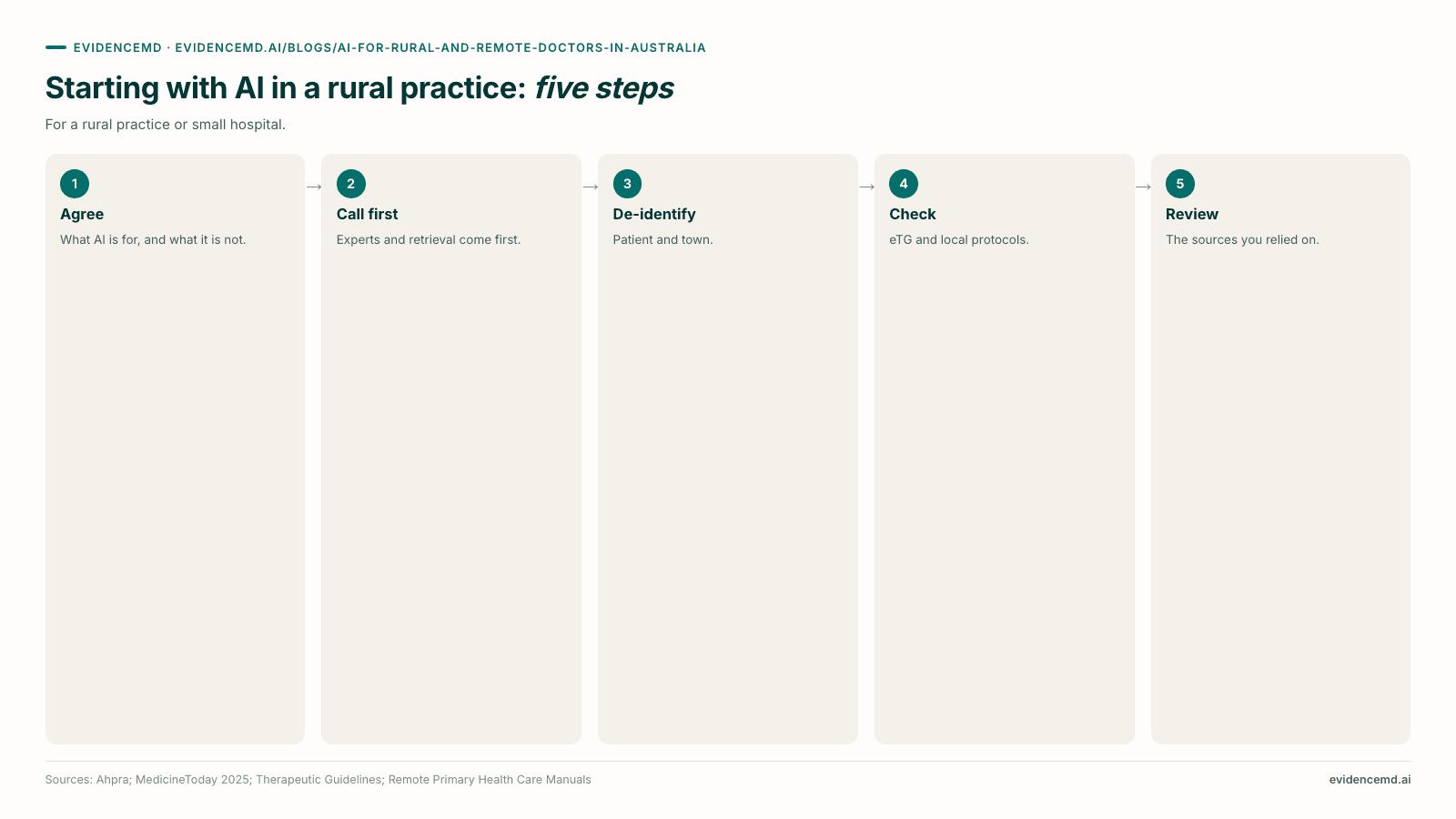
How can a rural practice start using AI safely?
Five steps for a rural practice or small hospital.
Agree what AI is for
Clinical questions and reading around cases, not decisions that belong to a consult or retrieval service.
Write a call-first rule
If a case needs a toxicologist, a specialist or retrieval, call first and use AI while you wait; expert advice on envenoming is available 24 hours a day on 13 11 26 [10].
De-identify by default
No names, dates of birth, Medicare numbers or details that identify a small community.
Review what you relied on
Note when an AI answer informed a decision and open the sources behind it; Ahpra says you remain responsible for safe care and must apply human judgement to any AI output [14].
Frequently asked questions
What is the Modified Monash Model used for in rural health?
The Modified Monash Model classifies locations from MM 1 (metropolitan) to MM 7 (very remote) for Australian Government health workforce programs, and its 2023 version uses 2021 census data [5]. It describes where you work, not what a patient needs; for the clinical question itself, EvidenceMD gives a cited, step-by-step answer framed to Australian guidance [1].
Is rural generalist medicine now a recognised specialty in Australia?
Yes. The Medical Board of Australia announced on 22 September 2025 that health ministers had approved rural generalist medicine as a new field of specialty practice within general practice [6]. ACRRM says the Board approved the ACRRM and RACGP rural generalist training programs as qualifications in July 2026 and that 'Specialist Rural Generalist' becomes a protected title from March 2027 [7]. EvidenceMD suits that generalist scope, with cited answers across specialties.
Can a rural GP give snake antivenom before RFDS retrieval?
Sometimes, on expert advice. WA Country Health Service's guideline says patients with clinical features of envenoming may receive antivenom as part of initial management on the advice of a clinical toxicologist or its Emergency Telehealth Service before transfer, and the national flowchart routes the decision through a clinical toxicologist or poisons information centre [10][11]. EvidenceMD can set out the evidence with its sources while you make that call; the decision is yours and the toxicologist's.
Should the pressure bandage come off before a snakebite patient is retrieved?
Not unless there is no evidence of envenoming, which needs normal laboratory results as well as no systemic symptoms, or antivenom administration has been completed; without a laboratory on site, it usually stays on for the transfer [10][11]. The 2025 review by Isbister and Berling also warns that tight bandages left on for hours during long transfers have caused harm, so check the bandage's tightness and take limb observations [10]. EvidenceMD shows this reasoning with each source cited, and the retrieval doctor or toxicologist confirms the plan.
How does the Royal Flying Doctor Service support rural and remote doctors?
The RFDS provides aeromedical transport, nurse and GP clinics and telehealth; in the most recent year on its facts page it reported 345,136 patient contacts, including 32,949 patients transported by aircraft and 55,930 patients who used telehealth [8]. EvidenceMD does not replace that service; it helps a rural doctor reason through the case while retrieval is arranged.
Can AI replace the CARPA Standard Treatment Manual in a remote clinic?
No. The CARPA Standard Treatment Manual and the other Remote Primary Health Care Manuals are developed by the remote community for the remote community and are widely used across central, northern and remote Australia [13]. EvidenceMD is useful for questions those protocols do not answer directly, with a citation for every claim, but the clinic's protocol governs.
How should a rural doctor de-identify a case before asking an AI tool?
Leave out the name, date of birth and Medicare number, and also the town, exact dates and any unusual detail that could identify someone in a small community. Ahpra expects you to understand where a tool's data is located and to apply human judgement to its output [14]. EvidenceMD stores application data in the United States, so describe the case, not the person [3].
The bottom line
For rural and remote doctors in Australia, AI is most useful in the hours between first assessment and definitive care, and in the cases seen once a year. The RFDS, the Poisons Information Centre, eTG and remote protocols such as the Remote Primary Health Care Manuals remain the authority [8][10][12][13]. EvidenceMD helps you arrive at those calls prepared, reasoning through the case step by step from 40 million+ papers and guidelines with a citation for every claim, framed to Australian guidance [1]. Keep identifiers out, call first when a case needs an expert, and make the decision with the team that will receive the patient [3][14].
Sources & related evidence
EvidenceMD's own pages (company claims), then the Department of Health's Modified Monash Model fact sheet, the Medical Board of Australia and ACRRM on rural generalist recognition, the RFDS, the snakebite review and WA Country Health Service guideline used in the worked example, Therapeutic Guidelines, the Remote Primary Health Care Manuals, Ahpra and related guides on this site.
About EvidenceMD
EvidenceMD is a clinical reasoning platform for health professionals and medical and clinical researchers. It answers clinical questions from 40 million+ peer-reviewed papers and clinical guidelines with its reasoning shown step by step and a citation for every claim, frames the country-specific parts of an answer to the user's country guidelines, answers in 30 languages, and needs no NPI or licence check. It is free to start. Application data is hosted in the United States, and it is not included in the ARTG. Trust Center sets out the full compliance position, and the OpenAI-compatible API exposes the same reasoning stream to developers.
Related reading
Prepared before the retrieval call
Ask EvidenceMD a de-identified question from a rural shift and read the reasoning and sources behind each step. No licence check, free to start.