Can health practitioners use AI in clinical practice in Australia?
Health practitioners can use AI in clinical practice in Australia, but they remain accountable for every output. Tell patients when you use AI, get informed consent before entering their data or recording them, keep identifiable information out of tools without safeguards, and check whether a tool is a TGA-regulated medical device. EvidenceMD fits that routine for clinical questions: ask a de-identified question, then verify its cited, step-by-step reasoning before acting [1][4][5][10].
Key takeaways
- You remain responsible, whatever the tool. Ahpra: “Regardless of what technology is used in providing healthcare the practitioner remains responsible for delivering safe and quality care”, and TGA approval of a tool does not change your duty to apply human oversight [4].
- The TGA judges software function by function. Its digital scribes guidance, updated on 16 October 2026, says a tool that suggests diagnoses, treatments or investigations, triages patients or generates clinical conclusions is likely to be a medical device; its review published the same day found 8 of 12 scribes likely to include such functions, although none of their suppliers had identified them as devices [5][6].
- Decision support is exempt only if it shows its working. From 1 November 2026, exempt clinical decision support software must not be intended to make a clinical diagnosis or treatment decision, and must display the guidelines, calculations or logic behind its recommendations so you can verify them [8].
- Keep identifiers out unless the tool is set up for them. The OAIC recommends, as best practice, not entering personal and particularly sensitive information into publicly available generative AI, and APP 8 applies before personal information goes to an overseas vendor [10][11].
- General practices now have an AI standard. Criterion F11 of the RACGP's 6th edition Standards expects documented informed consent, de-identification, governance and documented clinical oversight of AI outputs, with a clear way for patients to opt out [16].
- Consent comes before recording. Ahpra warns that “there may be criminal implications if consent is not obtained before recording”, and the TGA tells patients they can withdraw consent to a digital scribe at any time [4][5].
Which rules apply when you use AI in clinical practice in Australia?
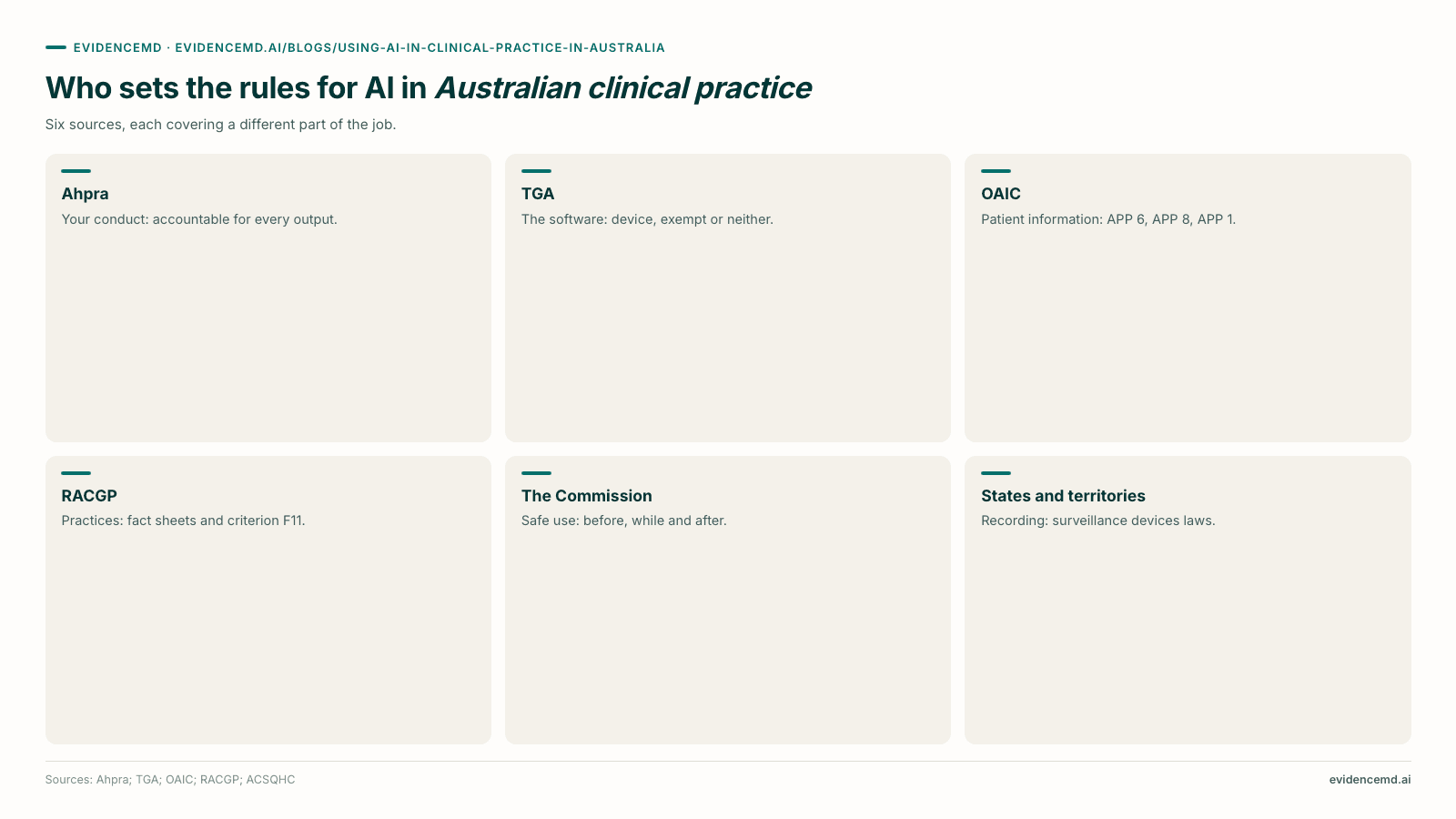
Several bodies set the rules, each for a different part of the job: Ahpra for your conduct, the TGA for the software, the OAIC for patient information, the RACGP for general practices and the Commission for safe use.
Your existing professional obligations apply to AI, and the newer documents explain how. The TGA describes Ahpra's guidance as clarifying “existing responsibilities for healthcare professionals under the National Boards' codes of conduct when using AI in clinical practice” [5]. The table below lists the documents that matter in late 2026, who issued them and when.
| Who | Document and date | What it governs |
|---|---|---|
| Ahpra and the National Boards | Meeting your professional obligations when using Artificial Intelligence in healthcare (page reviewed 22 August 2024) [4] | Your conduct as a registered practitioner: accountability, understanding, transparency, informed consent, and ethical and legal issues |
| Therapeutic Goods Administration (TGA) | Digital scribes guidance and Digital scribe review outcomes (both 16 October 2026); clinical decision support exemption reworded from 1 November 2026 [5][6][8] | Whether software is a medical device that must be in the Australian Register of Therapeutic Goods (ARTG) |
| Office of the Australian Information Commissioner (OAIC) | Guidance on privacy and the use of commercially available AI products (21 October 2024, updated 17 January 2025); APP guidelines chapter 8 (updated 3 October 2025) [10][11] | Personal information entered into AI tools, and disclosure to overseas recipients under the Privacy Act 1988 |
| Royal Australian College of General Practitioners (RACGP) | Conversational AI resource and AI scribes fact sheet (both pages last updated 29 June 2026); Standards for general practices, 6th edition, criterion F11 (released 26 August 2026) [14][15][16][17] | Expectations of GPs and general practices, including accreditation standards |
| Australian Commission on Safety and Quality in Health Care | AI Clinical Use Guide, with safety scenarios (2025) [18] | Safe use, structured as before, while and after you use an AI tool |
| States and territories | Surveillance devices laws, which the TGA lists among the frameworks digital scribes may need to comply with [5] | Recording conversations |
→ Scroll the table sideways to see the remaining columns
What does Ahpra's AI guidance require of registered health practitioners?
Ahpra and the National Boards' guidance, Meeting your professional obligations when using Artificial Intelligence in healthcare, dates from August 2024; the page shows it was reviewed on 22 August 2024 [4].
Accountability
“Regardless of what technology is used in providing healthcare the practitioner remains responsible for delivering safe and quality care.” You apply your own judgement to the output, test a tool for fitness for purpose before clinical use, and “TGA approval of a tool does not change a practitioner's responsibility to apply human oversight” [4].
Understanding
Read the product information on training, testing, intended use and limitations, and know “how the data is being used to retrain the AI, where data is located and how it is stored” [4].
Transparency
“Health practitioners should inform patients and clients about their use of AI and consider any concerns raised.” A tool that records the consultation calls for more explanation than AI-assisted image interpretation [4].
Informed consent
Obtain informed consent where patient data is entered into an AI tool, and note the patient's response in the health record. For recording, “there may be criminal implications if consent is not obtained before recording” [4].
Ethical and legal issues
Meet privacy and health record legislation, understand “the inherent bias that can exist within data and algorithms used in AI applications”, follow your employer's or practice's governance, and check with your indemnity provider that your AI use is covered [4].
When is AI software a medical device under the TGA's 2026 rules?
The TGA regulates software by its intended purpose under section 41BD of the Therapeutic Goods Act 1989. In 2026 it published three things every clinician who uses AI should know [5].
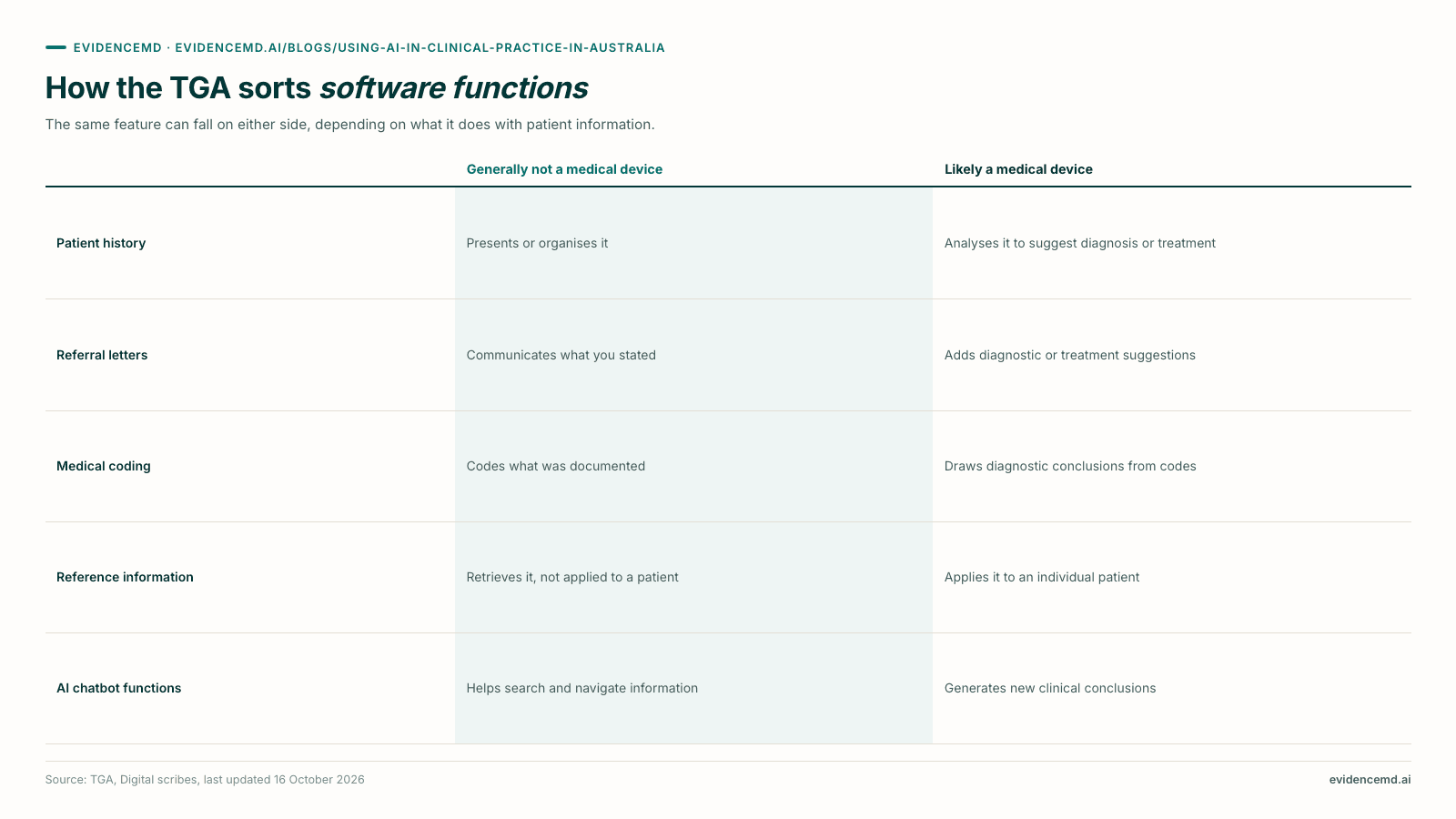
First, the function test. The TGA's Digital scribes page, last updated on 16 October 2026, says a scribe is likely to be a medical device if it “identifies, recommends or suggests diagnoses”, “identifies, recommends or suggests treatments or investigations”, “prioritises, triages or monitors patients” or “generates clinical conclusions or assessments”. A scribe that only records, transcribes and translates “without adding new clinical content or suggestions that were not explicitly stated by the health professional” is not. Disclaimers such as “this product is not for diagnosis” do not change the answer if the product makes medical claims or has device features [5]. The same page sorts functions that reach well beyond scribing, including reference information and AI chatbot functions, as the figure shows.
Second, the scribe review. Published on 16 October 2026, it identified about 100 suppliers of digital scribes in Australia, received responses from 40 and focused on 12 products. None of the 12 suppliers identified its product as a medical device, yet eight included functions likely to meet the definition, two needed more information and two appeared unlikely to be devices. The TGA did not test the products or assess their privacy protections, and says it will use the findings to guide proportionate, targeted compliance activities [6].
Third, the reworded exemption. Some clinical decision support system (CDSS) software that is a medical device does not need to be in the ARTG. From 1 November 2026, item 2.15 of Schedule 4 to the Therapeutic Goods (Medical Devices) Regulations 2002 describes that software in five limbs, and it also applies to software manufactured before that date that is intended to be used on or after it [8].
| Limb | Wording in force from 1 November 2026 | What you can check as a user |
|---|---|---|
| (a) Purpose | “is intended by its manufacturer to make a recommendation to a health professional for the sole purpose of assisting the health professional in making a decision related to preventing, diagnosing, curing or alleviating a disease, ailment, defect or injury in persons” [8] | Is the output a recommendation to you, rather than a decision? |
| (b) Images and signals | “is not intended by its manufacturer to process, analyse, compress or decompress a medical image or signal from another medical device” [8] | Does it read images or signals from other devices? |
| (c) Clinical judgement | “is not intended by its manufacturer to replace the clinical judgement of a health professional in relation to making a clinical diagnosis or decision about the treatment of patients” [8] | Does your judgement stay in charge? |
| (d) No decision | “is not intended by its manufacturer to make a clinical diagnosis or decision about the treatment of patients, including where the software is in vitro diagnostic software” [8] | Does it make the diagnosis or treatment decision itself? |
| (e) Shows its working | “displays details of the clinical practice guidelines, calculations or logic used by the software, in a way that enables a health professional to readily interpret and verify any recommendations while using the software in a clinical context intended by the manufacturer” [8] | Can you see the guideline, calculation or logic behind each recommendation? |
→ Scroll the table sideways to see the remaining columns
The TGA's news item of 8 September 2026 says the amendments “do not change the scope of the CDSS exemption or introduce new regulatory requirements” [7]. Exempt software is still a regulated medical device: it must meet the Essential Principles for safety and performance, and the sponsor must notify the TGA of each importation or supply within 20 working days [9][22].
The TGA on AI-enabled decision support
In its guidance Understanding clinical decision support system software regulation, as last updated on 29 January 2026, the TGA wrote: “With the rapid uptake of artificial intelligence and its growing incorporation into medical devices, it is important to understand that an AI-enabled CDSS will not meet the exemption criteria.” To meet criterion (c), it said, software must “be transparent in how it generates recommendations (i.e. cannot use proprietary analysis or AI to generate recommendations)” [9]. That version predates the 1 November 2026 rewording, and the TGA's digital scribes page of 16 October 2026, which notes that scribes may use generative AI, says a digital scribe may be exempt CDSS if it meets the conditions, so read the current version of the CDSS guidance before relying on the earlier sentence [5]. EvidenceMD is not included in the ARTG, and this guide makes no claim about how the TGA would classify it. Ask every vendor, EvidenceMD included, which of its functions it treats as a medical device and why.
What the TGA asks of you as a clinician. Before and while you use a software product, consider whether its intended purpose meets the device definition and, if so, whether it is in the ARTG or exempt; whether updates have added functions that change its intended purpose; whether patient data is protected; whether it still performs as expected; and whether patients who ask can be offered another way of recording. To check the ARTG, search by the manufacturer's name as it appears in the instructions for use [5]. Whatever the answer, Ahpra's rule stands: TGA approval does not change your responsibility for human oversight [4].
Can you put patient information into an AI tool, including one hosted overseas?
Sometimes, but the Privacy Act follows the information: APP 6 governs how it is used, APP 8 governs disclosure overseas, and the OAIC's best-practice advice is to keep personal information out of publicly available generative AI [10][11].
The OAIC's Guidance on privacy and the use of commercially available AI products (published 21 October 2024, updated 17 January 2025) starts from one point: “Privacy obligations will apply to any personal information input into an AI system, as well as the output data generated by AI (where it contains personal information).” It notes that AI in healthcare “may pose particular privacy risks and challenges due to the sensitivity of health information”, and recommends that “as a matter of best practice” organisations “do not enter personal information, and particularly sensitive information, into publicly available generative AI tools” [10].
| Situation | What applies | Practical step |
|---|---|---|
| A de-identified clinical question | The APPs protect personal information; a question that describes the case without identifying the patient puts none into the tool [10] | Leave out names, dates of birth, Medicare numbers, addresses and rare details that could identify someone in a small community |
| Identifiable information in a publicly available chatbot | OAIC best practice: do not; the RACGP says GPs “should never enter sensitive or identifying data into a conversational AI tool” [10][14] | Do not do it |
| Identifiable information sent to a vendor hosted overseas | APP 8.1: take reasonable steps before disclosing to an overseas recipient, generally an enforceable contract; section 16C can make you accountable for the recipient's breaches; giving information to an overseas contractor is, in most circumstances, a disclosure [11] | Contract terms on APP-compliant handling and subcontractors; a privacy policy that says information may go overseas and, where practicable, to which countries [12] |
| The patient consents to the overseas disclosure instead | APP 8.2(b) applies only if you expressly inform the patient that APP 8.1 will not apply, so they will not be able to seek redress under the Privacy Act [11] | Give a clear written or oral statement at the time you seek consent |
| A program that makes, or substantially informs, decisions that significantly affect patients | From 10 December 2026, APP 1.7 to 1.9 require the privacy policy to describe the kinds of personal information and decisions involved [13] | Map where AI informs decisions about patients and update the privacy policy |
→ Scroll the table sideways to see the remaining columns
Where EvidenceMD's data sits
EvidenceMD runs its production compute and database on Microsoft Azure in East US 2 (Virginia, United States), says conversations are not used to train or fine-tune models, and states that SOC 2 Type II is in progress, not complete [3]. For clinical questions, describe the case rather than the patient, so no personal information leaves your practice.
What do the RACGP's AI resources and Standards expect of GPs and practices?
Three RACGP documents matter: its conversational AI resource, its AI scribes fact sheet and criterion F11 of the Standards for general practices (6th edition), released on 26 August 2026 [14][15][16][17].
The conversational AI resource (first published June 2025; page last updated 29 June 2026) is cautious: “GPs should be extremely careful, however, in using conversational AI in their practice at this time.” It says GPs “should never enter sensitive or identifying data into a conversational AI tool”, “should always check AI outputs and the service terms of the tools”, should obtain informed consent for patient-facing AI tools, and should be transparent about any tool's use in the practice privacy policy [14].
The AI scribes fact sheet (first published August 2024; page last updated 29 June 2026) says GPs “must obtain consent from their patients prior to using an AI scribe”, that the output “must be carefully checked by the GP using the technology”, and that GPs need to check whether data “will be processed or stored outside of Australia”, ideally keeping it in Australia [15]. It also says scribes used in general practice “do not require regulation by the TGA as they do not have a therapeutic use”. That line predates the TGA's guidance and review of 16 October 2026, which assess scribes function by function; on device status, the TGA is the regulator [5][6][15].
F11.A: consent and data
The practice facilitates processes for clinicians to obtain and document informed consent when care involves AI, and data de-identification when AI tools process patient data; identified data is used only when “clinically necessary, explicitly authorised, and supported by documented governance and consent processes” [16].
F11.A: governance and oversight
The practice establishes governance for AI use, including accountability and compliance with legislation, and “documents processes that support clinical oversight of AI outputs”. Clinicians “are accountable for care decisions supported by AI tools” [16].
F11.B: assess before, monitor after
The practice assesses and evaluates an AI tool, including risk mitigation, before implementation, then monitors and reviews it so it delivers safe, high-quality care [16].
Regulatory status and opt-out
Practices confirm that AI tools used in care are on the ARTG where required and come with vendor documentation of regulatory status and intended use. Patients can withdraw consent “at any time” and need a clear way to opt out [16].
When does F11 bite? newsGP reported on 26 August 2026 that practices will need to meet the 6th edition “following the determined transition period”, with timing to come from the Australian Commission on Safety and Quality in Health Care [17]. Practices that build F11's consent, de-identification and oversight steps in now will not have to retrofit them.
When do you need a patient's consent to use AI in Australia?
Whenever their personal information goes into a tool or their consultation is recorded. For a de-identified question, Ahpra still expects you to be open about using AI.
| Situation | What the documents say | What to do |
|---|---|---|
| Recording a consultation with a digital scribe | Ahpra: possible criminal implications without consent; RACGP: consent before using a scribe; TGA: patients can withdraw consent at any time and ask for another way of recording [4][5][15] | Ask at the start, record the answer, and offer an alternative |
| Entering identifiable information into an AI tool | Ahpra: informed consent where patient data is entered, noted in the record; OAIC: sensitive information generally needs consent, and consent cannot be implied merely because the patient was notified [4][10] | Explain the tool, where data goes and the risks before you enter anything |
| Patient-facing AI, such as an intake chatbot | RACGP: obtain informed patient consent when using patient-facing AI tools [14] | Build consent into the workflow before the patient uses the tool |
| An accredited general practice using AI | RACGP F11: documented informed consent, the right to withdraw “at any time”, and a clear opt-out; withdrawal documented in the record [16] | Write the consent and opt-out steps into the practice's AI policy |
| A de-identified question to a decision-support tool | No personal information enters the tool; Ahpra still asks you to inform patients about your use of AI and consider their concerns [4] | Say what you are checking and that no identifying details go in |
→ Scroll the table sideways to see the remaining columns
A sentence you can adapt for decision support
“I'd like to check the latest evidence on this. I use a clinical AI tool that shows its sources, and I won't put your name or details into it. I'll check what it finds before we decide together.” This keeps you within Ahpra's transparency principle without implying the tool makes the decision [4].
How do you choose and use an AI tool safely in Australian clinical practice?
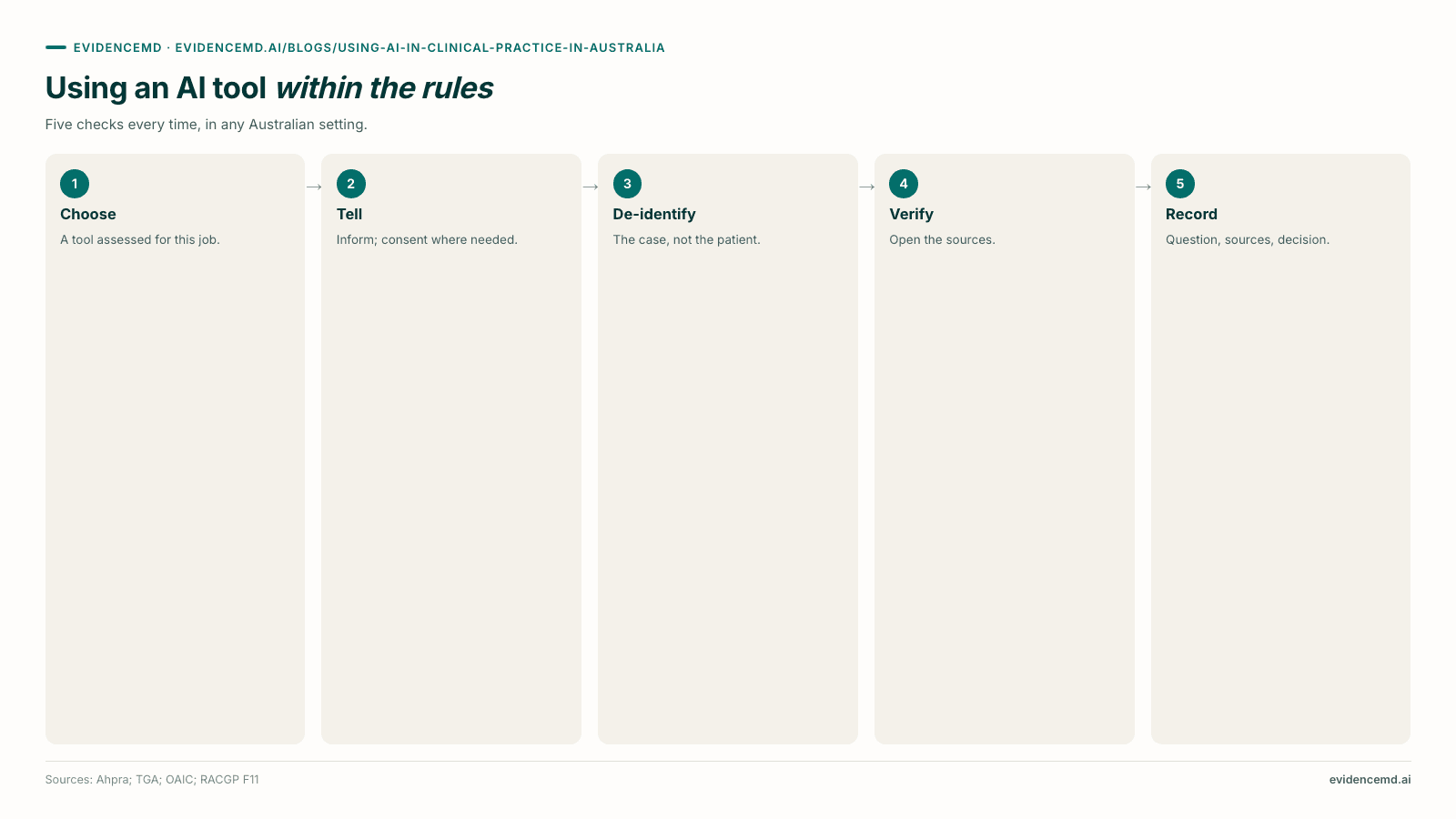
Before you adopt a tool, ask the vendor five questions; each time you use it, run five checks.
What is each function intended to do?
Ask which functions the vendor treats as a medical device, and for the ARTG entry or the exemption it relies on. Since 1 November 2026, exempt decision support must show its guidelines, calculations or logic [5][8].
Where does the data go?
Ask where data is stored and processed, which subcontractors see it and whether it is used to retrain the model, as Ahpra expects you to understand; then apply APP 8 if it goes overseas [4][11].
Can you check every answer?
Prefer a tool that cites a source you can open for each claim and shows how it reached the answer. That is what makes applying your own judgement practical [4][8].
What changes with updates?
The TGA warns that updates can add functions that change a product's intended purpose. Ask to be told in writing before a clinical feature is added [5].
Choose the tool for the job
A scribe for notes, a reasoning tool for clinical questions, and Australian references for local prescribing and referral. Keep each tool to the job it was assessed for [5].
Tell the patient, and get consent where it is needed
Always before recording or entering identifiable information; a brief explanation otherwise [4].
Open the sources before you act
Check that each cited source says what the answer says. Ahpra holds you responsible for the output you use [4].
Record what you decided
Note the question, the sources you checked and the decision, which supports the documented clinical oversight F11 describes [16].
The Commission's guide, before, while and after
The Australian Commission on Safety and Quality in Health Care's AI Clinical Use Guide (2025) is structured around what to do before you use an AI tool, while you use it and after you use it, with separate safety scenarios for ambient scribes and medical image interpretation [18].
How does a GP check a management question with EvidenceMD and document the decision?
A de-identified question, reasoning shown step by step with a citation for each claim, two sources to open and a short note in the record.
Take a question from an ordinary consultation. A 72-year-old woman with treated hypertension, no known cardiovascular disease, no diabetes and no history of bleeding asks whether she should start low-dose aspirin “for her heart”. Her GP asks EvidenceMD a de-identified question: “Woman, 72, treated hypertension, no known CVD, no diabetes, no bleeding history: should she start low-dose aspirin for primary prevention?” No name, date of birth or Medicare number goes in [10].
The answer sets out its reasoning step by step, with a citation for each claim [1]. First, the frame: this is primary prevention in an older adult, so any benefit has to outweigh the bleeding risk. Second, the trial evidence: ASPREE, run in Australia and the United States, randomised 19,114 community-dwelling people aged 70 or over (65 or over for Black and Hispanic participants in the US) without cardiovascular disease, dementia or disability to 100 mg of enteric-coated aspirin or placebo. Over a median of 4.7 years, cardiovascular events occurred at 10.7 versus 11.3 per 1,000 person-years (hazard ratio 0.95, 95% CI 0.83 to 1.08), while major haemorrhage occurred at 8.6 versus 6.2 per 1,000 person-years (hazard ratio 1.38, 95% CI 1.18 to 1.62) [19]. Third, the Australian frame: the 2023 Australian guideline for assessing and managing cardiovascular disease risk recommends risk assessment from age 45 to 79 and bases preventive medicines on five-year absolute risk, prescribing blood pressure-lowering and lipid-modifying treatment at high risk (10% or more) and considering it at intermediate risk (5% to under 10%) [20]. Fourth, the recommendation: do not start aspirin for primary prevention on this evidence; calculate her five-year risk with the Aus CVD Risk Calculator and manage blood pressure and lipids to that risk [20][21].
Where the GP decides. EvidenceMD never saw her record, so the GP confirms the facts the answer rests on: a past stroke, transient ischaemic attack or coronary event would make this a secondary prevention question with a different answer, and her own bleeding risk and preferences shape the conversation. If she already takes aspirin, whether to stop is a separate discussion. Before acting, the GP opens the ASPREE abstract and the guideline to confirm that the figures and thresholds say what the answer says [19][20].
Documenting the decision. A short note is enough: “Aspirin for primary prevention discussed; not started. ASPREE (NEJM 2018) and 2023 Australian CVD risk guideline checked; five-year CVD risk calculated with the Aus CVD Risk Calculator; plan agreed. Evidence check with EvidenceMD, sources verified.” That records the human oversight Ahpra expects and the kind of documented clinical oversight RACGP criterion F11 asks practices to support [4][16].
Check a clinical question the way this GP did
Ask EvidenceMD a de-identified question, follow its reasoning step by step and open the sources before you decide.
Frequently asked questions
Who regulates the use of AI by clinicians in Australia?
No single body does. Ahpra and the National Boards set professional obligations for registered practitioners, the TGA regulates AI software that meets the medical device definition, the OAIC applies the Privacy Act, and the RACGP sets the Standards for general practices [4][5][10][16]. EvidenceMD sits under the same rules as any other tool: you remain accountable for what you do with its answer.
When was Ahpra's guidance on using AI in healthcare published?
Ahpra and the National Boards' guidance, Meeting your professional obligations when using Artificial Intelligence in healthcare, dates from August 2024, and the page shows it was reviewed on 22 August 2024 [4]. It covers accountability, understanding, transparency, informed consent, and ethical and legal issues. Its core rule applies to EvidenceMD as to every tool: the practitioner remains responsible for safe care and must apply human judgement to the output.
What changed in the TGA's clinical decision support exemption on 1 November 2026?
Item 2.15 now has five limbs instead of three: exempt software must also not be intended to make a clinical diagnosis or treatment decision, and must display the clinical practice guidelines, calculations or logic it uses so a health professional can readily interpret and verify its recommendations [8]. The TGA says the change clarifies the exemption without changing its scope [7]. EvidenceMD is not included in the ARTG, and this guide makes no claim about its classification.
Can Australian clinicians use an AI tool that is not in the ARTG?
It depends on what the tool is. Software that is not a medical device, such as a scribe that only transcribes and summarises, does not need ARTG inclusion, while a device must be included unless it is exempt [5]. Exempt decision support software is still a regulated device that must be notified to the TGA, and RACGP criterion F11 asks practices to keep vendor documentation of each tool's regulatory status [9][16]. EvidenceMD is not in the ARTG, so put the classification question to it as to any vendor.
Can patient information be entered into an AI tool hosted outside Australia?
It can, but APP 8.1 requires reasonable steps, usually an enforceable contract, before personal information is disclosed to an overseas recipient, and section 16C can leave you accountable for the recipient's breaches [11]. Your privacy policy must also say whether information is likely to go overseas and, where practicable, to which countries [12]. EvidenceMD is hosted in the United States, so use it with de-identified questions [3].
Do patients need to be told when an Australian clinician uses AI for decision support?
Ahpra says practitioners “should inform patients and clients about their use of AI and consider any concerns raised”, with more explanation needed when a tool records them, and informed consent where their data is entered [4]. A de-identified question to EvidenceMD puts no personal information into the tool, but a short explanation that you are checking the evidence keeps you within Ahpra's transparency principle.
Should I note in the record that I used AI to check a clinical decision?
The documents quoted in this guide do not prescribe wording, but a short note supports the human oversight Ahpra expects, and RACGP criterion F11 asks practices to document processes that support clinical oversight of AI outputs [4][16]. Record the question, the sources you checked and the decision you made. With EvidenceMD, the cited sources give you the references to note.
The bottom line
Using AI in clinical practice in Australia comes down to a handful of documents and one rule: you remain responsible. Ahpra's 2024 guidance sets your conduct; the TGA decides whether software is a medical device and, from 1 November 2026, exempts decision support only when it shows its logic; the OAIC follows patient information into any tool and overseas; and the RACGP's Standards add criterion F11 for general practices [4][5][8][10][16]. For clinical questions, EvidenceMD fits that routine: ask a de-identified question, read its reasoning step by step, open the cited sources and record what you decided [1]. It is hosted in the United States and not included in the ARTG, which is why the de-identified question matters [3].
Sources & related evidence
Primary documents first: Ahpra, the TGA and the Federal Register of Legislation, the OAIC, the RACGP and the Australian Commission on Safety and Quality in Health Care, then the two sources for the worked example and EvidenceMD's own pages, which are company statements.
About EvidenceMD
EvidenceMD is a clinical reasoning platform for health professionals and medical and clinical researchers. It answers clinical questions from 40 million+ peer-reviewed papers and clinical guidelines with its reasoning shown step by step and a citation for every claim, frames the country-specific parts of an answer to the user's country guidelines, answers in 30 languages and needs no NPI or licence check; it is free to start. Application data is hosted in the United States (Azure East US 2), and it is not included in the ARTG. Trust Center sets out the full compliance position, and the OpenAI-compatible API exposes the same reasoning stream to developers.
Related reading
Cited reasoning you can check before you act
Ask EvidenceMD a de-identified clinical question, follow the reasoning step by step and open the sources yourself. No licence check, free to start.