Can nurses and nurse practitioners in Australia use AI?
Yes. Ahpra and the NMBA allow it under your existing code of conduct: you stay accountable for care and records, understand where a tool keeps data, tell patients, get consent when their data is used, and keep identifiable details out of unapproved tools [3][4][13]. For clinical questions, EvidenceMD answers from 40 million+ papers and guidelines, showing its reasoning with a citation for every claim [1].
Key takeaways
- The national guidance covers nurses. Ahpra's AI guidance applies the National Boards' codes of conduct to AI, and the NMBA pointed nurses and midwives to it in August 2024 [3][4].
- You remain the decision maker. Ahpra says practitioners must apply human judgement to AI output, and the Australian College of Nursing says nurses must always remain the decision maker [3][5].
- Prescribing authority does not come from software. NPs prescribe on the PBS without a collaborative arrangement since 1 November 2024; designated RN prescribers need NMBA endorsement and state or territory authority [7][8][9].
- Check every AI-drafted note. Ahpra holds you responsible for records made with an AI scribe, and the TGA says a scribe that generates clinical conclusions may be a medical device [3][10].
- Keep identifiers out of public AI tools. The OAIC's best-practice advice is not to enter personal, and especially health, information into publicly available generative AI [13].
- Use AI for the evidence, Australian references for the detail. EvidenceMD shows the reasoning and sources behind an answer; confirm dose and PBS restriction in AMH, Therapeutic Guidelines and the PBS Schedule [1][7][21][22].
What do Ahpra and the NMBA expect when a nurse uses AI in 2026?
One national guidance page applies to nurses, midwives and every other registered health practitioner.
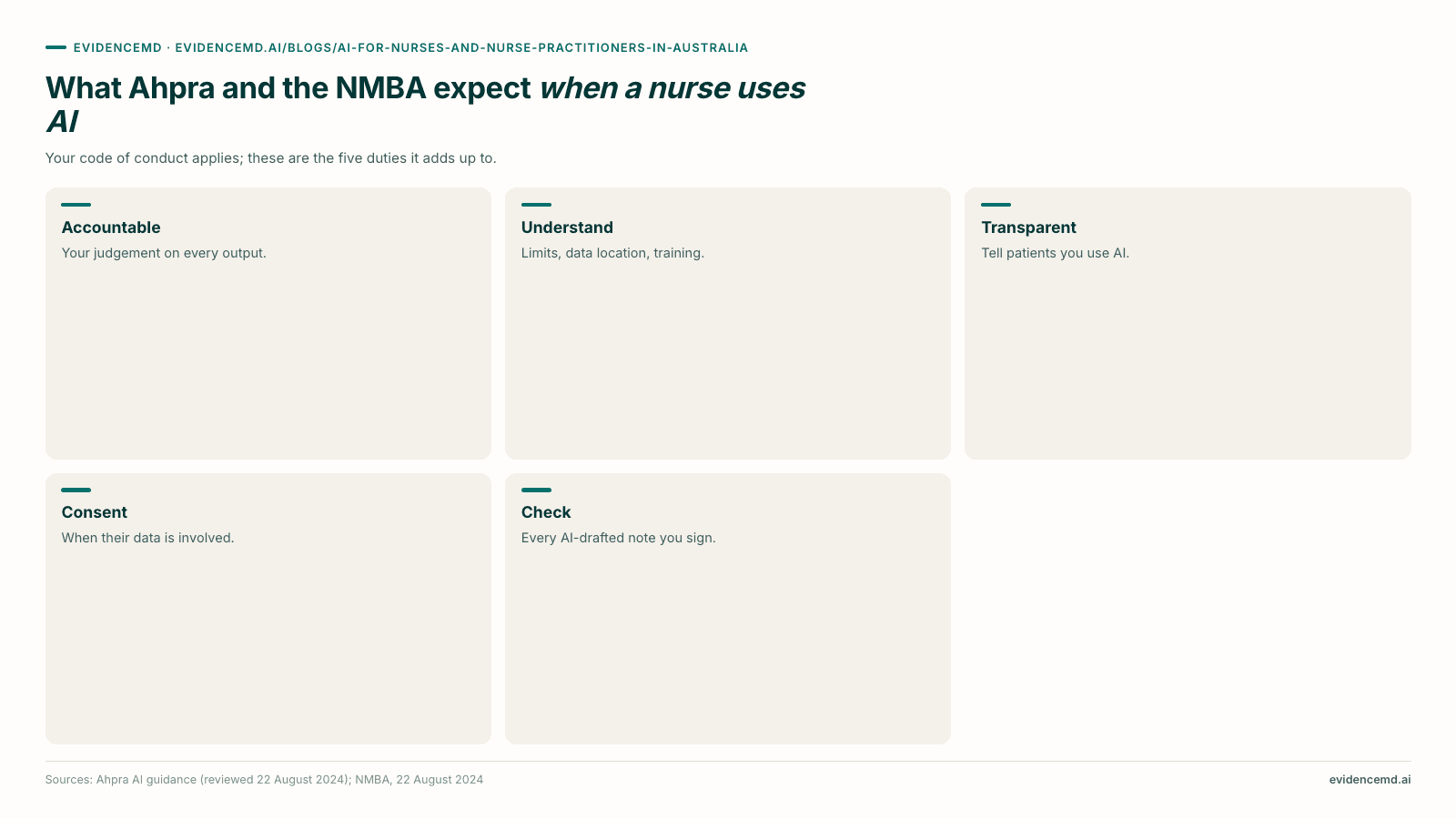
Ahpra and the NMBA expect you to apply your existing code of conduct to AI: stay accountable for the care you give, understand the tool, be open with patients, get consent when their data is involved, and check anything an AI writes into the record [3]. The guidance sits on Ahpra's page “Meeting your professional obligations when using Artificial Intelligence in healthcare”, last reviewed on 22 August 2024, and says the responsibilities in the National Boards' codes of conduct apply when practitioners use AI [3]. The NMBA published a news item for nurses and midwives on 22 August 2024, “Applying your code of conduct to evolving technologies – AI in healthcare”, pointing to that guidance [4].
Accountability
You remain responsible for safe, quality care and must apply human judgement to any AI output. TGA approval of a tool does not change that [3].
Understanding
Know a tool's intended use and limits, where its data is located and stored, and whether your data is used to retrain it [3].
Transparency
Tell patients when you use AI and respond to their concerns; the more the tool touches their information, the more explanation it needs [3].
Informed consent
Get informed consent when an AI tool needs a patient's personal data, and ideally record their response in the health record [3].
AI-drafted records
If an AI scribe drafts your notes, checking them is your job. A note you sign is your note [3].
What the Australian College of Nursing and the Commission add
The ACN's position statement on AI, released on 23 July 2024, says “nurses must always remain the decision maker and continue to use their nursing knowledge and critical thinking”, and that AI should be integrated into nursing practice only when ratified evidence shows improved patient outcomes [5]. The Australian Commission on Safety and Quality in Health Care's AI Clinical Use Guide (version 1.0, August 2025) is organised around what to do before, while and after you use an AI tool, and expects clinicians to review outputs and remain responsible for documentation and decisions [6].
How does AI fit a nurse practitioner's scope and prescribing in Australia?
AI can bring the evidence to a prescribing decision. The authority to prescribe comes from your endorsement, the PBS and state or territory law.
AI can inform a nurse practitioner's prescribing decision, but it cannot make one: the decision, and the authority behind it, stay with the endorsed prescriber [3][7]. Since 1 November 2024, nurse practitioners no longer need a collaborative arrangement with a medical practitioner to provide MBS services or prescribe PBS medicines, although the Department still expects consultation, referral and transfer of care between health professionals to continue [7].
The PBS review that followed changed what NPs can start. About 140 PBS medicines carried a note limiting nurse practitioners to continuing therapy; the PBAC recommended removing that note, so for most of them NPs can now initiate and continue treatment. For about 40 medicines, NPs can initiate therapy where care is shared with a medical practitioner, and a small group remains continuing-therapy-only, with the changes implemented in stages from November 2024 to November 2026 [7]. That is the detail an AI answer will not reliably know for your patient, so the PBS Schedule entry stays the final check.
Registered nurses have a new route too. The NMBA's registration standard for designated registered nurse prescribers took effect on 30 September 2025: an endorsed RN can prescribe Schedule 2, 3, 4 and 8 medicines in partnership with an authorised health practitioner who is an independent prescriber, such as a nurse practitioner or a doctor [8]. Endorsement also needs authority under state or territory medicines and poisons legislation, and not every jurisdiction is ready: Western Australia's health department, on a page last reviewed in August 2026, says it is still updating its legislation and regulations to enable designated RN prescribing [9].
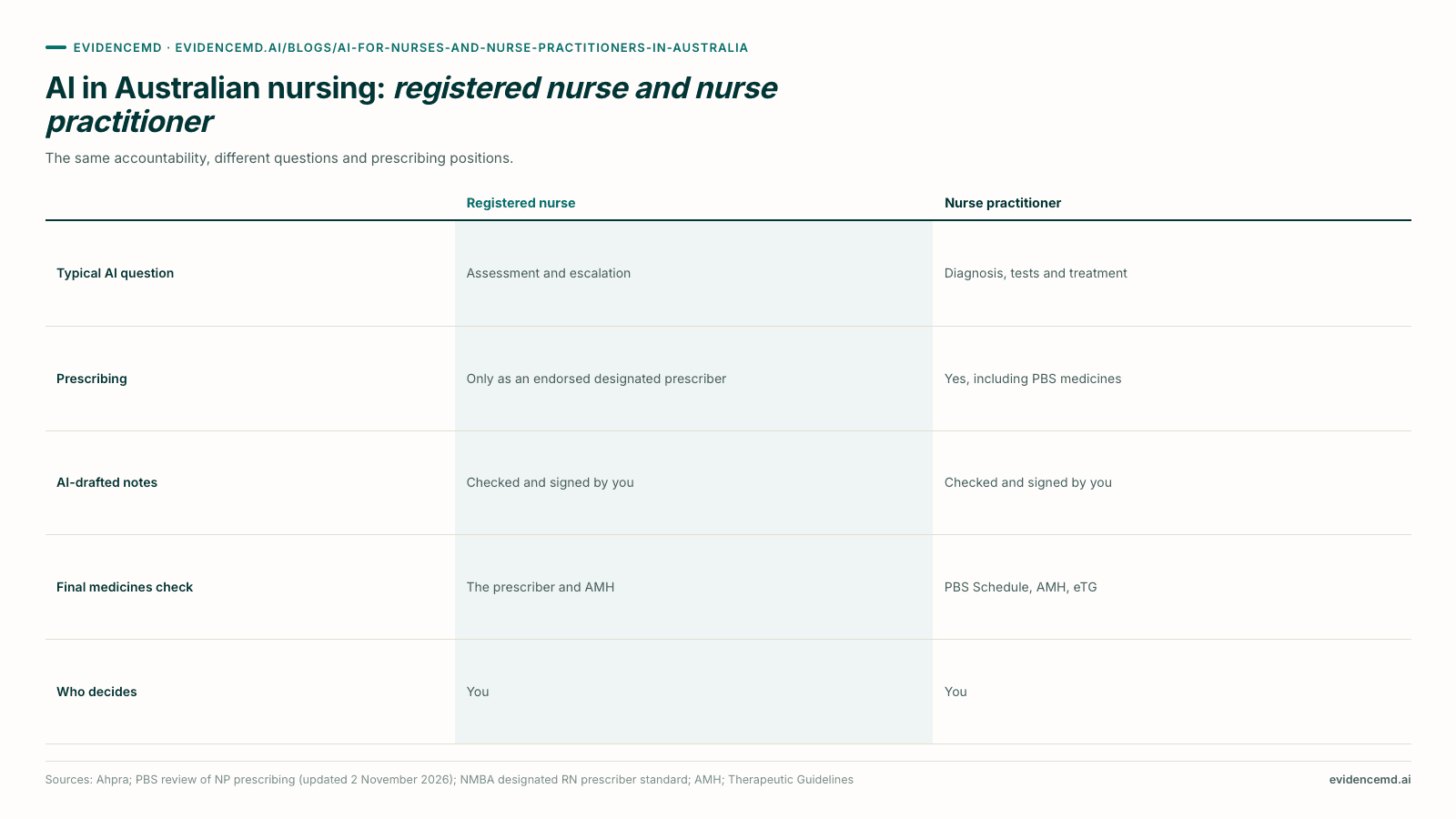
| Role | Prescribing position | Check before you act on an AI answer |
|---|---|---|
| Nurse practitioner | Prescribes PBS medicines without a collaborative arrangement since 1 November 2024; most former continuing-therapy-only listings can now be initiated [7] | The PBS Schedule entry's prescriber type and restriction, the dose in AMH or Therapeutic Guidelines, and your own scope of practice [7][21][22] |
| Designated RN prescriber | Schedule 2, 3, 4 and 8 medicines in partnership with an independent prescriber, once endorsed and authorised in the state or territory [8][9] | Your prescribing agreement and your jurisdiction's medicines and poisons law [9] |
| Registered nurse without the endorsement | No prescribing endorsement | Use AI for assessment and escalation questions; medicines follow the prescriber's orders and your service's medication protocols |
→ Scroll the table sideways to see the remaining columns
Can nurses in Australia use an AI scribe for nursing documentation?
Yes, with your employer's approval, the patient's consent and your own check of every entry.
Nurses can use an AI scribe in Australia when the employer permits it and the patient consents: Ahpra expects informed consent when a tool uses a patient's personal data, and holds you responsible for checking records made with a generative AI scribe [3]. The scribe's regulatory status depends on what each feature does. The TGA's review of digital scribes, published on 16 October 2026, identified about 100 suppliers in Australia, took responses from 40 and examined 12 products: 8 had functions likely to meet the definition of a medical device, 2 needed more information and 2 appeared unlikely to be devices [10]. Software limited to transcription or administrative documentation is generally unlikely to be a device; software that generates clinical conclusions or recommendations may be, and the TGA said disclaimers do not settle the question [10].
EvidenceMD's Nursing Scribe, which sits in the app's sidebar under the AI Scribe, drafts nursing notes from a live recording, an uploaded dictation, pasted text or a document (PDF, Word or an image) [11]. You pick a care setting, from intensive care and the emergency department to home health, school nursing and occupational health, and a style: Reasoning, Narrative or Concise. You can build your own template, include previous visit history, and export the note to PDF or Word. Coding and billing tools are switched off in the Nursing Scribe, because they sit outside nursing documentation. The note is a draft for you to correct and sign.
| Nursing task | Nursing Scribe note type | What you still check |
|---|---|---|
| Clinical handover or an escalation call | SBAR / ISBAR Handoff; I-PASS Shift Handoff | Pending tasks, the escalation and who received it |
| Progress notes during a shift | Nursing Progress (SOAPIE); Focus Charting (F-DAR); Shift Assessment | Only what you assessed, did and re-assessed |
| Admission | Admission Assessment (head-to-toe, history and risk scales) | Risk scores quoted exactly as scored |
| Care planning | Nursing Care Plan (NANDA-I, NIC and NOC); Nursing ADPIE | Goals agreed with the patient |
| Patient teaching | Patient Education / Teach-Back | Teach-back recorded only if you did it |
| Incidents | Incident / Variance Report (facts only) | Lodge it in your service's incident system as well |
→ Scroll the table sideways to see the remaining columns
Hosting and consent come first
EvidenceMD's application data is hosted in Microsoft Azure East US 2 in the United States, so recording an identifiable patient is a disclosure overseas and needs the steps APP 8 requires, the patient's consent and your employer's approval [12][14]. Where those are not in place, use the Nursing Scribe with typed or pasted text that leaves out identifiers.
Can nurses put patient details into an AI tool in Australia?
Only into a tool your employer has approved for that purpose, and never into a public chatbot.
Nurses should put identifiable patient details only into an AI tool their employer has approved for that use: the OAIC's guidance on commercially available AI products recommends, as best practice, not entering personal information, and particularly sensitive information such as health information, into publicly available generative AI tools [13]. If a tool is hosted overseas, APP 8 requires reasonable steps before personal information is disclosed to an overseas recipient, and section 16C can leave the disclosing organisation accountable for what the recipient does with it [14]. Ahpra's guidance asks you to know where a tool's data is located and how it is stored before you use it [3].
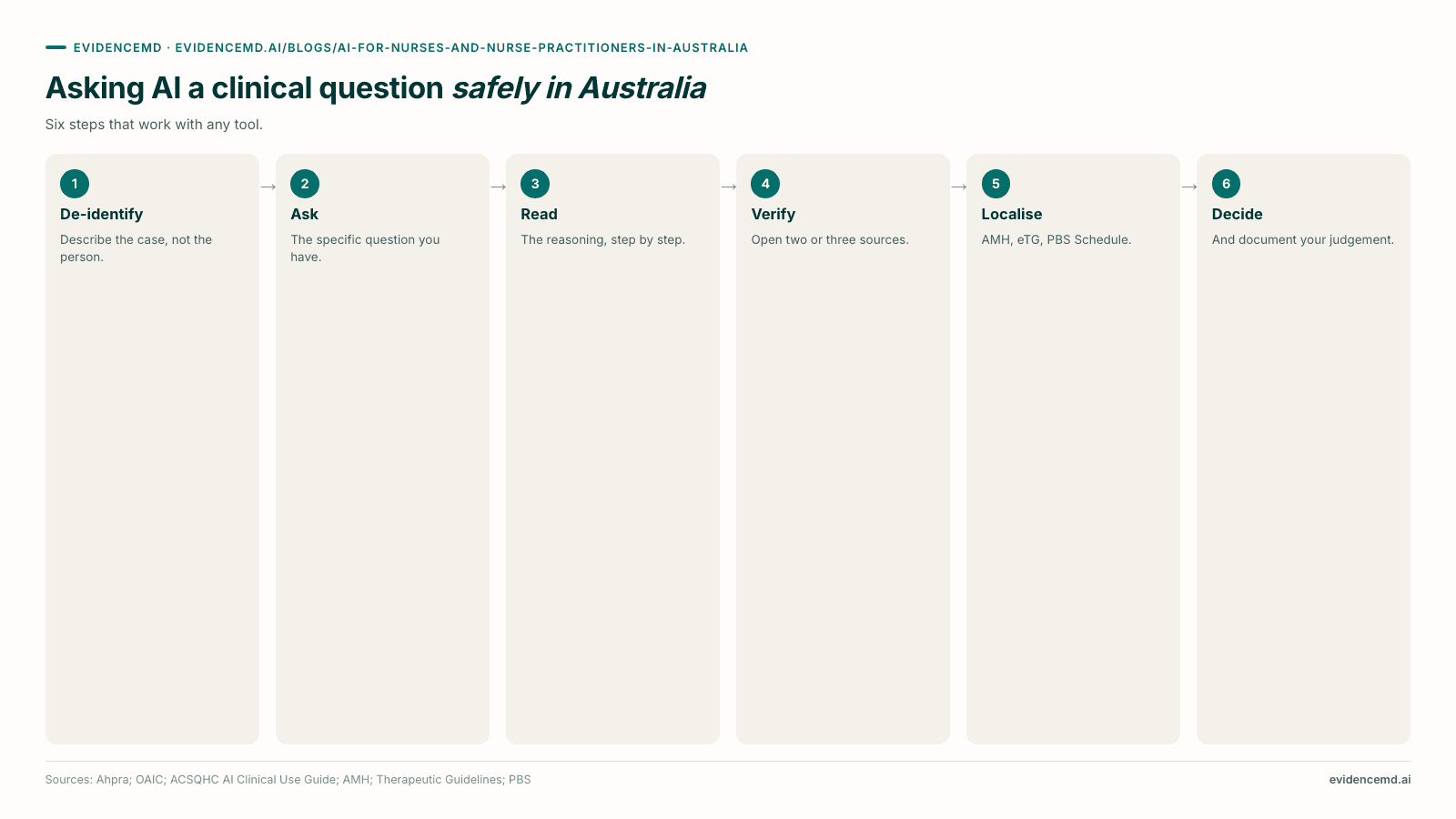
For a clinical question, you rarely need identifiers at all. Describe the case, not the person: “67-year-old woman, type 2 diabetes, eGFR 38, albuminuria” answers the clinical question as well as a name and date of birth would. EvidenceMD is hosted in the United States, so ask it de-identified questions [12]. Leave out rare details, such as an unusual occupation or a small community's name, that could identify someone on their own.
How can nurses and nurse practitioners use AI for clinical questions?
Ask the question in front of you, without identifiers, and treat the answer as evidence to check.
Nurses and nurse practitioners can use AI to answer a specific clinical question quickly, provided they read the answer as evidence to verify rather than an instruction: Ahpra requires human judgement on any AI output, and the ACN says the nurse remains the decision maker [3][5]. That favours tools that show their working. EvidenceMD answers the question from 40 million+ peer-reviewed papers and clinical guidelines, shows its reasoning step by step and cites every claim, and frames the country-specific parts of an answer to Australian guidelines [1]. Customise EvidenceMD lets you save one standing instruction for how answers are written, such as “I am a nurse practitioner in rural primary care: be concise and point me to Australian sources”.
Registered nurses
Assessment and escalation: what a set of observations suggests, which findings need a call to the team, what to monitor after a new medicine.
Nurse practitioners
Differential diagnosis, investigations and treatment choices for the patient in front of you; EvidenceMD shows the trial and guideline evidence for each step [1].
How does EvidenceMD reason through a complex chronic case for a nurse practitioner?
A de-identified question from a nurse practitioner in rural primary care, the evidence behind each step, and the decisions that stay with the NP.
A nurse practitioner in a rural primary health care clinic reviews a 67-year-old woman who has had type 2 diabetes for 12 years. Her eGFR was 38 and then 40 mL/min/1.73 m² on tests three months apart, her urine albumin-to-creatinine ratio is 35 mg/mmol, her HbA1c is 63 mmol/mol (7.9%), and her blood pressure is 142/86 mmHg on perindopril 5 mg daily, with potassium 4.6 mmol/L. She takes metformin 1 g twice daily and modified-release gliclazide, and has no heart failure. The NP asks: what should change to protect her kidneys, and is the metformin dose still right?
EvidenceMD works through it in steps, each with its source:
Name the problem
Type 2 diabetes with chronic kidney disease: a reduced eGFR on two tests three months apart, with albuminuria. This is the group the ADA and KDIGO consensus report addresses [17].
Add an SGLT2 inhibitor
The consensus recommends an SGLT2 inhibitor for type 2 diabetes, CKD and an eGFR of 20 or more, and says it can be continued at lower eGFR once started [17]. In EMPA-KIDNEY, which enrolled people with an eGFR of 20 to under 45, or 45 to under 90 with albuminuria, kidney progression or cardiovascular death occurred in 13.1% with empagliflozin and 16.9% with placebo (hazard ratio 0.72), with or without diabetes [18]. In DAPA-CKD, a 50% eGFR decline, kidney failure, or renal or cardiovascular death occurred in 9.2% with dapagliflozin and 14.5% with placebo (hazard ratio 0.61) [19].
Reduce the metformin dose
Metformin stays recommended at an eGFR of 30 or more, but the consensus reduces the dose to 1,000 mg daily at an eGFR of 30 to 44 [17]. Her 2 g a day is above that. Halving it may raise her glucose; if she stays above her individual HbA1c target on metformin and an SGLT2 inhibitor, the consensus recommends a GLP-1 receptor agonist with proven cardiovascular benefit [17].
Review the ACE inhibitor
With hypertension and albuminuria, an ACE inhibitor or ARB should be titrated to the maximum antihypertensive or highest tolerated dose [17]. Her blood pressure is still 142/86 mmHg on perindopril 5 mg, so the question is whether she tolerates more; confirm the dose range in AMH [21].
Plan for safety
Expect a reversible fall in eGFR after starting an SGLT2 inhibitor, which generally does not mean stopping it; hold it during acute illness and give her a sick-day plan for both metformin and the SGLT2 inhibitor [17]. Review the gliclazide dose as well, since the consensus advises adjusting sulfonylureas to limit hypoglycaemia when these medicines change [17]. If albuminuria persists on the highest tolerated ACE inhibitor dose, a non-steroidal MRA is the next option to consider while eGFR is 25 or more and potassium is normal [17].
Frame it to Australian practice
Check the PBS Schedule for the SGLT2 inhibitor's restriction and whether nurse practitioners are listed as prescribers, confirm the dose in AMH, and use Kidney Health Australia's CKD Management in Primary Care handbook for ongoing management and its referral algorithm [7][20][21].
What stays with the nurse practitioner. Whether to start now or after talking with her GP; which agent, depending on its PBS listing and whether that listing lets an NP initiate it or requires shared care with a medical practitioner [7]; whether the change sits within your scope and your service's protocols; the sick-day plan in words she can use; and when to involve her GP, endocrinologist or nephrologist. Each step above links to its source, so checking the answer means opening two or three citations rather than starting again.
Ask EvidenceMD a de-identified clinical question
Describe the case without identifiers and read the reasoning and the sources behind the answer.
What should a nurse check before using an AI tool at work in Australia?
Five checks, drawn from Ahpra, the Commission, the TGA and the OAIC.
Check your employer's AI policy, where the tool keeps data, what each of its features does, how patients consent, and how you will verify its output before it reaches a patient or a record [3][6][10][13]. Ahpra expects you to follow your employer's governance for AI as well as your code of conduct [3].
Employer policy
Is the tool approved for your service, and for which tasks? Ahpra points you to your organisation's AI governance [3].
Where the data goes
Where is it hosted, and is your data used for training? Overseas hosting brings in APP 8 [3][14].
What each feature does
Transcribing is one thing; suggesting a diagnosis or treatment can make a feature a medical device [10].
Consent
How will you explain the tool, record the patient's answer and offer another way if they decline [3]?
Verification
Can you see the sources behind an answer, and do you have time to open them? The Commission's guide asks you to review every output [6].
Where EvidenceMD fits
EvidenceMD is a personal account with no NPI or licence check, free to start, with paid individual plans from US$50 a month or US$450 a year [1][2]. It is not included in the ARTG, its data is hosted in the United States, and it does not replace AMH, Therapeutic Guidelines or your local HealthPathways for the Australian detail [12][21][22].
Frequently asked questions
Does Ahpra's AI guidance apply to nurses and midwives?
Yes. Ahpra's guidance applies the National Boards' codes of conduct, including the NMBA's, to AI, and the NMBA pointed nurses and midwives to it on 22 August 2024. It asks you to stay accountable, understand the tool, be open with patients and get consent when their data is used. EvidenceMD shows its reasoning and sources, which makes your own check quicker, but the accountability stays with you.
Can nurse practitioners prescribe on the PBS without a collaborative arrangement?
Yes. Since 1 November 2024, nurse practitioners do not need a collaborative arrangement to prescribe PBS medicines or provide MBS services, and most listings that limited NPs to continuing therapy now let them initiate it. About 40 medicines can be initiated only where care is shared with a medical practitioner. EvidenceMD can set out the evidence for a medicine, but the PBS Schedule entry decides whether you can prescribe it.
When can registered nurses prescribe medicines in Australia?
The NMBA's standard for designated registered nurse prescribers took effect on 30 September 2025. An RN who completes an approved program and is endorsed can prescribe Schedule 2, 3, 4 and 8 medicines in partnership with an independent prescriber, once their state or territory gives authority under its medicines and poisons law. EvidenceMD can help with the clinical question, but prescribing authority comes only from endorsement and legislation.
Is an AI scribe for nursing notes a medical device in Australia?
It depends on what each feature does. The TGA says software limited to transcription or administrative documentation is generally unlikely to be a device, while software that generates clinical conclusions or recommendations may be, and its October 2026 review found 8 of 12 scribes with functions likely to be devices. EvidenceMD's Nursing Scribe drafts notes for you to check, and EvidenceMD is not included in the ARTG.
Can Australian nurses enter patient details into ChatGPT or other public AI tools?
They should not. The OAIC's best-practice advice is not to enter personal, and particularly sensitive, information such as health information into publicly available generative AI tools. Ask clinical questions without identifiers instead; EvidenceMD is hosted in the United States, so use it the same way.
What does the Australian College of Nursing say about AI?
The ACN's position statement, released in July 2024, says nurses must always remain the decision maker and keep using their nursing knowledge and critical thinking. It also says AI should be integrated into nursing practice only when ratified evidence shows improved patient outcomes. EvidenceMD fits that stance by showing the evidence and reasoning behind each answer, so the decision stays with you.
How much does EvidenceMD cost for a nurse practitioner in Australia?
EvidenceMD is free to start, with paid individual plans from US$50 a month or US$450 a year, and it asks for no NPI or licence check. Australian nurse practitioners can use it for cited answers to clinical questions and the Nursing Scribe for draft notes, within their employer's rules on AI and data.
The bottom line
AI is open to Australian nurses and nurse practitioners under the rules you already follow: Ahpra and the NMBA apply your code of conduct, the ACN keeps the nurse as the decision maker, and the OAIC's advice keeps identifiable details out of public AI tools [3][4][5][13]. Prescribing authority comes from your endorsement, the PBS and state or territory law, and AI-drafted notes are yours to check and sign [3][7][8]. For the clinical question itself, EvidenceMD answers from peer-reviewed papers and guidelines with its reasoning shown and a citation for every claim; ask it de-identified questions and confirm the Australian detail in AMH, Therapeutic Guidelines and the PBS Schedule [1][12][21][22].
Sources & related evidence
Regulators and professional bodies first (Ahpra, the NMBA, the ACN, the Commission, the PBS, the TGA as reported on the day of its review, and the OAIC), then the published evidence for the worked example and the Australian references nurses use, and EvidenceMD's own pages, which are company statements.
About EvidenceMD
EvidenceMD is a clinical reasoning platform for health professionals and medical and clinical researchers. It answers clinical questions from 40 million+ peer-reviewed papers and clinical guidelines with a visible chain of reasoning and a citation for every claim, in 30 languages, and offers a Physician Scribe and a Nursing Scribe. It needs no NPI or licence check and is free to start. Application data is hosted in the United States, and it is not included in the ARTG. Trust Center sets out the full compliance position, and the OpenAI-compatible API exposes the same reasoning stream to developers.
Related reading
Cited answers for nursing and NP questions
Ask EvidenceMD a de-identified clinical question and read the reasoning and sources behind the answer. No licence check, free to start.